I'd like to spank the Academy

Posts tagged ‘Crime’

The Godfather (1972)

godfatherDirected by Francis Ford Coppola

Even though I’m a library person, and librarians have a reputation for having Views about reading being the only worthwhile activity, I’m not like that. I like reading, but I also really like movies. However, when it comes to books based on movies, I almost always like the book better. Books can just get into characters’ heads in a way that movies can’t. I can list dozens of books that I like better than the movies that are based on them. The Godfather is not on that list. I read Mario Puzo’s novel five or six years ago, and I was not impressed. Before I read the book, I had really wanted to see the movie, but after I read the novel, I was a little bit worried. I wondered if a movie based on such a mediocre book could really be all it is hyped up to be. After I watched The Godfather, I found that yes, it can.

So what’s the story? Michael Corleone, son of Mafia Don Vito Corleone, resists joining the family business until an attempt on his father’s life leaves Michael in charge.

The Good: I’m gonna mix things up today and go with cinematography first. The cinematography was awesome. Whatever the cinematographer did, he made me feel like I was peering over someone’s shoulder and peeking into the lives of the Corleones. The scene that this stood out to me most was in the hospital when Michael realizes that there’s about to be another assassination attempt. It was so good.

The acting! What can I say about the acting that hasn’t been said before? Not much, I think, but I’m still going to talk about it. Watching Al Pacino take Michael Corleone from a straight-arrow war hero to a cold, calculating Mafia Don was amazing. He was just fantastic. James Caan as hot-headed brother Sonny Corleone was excellent, as was Robert Duvall as adopted brother Tom Hagen. Richard S. Castellano did a fantastic job as the high-up mob man Clemenza, and Lenny Montana made his short role as Luca Brasi very memorable. It was all great. I love it when a movie has not only great leads, but also a great supporting cast.

The music is beautiful. It captures the moods and the culture and the action very well. It wasn’t eligible for an Oscar because it was basically reworked from another movie’s soundtrack, but it is lovely and poignant and memorable.

The Bad: I had a hard time with Marlon Brando. I don’t necessarily think he did a bad job, but I was really distracted by whatever the makeup artists put in his cheeks to make them puffy at the bottom. It doesn’t look real, and so every time there was a close up on Brando’s face, that was all I could think about.

Diane Keaton also did not do a bad job, but after watching Reds, I realized I don’t really care for her as an actress. I was kind of bummed when I realized she was in The Godfather. And yes, I realize I will have to watch three more movies with her before I’m done. Oh, well. Life is like that sometimes.

The Ugly: It’s a movie about the Mafia, so it’s violent. It’s somehow not as shockingly violent to me as No Country for Old Men, but it’s still got some strong violence. It never felt gratuitous, though, except possibly for the amount of blood in the infamous horse head scene (which, by the way, is much more dramatic to see on the screen than to read in a book).

Oscars Won: Best picture; best actor in a leading role (Marlon Brando); best writing, screenplay based on material from another medium.

Other Oscar Nominations: Best actor in a supporting role (James Caan); best actor in a supporting role (Robert Duvall); best actor in a supporting role (Al Pacino); best director; best costume design; best sound; best film editing.The Godfather

Sounder (1972)

sounderDirected by Martin Ritt

I think my third grade teacher hated children. What is my evidence for this? She made us read not only The Red Pony by John Steinbeck, but also Sounder by William H. Armstrong. While both are good books (SPOILER ALERT), the beloved animal dies at the end of both books. It does not make for happy reading for eight and nine year old children. The only thing that could have made the year worse was if we had also read Where the Red Fern Grows by Wilson Rawls. (We read Summer of the Monkeys instead.) Because I remembered how depressing and sad that year was, I wasn’t particularly looking forward to watching Sounder. But the screenwriter was smart, and the movie ends much more happily than the book does.

So what’s the story? During the Depression, sharecroppers David Lee and his father Nathan spend their nights hunting with their dog, Sounder, hoping to get any kind of meat to put on the table. One day, in desperation, Nathan steals a ham from his work. He is arrested and sent to a work camp. The town sheriff won’t tell David Lee and his mother and younger siblings where Nathan has been sent, so David Lee and Sounder go off in search of Nathan.

The Good: There are some nice performances in this movie. Kevin Hooks did a great job of carrying the movie as David Lee, which is a hard job for a teenager. Cicely Tyson plays Rebecca, Nathan’s wife, who is determined to keep the farming going without her husband. She does a beautiful job as the tough, yet loving woman. Paul Winfield is Nathan, a man trying so hard to provide for his family in an impossible time. The major standout for me, though, was Janet MacLachlan, who plays Camille, a teacher who cares. She shone in every scene she was in.

I liked the plot. I like seeing movies about people who love each other and who try to help each other through bad times. Sounder managed to tell the story without being cheesy, which is a hard thing to do.

The Bad: Even though all the performances were lovely, and even though I liked the story of the family, I felt like the movie rambled some. There were some unnecessary scenes. Or maybe they were necessary, but they just didn’t feel like they tied in to the rest of the movie. It dragged a bit, and that made it hard for me to connect with the movie, even though I felt for the people and their plight.

The Ugly: This is a G-rated movie, and there’s not anything horribly offensive in it, but it’s sad. Black sharecroppers in the South during the Depression did not have an easy time of it. This is a so-called “family movie,” but I would suggest not letting small children watch it on their own. I think it’s a movie that parents should talk about with their children so that children can understand what the family was going through.

Oscars Won: None.

Oscar Nominations: Best picture; best actor in a leading role (Paul Winfield); best actress in a leading role (Cicely Tyson); best writing, screenplay based on material from another medium.

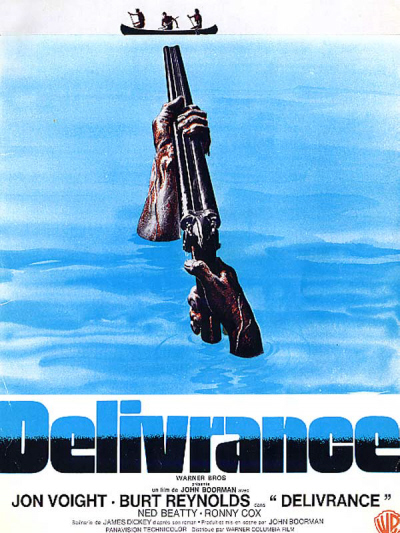
Deliverance (1972)

deliverance_posterDirected by John Boorman

I don’t know a lot about most of the Oscar-nominated movies from the 70s and 80s. I was raised on movies from the 30s through the 60s; I became at least semi-aware of the movies in the early 90s. But the 70s and 80s are just kind of a big, unexplored wilderness to me. Sometimes that’s a good thing; it means that I don’t have any preconceived ideas about the movies. But sometimes it means I get a nasty shock when something traumatic happens that I am not at all prepared for. That’s what happened to me with Deliverance, and that is why there will be a couple spoilers in this post. Normally I hate spoilers, and I try very hard to keep my posts spoiler-free, but I really wish someone had spoiled certain points about Deliverance for me.

So what’s the story? A dam is about to be built on a river in Georgia, so four friends decide to go canoeing down the river before the natural beauty of the area is destroyed. Although they are prepared for the dangers of nature, they aren’t ready for the dangerous men they will encounter.

The Good: The men who play the four friends do a phenomenal job. Burt Reynolds plays Lewis, the tough outdoor man who convinces everyone else to go on the trip. John Voight is his best buddy Ed. Gentle, music-loving Drew is played by Ronny Cox. Ned Beatty perfectly captures the cocky braggart Bobby. All four actors were terrific. I think the best scene was right after the tragedy when all four are reacting to it and trying to make a decision. Their personalities really shone through.

The cinematography was beautiful. Beautiful scenery makes gorgeous cinematography easier, so they definitely had a leg up when filming this movie, but the scenery wasn’t all there was to the cinematography. There were interesting and clever shooting angles. It was really cool.

The Bad: There were a couple of times in the movie that I had to rewind and watch very, very carefully to figure out what had just happened because it wasn’t clear.

Also, this movie has an awesome scene with the song “Dueling Banjos,” but because this movie left such a bad impression on me overall, I don’t think I will ever be able to listen to that happy song without thinking of this horrifying movie.

The Ugly: Okay, here’s the spoiler. If you don’t like spoilers, skip this section. If you read my blog regularly, you know that I’m not a huge fan of violence. Deliverance has one of the most horribly violent scenes I have ever seen. A man gets raped by another man. It was a terribly uncomfortable scene to watch, and the sick feeling it gave me made it hard to concentrate on the rest of the movie. I just can’t handle stuff like that, and not knowing that it was going to happen made it so much worse. I know not everyone is as sensitive to violence as I am, so it might not bother you, but it really bothered me. So there is my public service announcement about Deliverance.

Oscars Won: None.

Oscar Nominations: Best picture; best director; best film editing.

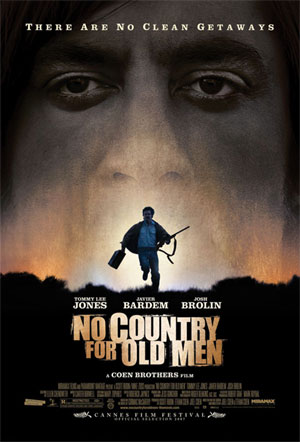
No Country for Old Men (2007)

No_Country_for_Old_Men_posterDirected by Ethan Coen and Joel Coen

I know it’s been a little while since I’ve posted, and I feel very bad about that. I know I left all my adoring fans hanging in 2007 (hahaha! Look at me, pretending I have fans!), but writing when you have a fever rarely produces anything that makes any sense, let alone anything readable. So in the future, I will attempt to not get sick until I’ve posted an entire week’s worth of reviews so that you, my loyal readers, will not be left without my wisdom.

I knew two things about this movie before I watched it: 1) It was based on a book by Cormac McCarthy and 2) It was a Coen brothers film. And this time, I was right on both counts! This movie makes a lot more sense for the Coen brothers. Although it’s a drama, it still has enough quirky characters and funny lines to bring that Coen brothers feel to it. Of course, that makes me extremely curious about the book that it’s based on. Does it have that same quirky feeling to it? Maybe one day when I have time in my life, I will find out.

So what’s the story? One day while he is out hunting (or poaching, maybe?) in the desert, Llewelyn Moss stumbles across the bloody aftermath of a drug deal gone wrong. He finds a case containing two million dollars, and instead of reporting it to the police, he decides to keep the money and run. Because he leaves his truck at the scene, he is soon being pursued by both the county sheriff and a psychopathic killer who works for the drug lord.

The Good: It’s extremely well-acted. Josh Brolin is Llewelyn Moss, a Vietnam veteran who wants more in his life. Tommy Lee Jones plays Ed Tom, the county sheriff who just can’t understand the mindless violence that has entered his life. And Javier Bardem won an Oscar for his portrayal of Anton Chigurh, the incredibly scary psychopathic killer. Side note: I realized while I was watching this movie that although Javier Bardem is an attractive man, I’ve only seen him in movies where he plays a really bad guy, so I’m a little bit scared of him. I’m sure he’s a perfectly nice man in real life, but I would need to see him being nice in real life to overcome the scary people I’ve seen him play. Kelly MacDonald is Moss’s innocent young wife with a backbone of steel. Her scene at the end was so well-played, I had to watch it twice.

I don’t know whether it was the acting or the screenplay or the direction, but No Country for Old Men is a gripping movie. I couldn’t stop watching. I got a phone call in the middle of the movie from someone I love, and getting pulled out of the movie made me really frustrated. I was so annoyed that I had to pause it; I was so into it and so absorbed in the world of the movie that coming out for a phone call was almost painful. And that was to talk to someone I care about. If it had been a telemarketer, I’m not sure what I would have done.

The Bad: Although I love Kelly MacDonald and think she’s a great actress, she looked so young that when I first saw her, I thought she was Josh Brolin’s teenaged daughter, which made it really creepy when he told her that if she didn’t stop talking, he was going to take her to the bedroom. It honestly took me a bit to realize she was supposed to be his wife. I think that’s more the fault of the makeup and costume people than anything. Everything else makeup and costumey worked, even Chigurh’s creepy haircut, but something needed to be done to make Kelly MacDonald not look like a sixteen-year-old.

I also felt like there was a lot of backstory to everyone which we as viewers never really get told about. Backstory is a good thing; it adds a lot of richness to a movie. But it left me with the feeling that there were things going on that I didn’t understand, and that frustrated me a bit. The questions didn’t all get answered, either. WHAT HAPPENED TO THE MONEY?

The Ugly: After watching No Country for Old Men, I feel kind of silly saying that There Will Be Blood was violent. No Country for Old Men is so much worse. People get shot left and right for no discernable purpose. I am also now afraid of oxygen tanks, although I recognize that Chigurh’s was a special cattle tool. Still. They are scary. And because there were so many deaths, I was left feeling empty at the end. I thought, “Wait. That’s it? That’s all there is to this story? What? How? Who? No, there has to be another ten minutes or so.” I didn’t have a feeling of closure; the movie just…ended. I didn’t like that at all. I felt like if that’s how it was going to end, then there wasn’t much point to the two hours that led up to the ending.

Oscars Won: Best motion picture of the year; best performance by an actor in a supporting role (Javier Bardem); best achievement in directing; best writing, adapted screenplay.

Other Oscar Nominations: Best achievement in cinematography; best achievement in film editing; best achievement in sound mixing; best achievement in sound editing.

Michael Clayton (2007)

michael claytonDirected by Tony Gilroy

When I was growing up, my dad would turn a movie on while he finished up paperwork at night. When the movie ended, he would simply rewind it and start the same movie over again. It never really bothered me too much (except when the movie was Groundhog Day), but I’ve never had the urge to do that myself until I watched Michael Clayton. It’s a very subtle corporate thriller, and I feel like I didn’t quite pick up on everything the first time through. I would like to watch it a couple more times, but since I have a full-time job which not my blog, I can’t do everything I want.

So what’s the story? Michael Clayton is his law firm’s clean-up man. Whenever anything goes wrong, he’s called on to fix it. So when the firm gets a call that one of the partners who was at a deposition has stripped himself and started chasing a witness through the parking lot, Michael Clayton is sent to see what can be done. When he gets there, Michael finds out that everything is not as it seems…

The Good: There were some fabulous performances in this movie. George Clooney plays Michael Clayton, a man who’s dealing with all kinds of stress at work and in his family life. It’s a very understated performance. His acting in the last few minutes of the movie and into the end credits was incredible. Tilda Swinton is the head legal counsel for the company that Clayton’s team is supposed to be representing. She is a fascinating character; she is smart and capable, but not at all confident. I’ve never been a huge fan of hers, but I have to admit that she is fabulous in Michael Clayton. Tom Wilkinson plays Arthur Edens, the partner whose breakdown leads Michael Clayton on a search for the truth. Movie director Sydney Pollack does a good acting job as one of the heads of the firm, and Austin Williams plays Michael’s fantasy-novel obsessed young son.

The cinematography really set the mood for the movie. It takes place during the late fall or early winter, and the cold, dying landscape and the wintry light reflected Michael’s mood.

The Bad: I like to think that I’m an intelligent person, but I know I missed some plot points. I will admit that I was tired and my brain wasn’t functioning at full capacity, but feel like I shouldn’t have to watch a movie more than once to understand all of what’s going on.

Also, why were the horses in the field bridled? I’m no horse expert, but I have always thought that horses don’t wear their bridles when they are left in the pasture. It’s a silly thing, but it disquieted me for the whole movie.

The Ugly: Even though Michael Clayton was interesting and had good acting, I never connected with the movie on an emotional level. I feel like I should have felt something, but the movie felt more like an intellectual logic puzzle than a work that touched my soul. I think an excellent movie should touch the viewer in some way.

Oscar Won: Best performance by an actress in a supporting role (Tilda Swinton).

Other Oscar Nominations: Best motion picture of the year; best performance by an actor in a leading role (George Clooney); best performance by an actor in a supporting role (Tom Wilkinson); best achievement in directing; best writing, original screenplay; best achievement in music written for motion pictures, original score.

Atlantic City (1981)

Atlantic-CityDirected by Louis Malle

It’s interesting to me that so many movies that were considered one of the five best movies made in any given year don’t last. I don’t mean that they become dated; they just fall out of the public consciousness. I’m more of an older movie person than 90% of people my age, and I had never heard of Atlantic City before I saw the name on the list of best picture nominees. It’s not a bad movie, and the emotions and yearnings of the main characters are timeless. It makes me wonder exactly what qualities a movie has to have to become a classic that is watched from generation to generation, because apparently being a good movie with a timeless message isn’t enough.

So what’s the story? Lou is an old man who used to be a low-level mobster. Now he’s a small-time bookie who also takes care of a mobster’s bedridden widow. He watches his neighbor, Sally, through his kitchen window. Sally is a young woman who dreams of becoming a blackjack dealer in Monte Carlo. When Sally’s estranged husband shows up with a bag of drugs that he’s stolen from a dealer in Philadelphia, both Sally’s and Lou’s lives change drastically.

The Good: Burt Lancaster makes Lou very sympathetic. I pitied Lou for feeling stuck in a life he didn’t want after having had a less than glorious life. Lancaster made it completely understandable that Lou would want to have the chance at being a more notorious criminal. It’s hard to describe, but Burt Lancaster makes Lou’s decisions more realistic.

Susan Sarandon is also good as Sally, a woman who is actively doing everything she can to make her dreams come true, but who is unfortunately dragged down by her past. I really felt for her as her frustration and unhappiness mounted.

There was some interesting cinematography. My favorite shot was where Dave is running from the drug kingpin in the car lift and the kingpin’s feet slowly come into the frame. That was one of the tensest shots I have ever seen.

The Bad: I didn’t understand all of Sally’s choices. I’m sorry, but if my husband who abandoned me showed up on my doorstep with my pregnant younger sister, I wouldn’t take them in. If my sister was as young and stupid as Chrissie, I might take her in, but there’s no way the husband is coming anywhere near me. Sally was a strong person. It didn’t seem to fit with her personality to allow Dave to stay with her. Sure, if she hadn’t there wouldn’t have been a movie, but still. It didn’t fit.

The Ugly: I don’t like movies that make criminals sympathetic. I feel like my emotions are being played with. Lou is such a nice old man, and he’s so happy when he’s able to get back into crime that I was happy for him. And then I thought, “Wait. No. I’m not happy for him. He’s selling drugs. That’s not okay.”

Oscars Won: None.

Oscar Nominations: Best picture; best actor in a leading role (Burt Lancaster); best actress in a leading role (Susan Sarandon); best director; best writing, screenplay written directly for the screen.

Mr. Smith Goes to Washington (1939)

Mr. Smith Goes to WashingtonDirected by Frank Capra

Mr. Smith Goes to Washington is one of the movies I had seen before I started this project and was happy to watch again because it’s so good. I was also happy in a really weird way that I couldn’t get it from the library I work at; there was a waiting list. For a movie from 1939. So I have hope for the future now, even though I had to get the movie from a different library.

So what’s the story? A senator from an unnamed state dies, and the governor needs to appoint a replacement. The corrupt political boss that got him elected tells him to pick one person, while the unions and other state leaders give him another name. His savvy kids (all eight of them!) tell him to appoint their local scout leader, Jefferson Smith. Not wanting to offend anyone, the governor appoints Jefferson Smith. Jeff is a naive patriot who loves his country and believes in the Constitution, but the rest of the elected officials from his state are corrupt and trying to push graft through. It’s up to him and his cynical assistant to stop the evil political machine from succeeding.

The Good: There is lots of good acting in the movie. Jimmy Stewart plays Jefferson Smith, and he’s always good. Jean Arthur is the cynical assistant Saunders who is slowly won over by Smith’s naivety. The corrupt senior senator is Claude Rains, who is one of my personal favorites, and I think it’s a shame that he never won an Oscar. He did get a best supporting actor nomination for this movie, though. So did Harry Carey , who is listed as President of the Senate, but if I remember my Constitution correctly, doesn’t that make him Vice President of the United States? Anyway, he has almost no lines in this movie, but his face is incredibly expressive.

I actually wrote a paper in college about the music in this movie for an American history class where they required us to watch Mr. Smith Goes to Washington; the music is very instrumental (hahaha) to the drama of the movie. Dimitri Tiomkin used lots of American folk songs and patriotic songs to underscore Smith’s fight against corruption.

I’m going to award kudos to the makeup people for this movie, too. I had always thought that Mr. Smith Goes to Washington was made in the late forties, many years after The Adventures of Robin Hood (1938) and Casablanca (1942). I assumed this because of Claude Rains, who looks so much older in this movie than in the other two. But since that is all down to the makeup department and not natural aging, I have to congratulate the makeup department for fooling me.

While I was watching this movie, I assumed that they had gotten permission to film on location at the Capitol Building. Nope! They just rebuilt the Senate Chamber in complete detail in a studio in California. It’s crazy good, and it says to me that Frank Capra cared a lot about this movie.

Another detail that I appreciated was that Capra never named the state that Smith is from or the which political party any of the politicians belong to. He made it so that no one could say, “Well, it didn’t happen in my state or my party, so I’m fine.” He didn’t allow anyone to be complacent about corruption in the government.

The Bad: As Jefferson Smith is trying to expose the corruption, his Boy Rangers back home try to spread the word about what he’s doing. The political machine shuts them down, and it’s very hard to watch. It’s not graphic, but if you’re sensitive to children in danger, be warned. Watch the movie anyway, but know that that’s coming.

The (Possibly) Ugly: Patriotism, idealism, and optimism aren’t always highly regarded now. People are more cynical, especially about the government. Some people might say that this movie is unbearably cheesy because of that. I don’t find it so; I kind of wish there were more people now who did believe that what they do can make a difference.

Oscar Won: Best writing, original story.

Other Oscar Nominations: Best picture; best actor in a leading role(James Stewart); best actor in a supporting role (Harry Carey); best actor in a supporting role (Claude Rains); best director; best writing, screenplay; best art direction; best sound, recording; best film editing; best music, scoring.

Chicago (2002)

chicagoDirected by Rob Marshall

This is the one of the movies (the other is Guess Who’s Coming to Dinner) that inspired me to watch all of the movies nominated for best picture. When I saw Chicago for the first time, I was not impressed; it made me wonder how bad the other nominees were for this movie to have won best picture.

So what’s the story? In 1920s Chicago, vaudeville star Velma Kelly murders her husband and sister when she finds them sleeping together. Actress wannabe Roxie Hart kills her lover when he decides to break off their relationship and reveals that he never had the connections to make her a star. Both women are represented by Billy Flynn, a defense attorney who has never lost a case. Will his defense be enough to save them from the hangman’s rope?

The Good: Catherine Zeta-Jones. She is amazing as Velma Kelly. She not only sings and dances, but she acts while she’s doing it. In the scene where she’s trying to convince Roxie to be her partner in a new act (the song “I Can’t Do It Alone”), you can see the desperation written on her face. She’s a proud woman begging for help, and it hurts her, but she does what she has to do. She completely deserved her Oscar for best supporting actress.

The musical numbers were fantastic. I don’t automatically like movie musicals. If the songs don’t add something either to the plot or to the development of character, they feel like a waste of time to me. But I loved the songs in Chicago. “Cell Block Tango” is my favorite. I liked the symbolism of “We Both Reached for the Gun” and Richard Gere’s tap dance. All of the musical numbers added to the movie.

I did like the trope of having the musical numbers be inside Roxie’s head. That was a good way to make a musical believable, because people don’t normally break into song in a courtroom. That meant the editing had to be good, and it was. The movie cut beautifully between what was happening in the real world and what was being sung in Roxie’s mind. Having Taye Diggs as the announcer to tie it all together was a smart choice, too.

The Bad: Renèe Zellweger is not a dancer, nor does she have a voice of the same caliber of Catherine Zeta-Jones’s or Queen Latifah’s. She wasn’t horrible, but when you put someone great next to someone merely good, it makes you cringe. That last dance number is particularly bad. Catherine Zeta-Jones looked like dancing is as natural to her as walking, which makes Renèe Zellweger look stiff. It’s just not good.

The Ugly: This movie has no heart or soul. The theme of the movie is that you can get away with anything if you are famous enough. While that might be true, I don’t feel like it’s something to celebrate.

Oscars Won: Best picture; best actress in a supporting role (Catherine Zeta-Jones); best art direction – set direction; best costume design; best film editing; best sound.

Other Oscar Nominations: Best actress in a leading role (Renèe Zellweger); best actor in a supporting role (John C. Reilly); best actress in a supporting role (Queen Latifah); best director; best writing, adapted screenplay; best cinematography; best music, original song (“I Move On”).

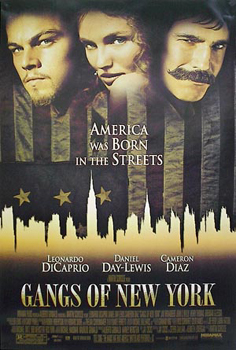
Gangs of New York (2002)

gangsofnyDirected by Martin Scorsese

There were two discs in the DVD case when I picked this movie up from the library, but I figured that one was the movie and one had special features like most DVDs do. Nope! I was wrong. For whatever reason, this movie is spread over two DVDs, with parts of the movie and special features on both discs. Yes, Gangs of New York is a long movie, but it’s shorter than Saving Private Ryan and The Thin Red Line, and they each managed to be on one disc. I kind of get the feeling that whoever made that decision wanted to make the movie feel more epic, but it really just made it seem long.

So what’s the story? In New York City in 1846, two rival gangs battle it out for supremacy. Bill the Butcher, the leader of the American-born Natives, kills the Priest, leader of the Irish Dead Rabbits. Sixteen years later, Amsterdam, the son of the Priest, comes back for revenge.

The Good: The set direction was fabulous. Every little detail combined to make me feel like I had been transported back to the 1860s. I thought the costume design was good, too, but this movie made me realize that I know very little about historical clothing when it comes to the poor, so I could be wrong on this one. But I can’t imagine anyone would put men in those ridiculously ugly plaid trousers unless it was accurate.

The story was good one. Revenge plots are always exciting, and there were some good moments where Amsterdam struggled between admiration of Bill the Butcher and his desire for revenge.

The best acting in the movie was done by men in supporting roles. The standout actor was Brendan Gleeson. He didn’t have a lot of screen time in his role as an Irish mercenary unaffiliated with any gang, but he played his part so convincingly. His scenes were among the best in the movie. Jim Broadbent as real-life corrupt politician Boss Tweed was hilarious, and Gary Lewis made a very intense Irishman in the wrong gang. The only lead actor who did a very good job was Daniel Day-Lewis. His performance was sometimes over the top, but so was his gang-leader character, so it worked.

The Bad: Leonardo DiCaprio. His acting wasn’t terrible all the time, but his Irish accent came and went, especially when he narrated. Were there no actors that were actually Irish that could have played the part? It would have helped a lot.

The story followed Amsterdam as he followed his plan to get revenge on Bill the Butcher. Everything led up to that, and then the climax was actually about the New York City draft riots of 1863. Yes, the draft and the dissatisfaction of the poor people about it were touched on throughout the movie, but not enough for it to be the climax. I thought that that was kind of sloppy storytelling. Also, sixteen years after 1846 would have been 1862, not 1863, so they got their year wrong, too.

Also, what were so many Chinese people doing in New York in the 1860s? Especially Chinese women? That rang false. I wouldn’t be surprised to see Chinese immigrants on the West Coast at the time, but I don’t think there were very many in New York.

The Ugly: When I told my younger brother about my quest to watch these movies, he said he’d seen some nominees from 2002 and that Gangs of New York was a pretty good movie – except Cameron Diaz ruined it. Now that I’ve seen it, I have to agree. I feel like Amsterdam was so focused on revenge that he wouldn’t have the emotion left over to fall in love. If he did fall in love, it would have to be with someone amazing. Cameron Diaz never made me feel like Jenny Everdeane was anything special. She spent most of the movie looking either smug or confused. Maybe another actress could have done a better job, but since Cameron Diaz was chosen, that part of the story should have been left out altogether.

Speaking of leaving things out…This movie is almost three hours long, and I felt every second of it. It actually took me over four and half hours to watch because I kept falling asleep and having to find my place again. Granted, I had a cold, but still. Other three-hour movies have managed to keep my attention. Saving Private Ryan is actually a little bit longer than Gangs of New York, but I was surprised to find that out because the time flies by in Saving Private Ryan. I’m not asking for non-stop action; I like character development and plot intricacies. But this movie had too many scenes that didn’t move the action along or even really develop the characters. It needed to be cut down.

Oscars Won: None

Oscar Nominations: Best picture; best actor in a leading role (Daniel Day-Lewis); best director; best writing, original screenplay; best cinematography; best art direction – set direction; best costume design; best film editing; best sound; best music, original song (“The Hands That Built America”).

In the Heat of the Night (1967)

In_the_Heat_of_the_Night_(film)Directed by Norman Jewison

I have a hard time sitting still and doing nothing when I watch movies. I get kind of antsy unless I have another project to occupy my time, so I’ll paint my nails or play a game on my phone or crochet a hat while the movie plays in the background. But doing this project has forced me to change all that. If I want to appreciate good acting or interesting camera work or immerse myself in another time through excellent production design, I have to give the movie my full attention. The first time I watched In the Heat of the Night, I was messing around on my computer. I thought it was a good movie, an interesting movie, but not that great. Then I watched it again on my big TV instead of my little computer screen, and I didn’t do anything but watch the movie. I was blown away. It was a totally different experience, and I understood the (well-deserved) acclaim.

So what’s the story? Late one summer’s night in Sparta, Mississippi, a police officer finds the murdered body of a prominent man lying in the street. The police start searching for the murderer, and they soon find and arrest the perfect suspect: Virgil Tibbs, a black man who is sitting in the train station. However, Virgil says he’s not a transient or a criminal, but a police officer from Philadelphia; he was just waiting for his train home. Sheriff Gillespie, the head of police in Sparta, calls Philadelphia to verify this, and the police chief in Philadelphia tells Gillespie that Tibbs is the best homicide detective in Philadelphia and that Tibbs should help on the case. None of the (white) police officers in Sparta want to accept help from black man, but the widow of the murdered man insists that Tibbs remain on the case. Tibbs and Gillespie now have to overcome their prejudices to work together to solve the murder.

The Good: I always seem to start with the acting, but I think that’s because bad acting ruins a  movie so quickly. There was some good acting here. Rod Steiger won an Oscar for his portrayal of Gillespie. I wasn’t completely convinced that he deserved it over Spencer Tracy in Guess Who’s Coming to Dinner until the scene where the four thugs have cornered Tibbs in the warehouse. At that point, something clicked for me, and I realized what a truly stellar job he was doing. Sydney Poitier is excellent as he always is as Virgil Tibbs. Lee Grant plays the widow; she isn’t in the movie much, but she commands every scene she’s in. Her heartbreak when she’s told of her husband’s death is so painful that it’s difficult to watch.

The story here is excellent. It’s based on a novel that I haven’t read, so I’m not sure what’s been changed and what was original, but it makes a great movie. I love how well-developed all the characters are. It would have been so easy to make Tibbs perfect, but he has his flaws, too, which are shown when he fixates so strongly on a suspect (who is admittedly a terrible person) that he loses all perspective on the case. The story and screenplay are so well done. And this movie gave us a classic line: “They call me Mr. Tibbs!”

The cinematography was interesting. I loved the part where Tibbs is examining the body. The camera cuts to his hands to show his skill and confidence as he explains what he will need to do a proper examination. The camera focuses hands in another scene, too. When Tibbs and Gillespie are going to go visit the wealthy cotton planter, they drive past a field of cotton being picked by black workers. Here, the camera’s focus serves to contrast Tibbs’s job and skills with those of the workers. If Tibbs had lived here, it seems to say, this is what he might be doing. At other times, the cinematography feels almost musical. As the cameraman zooms in on a fleeing suspect, for instance, it accentuates the tension almost like a crescendo in a piece of music. It adds a lot to the movie.

The Bad: The only thing that made this movie feel dated was the music. It just screamed the 1960s to me. It might have been groundbreaking at the time, but it feels very old-fashioned now.

The Ugly: The ugliest thing in this movie is the attitudes of the people, from the moment Tibbs is arrested because he’s an unknown black man to the climax where the thugs show up at Mama Caleba’s. But it’s this ugliness that allows the beauty of the eventual mutual acceptance and respect of Tibbs and Gillespie shine through.

Oscars Won: Best picture; best sound; best actor in a leading role (Rod Steiger); best film editing; best writing, screenplay based on material from another medium.

Other Oscar Nominations: Best director; best effects, sound effects.