I'd like to spank the Academy

Posts tagged ‘1860s’

The King and I (1956)

king and iDirected by Walter Lang

This is the second movie I’ve watched this week that I’ve seen more times than I can count, but it’s the first movie this week that was based on a play which was based on a book which was based on a true story. I loved musicals when I was young(which I think is funny considering how little patience I have with them now), and this was one of my favorite musicals. I can still sing along with all of the songs, and I think it will always have a special place in my heart.

So what’s the story? Anna Leonowens, a widowed Englishwoman, comes to Siam (now Thailand) to be the governess to the children of the king.

The Good: I love the music in this movie. I don’t love all of the songs, because I think there are one or two that slow the movie down, but most of them are enjoyable. And the score is amazing. All I have to do is see the cover of this movie and I have “The March of the Siamese Children” in my head. Not only that, but I am happy to have that song in my head. That never happens.

I like the lead actors in this movie. Yul Brynner plays a man who is trying to hold on to tradition and effect change at the same time. His inner struggle is plain on his face as he tries to make hard decisions. Deborah Kerr makes an excellent Anna. She is smart and determined and compassionate and courageous.

The costumes are gorgeous. Because of this movie, I have had a lifelong dream of polkaing in a dress with a giant hoopskirt. But Anna’s dresses are not the only beautiful ones in The King and I. The women of the court also wear lovely things. Even the king’s clothes are very sumptuous. It’s all very fun.

As impatient as I am with musical numbers that don’t help advance the plot or at least help with characterization, I love the Uncle Tom’s Cabin ballet. It’s different and beautiful and mesmerizing. I’m glad it’s in the movie.

The Bad: It bothers me a little bit that many of the “Asian” people in The King and I were played by Latinos. I can see the reasoning behind hiring Rita Moreno, because she’s amazing, and who wouldn’t pick Rita Moreno if she were a choice? But were the producers really unable to find enough children to play the king’s children who were, if not Thai, at least Asian? There weren’t ten to fifteen Asian kids living in California in 1956?

The Ugly: I have seen this movie many times, and it never bothered me before, so maybe I’m being ultra picky, but the attitude of the movie toward Siam in general and the king in particular is very condescending. There is very much an air of “everything in European culture is good because the Europeans are so enlightened, but there is nothing good about Siamese culture.” The king is only admired because he is trying to westernize his country. He makes silly mistakes (like wanting to send only male elephants to America) that are then corrected by the superior Englishwoman. At one point, Anna tells her young son, Louis, that in many ways, the king was no older than Louis. Really? This is a grown man who had ruled a country and managed to keep it independent in a time of colonization. He is very different from an eight-year-old. I think this might not bother me so much if these characters weren’t based on real people, but since they are, I feel like the characterization of the king and the attitude toward Siam in general is very disrespectful. And yes, I understand that The King and I is from a different era, which is why I can still enjoy this movie. But I can also understand why it’s banned in Thailand. Not that I advocate banning, but I can sympathize with the feelings behind the banning in this particular case.

Oscars Won: Best actor in a leading role (Yul Brynner); best art direction-set direction, color; best costume design, color; best sound, recording; best music, scoring of a musical picture.

Other Oscar Nominations: Best picture; best actress in a leading role (Deborah Kerr); best director; best cinematography, color.

Friendly Persuasion (1956)

friendly-persuasion-movie-poster-1956-1020505962Directed by William Wyler

I had a bad day the day I watched this movie. I hadn’t felt well all day at work, but I didn’t feel bad enough to take time off. About five minutes after I got home from work, I was violently ill. It lasted about half an hour. I was feeling sick and weak when I put Friendly Persuasion in the DVD player.  But the moment the opening notes of the theme song started, I felt much better. Watching this movie is like being wrapped in a giant puffy quilt or getting a hug from someone you love. That may be because I was raised on this movie, but I like to think that the sweetness of this movie could make anyone’s day better.

So what’s the story? Jess and Eliza Birdwell are Quakers living in southern Indiana during the Civil War. Their older son, Joshua, is old enough to fight in the war, but the family’s pacifist beliefs keep him from joining up. Their daughter, Martha, is in love with their Methodist neighbor, who is a soldier. And their younger son, Little Jess, is in constant battle with Samantha the Goose. The family tries to simply go about their lives, but the war is about to come to them, forcing them all to make decisions of faith and love and conscience.

The Good: The cast is perfect. Jess is played by Gary Cooper, who makes Jess a slightly mischievous man who believes in his religion, but sometimes struggles to live up to the standards it sets for him. Dorothy McGuire plays Eliza, the Quaker minister who sometimes has to fight to keep her family on the straight and narrow. Anthony Perkins (yes, the same Anthony Perkins who is in Psycho) plays Josh, whose conscience tells him that fighting is a sin, but that his family is worth fighting for. Phyllis Love plays the lovesick Mattie almost uncomfortably perfectly. Robert Middleton plays family friend Sam Jordan with humor and love. Everyone is just good.

Okay, this is a weird thing, but I was struck as I watched  Friendly Persuasion this time by the goose. Or possibly geese? I’m not sure how one goes about training a goose. I can’t imagine that it’s easy. But that goose does all sorts of things. Even if it’s many geese all doing one trick, it would have taken lots of work. So hats off to the animal trainers for this movie!

I love the music for this movie. Pat Boone sings the theme song, and it’s beautiful. It reflects the mood of the movie: slow, yet loving. Dimitri Tiomkin’s score is also good, reinforcing the love and joy found in the Birdwells’ home life.

And speaking of the home life, I love that this family is a family. The children sometimes tease each other. They sometimes fight. The father defers to his wife, but he sometimes teases her and sometimes gangs up with his kids to get her to relax. The writers made the characters real people with faults and virtues. I love that.

The Bad: The plot isn’t perfectly linear. It meanders a bit. There are some scenes that add to the characterization of the people, but don’t necessarily add to the overarching Civil War plot. I’m okay with this in this movie because all these scenes are so delightful, but that also might be because I’ve loved Friendly Persuasion for a long time. Other people might not be so forgiving.

As Quakers, the Birdwells use speech that is a little bit different. They use “thee” and “thy” instead of “you” and “yours”. But to my German-speaking ear, they don’t use them quite correctly. This is apparently accurate for the Quakers, but it bothered me a little bit. It took me about a quarter of the movie to be okay with it.

The Ugly: I don’t think there is anything ugly about Friendly Persuasion, unless you object to a feel-good movie about a family trying to live according to their consciences.

Oscars Won: None

Oscar Nominations: Best picture; best actor in a supporting role (Anthony Perkins); best director; best writing, best screenplay – adapted; best sound, recording; best music, original song (“Friendly Persuasion (Thee I Love)”).

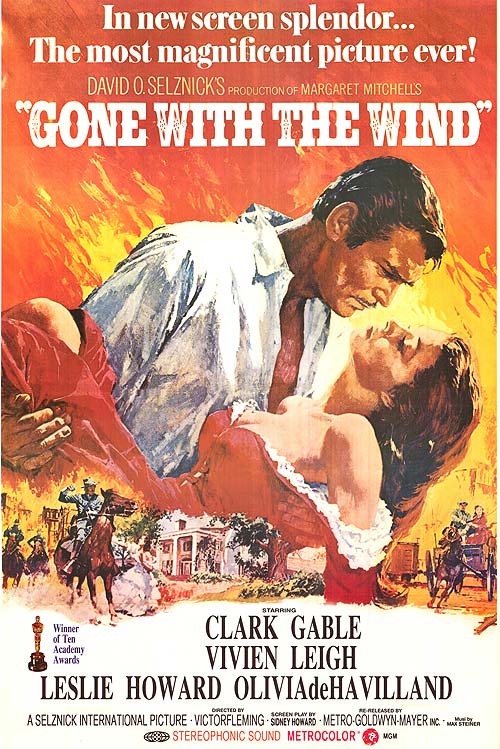
Gone with the Wind (1939)

gone with the windDirected by Victor Fleming

As I’ve been doing this project, I’ve noticed something that a lot of nominees have in common: they are freaking long. I have felt every minute of some of those three-hour movies (I’m looking at you, Thin Red Line!), while others have kept me captivated. Gone with the Wind is almost four hours long, but I didn’t feel it. I had seen bits and pieces growing up, but I watched the whole movie in one sitting when I was eleven. I’ve seen it several times since, including once in the theater when it was re-released for an anniversary event. And every single time I’ve watched it, I’ve been glued to the screen. It doesn’t matter that I know how it ends. The world of Gone with the Wind was so skillfully built that I can’t tear myself out of it. The characters are so real that they almost feel like friends; their triumphs and miseries become ours. That, my friends, is how you make a three-hour-plus movie fly by.

So what’s the story? Spoiled Southern belle Scarlett O’Hara’s world comes crashing down around her when the American Civil War begins. Her life of parties and flirting is over. As she tries to adjust to the harsh realities of her new life, she learns that she will do anything to keep what she loves. (That summary makes it sound boring. Trust me, it’s not.)

The Good: There are so many good things in Gone with the Wind that it’s hard to know where to start. I think I will change it up and start with cinematography. Gone with the Wind is a beautiful movie, full of glowing sunsets and billowing ball gowns. It’s not always pretty, though; the scene at the depot where the soldiers are lying dead in rows is tragic. The birth of Melanie’s son, where everything is shown in silhouette, is exquisitely done. These are just the highlights, though; there are lots of scenes where the camera work more quietly underscores the action or the emotion of the scene.

The costume design is also good. This movie is why I can complain about other movies’ lack of good historical costume. In Gone with the Wind, the fashions change with the times, like fashion does in real life. Not only that, but the clothes are fairly accurate (as far as I know. I am not a fashion historian; I have only picked up tidbits here and there.). I do know that the shape of the hoops change correctly for the times, which may only be a small detail, but it shows that the designer cared enough to do actual research.

The score is sweeping and beautiful and just a little bit over the top, which fits the epicness of this movie. Everything about Scarlett is dramatic, and it’s appropriate that the music in her movie is, too.

It is very easy to forget in this day and age that in 1939, everything in a movie was real. If you wanted a huge crowd of people, you had to hire actual people. If you wanted a fire, you had to burn something. There are some crazy special effects in this movie. I seriously wonder how they managed to film some of the scenes. Special effects took a certain kind of creativity back in the day, and have to give kudos to the special effects people for this movie.

Whoever adapted the giant book Gone with the Wind into a single (albeit long) movie was amazing. He found the most important things, the things that would make a compelling movie and took those out. He knew what to leave out; it was all good stuff – Ellen’s backstory, Scarlett’s other children, Will Benteen – but wasn’t necessary to the movie. Those extra things that fleshed out the novel would have bogged down the movie. It’s an excellent adaptation.

The entire cast of Gone with the Wind is stellar. After I had watched Dark Victory, I was thinking that maybe Bette Davis should have gotten the best actress Oscar, but when I saw Vivien Leigh’s performance again, I had to admit that Vivien Leigh deserved it. Clark Gable as gave an awesome performance as Rhett Butler. He is so good as the strong, manly lover hiding his love behind pride and lust. The flash of hurt on his face when Scarlett admits that she’s marrying him for his money…so sad. And that kind of thing happens more than once. It’s very subtle and very good. Olivia de Havilland plays Melanie Wilkes so beautifully. She manages to be an angelic, self-sacrificing person and yet not make you hate her. And she was only 23 when the movie came out. That was some serious acting for such a young woman. There is some controversy over Hattie McDaniel’s role as Mammy, Scarlett’s nurse/surrogate mother, but she plays the role well and allows us to see the main characters in a different light as she isn’t shy about expressing her opinions.

The Bad: This is an extremely frustrating movie to watch. Rhett loves Scarlett, but is too proud to admit that he’s actually fallen in love. Scarlett is too caught up with her make-believe love for Ashley to notice. When Rhett makes her notice, he is so ashamed of what he’s done that he doesn’t see the opening Scarlett is giving him. When he rejects her at that point, Scarlett is too proud to say anything. Grrrrr. These are two very strong, proud people who are so scared of showing weakness that they can’t allow happiness in. It makes me want to shake them both.

The Ugly: The movie laments the passing of a “beautiful, genteel” culture, but glosses over the evils that that culture is built upon. Slavery made that lifestyle possible, and so it’s hard to feel too sorry for the O’Hara family when they have to pick their own cotton and for Ashley Wilkes when he is splitting rails. Yes, it’s hard, and it’s not what they were brought up to do, but they were brought up to live off of the misery of others. Ashley briefly acknowledges this, but only briefly. Frankly, it was a culture that deserved to die. I can still enjoy the movie, but it doesn’t make me mourn the passing of the Old South.

Oscars Won: Best picture; best actress in a leading role (Vivien Leigh); best actress in a supporting role (Hattie McDaniel); best director; best writing, screenplay; best cinematography, color; best art direction; best film editing.

Other Oscar Nominations: Best actor in a leading role (Clark Gable); best actress in a supporting role (Olivia de Havilland); best sound, recording; best effects, special effects; best music, original score.

Other Oscars Won: Honorary award to William Cameron Menzies “for outstanding achievement in the use of color for the enhancement of dramatic mood in the production of Gone with the Wind”.

Technical Achievement Award to R.D. Musgrave “for pioneering in the use of coordinated equipment in the production Gone with the Wind”.

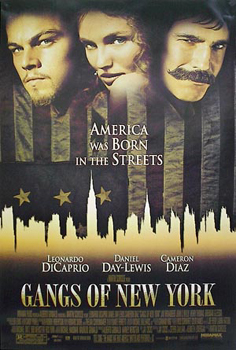
Gangs of New York (2002)

gangsofnyDirected by Martin Scorsese

There were two discs in the DVD case when I picked this movie up from the library, but I figured that one was the movie and one had special features like most DVDs do. Nope! I was wrong. For whatever reason, this movie is spread over two DVDs, with parts of the movie and special features on both discs. Yes, Gangs of New York is a long movie, but it’s shorter than Saving Private Ryan and The Thin Red Line, and they each managed to be on one disc. I kind of get the feeling that whoever made that decision wanted to make the movie feel more epic, but it really just made it seem long.

So what’s the story? In New York City in 1846, two rival gangs battle it out for supremacy. Bill the Butcher, the leader of the American-born Natives, kills the Priest, leader of the Irish Dead Rabbits. Sixteen years later, Amsterdam, the son of the Priest, comes back for revenge.

The Good: The set direction was fabulous. Every little detail combined to make me feel like I had been transported back to the 1860s. I thought the costume design was good, too, but this movie made me realize that I know very little about historical clothing when it comes to the poor, so I could be wrong on this one. But I can’t imagine anyone would put men in those ridiculously ugly plaid trousers unless it was accurate.

The story was good one. Revenge plots are always exciting, and there were some good moments where Amsterdam struggled between admiration of Bill the Butcher and his desire for revenge.

The best acting in the movie was done by men in supporting roles. The standout actor was Brendan Gleeson. He didn’t have a lot of screen time in his role as an Irish mercenary unaffiliated with any gang, but he played his part so convincingly. His scenes were among the best in the movie. Jim Broadbent as real-life corrupt politician Boss Tweed was hilarious, and Gary Lewis made a very intense Irishman in the wrong gang. The only lead actor who did a very good job was Daniel Day-Lewis. His performance was sometimes over the top, but so was his gang-leader character, so it worked.

The Bad: Leonardo DiCaprio. His acting wasn’t terrible all the time, but his Irish accent came and went, especially when he narrated. Were there no actors that were actually Irish that could have played the part? It would have helped a lot.

The story followed Amsterdam as he followed his plan to get revenge on Bill the Butcher. Everything led up to that, and then the climax was actually about the New York City draft riots of 1863. Yes, the draft and the dissatisfaction of the poor people about it were touched on throughout the movie, but not enough for it to be the climax. I thought that that was kind of sloppy storytelling. Also, sixteen years after 1846 would have been 1862, not 1863, so they got their year wrong, too.

Also, what were so many Chinese people doing in New York in the 1860s? Especially Chinese women? That rang false. I wouldn’t be surprised to see Chinese immigrants on the West Coast at the time, but I don’t think there were very many in New York.

The Ugly: When I told my younger brother about my quest to watch these movies, he said he’d seen some nominees from 2002 and that Gangs of New York was a pretty good movie – except Cameron Diaz ruined it. Now that I’ve seen it, I have to agree. I feel like Amsterdam was so focused on revenge that he wouldn’t have the emotion left over to fall in love. If he did fall in love, it would have to be with someone amazing. Cameron Diaz never made me feel like Jenny Everdeane was anything special. She spent most of the movie looking either smug or confused. Maybe another actress could have done a better job, but since Cameron Diaz was chosen, that part of the story should have been left out altogether.

Speaking of leaving things out…This movie is almost three hours long, and I felt every second of it. It actually took me over four and half hours to watch because I kept falling asleep and having to find my place again. Granted, I had a cold, but still. Other three-hour movies have managed to keep my attention. Saving Private Ryan is actually a little bit longer than Gangs of New York, but I was surprised to find that out because the time flies by in Saving Private Ryan. I’m not asking for non-stop action; I like character development and plot intricacies. But this movie had too many scenes that didn’t move the action along or even really develop the characters. It needed to be cut down.

Oscars Won: None

Oscar Nominations: Best picture; best actor in a leading role (Daniel Day-Lewis); best director; best writing, original screenplay; best cinematography; best art direction – set direction; best costume design; best film editing; best sound; best music, original song (“The Hands That Built America”).