I'd like to spank the Academy

Archive for the ‘Drama’ Category

Dark Victory (1939)

dark victory posterDirected by Edmund Goulding

People who care about such things may notice that I have gone out of order. Yes, I realize d comes before g in the alphabet, so yes, this should have been the first review of the week. But I don’t watch the movies in alphabetical order; I watch them as I want to watch them. And I had watched Goodbye, Mr. Chips earlier in the week, but stupid daylight savings time prevented me from getting to Dark Victory until later than I wanted. So write your congressman and say you want to put an end to daylight savings time.

So what’s the story? The reason I hadn’t watched Dark Victory was that the story just didn’t appeal to me. Judith Traherne is a young sporting socialite; she breeds and rides horses and hunts and all that kind of stuff. She’s had blinding headaches for the last six months, but when she misses a jump when riding her horse, she realizes something is seriously wrong. She is diagnosed with a brain tumor and has it removed, but the doctor knows that someday it will come back; Judith will be dead before then end of a year.

The Good: This movie had the potential to be either incredibly melodramatic or deadly dull. In order to avoid that, the viewer has to care about Judith. Bette Davis makes you care. Judith tries to pretend that she’s not really worried at the beginning, but Bette Davis lets us see beneath the strong words and actions to the scared young woman. She glows when she falls in love; she becomes tough, yet brittle when she feels like that love has betrayed her. I  found myself in complete sympathy with Judith, even though our lives are so very different. If this movie had starred a lesser actress, it would have been soapy garbage. Bette Davis saved it from that.

The supporting cast is also stellar. Geraldine Fitzgerald as Judith’s personal secretary and best friend is a standout. I hadn’t seen her in anything before, but I think I get to see her in a few more nominees, which makes me happy.

The Bad: Max Steiner wrote the soundtrack for this film, and the music is nice, but it’s  very dramatic. I realize that that was the trend of the time, but I like my soundtracks to be a little more subtle.

The Ugly: I think the fact that Bette Davis is so good kind of highlights a major weakness of this movie. The storyline is tripe. It’s silly and contrived and over dramatic. My advice for watching this movie is to allow yourself to get swept up in the fabulous acting and don’t think too hard about anything else. Also, Humphrey Bogart in a small supporting role with a bad fake Irish accent? No. Very ugly.

Oscars Won: None.

Oscar Nominations: Best picture; best actress in a leading role (Bette Davis); best music, original score.

Fun fact: There’s a very attractive young playboy in Dark Victory who looked kind of familiar to me, but I couldn’t place him, so I looked him up on IMDb. Turns out the very attractive playboy would be president of the United States a little over forty years later. Weird.

Goodbye, Mr. Chips (1939)

Goodbye,_Mr._Chips_(1939_film)_posterDirected by Sam Wood

I remember watching this movie when I was a young teenager. I liked it then. It’s a sweet movie. But watching it now was a totally different experience. Now I understand Mr. Chips so much better. We are actually very much alike; we are both slightly shy, rather reserved people who work with young people, but have a very hard time actually connecting to them. Because of this, I could empathize with his experiences, and I spent most of the last half of the movie in tears. It’s not an excessively tragic movie, but life itself is very sad sometimes.

So what’s the story? Mr. Chipping arrives at Brookfield School, a boarding school for English boys, in 1870. Over the next fifty-odd years, he experiences love and joy, heartache and heartbreak, all while teaching classics and other life lessons to the future leaders of England.

The Good: Often in movies that span a lot of time, two actors will play a single part, with one person playing the young man and the other playing the old man. That’s not the case in this movie. Robert Donat plays Chips from his twenties through his eighties — and he does a fantastic job. He walks differently as he gets older, he holds himself differently, he even moves his mouth differently. It’s very impressive. And that’s not all he does. Mr. Chipping changes dramatically personality-wise through the movie. It’s a struggle at first, but eventually being open and loving and caring towards the boys becomes second nature. Robert Donat shows us all of that through his portrayal of Mr. Chips. It’s an excellent performance.

The makeup artists did a very good job, too. They had to, or it would have been silly to pretend that a man in his mid-thirties was really in his eighties. They didn’t just put Donat in a grey wig and call it good(I’m looking at you, Giant!), but they gave him wrinkles and old man eyebrows and everything he needed to convincingly play an old man.

I also like how they showed the passage of time with the boys coming to the school in different uniforms and talking about current events. That was a nice way to handle a lot of years without something conventional like a fluttering calendar and without simply putting the date on the screen.

The Bad: When you are making a sentimental movie, it’s hard not to cross the line into cheesiness. Most of the time, this movie stayed on the right side of that, but the ending was a little much. Superimposing the face of Colley, who represents four generations of students, onto the screen was cringe-worthy. I know, I know, it was the 1930s, and people were less cynical then I think, but it was still a bit much.

This movie also has a slight costuming problem. I was trying to figure out about how old Chipping would have been when he met Katherine, but her clothes and hairstyle don’t quite match any era. Lots of movies throughout the history of movies have had the same problem; the actors are just put into clothes that feel old-timey without being from any specific time period. It can get ugly. Goodbye, Mr. Chips isn’t the worst I’ve seen, but it could have been better.

The Ugly: There wasn’t anything ugly about this movie unless you don’t like sweet sentimental movies about the difference one person can make to many. If that’s the case, don’t even bother with this one.

Oscars Won: Best actor in a leading role (Robert Donat).

Other Oscar Nominations: Best picture; best actress in a leading role (Greer Garson); best director; best writing, screenplay; best sound, recording; best film editing.

The Pianist (2002)

the-pianistDirected by Roman Polanski

When I was ten or so, I got interested in Holocaust literature. I think it’s because my teacher read us Daniel’s Story in class. Anyway, from that time on, I read lots of books written for children and teenagers about the Holocaust. I even read some written for adults. But that all stopped when I was sixteen. That year, my history teacher showed us footage of the liberation of the concentration camps. Reading all those books hadn’t prepared me for what the Holocaust really was. I hadn’t understood what it really meant, what it looked like when people were slowly being starved to death and being killed indiscriminately. But now I do, and now Holocaust movies are hard for me to watch. I don’t want to believe that people could treat other people that way. At the same time, even though they can be so terrible, movies about the Holocaust can also be testaments to human goodness and resilience.

So what’s the story? Wladyslaw Szpilman is a young pianist living and working in Warsaw in 1939. After Germany invades the country, Szpilman, who is Jewish, lives through the horrors of the Warsaw ghetto.

The Good: Adrien Brody. His performance is heartbreaking. His transformation from a carefree young musician to a starving, terrified shadow of a man is amazing. I cried as I watched him trying to open his can of food. Incredible.

I loved the costume design. It helped to tell the story in way I haven’t often seen. Wladyslaw starts out wearing fashionable suits, but as his life gets harder and harder, his clothes change, too. The contrasting clothing of the people in the ghetto also highlights the differences of the people. Some were dressed poorly; others had furs. Each of those people in the ghetto had a different story before they were forced together, and their clothes remind us of that. They aren’t just faceless people or numbers, but people with various pasts who faced a tragic future together.

The production design made me sad not just for the Jewish people, but for the Poles, also. Their capital was destroyed; many people died. I’m not sure how they were able to show such widespread destruction, but it was devastating to see a city in rubble.

The Bad: I know I’m not supposed to say this, especially about a Holocaust movie, but there are a couple of boring stretches in this movie. From the time Wladyslaw is separated from his family until he stops living in empty apartments, it’s not the most exciting movie. I suppose it really must have been boring trying to live silently in an apartment that is supposed to be empty, but it doesn’t make for thrilling cinema.

The Ugly: Roman Polanski was a Holocaust survivor who escaped from the Krakow ghetto, and he witnessed some horrific things. He doesn’t pull his punches in this movie, and so there is some very graphic and shocking violence. I don’t feel like it’s gratuitous in any way; it’s what happened. But that means there are some parts that are very difficult to watch.

Oscars Won: Best actor in a leading role (Adrien Brody); best director; best writing, adapted screenplay.

Other Oscar Nominations: Best picture; best cinematography; best costume design; best film editing.

The Lord of the Rings: The Two Towers (2002)

The_two_towerDirected by Peter Jackson

I knew when I started this project that I would have to watch some movies that I didn’t want to watch. I was thinking about movies like Taxi Driver, with its rough subject matter, and Raging Bull, with its graphic violence. I had forgotten that I would have to watch The Lord of the Rings. You see, I love the book. A lot. I’ve read it several times, and I have a very clear picture in my mind of what everyone and everything looks like. I saw The Fellowship of the Ring when it first came out, and I wasn’t impressed with what Peter Jackson had done with Tolkien’s masterpiece. I had no desire to see the other two, especially since the Ents are my favorite race. I didn’t want Jackson to ruin them for me. But I love writing this blog, so I made the sacrifice and watched The Two Towers. (And I was right. The Ents sucked.) I am going to try very, very hard to judge this film based on its own merits and not compare it to the book, but I may not succeed. Please just bear with me.

So what’s the story? This isn’t a stand-alone movie. It’s hours three through six of a nine-hour movie, so it’s a little hard to recap. But Frodo and Sam are making their journey into Mordor to destroy the ring. Merry and Pippin have been kidnapped by Orcs, and Aragorn, Legolas, and Gimli are on their trail. Merry and Pippin meet the Ents, a race of tree-people, while Aragorn, Legolas, and Gimli meet the Riders of Rohan, a tribe of Men. Saruman is growing bolder, sending out his armies to destroy both Rohan and Gondor. Confused? Yeah, don’t watch these movies out of order. There is no recap from one to the next, so you will be lost if you don’t already know the story. You might be lost even if you do know the story, because the movie and the book are rather different.

The Good: Sean Astin is wonderful as Sam, Frodo’s loyal friend and servant. His complete devotion to Frodo and their cause shines out of his faces. It’s great to see. I do rather like Ian McKellen as Gandalf. He manages to appear both grave and kind, both serious and cheerful. Good stuff.

The set design is quite good. The world of Middle Earth comes to life in these movies. Although it’s not quite the same as what I envisioned, I am willing to admit that it is a wonderful vision.

There are some wonderful effects. Gollum was especially well done, which I feel is also partly due to Andy Serkis’s acting. The animation or capture or both of Gollum made him come alive with all his facets.

The Bad: There wasn’t a good balance between battle and storytelling. I feel like there was a lot of time spent on the Battle of Helm’s Deep, while some other things (like everything in the court of Rohan) were skimmed over. The Ents and their destruction of Isengard are barely shown, even though it’s a crucial part of the fight against evil. Also, what was that Arwen/Aragorn interlude? Jackson is already telling multiple stories at once; throwing in one more just bogs the whole thing down.

I didn’t like how no one in this movie but Our Heroes are willing to do what they need to do. Aragorn tries unsuccessfully to get Theoden to fight against Saruman’s masses, but Theoden thinks that hiding is a better option. Of course, when the armies come to Helm’s Deep, it’s Aragorn who gives the pep talks and plans the defenses, even though Theoden has defended Helm’s Deep before. The Ents don’t care about helping fight Saruman until Pippin reminds Treebeard of what Saruman has done: he has cut down trees that were friends of Treebeard’s. If Pippin hadn’t come, Treebeard would have melted into the forest and sat peacefully watching his friends die to feed to fires of Isengard. The only problem with that is that Theoden and Treebeard are both noble men, leaders of their people. They would have taken action without a third party telling them what to do.

The Ugly: There were some seriously cheesy moments in this movie. I groaned out loud when Legolas slid down the stairs on a shield, shooting arrows all the way. I know Legolas is good, but that’s just silly. Also, the “Aragorn being rescued by his horse” scene was a bit much. It didn’t fit in this movie. (And here is where my book-loving part comes out: There is so much in the book that had to be cut because of time constraints. Why did Peter Jackson feel like he had to make stuff up and add it in? That time could have been spent better. Anyway, that’s my rant. I tried really hard to write this review based solely on its merits as a movie and forget that it was based on an extraordinary book, so I figure I am allowed one little rant.)

Oscars Won: Best sound editing; best visual effects.

Other Oscar Nominations: Best picture; best art direction-set direction; best film editing; best sound.

The Hours (2002)

The_Hours_posterDirected by Stephen Daldry

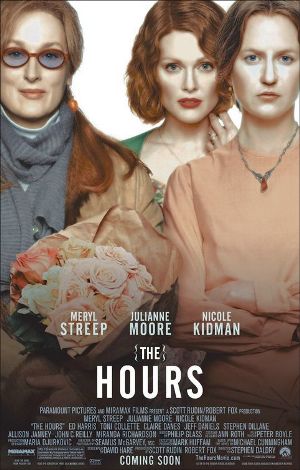
When I saw the poster for this movie, my first thought was, “Wait. It says Nicole Kidman is in this movie, but none of those three women are Nicole Kidman. Why isn’t she on the poster, and why doesn’t the third lady on the poster get higher billing?” So I looked it up on IMDb and realized that the makeup people did an amazing job; they managed to make Nicole Kidman look frumpy.

So what’s the story? Three different women from three different time periods have three parallel days that are all connected by parties, mental illness, and Virginia Woolf’s novel Mrs. Dalloway. I realize that doesn’t sound terribly exciting, but it’s a hard movie to sum up.

The Good: Like I said earlier, the makeup artists were amazing. They did a good job making Nicole Kidman look like Virginia Woolf, but they also did a fabulous job of aging Julianne Moore fifty years. Apparently, they weren’t eligible for an Oscar because a little bit CGI was used to make Nicole Kidman’s false nose look flawless, but still. Major kudos to them.

Major kudos also goes to the editors. The director is telling three different stories, but he jumps around from story to story often. The editing had to make that feel seamless and show the parallels in the different stories. It was very well done.

The soundtrack was beautiful, a lovely piano score. I thought it sounded very similar to the music from The Truman Show; sure enough, Philip Glass did the scores for both. But even though it wasn’t the most original, it was so lovely that it made me want to find some sheet music and learn it.

The acting was excellent. Nicole Kidman completely inhabited Virginia Woolf. Julianne Moore played a frustrated 1950s housewife, and Meryl Streep gave a moving performance as the woman of today (or 2001. But that was today when the movie was made.). John C. Reilly played Moore’s incredibly devoted husband, and Ed Harris was a poet dying of AIDS, a former lover of Meryl Streep’s character. Miranda Richardson felt completely natural as Virginia Woolf’s sister Vanessa.

The Bad: This movie is based on a book (which I haven’t read, so I can’t compare anything), and it shows. All three main character women spend a lot of time staring into space. I’m sure that in the novel, they are having deep thoughts, but those thoughts don’t always make it across on the screen. That got annoying.

I also felt like the three stories didn’t fit together as well as they should. Meryl Streep’s character had many parallels to Mrs. Dalloway, even down to the names, and her story dovetailed neatly with Julianne Moore’s, but the only connection that Julianne Moore had to Virginia Woolf was that she was reading Mrs. Dalloway, and I wanted it to be better than that.

The Ugly: Confession time: I struggle with depression. I have been suicidal in the past. I am a woman who doesn’t quite fit in her society. And even with all that, I never felt a deep connection with this movie. Maybe it was because we couldn’t get a deep look at these women’s inner thoughts, but it felt so shallow. The only woman I really felt like we got a good, sympathetic look at was Virginia Woolf; I would have happily watched an entire Virginia Woolf biopic starring Nicole Kidman and Stephen Dillane because they were the only very well-developed characters. That shouldn’t happen in a character-driven movie.

Oscars Won: Best actress in a leading role (Nicole Kidman).

Other Oscar Nominations: Best picture; best actor in a supporting role (Ed Harris); best actress in a supporting role (Julianne Moore); best director; best writing, adapted screenplay; best costume design; best film editing; best music, original score.

Gangs of New York (2002)

gangsofnyDirected by Martin Scorsese

There were two discs in the DVD case when I picked this movie up from the library, but I figured that one was the movie and one had special features like most DVDs do. Nope! I was wrong. For whatever reason, this movie is spread over two DVDs, with parts of the movie and special features on both discs. Yes, Gangs of New York is a long movie, but it’s shorter than Saving Private Ryan and The Thin Red Line, and they each managed to be on one disc. I kind of get the feeling that whoever made that decision wanted to make the movie feel more epic, but it really just made it seem long.

So what’s the story? In New York City in 1846, two rival gangs battle it out for supremacy. Bill the Butcher, the leader of the American-born Natives, kills the Priest, leader of the Irish Dead Rabbits. Sixteen years later, Amsterdam, the son of the Priest, comes back for revenge.

The Good: The set direction was fabulous. Every little detail combined to make me feel like I had been transported back to the 1860s. I thought the costume design was good, too, but this movie made me realize that I know very little about historical clothing when it comes to the poor, so I could be wrong on this one. But I can’t imagine anyone would put men in those ridiculously ugly plaid trousers unless it was accurate.

The story was good one. Revenge plots are always exciting, and there were some good moments where Amsterdam struggled between admiration of Bill the Butcher and his desire for revenge.

The best acting in the movie was done by men in supporting roles. The standout actor was Brendan Gleeson. He didn’t have a lot of screen time in his role as an Irish mercenary unaffiliated with any gang, but he played his part so convincingly. His scenes were among the best in the movie. Jim Broadbent as real-life corrupt politician Boss Tweed was hilarious, and Gary Lewis made a very intense Irishman in the wrong gang. The only lead actor who did a very good job was Daniel Day-Lewis. His performance was sometimes over the top, but so was his gang-leader character, so it worked.

The Bad: Leonardo DiCaprio. His acting wasn’t terrible all the time, but his Irish accent came and went, especially when he narrated. Were there no actors that were actually Irish that could have played the part? It would have helped a lot.

The story followed Amsterdam as he followed his plan to get revenge on Bill the Butcher. Everything led up to that, and then the climax was actually about the New York City draft riots of 1863. Yes, the draft and the dissatisfaction of the poor people about it were touched on throughout the movie, but not enough for it to be the climax. I thought that that was kind of sloppy storytelling. Also, sixteen years after 1846 would have been 1862, not 1863, so they got their year wrong, too.

Also, what were so many Chinese people doing in New York in the 1860s? Especially Chinese women? That rang false. I wouldn’t be surprised to see Chinese immigrants on the West Coast at the time, but I don’t think there were very many in New York.

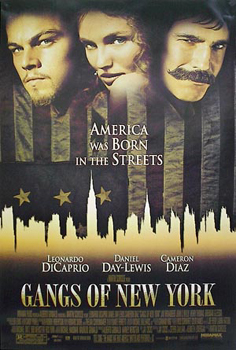
The Ugly: When I told my younger brother about my quest to watch these movies, he said he’d seen some nominees from 2002 and that Gangs of New York was a pretty good movie – except Cameron Diaz ruined it. Now that I’ve seen it, I have to agree. I feel like Amsterdam was so focused on revenge that he wouldn’t have the emotion left over to fall in love. If he did fall in love, it would have to be with someone amazing. Cameron Diaz never made me feel like Jenny Everdeane was anything special. She spent most of the movie looking either smug or confused. Maybe another actress could have done a better job, but since Cameron Diaz was chosen, that part of the story should have been left out altogether.

Speaking of leaving things out…This movie is almost three hours long, and I felt every second of it. It actually took me over four and half hours to watch because I kept falling asleep and having to find my place again. Granted, I had a cold, but still. Other three-hour movies have managed to keep my attention. Saving Private Ryan is actually a little bit longer than Gangs of New York, but I was surprised to find that out because the time flies by in Saving Private Ryan. I’m not asking for non-stop action; I like character development and plot intricacies. But this movie had too many scenes that didn’t move the action along or even really develop the characters. It needed to be cut down.

Oscars Won: None

Oscar Nominations: Best picture; best actor in a leading role (Daniel Day-Lewis); best director; best writing, original screenplay; best cinematography; best art direction – set direction; best costume design; best film editing; best sound; best music, original song (“The Hands That Built America”).

In the Heat of the Night (1967)

In_the_Heat_of_the_Night_(film)Directed by Norman Jewison

I have a hard time sitting still and doing nothing when I watch movies. I get kind of antsy unless I have another project to occupy my time, so I’ll paint my nails or play a game on my phone or crochet a hat while the movie plays in the background. But doing this project has forced me to change all that. If I want to appreciate good acting or interesting camera work or immerse myself in another time through excellent production design, I have to give the movie my full attention. The first time I watched In the Heat of the Night, I was messing around on my computer. I thought it was a good movie, an interesting movie, but not that great. Then I watched it again on my big TV instead of my little computer screen, and I didn’t do anything but watch the movie. I was blown away. It was a totally different experience, and I understood the (well-deserved) acclaim.

So what’s the story? Late one summer’s night in Sparta, Mississippi, a police officer finds the murdered body of a prominent man lying in the street. The police start searching for the murderer, and they soon find and arrest the perfect suspect: Virgil Tibbs, a black man who is sitting in the train station. However, Virgil says he’s not a transient or a criminal, but a police officer from Philadelphia; he was just waiting for his train home. Sheriff Gillespie, the head of police in Sparta, calls Philadelphia to verify this, and the police chief in Philadelphia tells Gillespie that Tibbs is the best homicide detective in Philadelphia and that Tibbs should help on the case. None of the (white) police officers in Sparta want to accept help from black man, but the widow of the murdered man insists that Tibbs remain on the case. Tibbs and Gillespie now have to overcome their prejudices to work together to solve the murder.

The Good: I always seem to start with the acting, but I think that’s because bad acting ruins a  movie so quickly. There was some good acting here. Rod Steiger won an Oscar for his portrayal of Gillespie. I wasn’t completely convinced that he deserved it over Spencer Tracy in Guess Who’s Coming to Dinner until the scene where the four thugs have cornered Tibbs in the warehouse. At that point, something clicked for me, and I realized what a truly stellar job he was doing. Sydney Poitier is excellent as he always is as Virgil Tibbs. Lee Grant plays the widow; she isn’t in the movie much, but she commands every scene she’s in. Her heartbreak when she’s told of her husband’s death is so painful that it’s difficult to watch.

The story here is excellent. It’s based on a novel that I haven’t read, so I’m not sure what’s been changed and what was original, but it makes a great movie. I love how well-developed all the characters are. It would have been so easy to make Tibbs perfect, but he has his flaws, too, which are shown when he fixates so strongly on a suspect (who is admittedly a terrible person) that he loses all perspective on the case. The story and screenplay are so well done. And this movie gave us a classic line: “They call me Mr. Tibbs!”

The cinematography was interesting. I loved the part where Tibbs is examining the body. The camera cuts to his hands to show his skill and confidence as he explains what he will need to do a proper examination. The camera focuses hands in another scene, too. When Tibbs and Gillespie are going to go visit the wealthy cotton planter, they drive past a field of cotton being picked by black workers. Here, the camera’s focus serves to contrast Tibbs’s job and skills with those of the workers. If Tibbs had lived here, it seems to say, this is what he might be doing. At other times, the cinematography feels almost musical. As the cameraman zooms in on a fleeing suspect, for instance, it accentuates the tension almost like a crescendo in a piece of music. It adds a lot to the movie.

The Bad: The only thing that made this movie feel dated was the music. It just screamed the 1960s to me. It might have been groundbreaking at the time, but it feels very old-fashioned now.

The Ugly: The ugliest thing in this movie is the attitudes of the people, from the moment Tibbs is arrested because he’s an unknown black man to the climax where the thugs show up at Mama Caleba’s. But it’s this ugliness that allows the beauty of the eventual mutual acceptance and respect of Tibbs and Gillespie shine through.

Oscars Won: Best picture; best sound; best actor in a leading role (Rod Steiger); best film editing; best writing, screenplay based on material from another medium.

Other Oscar Nominations: Best director; best effects, sound effects.

Guess Who’s Coming to Dinner (1967)

guess-who's-coming-to-dinner-posterDirected by Stanley Kramer

This is one of the two movies that made me want to start this blog. I had never seen it before last summer. It was one that I had always wanted to see; I had even checked out the DVD from the library a couple of times. I just somehow never got around to watching it. But late one night, I was packing to go on a trip and was looking for something to play in the background while I packed. This movie happened to be streaming on Netflix at the time (although it’s not right now), so I turned it on. My packing didn’t get done until the next morning. I couldn’t tear myself away from this movie. Even though this is a quiet movie about one day in the life of one family, the tension is so great as we wait to find out the parents’ opinions that I couldn’t stop watching.

So what’s the story? Joanna Drayton comes home unexpectedly from Hawaii with a surprise: her new fiancé, Dr. John Prentice, who happens to be black. She is excited for her parents to meet him, and because they are liberals from San Francisco, she is confident that they won’t be upset at the prospect of a black son-in-law. But Joanna doesn’t know something: John has told her parents that if they don’t one hundred percent approve of the marriage, he will respect their opinion and not marry their daughter. Since John is flying to New York and then Geneva soon after, Matt and Christina Drayton only have a few hours to come to terms with this shift in their world.

The Good: There are so many good things about this movie that it’s hard to know where to start. We can start with the acting, I guess. It was a pretty small cast, and everyone was spot on. Sydney Poitier and Katharine Houghton (Katharine Hepburn’s niece) are the engaged couple. Real-life lovers Spencer Tracy and Katharine Hepburn are her parents; Roy Glenn and Beah Richards are his. Isabel Sanford plays Tillie, the Draytons’ maid, who disapproves strongly of the relationship. Cecil Kellaway is the Draytons’ family friend Monsignor Ryan, who strongly supports the couple and quotes the Beatles. Everyone is very believable as people who are blindsided by an unexpected situation.

The music really worked for me, too. Background music was used sparingly throughout the movie, which made it feel more real. After all, who really has their own theme song?

The cinematography was fairly straightforward, but because of this, the one time that anything was different really stood out. When Tillie is berating John for thinking about marrying above himself, the camera is at an angle, reflecting her anger and his bewilderment. It was a small thing, but it made an impact.

The Bad: I don’t like the scene where Matt and Christina go for ice cream. It just didn’t seem to fit in the movie somehow.

Joanna’s attitude annoyed me throughout the whole movie. While she obviously realizes that John is black, she doesn’t seem to think about what that means on a daily basis. She seems to have no idea of the ugliness that is racism. She apparently thinks that their love will be enough to protect them from prejudice. I can understand that she’s a young girl in love, but I feel like she has no understanding of what is waiting for her and John in their life together.

Also, no one raised any objection to the fact that Joanna is 23 and John is 37 and that they are getting married after having known each other only ten days. John’s race is a huge deal, but so is that age difference. I would be seriously worried if my daughter brought home some guy fourteen years older than her that she had known for ten days and said it was true love, but the only thing anyone worried about was the race issue.

The Ugly: There isn’t really any ugly in this movie. It’s a well-done intimate look at what happens to people when they are called upon to live up to the ideals that they’ve preached all their lives.

Oscar Wins: Best actress in a leading role (Katharine Hepburn); best writing, story and screenplay – written directly for the screen.

Other Oscar Nominations: Best picture; best actor in a leading role (Spencer Tracy, posthumously); best actor in a supporting role (Cecil Kellaway); best actress in a supporting role (Beah Richards); best director; best art direction – set direction; best film editing; best music, scoring of music, adaptation, or treatment.

The Graduate (1967)

the-graduate-poster1Directed by Mike Nichols

When I was a sophomore in college, my roommate and I were talking about movies late one night. I don’t remember how it came up, but I admitted that I had never seen The Graduate. She was shocked. “But Melanie,” she said, “you’ve seen every other old movie out there. How have I seen an old movie that you haven’t seen?” I didn’t want to admit to my more sophisticated roommate that I hadn’t ever watched it because I was so uncomfortable with the subject matter; I had no interest in watching a forty-something-year-old woman and a man in his early twenties have sex. Now that I’ve seen it, though, I’ve learned that I was worried about the wrong thing. Nothing explicit is shown. No, what did make me uncomfortable was how very awkwardly that young man handled the affair.

So what’s the story? Benjamin Braddock has just graduated from college and come home to California. On the night of his welcome home party, his neighbor Mrs. Robinson asks him to drive her home. Once there, she tries to seduce Ben, but he gets spooked and leaves. He can’t stop thinking about it, though, and phones her one night to ask if the offer is still open. They begin to have an affair. It’s all going well until Elaine Robinson, Mrs. Robinson’s daughter and Benjamin’s contemporary, comes home from Berkeley. At the insistence of his parents and her father, who is unaware of the affair, Ben takes her out. But now he has a new problem: he’s starting to fall in love with Elaine.

The Good: Dennis Hoffman is ridiculously awkward as Ben, and it was fun to see William Daniels (without his Bostonian accent!) as Mr. Braddock. But Anne Bancroft and Katharine Ross were the standouts for me. I had only seen Anne Bancroft do comedy before, so it was a revelation to see her as an unhappy, alcoholic predator. And Katharine Ross did wonders with the part of Elaine, a girl in a seemingly impossible situation.

The soundtrack is fabulous. It features several Simon and Garfunkel songs, including “The Sounds of Silence”, “Scarborough Fair/Canticle”, and (of course) “Mrs. Robinson”. Good stuff.

I feel like the cinematography is a standout, too. There are lots of interestingly-composed shots that add to the emotions of moments in the film.

Like Bonnie and Clyde, this movie has an excellent ending. It’s not exactly happy, but it’s not sad, either. It fits the mood and the theme of the movie perfectly.

The Bad: I know that Mrs. Robinson is the villain of the piece, but I wished I had gotten a better sense of her motives. Why was she seducing Benjamin? I understand that she was unhappy, but that didn’t feel like enough of a reason to seduce the son of your husband’s business partner. I would have been better convinced by the movie if I had had more of an understanding of her character.

The Ugly: I get embarrassed for people very easily, and there is a lot to be embarrassed about in this movie. Ben is just so awkward, especially at the beginning of the affair. He is so far out of his depth that it can be hard to watch. I’m pretty sure that that’s what the director was going for, and he definitely succeeded. But man. Sometimes I just want to shake Benjamin and say, “Ben! Stop trying so hard! Also get away from that crazy lady!”

Oscar Won: Best director.

Other Oscar Nominations: Best picture; best actor in a leading role (Dustin Hoffman); best actress in a leading role (Anne Bancroft); best actress in a supporting role (Katharine Ross); best writing, screenplay based on material from another medium; best cinematography.

Bonnie and Clyde (1967)

bonnie and clyde posterDirected by Arthur Penn

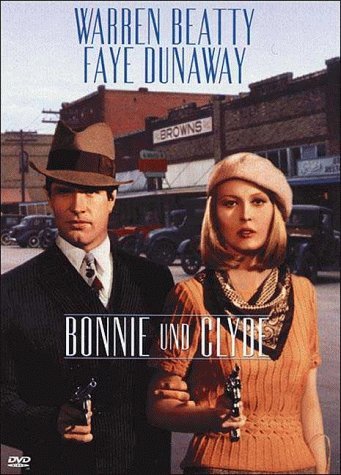
When I was growing up, my family had a book of pictures from classic Hollywood films. One of those pictures was from Bonnie and Clyde; it interested me because it was a picture of a girl with a great hat (that beret!) holding a gun standing in front of a cool old car. I wondered why she was doing that. Later on, I found out about the bank robbers from the 1930s, but still didn’t know very much about this movie going in.

So what’s the story? Bonnie, a young waitress in 1930s Texas, catches Clyde trying to steal her mother’s car one day. Rather than turn him in, Bonnie goes with Clyde into town. When Clyde points out to her that she hates her life and wants more, Bonnie decides to run away with him. They start robbing banks and stores together, always managing to keep one step ahead of the police. Clyde’s brother Buck and Buck’s wife Blanche come to visit and become part of the gang.

The Good: The cast was very good. I had never seen Faye Dunaway in anything. I knew her name, but I hadn’t ever seen any of her movies. She was fantastic as Bonnie. Estelle Parsons won an Oscar for her portrayal of Blanche, which I felt was well-deserved. She did a very good job as a woman who was not happy about associating with criminals at first, but then enjoying the lifestyle as long as the money came in. I grew up watching Gene Hackman in Hoosiers (often, because it was one of my dad’s favorite movies), so it was really fun to see him in such a different role.

The ending was one of the best endings I have ever seen. It wasn’t overdone or cheesy, which would have been easy to do. It was restrained and elegant instead. Perfect.

The Bad: The music got on my nerves. It was probably fairly authentic, but it felt more stereotypical to me – these were hicks from Texas, so they must listen to hick music.

Also, Faye Dunaway’s look was more 1960s than 1930s. I feel like that was a problem for a long time in historical movies, though, and everyone else looked right. I guess they just wanted the leading lady to look more glamorous than 1930s would have allowed.

The Ugly: I had no emotional connection to this movie. I understand feeling stifled by society’s expectations and wanting a bigger life, but going on a crime spree is not a good way to break out of the oppression of everyday life. The Barrow Gang killed lots of innocent people and stole from others. I know it was the Depression and money was scarce, but I’m sure the small town grocers they robbed were struggling, too. I felt no sympathy for Bonnie and Clyde whatsoever, and I hate that this movie made them seem almost noble for what they did.

Oscars Won: Best actress in a supporting role (Estelle Parsons); best cinematography.

Other Oscar Nominations: Best picture; best actor in a leading role (Warren Beatty); best actress in a leading role (Faye Dunaway); best actor in a supporting role (Gene Hackman); best actor in a supporting role (Michael J. Pollard); best director; best costume design; best writing, story and screenplay – written directly for the screen.