I'd like to spank the Academy

Archive for the ‘Best Picture’ Category

The 25th Academy Awards: My Verdict

The 25th Academy Awards were delightfully controversial. I like it when the Academy gets things wrong, because it gives me more to write about. And who doesn’t like a good gripe session? That’s one of the best things about award season: complaining that the judges got it wrong.

So what went wrong this time? Well, the movie from 1952 that has emerged (or perhaps endured) as a classic of American filmmaking wasn’t even nominated for best picture. It was only nominated for two Oscars at all: best supporting actress and best musical scoring. What is this icon that the Academy almost completely overlooked? Singin’ in the Rain. Yep, Gene Kelly’s classic musical about Hollywood got no recognition in its time. And yet Ivanhoe was nominated for best picture. I will never understand how the Academy works.

The winner for best picture is equally puzzling. The Greatest Show on Earth isn’t a bad movie, but it’s definitely not best picture-worthy. Every other nominee that from that year (with the exception of Ivanhoe) is a better movie than The Greatest Show on Earth. I would have voted for High Noon myself. Even if Singin’ in the Rain had been nominated, I still would have voted for High Noon. Why? Because it’s got so much depth to it. It’s about standing up for what’s right, even if you have to stand alone. Apparently, this was not a message that went over well in Hollywood during the McCarthy hearings, and the writer of the film was blacklisted (and eventually moved to England). That explains why it didn’t win best picture, but it’s doesn’t excuse the Academy for being so very, very wrong.

A third odd thing about these awards is that the movie that won the most Academy Awards wasn’t even nominated for best picture. The Bad and the Beautiful won awards for best supporting actress (Gloria Grahame, who was also in The Greatest Show on Earth that year), screenplay, costumes, and cinematography, and Kirk Douglas, the star, was nominated for best actor. It’s another movie about Hollywood. The Academy currently loves movies about Hollywood. (Birdman and The Artist are two recent films about show business that won best picture.) They must not have been as interested in movies about themselves as they are now, but it really surprises me.

Some awards make complete sense to me. Gary Cooper completely deserved his Oscar for his work in High Noon, and the editing of High Noon was excellent, also. The Quiet Man had beautiful cinematography, and the costumes and art direction of Moulin Rouge bring Paris to life. John Ford did some good directing in The Quiet Man.  On the other hand, I cannot for the life of me understand how The Greatest Show on Earth won for best screen story; it’s a very typical story, and kind of blah. But I haven’t seen any of the other movies that were nominated for that particular award, so it may actually have been the best that year. I also am strongly against the song “High Noon (Do Not Forsake Me, Oh My Darlin’)”. There are parts that are not horrible, but rhyming “his’n” and “prison” should automatically disqualify you from receiving an Oscar.

I’ve always felt that the Academy Awards should be free from politics. Even if the Academy doesn’t like the message of the movie, greatness should be recognized. The Academy failed in 1952 for the worst of reasons. I hope they have learned from that and voters in the future will refuse to be swayed from voting for the best because of how they think they “should” vote.

So how do I rank the nominees?

5. Ivanhoe
4. The Greatest Show on Earth
3. Moulin Rouge
2. The Quiet Man
1. High Noon

Join me next week for Paul Newman, politics, crossdressers, and aliens!
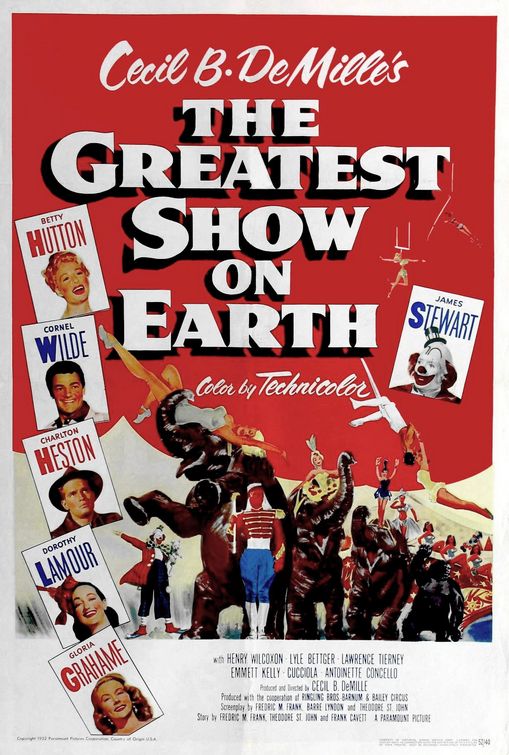
The Greatest Show on Earth (1952)

the_greatest_show_on_earth_posterDirected by Cecil B. DeMille

I have only been to the circus once. I was two, I think. The only thing I remember about the circus is the elephants coming in to the ring; that’s all. Because I have so little circus-watching experience, I wasn’t sure what to expect from this movie. I was glad I didn’t have high expectations, because I was able to enjoy it, even though it has its ups and downs.

So what’s the story? The Ringling Brothers-Barnum and Bailey Circus is not doing well. People just don’t want to come to the circus anymore. The backers don’t want to do a full season. Brad, the circus manager, gets them to promise that the circus will stay out as long as they stay in the black. To do this, he hires Sebastian, a famous trapeze artist. This makes unknown, but excellent, trapeze artist Holly angry, because she wanted to be in the center ring. She decides to prove to Brad and Sebastian that she is the best.

The Good: The circus is amazing. I kind of wish Cecil B. DeMille had just made a documentary about the circus and the real circus performers, because the story wasn’t all that interesting. I would have loved to know how people got involved in the circus, how they learned to do some of the incredible things they do, if they would ever consider leaving the circus. The circus was truly the best part of the movie.

The cinematography was well done. It had to be in order to capture the feeling of the circus, the size and the noise and the color and the bustle and the amount of work it is to put a circus on.

Gloria Grahame is fantastic as Angel, a “sadder but wiser” circus performer who loves Brad, but isn’t sure that he will love her back because of her past. Charlton Heston (whom I did not recognize in normal clothes and a hat) is very good as Brad, the manager who will do anything to keep the circus going. Cornel Wilde is charming as the playboy performer Sebastian. It’s always nice to see Jimmy Stewart, even though his role as the clown with a mysterious past isn’t very large. His little dog is adorable, too. Lyle Bettger was good as the Angel-obsessed Klaus. And it is fun to see famous circus people like John Ringling North and Emmett Kelly doing their thing.

The Bad: I did not like Betty Hutton, who played Holly. She was more annoying than anything. Apparently, she was a famous singer at the time, but her acting skills could have used some work.

Since I grew up watching The Ten Commandments, I’m used to Cecil B. DeMille narrating with great weight about serious subjects. It was really odd to hear him narrating about the circus. It wasn’t necessarily bad, per se, but it was really weird for me. It probably wouldn’t bother someone who isn’t familiar with DeMille’s voice.

The Ugly: The story is really weak and not particularly interesting. How the writers managed to win an Oscar for best story is beyond me. It must have been a weak year for that award.

The train wreck at the end was probably good for its day, but it doesn’t hold up well. Klaus is obviously sitting in front of screen when he’s supposedly on the tracks. I try not to let that kind of stuff get to me, but sometimes it does. This is one of those times.

Oscars Won: Best picture; best writing, motion picture story.

Other Oscar Nominations: Best director; best costume design, color; best film editing.

74th Academy Awards: My Verdict

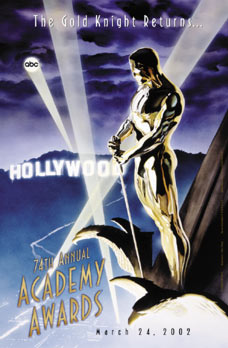
74_academy_awards_posterI don’t have much to say about the 74th Academy Awards. The Oscars were quite spread out that year. No movie won more than four awards, and based solely on what I’ve seen, I feel like the awards went to people who deserved them. I would have picked Helen Mirren in Gosford Park over Jennifer Connelly in A Beautiful Mind for best supporting actress, but that’s just my preference. Jennifer Connelly didn’t do a bad job, and I’m not upset that she won. I just would have voted for Helen Mirren. I feel the same way about the award for best makeup. While A Beautiful Mind had fabulous aging makeup and the makeup in Moulin Rogue! was so good I didn’t even recognize Jim Broadbrent, The Fellowship of the Ring would have deserved best makeup just for the Hobbit feet.  I guess there were a lot of technically proficient movies made in 2001. The biggest thing I learned from this year is that I need to watch more movies, because apparently five a week isn’t enough. After watching Russell Crowe’s fabulous performance in A Beautiful Mind, I don’t understand how anyone else could have won best actor. On the other hand, I haven’t seen Training Day; maybe Denzel Washington’s performance is just as amazing. Not having seen all the movies makes it really hard to judge whether or not the Academy got it right. I guess I will just have to content myself with saying that Russell Crowe gave the best performance that I saw from the movies that year.

Man, it is really hard to write my opinions when I feel like the Oscars went to the right people. Controversy makes for much better blogging.

So how do I rank the nominees?

5. Moulin Rogue!
4. The Lord of the Rings: The Fellowship of the Ring
3. In the Bedroom
2. Gosford Park
1. A Beautiful Mind

Look, they’re in alphabetical order! That pleases my librarian mind to no end.

Join me next week for gunfights, boxing matches, nightclubs, jousting tournaments, circus performances, and actual controversy in the awards!

A Beautiful Mind (2001)

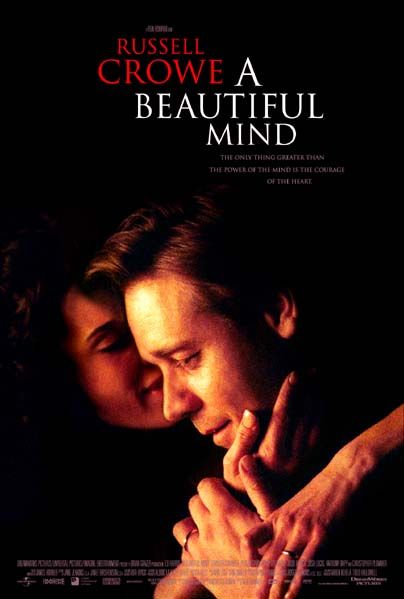
beautiful mindDirected by Ron Howard

It was late the night I put this movie in the DVD player, and I wasn’t going to watch the whole thing. But even though it’s not the most action-packed movie ever made, A Beautiful Mind is an extremely gripping movie. As it got later and later (or earlier and earlier in the morning), I kept thinking, “I should really turn this off and go to bed,” but I just couldn’t. I needed to know what happened to John Nash.

So what’s the story? John Nash is a genius mathematician from West Virginia. He doesn’t fit in with all the other Princeton graduate students, mostly because he is completely asocial. He makes a great mathematic breakthrough and gets a job at MIT with the Department of Defense. He meets and marries Alicia, but the top-secret decryption project he’s working on suddenly takes a dark turn.

The Good: The acting was superb. I haven’t seen a lot of Russell Crowe’s movies, and I wasn’t expecting much from him in A Beautiful Mind, mostly because what I’ve seen him in lately is clips from Les Miserables (no, I haven’t seen the whole thing yet, because I don’t want to watch it). Anyway, Russell Crowe became John Nash. I’m always impressed when actors can play a person with a mental disability without overacting. I loved his performance. The supporting cast was great, too. Paul Bettany as Charles, John’s crazy-fun roommate; Jennifer Connelly as John’s wife, Alicia; Ed Harris as John’s government contact; Adam Goldberg, Josh Lucas, and Anthony Rapp as John’s mathematician colleagues; and Christopher Plummer as Dr. Rosen, John’s psychiatrist are all wonderful. I don’t think any of the roles could have been easy to play, but all of the actors did very well.

The costume design was well done, especially since the year in which something happened was rarely given. The clothes were a clue to how many years had passed, and I was very thankful for that. The makeup was good, too. The stars were aged well. I didn’t much care for John Nash’s old look, but that’s because he looked uncomfortably like someone I know, and I couldn’t get past that. But everyone looked definitely, believably older (unlike the people in Giant, which is still my baseline of terribleness when it comes to aging in movies).

The screenplay was good. John Nash’s story could not have been an easy one to tell without giving too much away, but the writers did an excellent job.

The Bad: The music was beautiful, but there were some moments when James Horner copied his own music. At the very beginning of the movie, the music sounded exactly like the music from Sneakers, which I wasn’t even aware James Horner had scored. I had to look it up to be sure. Later on, there are bits from Titanic, which has a brilliant score. It makes me sad that someone who is as obviously talented as James Horner reuses his own stuff.

The Ugly: There wasn’t anything ugly in A Beautiful Mind. It’s a well-made movie that takes a hard topic and treats it sensitivity and tact. Ron Howard deserves major kudos for this movie.

Oscars Won: Best picture; best actress in a supporting role (Jennifer Connelly); best director; best screenplay, screenplay based on material previously produced or published.

Other Oscar Nominations: Best actor in a leading role (Russell Crowe); best film editing; best makeup; best music, original score.

The 21st Academy Awards: My Verdict

jane wyman

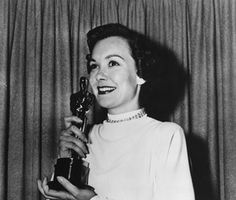
Jane Wyman with her Oscar for Best Actress.

Here’s an interesting fact: if you push “save draft” instead of “publish,” your blog post does not show up on your blog. Crazy, right? So I apologize that this post didn’t show up a couple of weeks ago when I reviewed the movies from 1948. I’m also sorry that I’ve been AWOL in general; I got bit by an organizing bug and started cleaning my house. That never happens, so I had to take full advantage of it. But I’m back on track for the coming week, and hopefully I will be able to get back in my blogging groove. So without further ado, I present the 21st Academy Awards.

One thing that I love about doing this project is that I get to see a lot of movies that I’ve been meaning to watch, but have never gotten around to. But it’s sad, too, because some of those movies that I want to watch and expect to be watching (mostly because they’re so famous) turn out not to have been nominated for best picture. For 1948, those movies include Key Largo, I Remember Mama, and Joan of Arc with Ingrid Bergman. I will still probably watch them someday, but it makes it easier if I have an excuse.

Well, I’m going to dive right in and say that I have no idea why Hamlet won best picture. It’s a fine movie, albeit kind of boring, but I would say that Johnny Belinda, The Treasure of the Sierra Madre, and The Snake Pit are all much better movies. Plus, they’re not boring. Maybe everyone thought that if they didn’t vote for a classic Shakespeare directed by Sir Laurence Olivier, a classic Shakespearean, it meant that they were all boorish hicks who didn’t know great art when they saw it. I don’t know. Whatever reasons the Academy members had to vote for Hamlet that year, they were wrong; it was not the best picture of 1948.

Having said that, I feel like I should say that Hamlet isn’t a bad movie. It has its high points; Laurence Olivier is definitely a high point. He is truly fantastic as Hamlet (except for the blond hair, which looks too unnatural) and completely deserved his best actor Oscar. I think it would have been a hard year to choose acting awards, though. There were many good performances across all the movies.

I do find the lack of nominations for The Treasure of the Sierra Madre interesting. It had many good elements, like cinematography, art direction, and music, that weren’t even nominated. Humphrey Bogart should also have been nominated for best actor. I feel like The Treasure of the Sierra Madre got snubbed in lots of categories. Admittedly, I haven’t seen all of the movies that were nominated for all the awards, but I find it hard to believe that there were that many movies that were that much better than The Treasure of the Sierra Madre in so many categories. But I am glad that John Huston won best director; he deserved it.

John Huston must have been crazy-busy for a couple of years leading up to 1948. He not only wrote, directed, and appeared in The Treasure of the Sierra Madre, but also wrote and directed Key Largo. I’m not sure how he did that, but it was an impressive feat. I can barely find time to work one job, watch a few movies a week, and keep my house in a semi-clean condition. There’s no way I could write and direct one classic movie, let alone two. He had serious talent.

1948 was an interesting year for nominees because two of the movies dealt with serious contemporary issues: mental illness and rape. Those are still serious issues, and movies about those topics are still rare. I was really impressed that the people working on The Snake Pit and Johnny Belinda were brave enough to tackle those topics.

How do I rank the nominees?

5.The Red Shoes
4.Hamlet
3.The Snake Pit
1.Johnny Belinda and The Treasure of the Sierra Madre(tie)

Why the tie? Both movies are so good in their different ways that I couldn’t put one above the other. Fun fact: They tied for best motion picture-drama in the Golden Globes that year. I think the Globes did a better job picking than the Academy that year.

Hamlet (1948)

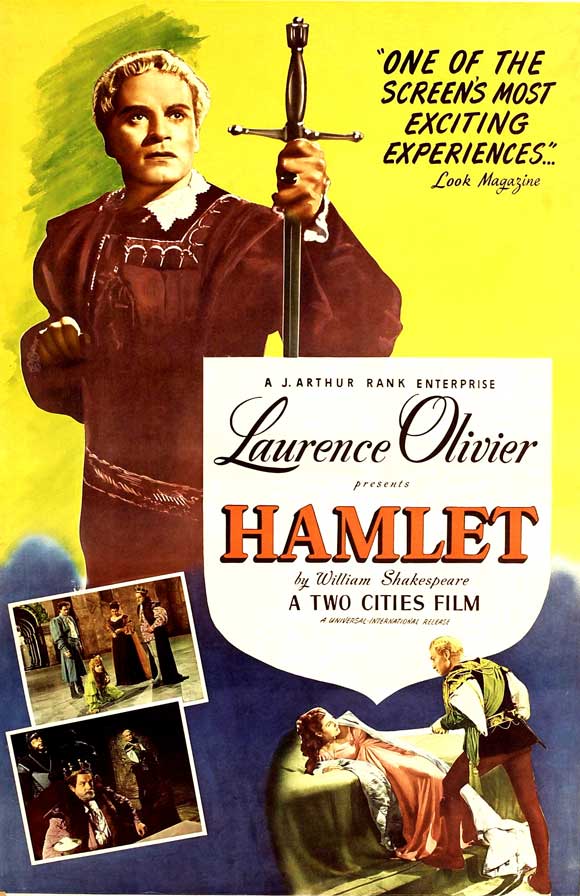
laurence_olivier_hamlet_movie_poster_b_2aDirected by Laurence Olivier

There are lots of versions of Hamlet. Kenneth Branagh starred in one; so did Ethan Hawke. David Tennant and Patrick Stewart did an excellent Hamlet onstage a few years ago that was made into a Masterpiece Theatre production. Even Mel Gibson has played Hamlet. And those were all made in the last twenty years or so. There are so many others. Why is Hamlet so popular? I’m guessing because it’s a great story. It’s so psychologically dramatic, and it has the potential to have some really great moments. I like Hamlet. I like Shakespeare in general. I think there’s a reason why his plays have been celebrated for the past 400 years. And yet, I found this production dull. It has all the ingredients for greatness, but it somehow misses the mark.

So what’s the story? Prince Hamlet is depressed and reeling. His father died not long ago, and his mother is already remarried—to Hamlet’s uncle, Claudius, his father’s brother. It only gets worse when the ghost of his father appears and tells Hamlet that he didn’t die of natural causes; Claudius murdered him. Hamlet’s father gives Hamlet a mission – avenge his death.

The Good: The acting is excellent. I’m guessing (because I haven’t done the research) that many of the actors and actresses were well-trained stage actors. They all do a wonderful job. Laurence Olivier has some good moments as Hamlet. Jean Simmons does crazy beautifully as Ophelia. Felix Aylmer is appropriately stuffy and self-important as Polonius. Eileen Herlie shows sorrow, remorse, and confusion as Queen Gertrude. Norman Wooland is a sensitive Horatio. Plus this movie has nerd cred. Patrick Troughton (aka the Second Doctor), Peter Cushing (Grand Moff Tarkin and Doctor Who),  and Christopher Lee (Saruman and Count Dukoo) all have small roles. It’s kind of fun to pick them out.

The costumes are beautifully sumptuous. It’s almost enough to make me want to be a noble in Denmark in the Middle Ages. (Or at least in Laurence Olivier’s Middle Ages. Because I’m not sure on the accuracy of the costumes. But they are gorgeous.)

The Bad: In all the other versions of Hamlet I have seen, the filmmakers take advantage of the fact that they although they are making a movie based on play, they don’t have the constraints of a play; they don’t have to shoot on a stage, but can move outside or shoot on location or do anything their imagination tells them to do. In this Hamlet, I felt like I was always looking at a stage set. It wasn’t particularly impressive.

I will probably never say this about a movie again, but it needed more music. I’m usually a fan of restraint in movie soundtracks, but I think more music would have helped it feel less stark and dull. Don’t get me wrong; the music itself isn’t bad. It’s quite good, in fact, but there should have been more to help the movie along.

While Laurence Olivier is a great actor, and he did a marvelous job in the role, I feel like he was too old to make a convincing Hamlet at that point in his life. It might have worked on stage where the audience doesn’t get any close-up views of him, but his age shows in the film. Also, he does not make a convincing blond.

The Ugly: It is so boring. I can’t put my finger on what makes it that way, but I had to rewind at least five times because I kept falling asleep. I wasn’t mentally captivated by this film. It was a fine film, but it didn’t stand out in a particularly memorable way.

Oscars Won: Best picture; best actor in a leading role (Laurence Olivier); best art direction-set decoration, black-and-white; best costume design, black-and-white.

Other Oscar Nominations: Best actress in a supporting role (Jean Simmons); best director; best music, scoring of a dramatic or comedy picture.

Fun fact: I didn’t plan it this way, but today is actually Laurence Olivier’s birthday. Happy 108th birthday, Mr. Olivier!

The 45th Academy Awards: My Verdict

45th_Academy_AwardsAll I can think to say about the 45th Academy Awards is: What were they thinking? Some of the awards and nominees are so odd. So many people were put into the wrong category. For example, while Paul Winfield did an excellent job as the father in Sounder, he wasn’t in most of the movie. I would have thought he belonged in the best supporting actor category. And frankly, The Godfather is not about Vito Corleone, but about Michael. Al Pacino should have been nominated for best actor, not best supporting actor (Al Pacino thought so too, and didn’t attend the ceremony out of protest). I understand that Marlon Brando was an established actor, but his role in The Godfather was a supporting role, and that’s where his nomination belonged. I also felt that the man who actually won for best supporting actor didn’t even deserve to be nominated. Joel Grey did a fine job singing and dancing in Cabaret, but he didn’t appear outside of his cabaret performer makeup. He was only shown onstage at the Kit-Kat Club. We know nothing of his character’s life, backstory, anything. I just don’t understand that nomination. If the Academy wanted to award great singing and dancing, then that’s fine. But the award is called “Best Actor in a Supporting Role,” not “Best Singer and Dancer”. And if they did want to give an award for a singer in a supporting role, I would have nominated John Cullum for his role as Edward Rutledge in 1776. He not only sings, but he also acts. Maybe I’m just not as good a judge of acting as I thought I was, but the nomination (and win) of Joel Grey is truly puzzling to me.

I will admit right here that 1776, although a musical, is one of my favorite movies. I could watch that movie over and over and be happy about watching it every time. I love the songs and the music and actors. The costume design is fantastic, too. And yet it was only nominated for one Oscar – cinematography. That also confuses me. 1776 does have a couple of flashy cinematographic moments, but overall, it doesn’t compare to the cinematography of The Godfather or Deliverance, neither of which were nominated. Cabaret won for cinematography, which is odd. It didn’t have bad cinematography, but it wasn’t nearly as impressive as The Godfather.

Actually, I’m just now realizing that of the awards that I feel able to judge, the only awards I would have given to Cabaret are best actress and best film editing. Liza Minnelli was admittedly fabulous as Sally Bowles, and I liked the way they cut between the musical numbers in the Kit-Kat Club and Sally’s real life. It was effective. But I would have given best director to Francis Ford Coppola for The Godfather over Bob Fosse. I can’t judge best sound, and I have no clue whatsoever what “Best Music, Scoring Original Song Score and/or Adaptation” means. I know that the number of Academy Awards won does not necessarily correlate with how good a movie actually is, but I feel like The Godfather got a little shafted. It only won three awards to Cabaret’s eight.  At least the Academy got one award right – The Godfather truly deserved its best picture win.

How do I rank the nominees?

5. Deliverance
4. Sounder
3. Cabaret
2. The Emigrants
1. The Godfather

Join me next week for reviews of dramas about murder, rape, mental illness, and ballet!

The 80th Academy Awards: My Verdict

AcademyAwards-2008As much as I love old movies, the best thing about 2007’s best picture nominees as compared to those from 1956 is that I didn’t have to watch any three-hour epics, let alone three. It was kind of a relief.

Anyway, aside from all being mercifully short (at least comparatively), the movies from 2007 are kind of a mixed bag. There’s a period romance, a quirky independent comedy, a cerebral mystery, a period drama, an extremely violent period thriller. Okay, so three of the five movies are period movies based on novels, but they are all very different, which made for a very fun viewing week. It also made for an interesting year at the Oscars, because the awards themselves were spread out. The movie that won the most Oscars (No Country for Old Men) only won four. There was no one movie that was clearly better than all the others; on the other hand, none of the nominees were unworthy. There were five very good movies all nominated for best picture in 2007.

2007 is actually a year that I wish that there would have been a couple of ties. Javier Bardem was so good in No Country for Old Men, and he totally deserved recognition for his acting, but I wish Tom Wilkerson had also won for Michael Clayton. He also did an amazing job. I know, I know, ties are rare, but they can happen. I feel the same way about Tilda Swinton and Saoirse Ronan. They were both fantastic, and I wouldn’t have been able to pick one if I had to vote. Actually, no, I might have voted for Saoirse Ronan just because if she hadn’t done as well as she did, Atonement would have been ruined, but Michael Clayton wouldn’t have suffered as much if Tilda Swinton had been a little bit off her game. But still. They were both amazing performances. I’m actually a little bit sad that the movies that were nominated for best picture didn’t get more acting nominations. I like it when I’ve seen all the performances; then I feel like I can really have an opinion on whether or not the right actors got them. Sadly, in this year of male-centric movies, I missed a lot of the acting nominees. If I could somehow make this blog my full-time job, I might be able to watch all the movies that were nominated for an award, but alas. It is not to be.

The one random winner that I am going to mention is the winner for best original song. I remember when I watched the Oscars in 2007 that I was sad that none of the songs from Enchanted won. But just recently, I discovered the song “Falling Slowly” from the movie Once. I don’t remember how I happened upon it, but it is a beautiful song. While all the songs from Enchanted are cute songs, “Falling Slowly” is a truly wonderful song. If you don’t know it, go find it and listen to it. It’s great.

I’m having a really hard time putting the movies in order this time around. I thought all of them were really good. So know that my rankings below might be different if I were doing them at a different time of day or if I were in a slightly different mood:

5. Atonement
4. Michael Clayton
3. Juno
2. There Will Be Blood
1. No Country for Old Men

And just because I ranked No Country for Old Men in the number one spot doesn’t mean it’s a movie I would like to watch over and over again. It’s fantastic, but I don’t think I could sit through it again. Ugh. It’s hard to justify my own rankings sometimes. But that just feels right.

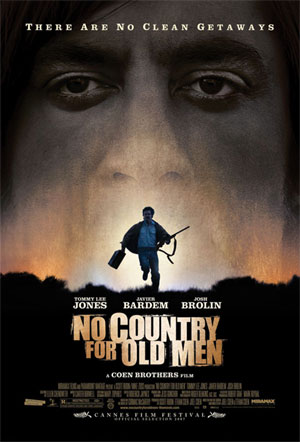
No Country for Old Men (2007)

No_Country_for_Old_Men_posterDirected by Ethan Coen and Joel Coen

I know it’s been a little while since I’ve posted, and I feel very bad about that. I know I left all my adoring fans hanging in 2007 (hahaha! Look at me, pretending I have fans!), but writing when you have a fever rarely produces anything that makes any sense, let alone anything readable. So in the future, I will attempt to not get sick until I’ve posted an entire week’s worth of reviews so that you, my loyal readers, will not be left without my wisdom.

I knew two things about this movie before I watched it: 1) It was based on a book by Cormac McCarthy and 2) It was a Coen brothers film. And this time, I was right on both counts! This movie makes a lot more sense for the Coen brothers. Although it’s a drama, it still has enough quirky characters and funny lines to bring that Coen brothers feel to it. Of course, that makes me extremely curious about the book that it’s based on. Does it have that same quirky feeling to it? Maybe one day when I have time in my life, I will find out.

So what’s the story? One day while he is out hunting (or poaching, maybe?) in the desert, Llewelyn Moss stumbles across the bloody aftermath of a drug deal gone wrong. He finds a case containing two million dollars, and instead of reporting it to the police, he decides to keep the money and run. Because he leaves his truck at the scene, he is soon being pursued by both the county sheriff and a psychopathic killer who works for the drug lord.

The Good: It’s extremely well-acted. Josh Brolin is Llewelyn Moss, a Vietnam veteran who wants more in his life. Tommy Lee Jones plays Ed Tom, the county sheriff who just can’t understand the mindless violence that has entered his life. And Javier Bardem won an Oscar for his portrayal of Anton Chigurh, the incredibly scary psychopathic killer. Side note: I realized while I was watching this movie that although Javier Bardem is an attractive man, I’ve only seen him in movies where he plays a really bad guy, so I’m a little bit scared of him. I’m sure he’s a perfectly nice man in real life, but I would need to see him being nice in real life to overcome the scary people I’ve seen him play. Kelly MacDonald is Moss’s innocent young wife with a backbone of steel. Her scene at the end was so well-played, I had to watch it twice.

I don’t know whether it was the acting or the screenplay or the direction, but No Country for Old Men is a gripping movie. I couldn’t stop watching. I got a phone call in the middle of the movie from someone I love, and getting pulled out of the movie made me really frustrated. I was so annoyed that I had to pause it; I was so into it and so absorbed in the world of the movie that coming out for a phone call was almost painful. And that was to talk to someone I care about. If it had been a telemarketer, I’m not sure what I would have done.

The Bad: Although I love Kelly MacDonald and think she’s a great actress, she looked so young that when I first saw her, I thought she was Josh Brolin’s teenaged daughter, which made it really creepy when he told her that if she didn’t stop talking, he was going to take her to the bedroom. It honestly took me a bit to realize she was supposed to be his wife. I think that’s more the fault of the makeup and costume people than anything. Everything else makeup and costumey worked, even Chigurh’s creepy haircut, but something needed to be done to make Kelly MacDonald not look like a sixteen-year-old.

I also felt like there was a lot of backstory to everyone which we as viewers never really get told about. Backstory is a good thing; it adds a lot of richness to a movie. But it left me with the feeling that there were things going on that I didn’t understand, and that frustrated me a bit. The questions didn’t all get answered, either. WHAT HAPPENED TO THE MONEY?

The Ugly: After watching No Country for Old Men, I feel kind of silly saying that There Will Be Blood was violent. No Country for Old Men is so much worse. People get shot left and right for no discernable purpose. I am also now afraid of oxygen tanks, although I recognize that Chigurh’s was a special cattle tool. Still. They are scary. And because there were so many deaths, I was left feeling empty at the end. I thought, “Wait. That’s it? That’s all there is to this story? What? How? Who? No, there has to be another ten minutes or so.” I didn’t have a feeling of closure; the movie just…ended. I didn’t like that at all. I felt like if that’s how it was going to end, then there wasn’t much point to the two hours that led up to the ending.

Oscars Won: Best motion picture of the year; best performance by an actor in a supporting role (Javier Bardem); best achievement in directing; best writing, adapted screenplay.

Other Oscar Nominations: Best achievement in cinematography; best achievement in film editing; best achievement in sound mixing; best achievement in sound editing.

The 29th Academy Awards: My Verdict

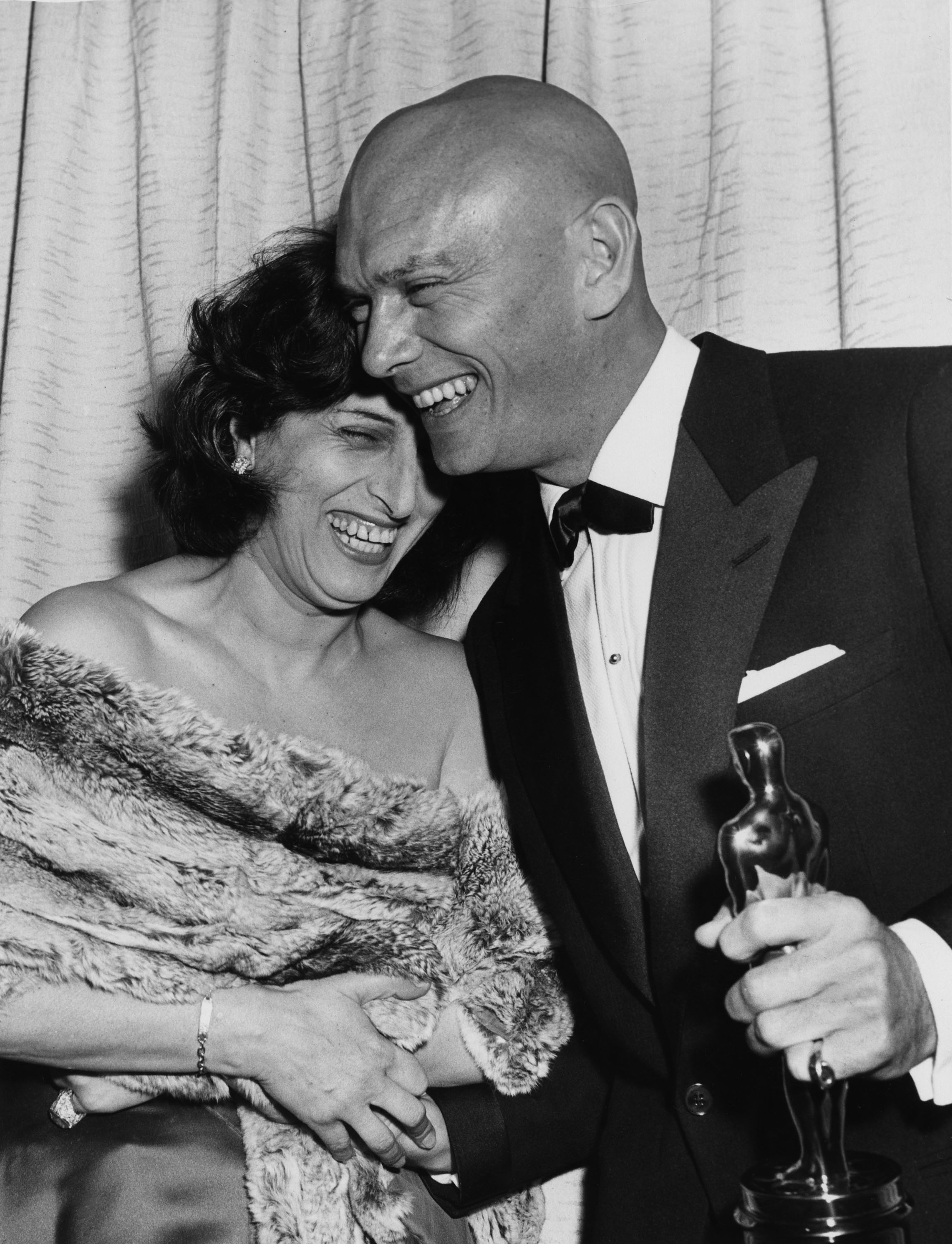
yul brynner

Yul Brynner receives his Academy Award from Anna Magnani.

After I decided I was going to watch all of the movies that have been nominated for best picture, I typed up a list of all the nominees and winners by year and crossed out all the ones I had already seen. There were two years where I had seen every single nominee, but not the movies that had actually won best picture. 1956 was one of those years. (If you’re curious, the other one is 1995. No, I’ve never seen Braveheart. Don’t judge.) So this week was a week of watching some old favorites and way too many epic movies (three of the movies this week were three hours or more) and trying to figure out why in the world The Ten Commandments hadn’t won best picture; I thought biblical epics had always been favorites for best picture wins. But I also got to see a fun new movie that I probably would never have watched if not for this blog.

Having seen so many of the movies and having loved so many of them for so long makes it really hard for me to be impartial. Do I think The Ten Commandments deserved the award for best art direction-set direction because I love the movie, or do I truly think that it was better than The King and I? Actually, no, I think The Ten Commandments should have gotten that one. And best costume design. And since I also love The King and I, I’m not showing too much favoritism, right? But it would have been a hard year to vote on some things. The music in all the movies I watched was equally good. While Yul Brynner did an excellent job in The King and I, and I don’t begrudge him the award at all,  James Dean was equally good in Giant. Actually, I’m a little bit surprised that James Dean didn’t win; sentimentality often plays a part in who wins, and James Dean’s nomination was posthumous. Anyway, a lot of good things happened in motion pictures in 1956.

However, I don’t agree with the best picture winner. Around the World in Eighty Days was fun, and the cinematography was amazing, and the sheer amount of work that it must have taken is mind-boggling. While it deserved recognition for all of that, the movie that I think is the best of the five didn’t win a single Academy Award. Friendly Persuasion is my pick for best picture. In a year of epics, it stands out as a quiet movie about a single family. Everything about it is good, from the acting to the music to the screenplay. The characters are all so alive; they have their virtues, but they also have flaws. Many of the characters are facing inner struggles, which are hard to portray in a movie, but the actors are so good that you can see the struggle inside. The characters aren’t judged for their decisions, either. Each one makes his choice, but the movie doesn’t condemn anyone for what they do. The viewers may or may not disagree with what everyone does, but that’s left to the viewer. The movie itself is neutral, which isn’t often the case, especially when it comes to war movies. I think that was a real feat in and of itself. That’s why I think Friendly Persuasion was the best movie from 1956.

How do I rank the nominees?

5. Giant
3. Around the World in Eighty Days and The Ten Commandments (tie)
2. The King and I
1. Friendly Persuasion

Why a tie? Around the World in Eighty Days drags a bit at times, while The Ten Commandments is interesting all the way through. However, the screenplay for The Ten Commandments is not the best. Around the World in Eighty Days has an excellent screenplay. It also doesn’t take itself too seriously, which I always admire in a movie. I would have given The Ten Commandments the edge just because I like it so much, but that’s not fair, so it’s a tie.