I'd like to spank the Academy

Posts tagged ‘World War II’

Atonement (2007)

Atonement-movie-posterDirected by Joe Wright

It was five or six years ago when I read Ian McEwan’s novel Atonement, but it has stayed with me. Even though I liked the writing style and thought that the characters were very well drawn, it was a hard book for me to get through. As soon as Robbie handed Briony his note, I knew things were going to take a turn for the worse; I didn’t want that to happen, so I put the book down for a while. I couldn’t stay away, though; I had to find out exactly what happened to all of these great characters. I finished it and loved it, but never felt like I had to emotional strength to read it again. So it was with a feeling of trepidation that I watched Atonement. I didn’t want to see all the bad things happen to the people I cared about. I needn’t have worried. Although it’s a good film, I didn’t get as emotionally caught up with the characters as I did when I read the book. Maybe it’s because I already knew what was going to happen, so I subconsciously made the decision to stay detached.

So what’s the story? On a hot summer’s day in 1935 England, thirteen-year-old Briony witnesses some things that she doesn’t understand and so misinterprets as menacing. When her cousin is attacked, Briony makes an accusation based on what she’s seen earlier. This accusation has serious repercussions for Briony’s sister, Cecelia, and Cecelia’s lover, Robbie, that will echo throughout the rest of their lives.

The Good: The music struck me from the very beginning. I really liked the way that the typewriter was used almost as a percussion instrument. It was very clever and somehow added to the tension of the movie.

The acting was very good. I don’t usually like Keira Knightly, but she really fit her part here. James McAvoy made an excellent Robbie. Saoirse Ronan was nominated for best supporting actress for her role as thirteen-year-old Briony. She has very expressive eyes. Romola Garai plays eighteen-year-old Briony, a young woman haunted by what she did five years before. They are all excellent in their roles.

The cinematography was lovely. The very long tracking shot on the beach emphasized the hopelessness and chaos of the situation. The cinematographer also somehow made the scenes at the country house glow like a long-cherished memory. It’s a very pretty movie.

The screenplay was well-done, too. I was wondering how they were going to show what really happened and also what Briony saw and interpreted. They did an excellent job with that.

The Bad: I kept wondering about the scene between Cecelia and Robbie in the coffee shop/at the bus stop. (SPOILER ALERT): If everything we see in the movie up until the interview is Briony’s story that she’s rewritten for Robbie and Cecelia’s happy ending, how did Briony know about that meeting and the summer cottage? Because when we see Robbie dying, he has the photograph of the beach house. That kind of bugged me.

The Ugly: The movie itself didn’t have anything ugly about it, but the story is frustrating and sad. It’s probably not a good movie for the easily depressed to watch.

Oscar Won: Best achievement in music written for motion pictures, original score.

Other Oscar Nominations: Best motion picture of the year; best performance by an actress in a supporting role (Saoirse Ronan); best writing, adapted screenplay; best achievement in cinematography; best achievement in art direction; best achievement in costume design. (When did the names of the awards get so long?)

The Pianist (2002)

the-pianistDirected by Roman Polanski

When I was ten or so, I got interested in Holocaust literature. I think it’s because my teacher read us Daniel’s Story in class. Anyway, from that time on, I read lots of books written for children and teenagers about the Holocaust. I even read some written for adults. But that all stopped when I was sixteen. That year, my history teacher showed us footage of the liberation of the concentration camps. Reading all those books hadn’t prepared me for what the Holocaust really was. I hadn’t understood what it really meant, what it looked like when people were slowly being starved to death and being killed indiscriminately. But now I do, and now Holocaust movies are hard for me to watch. I don’t want to believe that people could treat other people that way. At the same time, even though they can be so terrible, movies about the Holocaust can also be testaments to human goodness and resilience.

So what’s the story? Wladyslaw Szpilman is a young pianist living and working in Warsaw in 1939. After Germany invades the country, Szpilman, who is Jewish, lives through the horrors of the Warsaw ghetto.

The Good: Adrien Brody. His performance is heartbreaking. His transformation from a carefree young musician to a starving, terrified shadow of a man is amazing. I cried as I watched him trying to open his can of food. Incredible.

I loved the costume design. It helped to tell the story in way I haven’t often seen. Wladyslaw starts out wearing fashionable suits, but as his life gets harder and harder, his clothes change, too. The contrasting clothing of the people in the ghetto also highlights the differences of the people. Some were dressed poorly; others had furs. Each of those people in the ghetto had a different story before they were forced together, and their clothes remind us of that. They aren’t just faceless people or numbers, but people with various pasts who faced a tragic future together.

The production design made me sad not just for the Jewish people, but for the Poles, also. Their capital was destroyed; many people died. I’m not sure how they were able to show such widespread destruction, but it was devastating to see a city in rubble.

The Bad: I know I’m not supposed to say this, especially about a Holocaust movie, but there are a couple of boring stretches in this movie. From the time Wladyslaw is separated from his family until he stops living in empty apartments, it’s not the most exciting movie. I suppose it really must have been boring trying to live silently in an apartment that is supposed to be empty, but it doesn’t make for thrilling cinema.

The Ugly: Roman Polanski was a Holocaust survivor who escaped from the Krakow ghetto, and he witnessed some horrific things. He doesn’t pull his punches in this movie, and so there is some very graphic and shocking violence. I don’t feel like it’s gratuitous in any way; it’s what happened. But that means there are some parts that are very difficult to watch.

Oscars Won: Best actor in a leading role (Adrien Brody); best director; best writing, adapted screenplay.

Other Oscar Nominations: Best picture; best cinematography; best costume design; best film editing.

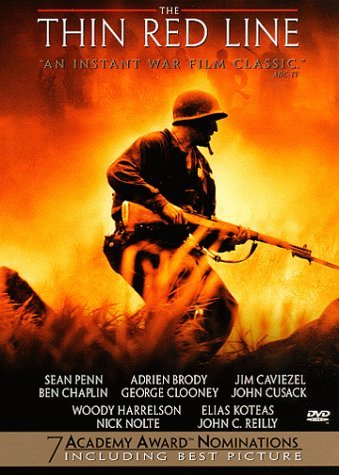
The Thin Red Line (1998)

Thin Red Line posterDirected by Terrence Malick

When the Criterion Collection DVD started off with a message from the director suggesting that it be played loud, I thought two things. First, Terrence Malick has never lived in an apartment building with neighbors who get mad over the smallest noise. (Seriously. My neighbors complained to the landlord last week when I was watching Parks and Recreation reruns. At nine o’clock.) Second, Terrence Malick has control issues. He obviously cares very much about his movie, but he doesn’t seem to realize that once it is out in the world, people will do what they please with it.

So what’s the story? This movie doesn’t exactly have a cohesive, concise storyline. It follows the progress of the Battle of Guadalcanal on the Solomon Islands during World War II, but through the points of view of many soldiers.

The Good: There were excellent performances from many people. Elias Koteas as the sympathetic captain and Ben Chapin as the man desperately in love with his wife were the ones who stood out for me, but that’s possibly because I sympathized with their characters the most. Nick Nolte was great as a slightly bitter career Army officer, Jim Caviezel fantastic as always as a lowly private, Sean Penn convincing as a crusty sergeant.

After I watched the movie, I did some research and found out that if Terrence Malick had had his way, this movie would have been six hours long. So I’m also going to give the editors props for cutting it down to the more manageable three hours.

The movie was beautiful, but that was a double-edged sword for me. I have a feeling that soldiers running away from the enemy don’t tend to notice the giant lizards clinging to trees and the flying foxes hanging in the branches overhead. Maybe I’m wrong. (Please tell me if I’m wrong; if you have experience with situations like this and you did notice, let me know!)

The Bad: They had Adrian Brody and he got to do nothing! All he did was look terrified in various positions: standing and looking terrified, crouching and looking terrified, kneeling and looking terrified. He’s such a good actor; it made me crazy that he didn’t really have a story.

I didn’t like the music, either. Yes, it was nice music (Hans Zimmer, even!), but it never seemed to underscore what was going on. I understand the concept of using music that contrasts the action to make it stand out starkly, but this movie didn’t do that for me. The music just made me think that they were trying to glorify war, like when glorious music played as the soldiers charged up the hill. The music that played as the American soldier told the Japanese soldier that the birds were going to come and eat him was just felt off-kilter. Much of the music did.

The Ugly: This movie was three freaking hours long. It got boring. There were too many characters who could be called main characters, so the movie wasn’t really about anyone. It was just a rather nebulous collection of things that happened to a bunch of people who were in the same place at the same time. I felt like this was a movie made to impress other movie makers, not for the general public. I have a list of works of art in my head that I can appreciate as being well done, but which I personally did not like. This movie has joined that list.

Oscars Won: None

Oscar Nominations: Best picture; best director; best writing, screenplay based on material previously produced or published; best cinematography; best sound; best film editing; best music, original dramatic score.

Saving Private Ryan (1998)

saving private ryan posterDirected by Steven Spielberg

 As I sat watching the battle for the bridge at the end of this movie for the second time, I couldn’t hold back my tears. But it wasn’t because the movie characters were dying; it was because similar scenes actually happened. I couldn’t help but wonder what war does to the souls of men, and I cried for the brave men who fought and died a bit inside each time they killed someone. I think that’s the greatest thing that Saving Private Ryan does. It reminds us that ordinary men sacrificed not just their lives, but bits of their souls, to protect the world from unimaginable evil. It makes us ask the question that is asked at the end: Am I a good person? Do I deserve the sacrifices that were made?

So what’s the story? After D-Day, three of the Ryan brothers have died. The youngest is still alive, and the war department decides that he is going to go home. Captain John Miller is ordered to take a small squad of men to go find him somewhere in Normandy. As they search for Private Ryan, they continue to face the dangers of war.

The Good: There is so much good in this movie, it’s hard to get it all down. All of the performances were perfect, from the thirty seconds we see of Mrs. Ryan to the more than two hours of Tom Hanks. It was surprising, but nice, to see Vin Diesel playing something other than an action hero.

The screenplay allowed us to catch glimpses of the soldiers as men. For example, when Captain Miller orders Caparzo to leave the kids behind, Caparzo says he can’t, because the little girl reminds him of his niece. Just that little line made me see Caparzo at a big family gathering with kids running around and screaming and playing. He probably wasn’t joining in on the play, but he was the kind of uncle who would give a kid a nickel to go buy a soda. There were little things like that sprinkled throughout that just made everyone seem more alive.

I loved the cinematography. I’m not sure whose call it was to use more muted colors, but those colors made it seem more like a memory than something that was currently happening. I thought it was a brilliant decision.

When the small group first heads out, I was extremely frustrated. I didn’t know any of the soldiers’ names, and they were all wearing their helmets, so I couldn’t tell them apart very well. But as the movie went on, I realized that the viewers were having the same experience as Upham of being thrown together with men they didn’t know, but would grow fond of as the story progressed. It made for very effective storytelling.

The Bad: Tom Hanks did not give a bad performance, but he never became Captain John Miller to me. He became a captain who cared about his men, a man who missed his family, a man who was losing himself and didn’t know how to stop it, but he still remained Tom Hanks. (Captain Tom Hanks, maybe?) It’s not his fault or the fault of the movie. I think it might be the media. We see actors in magazines and on the internet so often as real people that sometimes it’s hard to suspend the disbelief and let them be who they are supposed to be in the role. On the other hand, I had no problem with the other actors at all. I was watching for Nathan Fillion and almost didn’t catch him, and I didn’t realize Ted Danson was in this movie at all until I looked at the cast list. That was good. Tom Hanks just couldn’t break the “That’s Tom Hanks!” barrier in my mind.

The frame story bugged the heck out of me. Having the old man at the end was fine, but starting with him just felt wrong, somehow. (Although I would like to know how they find people who look so much like an old version of someone. The resemblance in this movie really is amazing.)

The Ugly: War is ugly. That’s all there is to it. And because this movie is so accurate, it is extremely hard to watch. I watched most of it twice, but I couldn’t handle watching the first half hour again. I am so grateful for the men who did what they did in the war, and I am so glad that I will never have to do that myself.

Oscars Won: Best director; best cinematography; best sound; best film editing; best effects, sound effects editing.

Other Oscar Nominations: Best picture; best actor in a leading role (Tom Hanks); best writing, screenplay written directly for the screen; best art direction-set direction; best makeup; best music, original dramatic score.

La vita è bella-Life is Beautiful (1998)

life is beautiful posterDirected by Roberto Benigni

When I was a sophomore in high school, my history teacher broke precedent and offered us extra credit if we went to a certain movie that was playing at the arthouse cinema downtown. Getting extra credit for watching a movie was a no-brainer to me, so one cold, snowy Saturday night in January, I called up my best friend to see if she wanted to go see it with me. Her mom asked what the movie was about, and when Tiffany said that it was a comedy about the Holocaust, her mom flipped out and almost refused to let her go. The extra credit was too good to pass up, though, so my brother drove us down to the theater. When we got there, my jaw dropped. The line for tickets wound out the door, filled the sidewalk, and bumped up onto the street. We didn’t get in to the early showing and barely made it into the late one. But after I had seen Life is Beautiful, I understood. I knew why people were willing to stand on the sidewalk in the dark and the freezing cold to experience this movie.

So what’s the story? Guido is a young man who moves to the city hoping to open a bookshop but willing to work as a waiter until that dream comes true. He meets the beautiful Dora, his “pricipessa,” and wins her heart when he shares with her the joy he finds in life. Despite the disapproval of Dora’s mother, they marry and have a little boy, Giosuè. But it’s not safe to be a Jew in Italy during World War II, and Guido, his uncle, and Giosuè are taken to a labor camp. Dora insists on going, even though she is not Jewish. Giosuè is too young to understand what’s going on, and Guido is determined to keep Giosuè in the dark. He invents a story that the camp is game with challenges to be won. Life in the camp gets harder and darker, but Guido keeps up his spirits and humor so that his child won’t see the horrors of the concentration camp.

The Good: Roberto Benigni had to tread very carefully with this film. When you are making a comedy about such a serious topic, everything has to be perfect. If it’s too over the top, it will be disrespectful. If it’s too subtle, people are going to wonder if it was meant to be funny. I think Nicola Piovani managed to walk that line perfectly with his musical score. The music underscored the darker moments, but also brightened the happier ones.

The acting was also marvelous. Roberto Benigni showed so many facets of a complex man, a man willing to do anything and everything for love. Nicoletta Braschi, Benigni’s real-life wife, did an excellent job playing a woman who finds the courage to accept love and fight to keep it when she finds it. Giorgio Cantarini is adorable as Giosuè. The rest of the cast was excellent, as well.

The Bad: The only thing I don’t like about this movie is that Guido’s friend Ferruccio disappears. Once Dora and Guido leave the restaurant, he never shows up again. While I realize that friendships shift and change over time, I would have liked to have seen him again. But really, that’s a tiny quibble.

The Ugly: Never ever ever watch this movie dubbed. Only watch it in its original Italian with subtitles. I checked the movie out on VHS not long after it was released on video, and I was shocked that it wasn’t in Italian. The dubbing made me almost physically sick. It loses so much of its charm and life when its dubbed. Don’t do it!

Oscars Won: Best foreign language film; best actor in a leading role (Roberto Benigni); best music, original dramatic score

Other Oscar Nominations: Best picture; best director; best writing, screenplay written directly for the screen; best film editing