I'd like to spank the Academy

Posts tagged ‘Turn of the Century’

The Life of Emile Zola (1937)
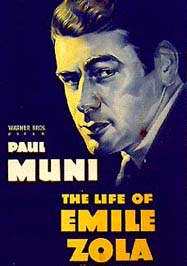
The_Life_of_Emile_Zola_posterDirected by William Dieterle

Alfred Dreyfus=Dreyfus Affair=Emile Zola=J’acusse. Alfred Dreyfus was Jewish and this whole story has nothing to do with Richard Dreyfuss. This is what I remember from the European history class that I took in high school. I could not have told you what the Dreyfus Affair was about, just that it had happened. I knew Zola was an author who championed the lower and middle classes, but even though I’m a librarian and librarians are supposed to have read every book ever, I have never read anything by him. That is everything I knew about Emile Zola before I watched this movie. Yes, I realize it’s a biopic and therefore full of half-truths or stuff made up to make it more interesting, but I will never forget the intricacies of the Dreyfus Affair or the booming character of Emile Zola.

So what’s the story? The young writer Emile Zola has a penchant for getting into trouble.He writes about prostitutes, oppressed coal miners, and the ineptness of the French army. He loses jobs and gets called into the office of the Censor of Paris more than once on account of his controversial books, but he refuses to stop exposing the uncomfortable truths of French society. However, Zola eventually stops writing. His wealth insulates him from the poverty around him. The story stops following Zola at this point, and switches to the story of Alfred Dreyfus. The higher-ups of the French army discover that someone has been passing secret military information to the Germans. They decide to pin the blame on Alfred Dreyfus, mostly because he’s Jewish. Dreyfus proclaims his innocence, but he is convicted and exiled anyway. Evidence is later found that Dreyfus is not the traitor, but the army doesn’t want to admit their mistake and tries to cover up what they have found. At this point, Anatole French, one of Zola’s writer friends, urges Zola to remember his commitment to social justice and intercede on Dreyfus’s account. Zola is reluctant, but eventually writes what would become his most famous and influential piece: J’accuse.

The Good: Emile Zola was quite the character. It would have been easy to overplay him, to ham it up and turn him into a caricature of the man. Paul Muni, however, plays him with more subtlety. His optimism, his despair, his desire to stand up for the underdog, his self-satisfaction in later life, are all brought out brilliantly by Muni. Muni’s delivery of Zola’s last speech in court was so amazing that it brought me to tears. It’s a truly great example of acting.

Paul Muni is not the only great actor in this film. Joseph Schildkraut plays Alfred Dreyfus to perfection, bewildered as to why his beloved France would do this to him, despairing as he realizes that nothing he can do will convince the army that he’s innocent, joyful when he’s released and reinstated into the army. Gale Sondergaard is Dreyfus’s stalwart wife, determined to do everything in her power to reveal the truth and exonerate her husband. Zola’s defense attorney, played by Donald Crisp (not Claude Rains, even though he looks like Claude Rains here), doesn’t have a large role in the movie, but Crisp does such a good job expressing his exasperation with the court that blocks him at every turn. The brave Colonel Georges Piquart, the only officer to stand up for the truth, was very well portrayed by Henry O’Neill. I love a well-cast movie.

The screenplay was very good. The writers managed to be inspiring without crossing the line into cheesiness, there was enough humor to balance out the drama, and I loved the foreshadowing of the (paraphrased) line that if you get too fat, you can’t see past your own stomach. I assume some of Zola’s words were his own, especially his dramatic last speech, but it’s all woven seamlessly together.

The clothing and makeup were well done. The clothing styles changed as the years passed, giving a hint to how much time had gone by. The makeup captured the real-life people excellently. The movie Dreyfus matches photographs of the real Dreyfus so well it’s almost uncanny. The makeup done to age the actors was also good.  I don’t know what happened in the years between 1937 and 1956 when Giant was made, but makeup artists in the 1930s were wonderful at using makeup to make actors look decades older.

The Bad: The actual words that were spoken were good, but the screenplay was rather disjointed. The story started with Zola’s life, and then completely cut Zola out while it explored the Dreyfus affair. Zola came back eventually, but it just felt odd to change perspectives like that.

It was very hard to tell the many mustachioed army officers apart. I know the mustaches were the fashion of the time, and since they were officers, it makes sense that they were in uniform, but I was never exactly sure who was who. Dreyfus wore glasses and Colonel Piquart had a longer face, which helped, but other than that, I could not tell you which officer was which. It got very confusing.

The Ugly: Although there were some slight problems with The Life of Emile Zola, there was nothing so bad that it fell into the ugly category.

Oscars Won: Best picture; best actor in a supporting role (Joseph Schildkraut); best writing, screenplay.

Other Oscar Nominations: Best actor (Paul Muni); best director; best writing, original story; best art direction; best sound, recording; best assistant director; best music, score.

Mind-boggling Fact: The Dreyfus Affair wasn’t completely resolved until 1906, only 31 years before The Life of Emile Zola was made; Alfred Dreyfus himself died in 1935. That means that the Dreyfus Affair was as close in time to the filmmakers as 1986 is to us. 1986 is not that long ago. Crazy, right?
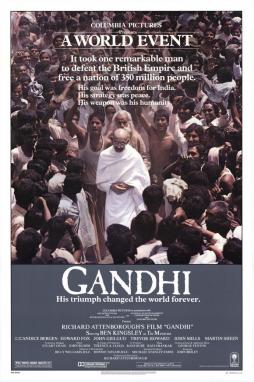
Gandhi (1982)

gandhi-movie-poster-1982-1020195902Directed by Richard Attenborough

I always worry when I’m watching a movie about a culture that isn’t my own, especially when it’s made by someone also outside that culture. I worry that I will “learn” something inaccurate or get the wrong idea about that culture. I had seen Gandhi before, but I was probably fourteen or fifteen and impressionable, so I was worried about how Indians view the movie and whether I could watch it comfortably as an American. But the day I picked it up from the library, an Indian coworker of mine said, “Oh, you are going to watch that movie? It is such an excellent movie. So well done.” Later that night, a British friend of mine whose parents are from India and Pakistan asked me what I was doing. I told him I was watching Gandhi. His response? “I love that movie.” So while there might be historical inaccuracies or only part of the story told, I at least know that Indians do not find this movie offensive, which does make me glad.

So what’s the story? Mohandas Gandhi, a young Indian lawyer educated in London, experiences racial prejudice in South Africa and decides that it is unacceptable for anyone to be treated that way. He begins a protest of the way Indians in South Africa are treated. His activism doesn’t stop there, however. He goes back to India and becomes the leader of the long struggle against British rule.

The Good: Ben Kingsley makes an excellent Gandhi, both young and old. He takes us on the same journey that Gandhi made, from rash young man to wise old leader, full of patience and kindness. It is an excellent performance.

I’m not going to name all of the people who did a good job of acting, because in a three-hour movie with lots of small roles filled by famous or soon-to-be-famous people (including Daniel Day-Lewis!), there is lots of good acting. I will mention Rohini Hattangadi, though. She played Ba, Gandhi’s wife, going from a young woman unsure if her husband is doing the right thing or if he has gone crazy to a woman who believes fully in what he does and supports him completely. She was impressive.

I loved the cinematography. There are times when it shows the grandeur of India, the huge scale of that country, and other times when it is intimate, showing how one man was able to make such a difference in such a large, diverse country. If I hadn’t already wanted to visit India someday, the cinematography of this movie would have made me want to go.

The makeup people did an excellent job of making Gandhi and Ba look older as time passed. I might have thought that the old and young were played by different people, especially as Ben Kingsley looks less like himself and more like Gandhi as he “aged”.

The Bad: Those same makeup people who did such a good job on Gandhi did a less-than-stellar job on Gandhi’s associates Nehru, Jinnah, and Patel. They didn’t age at all until the very end, even though they had been working for independence for thirty years. If this was done on purpose to show how much more quickly people age when they are living a lifestyle of poverty, than I suppose it was okay. But even if you are wealthy, you age over time, not all at once.

What happened to Gandhi’s sons? They are shown at the beginning of the movie in South Africa, but then we never see them again. There was nothing about the sons to make them a huge plot point, but I really did have to wonder if they all died, since they don’t seem to be anywhere around Gandhi and his wife for the rest of his life. Leaving them out altogether would have been one thing, but to show them once and then never again is bad storytelling.

The Ugly: I’m not disputing that Gandhi was a great man. He truly was. It takes an amazing kind of person to struggle for independence without fighting and to inspire an entire nation to do the same. His story is an incredible one. But except for one scene where he is angry at his wife, he is shown as having no weaknesses. He is made out to be a saint. I’m not trying to insult anyone or tear Gandhi down, but no one is that perfect, which made me feel like the movie was only semi-factual. I may be wrong; I know very little about the Mahatma. He may have been perfect. But because I was feeling that throughout the movie, I couldn’t immerse myself completely in the experience, so I’m going to stand firm in my belief that it was a weakness for this movie.

Oscars Won: Best picture; best actor in a leading role (Ben Kingsley); best director; best writing, screenplay written directly for the screen; best cinematography; best art direction-set decoration; best costume design; best film editing.

Other Oscar Nominations: Best sound; best music, original score; best makeup.

Moulin Rouge! (2001)

moulin rouge!Directed by Baz Luhrmann

I was a freshman in college when Moulin Rouge! came out, and I had a friend who was obsessed with the soundtrack. Whenever we would go and hang out and play games at his apartment, that CD would be playing. It made watching the movie kind of surreal; the music had seeped into my subconscious without my knowledge. I knew all the music, but I had never seen the movie before (overprotective friends again), so I had a strange sense of déjà vu. I’m not sure that helped my general perception of the movie, which was of noise, color, and oddness.

So what’s the story? Young Christian comes to Paris from Great Britain so that he can write about the Bohemians ideals of truth, beauty, freedom, and love. At the famous nightclub Moulin Rouge, he meets and falls for Satine, a performer/prostitute who has dreams of being a real actress. Will they be able to find happiness in the noisy, colorful life that is Paris?

The Good: There was some good acting. Nicole Kidman did a nice job as Satine, even if I did think she was Amy Adams ninety percent of the time. Jim Broadbent was excellent as Zidler, the owner of the Moulin Rouge, who is sympathetic to Satine and Christian’s love, but who also wants his own dreams to come true. Ewan McGregor is a little bit nondescript as Christian at the beginning of the movie, but he does jealousy and heartbreak well towards the end. Toulouse-Lautrec is played by John Leguizamo, who does a good job of showing the yearning for a love that he will never have.

Before I talk about the cinematography, I want to make something clear. I don’t get carsick. I don’t airsick or seasick or rollercoaster sick. But I have known to get sick from certain visual stimuli. I can’t play first-person shooter games, for example, or any first-person games, really. I have run, not walked, out of IMAX movies because I was about to be sick. Moulin Rouge! did the same thing to me. The jerky, constantly moving cinematography did not make agree with my stomach. Or with my head. So I was watching Moulin Rouge through a haze of headache and stomachache. But just because I didn’t like the cinematography and it didn’t agree with my stomach doesn’t mean the cinematography is bad, per se; it’s creative and different and fits with the whirling gaiety of the nightclub. I just didn’t personally like it. I wish I had a section called “Things I didn’t personally like, but can respect for their artistry.” That would make writing reviews easier sometimes. But I since I didn’t feel it was bad, I’m going to leave cinematography in the good category.

The makeup and costumes and production design were over the top and crazy, but so were the lives of the denizens of the Moulin Rouge. Like the crazy cinematography, it worked for the film and what the filmmakers were trying to do accomplish. Again, I’m not sure I liked it that much, but it was admirable.

The Bad: The music rubbed me the wrong way. Yes, it is very clever to use modern music in a movie that takes place over a hundred years ago, but I feel like the filmmakers were a little too clever sometimes, like they were drawing attention to their own cleverness. I feel like they were saying, “Look how clever we are! We used ‘Smells Like Teen Spirit’ to show how immature all these men are who frequent nightclubs! Aren’t we smart?” It became more of a gimmick than something meaningful.

The Ugly: The story was terrible, unoriginal, and uninspired. It was kind of a cheap rip off of Cabaret combined with La bohème. (Possible spoilers ahead) Christian and Satine fell in love for no reason at all. The Duke was silly and not believable as a real person. Also, if you were coughing up blood in 19th century Paris, you knew you were dying of consumption. Tuberculosis wasn’t uncommon then. And while I’m no expert, I’m pretty sure that if you are about to die from tuberculosis, you don’t have the energy to appear in a musical theater production, especially not one based in India with lots of high-energy dancing. The ending is curiously flat. The movie as a whole feels more like an excuse to do crazy musical numbers with modern music than a movie that has anything meaningful to say.

Oscars Won: Best art direction-set decoration; best costume design.

Other Oscar Nominations: Best picture; best actress in a leading role (Nicole Kidman); best cinematography; best film editing; best makeup; best sound.