I'd like to spank the Academy

Posts tagged ‘Thriller’

Crossfire (1947)

Directed by Edward Dmytryk
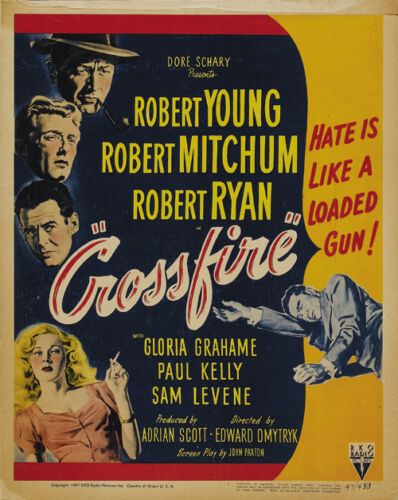
I didn’t know very much about this movie before I watched it. The DVD case made it appear to be a thrilling film noir with Gloria Grahame as the femme fatale. I’d been burned before, though (see: Dead End https://theoscargrouch.wordpress.com/2017/05/18/dead-end-1937/), so I didn’t let myself get my hopes up.

So what’s the story? Crossfire starts with the murder of a man, followed by the murderer running away. There’s confusion with the light and shadows, and we don’t know who the murderer is, but soon an off-duty soldier shows up to the apartment looking for his buddy who had been there earlier. The police zero in on the buddy, but did he really do it?

The Good: This movie may be the noiriest noir I have ever seen. There are so many shadows obscuring everything, figuratively and literally. Sometimes the shadows seem almost overwhelming. Light is used sparingly and very well. 

The music is used very much like the light: sparingly and well. Almost the only music in the movie at all is the music from the activity going on around the soldiers: music in a dance hall, music heard on the street while they pass bars, music in a movie that they watch. The filmmakers did not rely on music to tell you how to feel. 

The acting is great. Apparently, if you were a man who wanted a part in this movie, you had to be named Robert. Robert Ryan is Montgomery, the soldier who points civilian detective Robert Young in the direction of his buddy. Robert Mitchum is a soldier who doesn’t believe Montgomery’s accusation and goes looking for the truth on his own. To be fair, though, the Roberts were not the only good actors, although they were all superb. Sam Levene’s role as Samuels, the murdered man, is small, but he makes the character come alive in a way that his death hits pretty hard. Gloria Grahame plays a very sympathetic femme fatale; she’s less femme fatale and more “hooker with a heart of gold.” 

I rarely comment on the theme or message of a movie, but I feel like it’s important in the current political climate in the United States. Crossfire is about the dangers of vilifying “the other,” about feeling that you or your group is more important than or just straight-up better than another group. It warns about the danger of falling into that trap and says that even if you yourself feel safe, you need to stand up for others in the persecuted group. It’s a good message in a movie that isn’t a feel-good movie.

The Bad: It did drag at times. Not often, but there were a few scenes that could be trimmed just a little bit to make the movie tighter.  

The Ugly: I really did not understand who The Man was or what he was doing in the movie. His character just added unnecessary confusion. 

Oscars Won: None.

Oscar Nominations: Best picture; best actor in a supporting role (Robert Ryan); best actress in a supporting role (Gloria Grahame); best director (Edward Dmytryk); best writing, screenplay. 

Fun Bonus Fact: Although Crossfire deals with antisemitism, the novel that it is based on, The Brick Foxhole, is about homophobia, which is incredibly progressive for a book published in 1945.
Argo (2012)

Directed by Ben Affleck

Okay, so argoit’s been awhile again. Apparently, because I wrote about my depression and how it was doing so much better in my Silver Linings Playbook post, my depression decided to remind me how powerful it actually can be. So yeah. Sorry if you’ve been waiting and hoping and wishing for my Argo review and my wrap-up of 2012; I’ve been trying not to slit my wrists. But at least I’ve been successful!
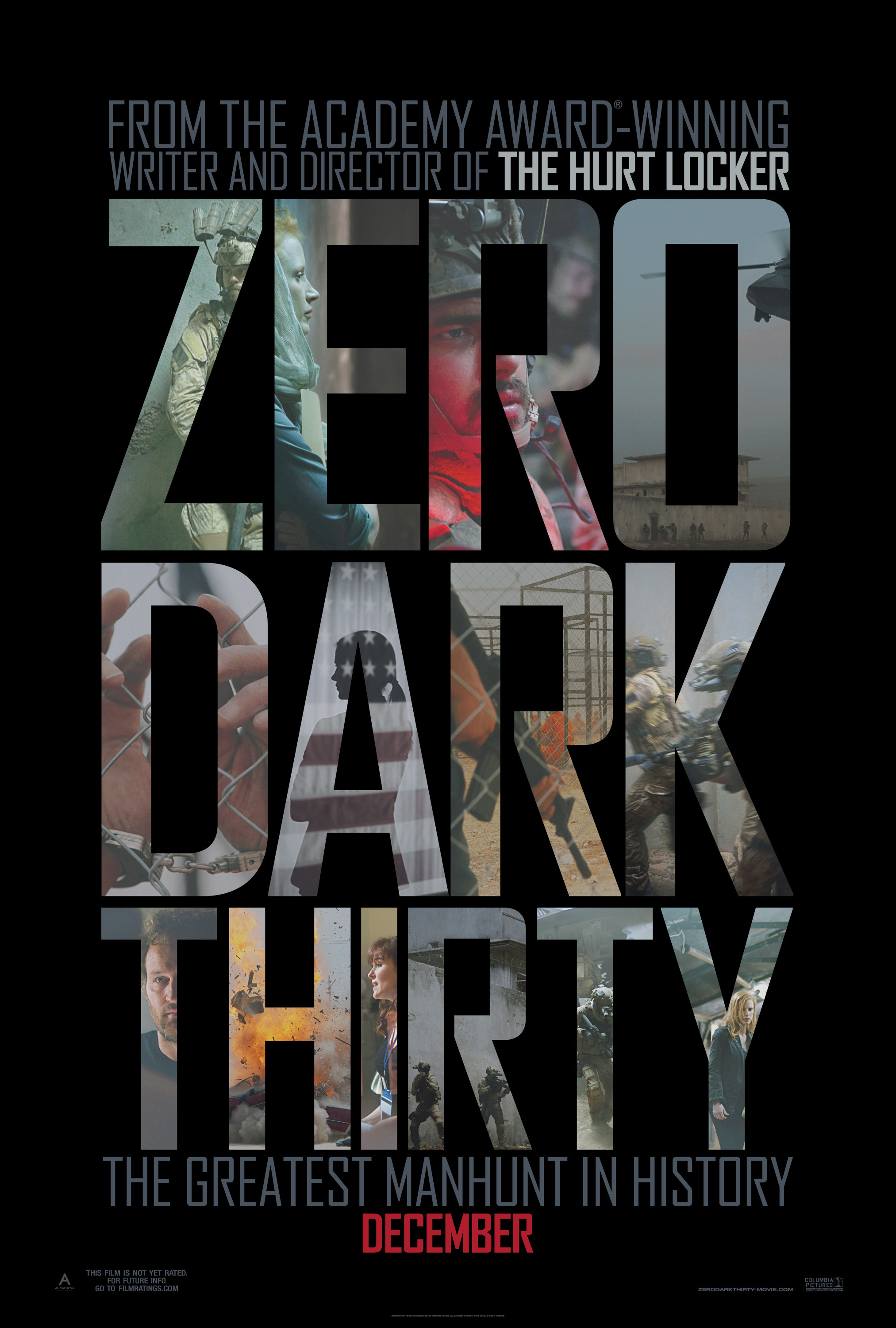
As I said in my Zero Dark Thirty review, I was excited for the 2012 movies because I got to watch two action movies that had been nominated for best picture. But just like Zero Dark Thirty, Argo is also not an action movie. It’s exciting, and it’s fun, and it has wonderfully tense moments, but it’s not an action movie. I think I might have watched the only action movie ever nominated when I watched Raiders of the Lost Ark. Argo is a fantastic movie, and I truly enjoyed it, but it’s not an action movie. It was also weird watching it on the heels of Zero Dark Thirty because they are so similar. Both movies are more spy film than action flick, both are based on true stories, both take place in the Middle East, both even have Kyle Chandler. So while I recommend seeing both films, don’t watch them back to back.

So what’s the story? During the takeover of the American embassy in Iran in 1979, six Americans manage to escape to the home of the Canadian ambassador. As the occupation of the embassy drags on, the U.S. government tries frantically to come up with an idea to get the six out before the Iranians realize that they aren’t in the embassy with the other civil servants they have taken hostage. Tony Mendez, a CIA officer whose job is extracting people from bad situations, finally comes up with “the best bad idea”—produce a fake movie, complete with screenplay, casting, and movie posters. He will then fly to Iran to “scout locations” and fly back with the six Americans as members of the production company. It’s a risky plan; can they pull it off?

The Good: I don’t know the term for what I’m about to admire, but I love that Argo looks like a movie from the late seventies or early eighties. The film quality is grainier, less sharp than current movies. No high definition here! I liked that the old Warner Brothers logo was used at the beginning of the film, too. It was a small thing, but helped set the tone for the movie.

Argo was a well-cast film. Everyone from Ben Affleck as Tony Mendez to John Goodman as legendary make-up artist John Chambers to Bryan Cranston as Mendez’s boss, Jack O’Donnell was fantastic. I was especially glad to see Victor Garber playing a sympathetic character (the Canadian ambassador) for once. He seems like the nicest man, but in the movies I’ve seen him in, his characters are always jerks (Mayor Shinn in The Music Man, the lecherous professor in Legally Blond, the money-grubbing lawyer in Eli Stone). Alan Arkin is a delight as the “producer” of Mendez’s movie, and the people playing the six non-hostages were also good. I didn’t feel like there was a false note in the casting.

The pacing of the movie was great. The director managed to keep the feeling of a lot of time going by balanced with the tension of having to get the people out. It would have been very easy to err in either direction – either with the movie dragging as the hostages stayed inside for months, or with the action happening too quickly to be believable.

Even though I feel like I know more about history than the average American, I didn’t know much about the Iran Hostage Crisis. We didn’t tend to get to more recent things in any of my history classes just because there was so much to cover in a year, and I wasn’t alive when it actually happened, so I appreciated the overview of the modern history of Iran at the beginning. Some of the movie wouldn’t have made sense without that background.

Alexandre Desplat’s score was a haunting, beautiful mix of Middle Eastern and Western music. It was subtle enough to underscore the drama of the situation without being overwhelming.

The Bad: While the casting was all good, I had a hard time keeping the six escapees straight. They didn’t get enough screen time for the viewers to understand their characters, so they all kind of blended together. I would have liked to have seen more of John Goodman and Alan Arkin and the Hollywood end of things, also. I feel like a lot of that was glossed over to give Ben Affleck more screen time and make Mendez seem more heroic.

Because I put off writing this review, I had to watch Argo twice in order to feel like I could give it an honest, helpful review. The first time, I loved it. It was one of those moments when you want to tell everyone you know that they should see it. A few weeks later, when I saw it for the second time, I just couldn’t get into it. I already knew what was going to happen, so there was no tension for me. This seems to be a flaw in the movie, but I can’t put my finger on why I didn’t care so much the second time around. It might be because I felt no connection to the characters; I’m not sure. But I feel like a movie that is named the best picture of the year should be able to be enjoyed more than once.

The Ugly: I didn’t find anything bad enough about Argo to be in this category. It’s flaws were minor.

Oscars Won: Best motion picture of the year; best writing, adapted screenplay; best achievement in film editing.

Other Oscar Nominations: Best performance by an actor in a supporting role (Alan Arkin); best achievement in music written for motion pictures, original score; best achievement in sound mixing; best achievement in sound editing.

Zero Dark Thirty (2012)

PrintDirected by Kathryn Bigelow

When I’m deciding which year of movies I want to watch next, sometimes I let a random number generator pick. But when I chose the movies of 2012, I had a very specific reason in mind: I was in the mood to watch an action movie. There haven’t been a lot of action movies nominated for best picture, but I was certain that 2012 had two: Zero Dark Thirty and Argo. I hadn’t seen either one, but I knew that Zero Dark Thirty was about the assassination of Osama Bin Laden, which was exciting, so it had to be an action movie, right? Guess what. I was wrong. Don’t get me wrong; it’s a fantastic movie. It’s definitely not an action movie, though.

So what’s the story? Maya is a young CIA operative sent to Pakistan to protect the US from future terrorist attacks. It takes her ten long years of ferreting out information from the thinnest threads, but she is finally certain that she knows where Osama Bin Laden is hiding. Now she just has to convince the rest of the CIA.

The Good: Jessica Chastain is fabulous as Maya, the woman who believes in what she’s doing and refuses to budge on what she believes is correct. She’s tenacious and single-minded and tough. She doesn’t care about what other people think and she’s not ever going to give up. The part itself may seem a little cold, but Jessica Chastain does an excellent job. Her acting makes the ending perfect.

The supporting cast is solid. I love it when a movie has even the smallest role perfectly cast, and Zero Dark Thirty is one of those movies. If I made a list of everyone who does an amazing job in this movie, it would be really long, so I will just mention a couple. Jason Clarke and Jennifer Ehle both make fantastic CIA operatives. Kyle Chandler is good as Joseph Bradley, Maya’s boss who doesn’t really believe in her lead, but who knows that ignoring her is a bad idea. Joel Edgerton and Chris Pratt make excellent Seal Team Six members. But again, everyone is so spot on that it’s hard to pick out the best people.

I’ve watched other movies based on historical events that play fast and loose with dates and places (cough, Elizabeth, cough). I appreciated how places and dates were so specific. I even like the “chapters” that helped keep the story moving and showed how time passed, because frankly, spy work seems to move very slowly sometimes, and it would have been boring if every single step that Maya made to draw the lines and make the connections had been shown.

I loved the beginning. The lack of any images made the voices of September 11th so compelling that it drew me in and made me remember my September 11th experience. I don’t think that could have been done nearly so well if scenes from that day had been splashed on the screen.

The soundtrack is amazing. Music is used sparingly, so that when it happens, it really makes an impact. Most of the action happens to natural noises, which makes it more realistic, and the occasional music unobtrusively underscores the emotion. That was an excellent choice.

The screenplay manages not only to tell the story of what happened, but to make the characters feel real and believable. They have backstories and lives outside of what’s going on thanks to the screenplay, which I understand was rewritten after Osama Bin Laden was killed. I think it would be fascinating to know what the ending was going to be before that happened.

The Bad: Even though we all know how the story ends, the tension during the Seal Team Six scene is almost unbearable. That’s probably a good thing from a storytelling point of view, but for me, it’s as uncomfortable as watching a horror movie, especially since there are innocents involved.

The Ugly: The first twenty minutes or so of the movie are mostly scenes of torture, and there are other scenes of torture throughout. Bigelow doesn’t pull any punches or soften these scenes, and they are hard to watch. I know a lot of people believe that torture is sometimes necessary; I don’t want to get involved in any discussion about that. I’m just saying that it’s not an easy thing to see, especially knowing that torture happens in real life.

Oscar Won: Best achievement in sound editing (tied with Skyfall).

Other Oscar Nominations: Best motion picture of the year; best performance by an actress in a leading role (Jessica Chastain); best writing, original screenplay; best achievement in film editing.

Missing (1982)

Missing_1982_filmDirected by Costa-Gravas

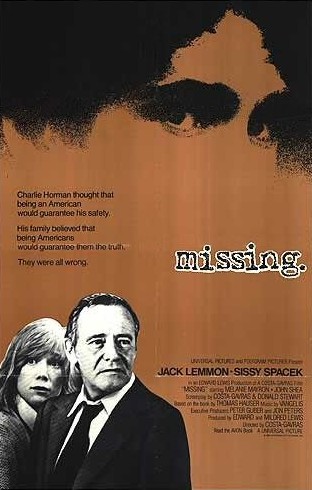
As I’ve been watching these Oscar-nominated movies, there have been many, especially from the 1970s and 1980s, that I haven’t really known anything about. Some of them have been less than stellar, and I can understand why they have fallen by the wayside, even for someone like me who likes watching good movies, no matter how old they are or what language they are in. Missing is not one of those movies. Missing is so awesome I want to show it to everyone I know, and I’ve been telling random people how sad I am that no one seems to have seen it. Missing makes me want to be a high school history or civics teacher so that I could show it to my class to teach them not to be too trusting of government. It makes me so mad that Missing is not a classic; it completely deserves to be one.

So what’s the story? Charlie and Beth Harmon are an idealistic young married couple who have been living in Chile for a couple of years when a right-wing coupe happens. They are going to leave the country soon, so Beth goes to say good-bye to a couple of friends. She gets stuck overnight because of the curfew. When she finally makes it home, Charlie is gone. About two weeks after his disappearance, Charlie’s conservative businessman father, Ed Horman, comes to help Beth navigate the waters of diplomacy and bureaucracy. What they find out together will change their lives forever.

The Good: I’m tired of starting with acting, so I’m going to start with music today. Vangelis’s score is beautiful and haunting. It’s more orchestral than the music in Chariots of Fire, and where he does use the synthesizer, it fits the time much better. The other thing that is great about the music is that it is not constant. Lots of the movie has no music, so that where there is music, it has a much greater impact.

The acting is wonderful. Sissy Spacek is wonderful as Beth, who changes from a vibrant, loving young woman to a frantic wife to a jaded and accepting woman in the course of just a few weeks. It’s a marvelous performance. Jack Lemmon is fantastic as Ed, who starts out so convinced that he’ll be able to fix everything with connections, but slowly comes to realize the truth. I’ve only ever seen Jack Lemmon in comedies, so this was a revelation. John Shea plays idealistic, happy-go-lucky Charlie. He’s not in the movie much, but he leaves an impact when his character is gone. Government agent Captain Ray Tower is played rather chillingly by Charles Cioffi. He’s so scary in part because he’s so friendly, but you can tell he’s hiding the truth.

This is going to sound silly, but the set decoration was so clever at one point. Beth and Ed are at the US Embassy, trying to get answers about what happened to Charlie. The US Ambassador is telling them that he’s probably in hiding and that they shouldn’t worry about him. While he is talking to them, he is standing directly under a picture of Richard Nixon. This movie takes place in 1973, so Nixon was the president then, but by the time Missing was made in 1982, everyone knew that Nixon was a liar. To see a man appointed by that president standing underneath him subtly, yet effectively, underscored the fact that the ambassador was also a liar.

The screenplay was very good. It made the characters come alive. It also made the movie completely gripping. I was so angry that I had to stop watching to go to work. I wanted to know what happened, and I wanted to know NOW! It was fantastic.

I have no concrete examples of why I felt this way, but I though the directing was very good. It’s hard to define good directing, because it’s hard for me to know how much of a hand the director had in various aspects of the movie, but I really felt good directing at play here.

The Bad: The only complaint I have is that Beth and Charlie’s friend Terry has 1980s poufy hair. As a free-spirited 1970s woman, Terry’s hair should have been longer and straighter. I know, tiny quibble. But it bothered me.

The Ugly: War is always ugly, and there are some shocking images and situations in this movie. It’s not the easiest movie to watch because of this, and also because this is a true story. Art that is great tends to bring up issues that might make people uncomfortable, but that doesn’t mean that these issues should be ignored. I think it’s better for people to know what is wrong in their world than to believe that everything is perfect when corruption is hiding underneath.

Oscar Won: Best writing, screenplay based on material from another medium.

Other Oscar Nominations: Best picture; best actor in a leading role (Jack Lemmon); best actress in a leading role (Sissy Spacek).

Michael Clayton (2007)

michael claytonDirected by Tony Gilroy

When I was growing up, my dad would turn a movie on while he finished up paperwork at night. When the movie ended, he would simply rewind it and start the same movie over again. It never really bothered me too much (except when the movie was Groundhog Day), but I’ve never had the urge to do that myself until I watched Michael Clayton. It’s a very subtle corporate thriller, and I feel like I didn’t quite pick up on everything the first time through. I would like to watch it a couple more times, but since I have a full-time job which not my blog, I can’t do everything I want.

So what’s the story? Michael Clayton is his law firm’s clean-up man. Whenever anything goes wrong, he’s called on to fix it. So when the firm gets a call that one of the partners who was at a deposition has stripped himself and started chasing a witness through the parking lot, Michael Clayton is sent to see what can be done. When he gets there, Michael finds out that everything is not as it seems…

The Good: There were some fabulous performances in this movie. George Clooney plays Michael Clayton, a man who’s dealing with all kinds of stress at work and in his family life. It’s a very understated performance. His acting in the last few minutes of the movie and into the end credits was incredible. Tilda Swinton is the head legal counsel for the company that Clayton’s team is supposed to be representing. She is a fascinating character; she is smart and capable, but not at all confident. I’ve never been a huge fan of hers, but I have to admit that she is fabulous in Michael Clayton. Tom Wilkinson plays Arthur Edens, the partner whose breakdown leads Michael Clayton on a search for the truth. Movie director Sydney Pollack does a good acting job as one of the heads of the firm, and Austin Williams plays Michael’s fantasy-novel obsessed young son.

The cinematography really set the mood for the movie. It takes place during the late fall or early winter, and the cold, dying landscape and the wintry light reflected Michael’s mood.

The Bad: I like to think that I’m an intelligent person, but I know I missed some plot points. I will admit that I was tired and my brain wasn’t functioning at full capacity, but feel like I shouldn’t have to watch a movie more than once to understand all of what’s going on.

Also, why were the horses in the field bridled? I’m no horse expert, but I have always thought that horses don’t wear their bridles when they are left in the pasture. It’s a silly thing, but it disquieted me for the whole movie.

The Ugly: Even though Michael Clayton was interesting and had good acting, I never connected with the movie on an emotional level. I feel like I should have felt something, but the movie felt more like an intellectual logic puzzle than a work that touched my soul. I think an excellent movie should touch the viewer in some way.

Oscar Won: Best performance by an actress in a supporting role (Tilda Swinton).

Other Oscar Nominations: Best motion picture of the year; best performance by an actor in a leading role (George Clooney); best performance by an actor in a supporting role (Tom Wilkinson); best achievement in directing; best writing, original screenplay; best achievement in music written for motion pictures, original score.