I'd like to spank the Academy

Posts tagged ‘strong female lead’

Dark Victory (1939)

dark victory posterDirected by Edmund Goulding

People who care about such things may notice that I have gone out of order. Yes, I realize d comes before g in the alphabet, so yes, this should have been the first review of the week. But I don’t watch the movies in alphabetical order; I watch them as I want to watch them. And I had watched Goodbye, Mr. Chips earlier in the week, but stupid daylight savings time prevented me from getting to Dark Victory until later than I wanted. So write your congressman and say you want to put an end to daylight savings time.

So what’s the story? The reason I hadn’t watched Dark Victory was that the story just didn’t appeal to me. Judith Traherne is a young sporting socialite; she breeds and rides horses and hunts and all that kind of stuff. She’s had blinding headaches for the last six months, but when she misses a jump when riding her horse, she realizes something is seriously wrong. She is diagnosed with a brain tumor and has it removed, but the doctor knows that someday it will come back; Judith will be dead before then end of a year.

The Good: This movie had the potential to be either incredibly melodramatic or deadly dull. In order to avoid that, the viewer has to care about Judith. Bette Davis makes you care. Judith tries to pretend that she’s not really worried at the beginning, but Bette Davis lets us see beneath the strong words and actions to the scared young woman. She glows when she falls in love; she becomes tough, yet brittle when she feels like that love has betrayed her. I  found myself in complete sympathy with Judith, even though our lives are so very different. If this movie had starred a lesser actress, it would have been soapy garbage. Bette Davis saved it from that.

The supporting cast is also stellar. Geraldine Fitzgerald as Judith’s personal secretary and best friend is a standout. I hadn’t seen her in anything before, but I think I get to see her in a few more nominees, which makes me happy.

The Bad: Max Steiner wrote the soundtrack for this film, and the music is nice, but it’s  very dramatic. I realize that that was the trend of the time, but I like my soundtracks to be a little more subtle.

The Ugly: I think the fact that Bette Davis is so good kind of highlights a major weakness of this movie. The storyline is tripe. It’s silly and contrived and over dramatic. My advice for watching this movie is to allow yourself to get swept up in the fabulous acting and don’t think too hard about anything else. Also, Humphrey Bogart in a small supporting role with a bad fake Irish accent? No. Very ugly.

Oscars Won: None.

Oscar Nominations: Best picture; best actress in a leading role (Bette Davis); best music, original score.

Fun fact: There’s a very attractive young playboy in Dark Victory who looked kind of familiar to me, but I couldn’t place him, so I looked him up on IMDb. Turns out the very attractive playboy would be president of the United States a little over forty years later. Weird.

Chicago (2002)

chicagoDirected by Rob Marshall

This is the one of the movies (the other is Guess Who’s Coming to Dinner) that inspired me to watch all of the movies nominated for best picture. When I saw Chicago for the first time, I was not impressed; it made me wonder how bad the other nominees were for this movie to have won best picture.

So what’s the story? In 1920s Chicago, vaudeville star Velma Kelly murders her husband and sister when she finds them sleeping together. Actress wannabe Roxie Hart kills her lover when he decides to break off their relationship and reveals that he never had the connections to make her a star. Both women are represented by Billy Flynn, a defense attorney who has never lost a case. Will his defense be enough to save them from the hangman’s rope?

The Good: Catherine Zeta-Jones. She is amazing as Velma Kelly. She not only sings and dances, but she acts while she’s doing it. In the scene where she’s trying to convince Roxie to be her partner in a new act (the song “I Can’t Do It Alone”), you can see the desperation written on her face. She’s a proud woman begging for help, and it hurts her, but she does what she has to do. She completely deserved her Oscar for best supporting actress.

The musical numbers were fantastic. I don’t automatically like movie musicals. If the songs don’t add something either to the plot or to the development of character, they feel like a waste of time to me. But I loved the songs in Chicago. “Cell Block Tango” is my favorite. I liked the symbolism of “We Both Reached for the Gun” and Richard Gere’s tap dance. All of the musical numbers added to the movie.

I did like the trope of having the musical numbers be inside Roxie’s head. That was a good way to make a musical believable, because people don’t normally break into song in a courtroom. That meant the editing had to be good, and it was. The movie cut beautifully between what was happening in the real world and what was being sung in Roxie’s mind. Having Taye Diggs as the announcer to tie it all together was a smart choice, too.

The Bad: Renèe Zellweger is not a dancer, nor does she have a voice of the same caliber of Catherine Zeta-Jones’s or Queen Latifah’s. She wasn’t horrible, but when you put someone great next to someone merely good, it makes you cringe. That last dance number is particularly bad. Catherine Zeta-Jones looked like dancing is as natural to her as walking, which makes Renèe Zellweger look stiff. It’s just not good.

The Ugly: This movie has no heart or soul. The theme of the movie is that you can get away with anything if you are famous enough. While that might be true, I don’t feel like it’s something to celebrate.

Oscars Won: Best picture; best actress in a supporting role (Catherine Zeta-Jones); best art direction – set direction; best costume design; best film editing; best sound.

Other Oscar Nominations: Best actress in a leading role (Renèe Zellweger); best actor in a supporting role (John C. Reilly); best actress in a supporting role (Queen Latifah); best director; best writing, adapted screenplay; best cinematography; best music, original song (“I Move On”).

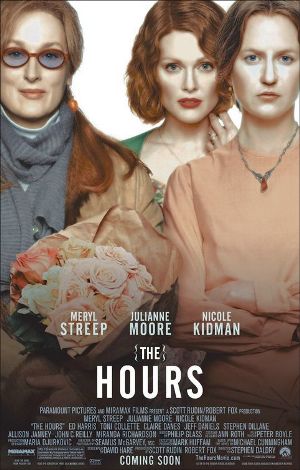
The Hours (2002)

The_Hours_posterDirected by Stephen Daldry

When I saw the poster for this movie, my first thought was, “Wait. It says Nicole Kidman is in this movie, but none of those three women are Nicole Kidman. Why isn’t she on the poster, and why doesn’t the third lady on the poster get higher billing?” So I looked it up on IMDb and realized that the makeup people did an amazing job; they managed to make Nicole Kidman look frumpy.

So what’s the story? Three different women from three different time periods have three parallel days that are all connected by parties, mental illness, and Virginia Woolf’s novel Mrs. Dalloway. I realize that doesn’t sound terribly exciting, but it’s a hard movie to sum up.

The Good: Like I said earlier, the makeup artists were amazing. They did a good job making Nicole Kidman look like Virginia Woolf, but they also did a fabulous job of aging Julianne Moore fifty years. Apparently, they weren’t eligible for an Oscar because a little bit CGI was used to make Nicole Kidman’s false nose look flawless, but still. Major kudos to them.

Major kudos also goes to the editors. The director is telling three different stories, but he jumps around from story to story often. The editing had to make that feel seamless and show the parallels in the different stories. It was very well done.

The soundtrack was beautiful, a lovely piano score. I thought it sounded very similar to the music from The Truman Show; sure enough, Philip Glass did the scores for both. But even though it wasn’t the most original, it was so lovely that it made me want to find some sheet music and learn it.

The acting was excellent. Nicole Kidman completely inhabited Virginia Woolf. Julianne Moore played a frustrated 1950s housewife, and Meryl Streep gave a moving performance as the woman of today (or 2001. But that was today when the movie was made.). John C. Reilly played Moore’s incredibly devoted husband, and Ed Harris was a poet dying of AIDS, a former lover of Meryl Streep’s character. Miranda Richardson felt completely natural as Virginia Woolf’s sister Vanessa.

The Bad: This movie is based on a book (which I haven’t read, so I can’t compare anything), and it shows. All three main character women spend a lot of time staring into space. I’m sure that in the novel, they are having deep thoughts, but those thoughts don’t always make it across on the screen. That got annoying.

I also felt like the three stories didn’t fit together as well as they should. Meryl Streep’s character had many parallels to Mrs. Dalloway, even down to the names, and her story dovetailed neatly with Julianne Moore’s, but the only connection that Julianne Moore had to Virginia Woolf was that she was reading Mrs. Dalloway, and I wanted it to be better than that.

The Ugly: Confession time: I struggle with depression. I have been suicidal in the past. I am a woman who doesn’t quite fit in her society. And even with all that, I never felt a deep connection with this movie. Maybe it was because we couldn’t get a deep look at these women’s inner thoughts, but it felt so shallow. The only woman I really felt like we got a good, sympathetic look at was Virginia Woolf; I would have happily watched an entire Virginia Woolf biopic starring Nicole Kidman and Stephen Dillane because they were the only very well-developed characters. That shouldn’t happen in a character-driven movie.

Oscars Won: Best actress in a leading role (Nicole Kidman).

Other Oscar Nominations: Best picture; best actor in a supporting role (Ed Harris); best actress in a supporting role (Julianne Moore); best director; best writing, adapted screenplay; best costume design; best film editing; best music, original score.

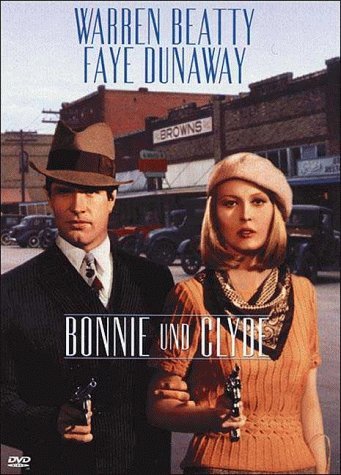
Bonnie and Clyde (1967)

bonnie and clyde posterDirected by Arthur Penn

When I was growing up, my family had a book of pictures from classic Hollywood films. One of those pictures was from Bonnie and Clyde; it interested me because it was a picture of a girl with a great hat (that beret!) holding a gun standing in front of a cool old car. I wondered why she was doing that. Later on, I found out about the bank robbers from the 1930s, but still didn’t know very much about this movie going in.

So what’s the story? Bonnie, a young waitress in 1930s Texas, catches Clyde trying to steal her mother’s car one day. Rather than turn him in, Bonnie goes with Clyde into town. When Clyde points out to her that she hates her life and wants more, Bonnie decides to run away with him. They start robbing banks and stores together, always managing to keep one step ahead of the police. Clyde’s brother Buck and Buck’s wife Blanche come to visit and become part of the gang.

The Good: The cast was very good. I had never seen Faye Dunaway in anything. I knew her name, but I hadn’t ever seen any of her movies. She was fantastic as Bonnie. Estelle Parsons won an Oscar for her portrayal of Blanche, which I felt was well-deserved. She did a very good job as a woman who was not happy about associating with criminals at first, but then enjoying the lifestyle as long as the money came in. I grew up watching Gene Hackman in Hoosiers (often, because it was one of my dad’s favorite movies), so it was really fun to see him in such a different role.

The ending was one of the best endings I have ever seen. It wasn’t overdone or cheesy, which would have been easy to do. It was restrained and elegant instead. Perfect.

The Bad: The music got on my nerves. It was probably fairly authentic, but it felt more stereotypical to me – these were hicks from Texas, so they must listen to hick music.

Also, Faye Dunaway’s look was more 1960s than 1930s. I feel like that was a problem for a long time in historical movies, though, and everyone else looked right. I guess they just wanted the leading lady to look more glamorous than 1930s would have allowed.

The Ugly: I had no emotional connection to this movie. I understand feeling stifled by society’s expectations and wanting a bigger life, but going on a crime spree is not a good way to break out of the oppression of everyday life. The Barrow Gang killed lots of innocent people and stole from others. I know it was the Depression and money was scarce, but I’m sure the small town grocers they robbed were struggling, too. I felt no sympathy for Bonnie and Clyde whatsoever, and I hate that this movie made them seem almost noble for what they did.

Oscars Won: Best actress in a supporting role (Estelle Parsons); best cinematography.

Other Oscar Nominations: Best picture; best actor in a leading role (Warren Beatty); best actress in a leading role (Faye Dunaway); best actor in a supporting role (Gene Hackman); best actor in a supporting role (Michael J. Pollard); best director; best costume design; best writing, story and screenplay – written directly for the screen.

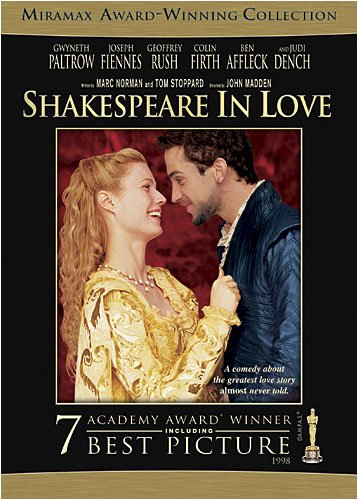
Shakespeare in Love (1998)

shakespeare in love posterDirected by John Madden

I hadn’t seen this movie when it first came out, so all I really knew about it was that according to everyone, it stole the best picture Oscar from Saving Private Ryan (which I also hadn’t seen). I think I was half expecting it to be terrible after all the outrage. And I know I am about to damn this movie with faint praise, but it was cute. There was nothing really wrong with it.

So what’s the story? Shakespeare, a young playwright with a good reputation, is struggling to write his next play. He finds a muse in Viola De Lesseps, a young woman so obsessed with the theater that she is willing to break the law and perform on stage disguised as a man. There are some misunderstandings and mishaps, but eventually Shakespeare writes his masterpiece Romeo and Juliet.

The Good: I loved the production design. I felt like it was a very full picture of Elizabethan England, from the formality of the court to the disgusting dirtiness of the streets. It felt very alive. It almost made me want to live in those times. Well, no. Really too dirty for my taste. But maybe visit!

The music! It was fun and upbeat and just…fit. Loved it.

The supporting cast was great. I’m not a huge fan of either Gwyneth Paltrow or Joseph Fiennes, but I loved everyone else. Imelda Staunton as the nurse was a huge favorite of mine, as was Geoffrey Rush in his role as a befuddled producer. Colin Firth was surprising as a slightly evil stuffed shirt nobleman, and I loved Mark Williams as the tailor who wanted to be an actor. Judi Dench was good in her expanded cameo as Queen Elizabeth, even though I don’t think that eight minutes of a movie is enough to count as a supporting role. I even liked Ben Affleck’s egotistical actor. The cast was really just stellar.

The Bad: The writers played around with history a little too much for my liking. Romeo and Juliet was written in the 1590s; no one was settling Virginia until the early 1600s. But since I feel like the filmmakers weren’t trying to make any kind of serious movie, but just present a fun alternative backstory to Romeo and Juliet, I suppose I can forgive them.

The Ugly: There’s nothing really ugly about this movie. It’s just cute and sweet. But I do have a little rant. Everyone thinks the ending of this movie is so sad. But guess what? It wouldn’t have lasted. And no one seems to understand that. Whatever the real Shakespeare was like, the character in this movie was a philanderer who fell in and out of love with ease, just like Romeo. Which has always bugged me about Romeo, incidentally. I guess I just have never felt that Romeo and Juliet was a particularly romantic play, so I carry those feelings over to this movie.

Oscars Won: Best picture; best actress in a leading role; best actress in a leading role; best writing, screenplay written directly for the screen; best art direction-set direction; best costume design; best music, original musical or comedy score.

Other Oscar Nominations: Best actor in a supporting role (Geoffrey Rush); best director; best cinematography; best sound; best film editing; best makeup.

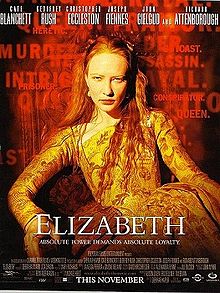
Elizabeth (1998)

220px-Elizabeth_PosterDirected by Shekhar Kapur

I am not a historian, let alone an expert on the Tudor era, but I do flatter myself that I know a little bit more about history than the average American (which, sadly, is not that difficult because very few people here understand the value of history. But that’s a whole nother topic.). Having said that, nothing annoys me more than a movie that pretends to be historical, but is riddled with inaccuracies (*cough* Ever After *cough*) or has added made-up events because it makes a better story. If the original story isn’t interesting enough, why are you making a movie about it at all?

So what’s the story? Elizabeth tries to find her place as queen amid the danger and intrigue of the Tudor court.

The good: The costumes were gorgeous. I felt like they did a good job of showing the shifting of the fashions over time. The makeup was also well done. The makeup artists did an excellent job of making Cate Blanchett age just a few years, making her look older, but still young. They also avoided the problem that plagues so many historical movies; the actors did not look like 20th century people dressed in costume. I’m not sure what they did differently from some of the other movies of 1998, but somehow it worked.

The bad: The first time there is a shot looking down into a lofty stone hall from above, it’s really awesome. By the twentieth time, I feel like the director and/or cinematographer is saying, “Look at these cool shots we can do! Aren’t we awesome?” I was also annoyed by the martyr scene in the beginning. I felt like it was only included so that it could foreshadow the ending, which felt really heavy handed.

I didn’t much care for the production design, either. It has always seemed to me that this time was rather alive and noisy and messy, but everything seemed to be so…sterile. Too perfectly posed, maybe. It just made me feel more disconnected from the movie, rather than drawn in.

The ugly: The movie starts off with a definite date: 1554. And that is the last date we see in the movie. Although Elizabeth looks subtly older as the movie goes on, the viewer is left with no idea how much time has passed. Is it a matter of months or years? Considering that specific places are labeled, this lack of dates is disconcerting. Of course, since so many things in the movie didn’t happen anyway (a poisoned dress?), I guess they couldn’t have done dates. It annoyed the crap out of me, though.

Oscar Wins: Best makeup

Other Oscar Nominations: Best picture; best actress in a leading role; best cinematography; best costume design; best art direction-set direction; best music, original dramatic score.

(Random thought inspired by this movie: If Elizabeth had married the Duke of Anjou, her mother-in-law would have been Catherine de Medici. This is the only circumstance in which I can accept the poisoned dress as a possibility, because Catherine de Medici was CRAZY! I would totally watch the alternate history movie of this story if it existed.)