I'd like to spank the Academy

Posts tagged ‘Show Business’

A Star is Born (1937)
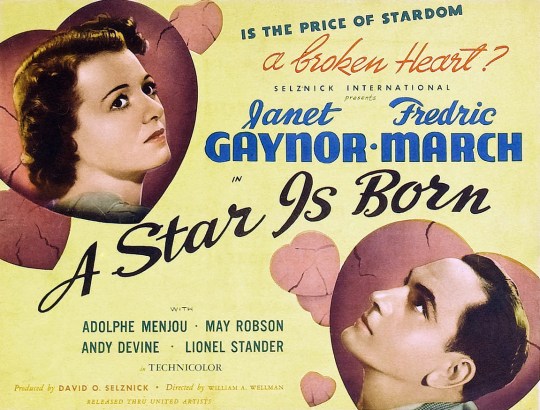
Poster - A Star is Born (1937)_02Directed by William A. Wellman

Surprise! There are extra posts this week! I miscounted the movies, and since I had a specific movie in mind for next week, I needed to finish 1937. So for your reading pleasure, I present The Rest of 1937.

I had a hard time getting hold of this movie, even though there are several copies of it in my library system. I had put it on hold, but it didn’t come in, so I called the customer service line to see what was going on. The lady on the other end said, “Oh, let me place that on hold for you again; it should spark the hold then. So you want A Star is Born? Oh, here it is. I just love Judy Garland in that movie. Wait. You don’t want the one with Judy Garland? You want Janet Gaynor? Are you sure that’s the one you want? It’s rather old.” She still sounded skeptical after I assured her that, yes, I was looking for the version with Janet Gaynor. I ended up having to call a coworker to grab a copy off the shelf at the library I work at so that I could get it. Yes, young people like old movies and just because something has been remade (and remade three times) doesn’t mean that the first one is obsolete.

So what’s the story? Young Esther Blodgett runs away to Hollywood with stars in her eyes, convinced that she will become a famous actress as soon as she gets there. Esther finds that it’s harder than she thought, but soon she catches the eye of the famous actor Norman Maine and finds herself shooting to stardom, even as Norman’s career begins to fail due to alcoholism.

The Good: I had only seen Janet Gaynor in silent movies before I watched A Star is Born. I had to check to make sure it was the same actress; she made such a good crossover to talkies that I felt a little unsure. Gaynor captures the spirit of Esther Blodgett as she goes from starry-eyed girl to mature woman. She also makes sure that the film doesn’t descend into melodrama.  Norman Maine, a man of humor and despair, is played to perfection by Fredric March. In his third role in an Oscar nominated movie in 1937, Adolphe Menjou plays Oliver Niles, Norman and Esther’s sympathetic agent. There was no type-casting for him, by the way. The three (large) roles he played in One Hundred Men and a Girl, Stage Door, and A Star is Born were all completely different. He did an excellent job in each.  I’m always glad to see Andy Devine, and he does a good job (as always) as Esther’s brotherly neighbor Danny (and he looks so young!). May Robson gives a sassy performance as Esther’s strong-willed grandmother Lettie.

The screenplay was co-written by one of my personal heroes: Dorothy Parker. Her trademark wit is scattered throughout. Again, although the story is a good one, A Star is Born could easily have become a melodrama. Thanks to Parker and her colleagues Alan Campbell and Robert Carson, the screenplay was able to help avoid that.

A Star is Born is a study in contrasts. The costuming, art direction, and music all work together to highlight Esther’s rise to stardom. Esther starts out as a girl from the sticks; her family lives in a small, plain house in the freezing mountains. She wears simple, practical clothes. The music that underscores these homely scenes includes familiar melodies, such as “Auld Lang Syne.” When she moves to Hollywood, her simple clothes stay the same, but her poverty is evident through her boardinghouse, which is old, cramped, and falling apart. Her neighbor Danny’s suits are of poor quality and always rumpled. The music here is rather sweet and innocent. The night that Esther goes to waitress at a party for Hollywood’s elite, everything changes. The suits and dresses of the wealthy are of a much better quality and cut, and of course of the highest fashion. The homes of the wealthy are also beautiful and fashionable, clean and open. They even have more modern telephones – and Oliver’s is even gold plated. The music is jazzy and fun, because these wealthy people seem not to have a care in the world. As Esther becomes a star, her clothes become more and more fantastic. At first they are of better quality, but still conservative. They get more fashionable the wealthier she gets. Esther and Norman’s house that they buy together is amazing, too. It has spacious rooms, beautiful gardens, and even a swimming pool. The music becomes much more sweeping and dramatic as Esther’s life fills not only with luxuries, but also difficulties. However, no matter how much life changes for Esther, she is still the simple farm girl inside. She’s obviously sending money home, because when Grandmother Lettie comes to remind Esther that Esther is strong and can get through anything, Grandmother Lettie is wearing fashionable old lady clothes instead of the old-fashioned country clothes she wore before Esther left. As her house empties out around her, the gentle music is a reminder that life can get better. Although not always the flashiest elements, the costuming, art direction, and music subtly add an extra dimension to the movie.

The Bad: The story on its own is a tad melodramatic. The theme of a country girl making it big and marrying the man of her dreams is not unfamiliar, but the story of Norman’s alcoholism could be a story written by a teetotaler in the 1880s. The title would be something like “The Evils of Drinking,” and it would detail the story of a wealthy man who ended up dying broken and alone because of his inability to give up alcohol. The original ending would have ruined the movie. Luckily, due to the screenplay and the excellent acting, A Star is Born avoids becoming a heavy-handed tale; it is instead a sensitive portrayal of an all-too-common issue.

The Ugly: There’s nothing truly horrible about A Star is Born; I had to reach to even find anything bad.

Oscars Won: Best writing, original story.

Honorary Oscar Won: W. Howard Greene, for the color photography.

Other Oscar Nominations: Best picture; best actor in a leading role (Fredric March); best actress in a leading role (Janet Gaynor); best director; best writing, screenplay; best assistant director.

Fun Fact: A Star is Born was the first all-color best picture nominee.


Stage Door (1937)

ORIGINAL-STAGE-DOOR-MOVIE-POSTERDirected by Gregory LaCava

I feel like the films from 1937 are trying to deceive me. We had a musical that wasn’t a musical (The Awful Truth), a film noir that wasn’t a film noir (Dead End), a historical movie that ended up being set in the present (Captains Courageous). Now with Stage Door, we get a movie that was promoted as a comedy (“The gaiety…glamour…foolishness and fun of showbusiness!”), but which has a too-serious ending.

So What’s the Story? The young women living at the Footlights boarding house all have the same ambition: stardom on the stage. Some are actresses, some dancers, some singers, but they’re all just waiting for that big break. Into this madhouse of laughter and rivalry comes the mysterious Terry Randall, who just doesn’t fit in. She’s too wealthy and too educated to understand these smart-mouthed girls. As she beings to settle in, she begins to see that much more is required for stage work than talent and pluck.

The Good: I have never seen Katharine Hepburn not a good job in a movie, but she is brilliant as Terry Randall. Standoffish and snobby at first, she learns to appreciate what her housemates are going through the longer she’s there. She loves them and sticks up for them. With a lesser actress, Stage Door would not have been the strong movie it is.

Many of the girls living in the boarding house would become famous actresses in later years. Ginger Rogers was already well known, of course. She is fabulous as Jean, Terry’s slightly bitter wise-cracking roommate. Gail Patrick was also famous at the time. She plays Linda, a woman who has decided that accepting advances from a man is better than struggling as an actress. Ann Miller is Annie, an optimistic girl who is Jean’s dance partner in a tap routine. Eve Arden plays Eve, a jaded young woman who wears her cat around her neck like a stole (yes, it sounds silly, but seriously, how did they train that cat?). The name that is perhaps more familiar to people now is that of Lucille Ball. She plays Judy, a girl from Seattle who is more interested in boys than auditions. All of these actresses are so funny; they deliver their quips at a whip-crack pace that somehow manages to seem natural. Each displays a distinct personality even though they all want the same thing.

There is one girl in the boardinghouse who doesn’t join in the fun, but is still sweet and kind. Kay is recognized as a great actress, but she has lost confidence in her abilities because she hasn’t had a part for over a year. Andrea Leeds plays the part with great sensitivity, showing Kay’s determination and desperation as she tries to get the part she was born to play.

Adolphe Menjou is in Stage Door, as well as being One Hundred Men and a Girl. 1937 must have been a busy year for him. However, he is not the sweet father that he played in One Hundred Men and a Girl, but a slimy stage producer who takes advantage of desperate girls who want to be stars. He is really, really good at being gross, unlikable, and debonair. It’s hard to see the kindly father in this smug, wealthy jerk.

The screenplay is quite good. It brings out the personalities and contrasts between each of the characters in a humorous way, but it’s also able to make tragedy personal and realistic. It’s not just a sunny comedic romp through a bustling girls’ boarding house; the screenplay shows the downsides and sadness of show business just as well as it does the humor. There isn’t exactly a happy ending, which makes the movie deeper and truer.

The Bad: With the quips flying quickly from every direction as the girls talk over each other, sometimes the lines get garbled. Everything is so funny that I want to hear everything they say, so it’s a little bit sad that they don’t all come out clearly.

Both Ginger Rogers and Ann Miller are in this movie, and there is no fantastic dance number to show off their skills. It might have been out of place. It may have slowed the movie down. But still. Two great dancers that don’t get a chance to show off their skills? It is a sad waste of talent.

The Ugly: Nope. Stage Door is really a well-done picture.

The Apology: I’m sorry that I kept referring to all the young women as girls. They are (mostly) all adults. I will use the excuse that they are always called “girls” in the movie, and so that’s what is in my head.

Oscars Won: None.

Oscar Nominations: Best picture; best actress in a supporting role (Andrea Leeds); best director; best writing, screenplay.

One Hundred Men and a Girl (1937)

One-Hundred-Men-and-a-Girl-PosterDirected by Henry Koster

Some things are definitely cute. Babies are cute. Puppies are cute. Pikachu is cute. But I hate it when people call other things cute: “That’s a cute book,” or “It was such a cute movie!” When people work hard on an artistic endeavor, they deserve to hear something more specific than the rather generic “cute”. As much as I hate it, though, I am going to have to use it now: One Hundred Men and a Girl is a cute movie.

So what’s the story? John Cardwell is a trombonist struggling to get work during the Great Depression. Every night, he waits outside the concert hall with the hope of meeting the great conductor Leopold Stokowski and getting an audition with him; however, he is never successful. After an encounter with some wealthy arts patrons who carelessly promise financial backing, his young teenaged Patricia decides she will get all the unemployed musicians together to form their own orchestra. Her grit and tenacity, along with much confusion, lead to a happy ending.

The Great: I know I don’t usually do a “great” section, but Deanna Durbin is so amazing that she needs special mention. The girl can sing. And by sing, I don’t mean that she can carry a tune or sing pop songs; Deanna Durbin had a beautiful operatic voice. She was only fifteen when One Hundred Men and a Girl was released in theaters, and it is hard to believe that she does her own singing. Not only could she sing, but Deanna Durbin could also act. She does a beautiful job in One Hundred Men and a Girl. There are moments when she’s talking fast because she’s so excited, but you can understand every word. She is completely convincing at every moment. This was my first experience with Deanna Durbin, and I remain completely blown away.

The Good: Deanna Durbin may have been the standout, but other great actors were involved in this movie. Adolphe Menjou gives a sweet performance of a man who has been ripped apart by the world, but is willing to hope again for his daughter’s sake. He goes from hopeless to grudgingly hopeful to exultant as the movie goes on. Mischa Auer brings enough humor as Michael to offset the hopelessness of the beginning. Frank Jenks brings some happy seriousness as the encouraging taxi driver, and Alice Brady is fabulous, darling as the rather thoughtless Mrs. Frost. Leopold Stokowski is a surprisingly good actor for a conductor. I have seen other real-life conductors/musicians/dancers in movies, and they are often not convincing, but Stokowski was a good actor as well as being a wonderful conductor.

The story was good. It brought the plight of people out of work because of the Depression into the forefront. It showed the good people who wanted to work, but just couldn’t find anything. It also showed the thoughtlessness of the rich. Mrs. Frost makes an impulsive promise to a young girl, then promptly forgets about it and goes out of town. She doesn’t really care about Patricia; she sees Patricia as something interesting and new in her dull, expensive life. The wealthy men who play practical jokes on each other are just as bad. While the poor are playing poker using matchsticks, these rich men bet significant amounts of money on who has the better joke. It idealizes the honest poor while uncovering the faults of the uncaring rich.

The music was awesome. I’m not sure how it was nominated for original score; most of the music was classical music. But it was amazing. I would have given them an award for best use of classical music in a musical score. The music person (not sure who it was, because there’s not really a credit for it) matched the classical music to the action perfectly. I’ve never seen it done better.

 The Bad: As talented as Deanna Durbin is with both singing and acting, she has no talent for lip-syncing. By saying she’s lip-syncing, I in no way mean to imply that she is not doing her own singing. She’s just lip-syncing to her own pre-recorded singing. And she’s bad at it. At first I just thought the audio was off, but no. It’s Deanna Durbin.

Both Patricia and her father are constantly trying to get past the doorman at the theater where Stokowski works. It gets old after a bit. Repeated jokes are not as funny as people think they are.

Why do I call One Hundred Men and a Girl cute? Because it’s a well-done, happy movie with not much depth. It’s too simplistic to be anything but cute. It’s a movie you would watch when you’re feeling down and don’t want to think too much. It’s fun, but not extraordinary. It’s just…cute.

The Ugly: There is nothing ugly about this movie. It’s too cute to be ugly.

Oscar Won: Best music, score.

Other Oscar Nominations: Best picture; best writing, original story; best sound, recording; best film editing.

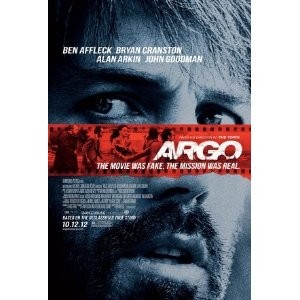
Argo (2012)

Directed by Ben Affleck

Okay, so argoit’s been awhile again. Apparently, because I wrote about my depression and how it was doing so much better in my Silver Linings Playbook post, my depression decided to remind me how powerful it actually can be. So yeah. Sorry if you’ve been waiting and hoping and wishing for my Argo review and my wrap-up of 2012; I’ve been trying not to slit my wrists. But at least I’ve been successful!

As I said in my Zero Dark Thirty review, I was excited for the 2012 movies because I got to watch two action movies that had been nominated for best picture. But just like Zero Dark Thirty, Argo is also not an action movie. It’s exciting, and it’s fun, and it has wonderfully tense moments, but it’s not an action movie. I think I might have watched the only action movie ever nominated when I watched Raiders of the Lost Ark. Argo is a fantastic movie, and I truly enjoyed it, but it’s not an action movie. It was also weird watching it on the heels of Zero Dark Thirty because they are so similar. Both movies are more spy film than action flick, both are based on true stories, both take place in the Middle East, both even have Kyle Chandler. So while I recommend seeing both films, don’t watch them back to back.

So what’s the story? During the takeover of the American embassy in Iran in 1979, six Americans manage to escape to the home of the Canadian ambassador. As the occupation of the embassy drags on, the U.S. government tries frantically to come up with an idea to get the six out before the Iranians realize that they aren’t in the embassy with the other civil servants they have taken hostage. Tony Mendez, a CIA officer whose job is extracting people from bad situations, finally comes up with “the best bad idea”—produce a fake movie, complete with screenplay, casting, and movie posters. He will then fly to Iran to “scout locations” and fly back with the six Americans as members of the production company. It’s a risky plan; can they pull it off?

The Good: I don’t know the term for what I’m about to admire, but I love that Argo looks like a movie from the late seventies or early eighties. The film quality is grainier, less sharp than current movies. No high definition here! I liked that the old Warner Brothers logo was used at the beginning of the film, too. It was a small thing, but helped set the tone for the movie.

Argo was a well-cast film. Everyone from Ben Affleck as Tony Mendez to John Goodman as legendary make-up artist John Chambers to Bryan Cranston as Mendez’s boss, Jack O’Donnell was fantastic. I was especially glad to see Victor Garber playing a sympathetic character (the Canadian ambassador) for once. He seems like the nicest man, but in the movies I’ve seen him in, his characters are always jerks (Mayor Shinn in The Music Man, the lecherous professor in Legally Blond, the money-grubbing lawyer in Eli Stone). Alan Arkin is a delight as the “producer” of Mendez’s movie, and the people playing the six non-hostages were also good. I didn’t feel like there was a false note in the casting.

The pacing of the movie was great. The director managed to keep the feeling of a lot of time going by balanced with the tension of having to get the people out. It would have been very easy to err in either direction – either with the movie dragging as the hostages stayed inside for months, or with the action happening too quickly to be believable.

Even though I feel like I know more about history than the average American, I didn’t know much about the Iran Hostage Crisis. We didn’t tend to get to more recent things in any of my history classes just because there was so much to cover in a year, and I wasn’t alive when it actually happened, so I appreciated the overview of the modern history of Iran at the beginning. Some of the movie wouldn’t have made sense without that background.

Alexandre Desplat’s score was a haunting, beautiful mix of Middle Eastern and Western music. It was subtle enough to underscore the drama of the situation without being overwhelming.

The Bad: While the casting was all good, I had a hard time keeping the six escapees straight. They didn’t get enough screen time for the viewers to understand their characters, so they all kind of blended together. I would have liked to have seen more of John Goodman and Alan Arkin and the Hollywood end of things, also. I feel like a lot of that was glossed over to give Ben Affleck more screen time and make Mendez seem more heroic.

Because I put off writing this review, I had to watch Argo twice in order to feel like I could give it an honest, helpful review. The first time, I loved it. It was one of those moments when you want to tell everyone you know that they should see it. A few weeks later, when I saw it for the second time, I just couldn’t get into it. I already knew what was going to happen, so there was no tension for me. This seems to be a flaw in the movie, but I can’t put my finger on why I didn’t care so much the second time around. It might be because I felt no connection to the characters; I’m not sure. But I feel like a movie that is named the best picture of the year should be able to be enjoyed more than once.

The Ugly: I didn’t find anything bad enough about Argo to be in this category. It’s flaws were minor.

Oscars Won: Best motion picture of the year; best writing, adapted screenplay; best achievement in film editing.

Other Oscar Nominations: Best performance by an actor in a supporting role (Alan Arkin); best achievement in music written for motion pictures, original score; best achievement in sound mixing; best achievement in sound editing.

Silver Linings Playbook (2012)

silver linings playbookDirected by David O. Russell

I’ve mentioned before that I have mental health issues; depression is what I have to put up with. It’s not fun, and it’s not easy. It has been especially hard in the past because mental illnesses aren’t something you talk about. If you tell someone you have cancer or diabetes, they will sympathize with you, whereas there are still people out there who don’t believe that depression is a real thing. “Just look on the bright side,” they say. “Go running. Eat better. You’re just feeling down.” But people who are just having a bad day don’t seriously fantasize about slitting their wrists or driving their car off a cliff. They haven’t written letters to their families explaining why they felt the need to do this. People who are just feeling down don’t skip their favorite activity of the year for which they have VIP passes because they are crying all day for no particular reason and can’t stop. They don’t sit and think about how worthless they are and how no one really would miss them if they were gone and how their pets would really be happier with another family anyway. Yes, everyone has off days now and then, but for me, those things were my reality. Every. Single. Day. Now that I’ve found an antidepressant that works for me, those things are thankfully not a part of my life as often as they were, but this is why I appreciate movies like Silver Linings Playbook that bring to life people struggling with real issues that are so misunderstood. It’s also why I started this movie three or four times before I could actually watch it all the way through and why I still wouldn’t have seen it if it weren’t for my medication. It’s too real and too painful, too hard to watch when I wasn’t doing well. Sorry for the very long ramble, but it’s a subject close to my heart and I apparently had a lot to say about it.

So what’s the story? Pat Salitano has just been released from a mental institution after fulfilling a court-ordered eight month stint there. He is determined to get his life back to normal and win back his ex-wife, Nikki, who has not only left him, but gotten a restraining order against him. He meets a young woman named Tiffany who wants him to join a dance contest with her. Hoping that this will show Nikki that he has turned his life around, Pat agrees.

The Good: The acting was wonderful. Bradley Cooper as Pat, Jennifer Lawrence as Tiffany, and Robert De Niro and Jacki Weaver as Pat’s parents were amazing. I loved the subtle hints in Robert De Niro’s acting and character that showed that he, too, was dealing with mental health issues, although they were undiagnosed in his case. I thought that casting grumpy-faced Julia Stiles in the part of Veronica, a woman not really satisfied with anything, was brilliant, and I also liked John Oritz in the role of Ronnie, Veronica’s husband.

The music fit the movie perfectly, just kind of laid-back piano and guitar music. Nothing overblown or loud or fancy, because the story isn’t any of those things. It’s a small, intimate story about people working through their problems and finding out that when dreams die, it’s okay to find new ones.

I liked the screenplay. It made all the characters very real, not caricatures of people with mental illness. Or of people living in Philadelphia, for that matter. It helped make the people come alive. I appreciated, too, the humor in the screenplay. Yes, mental illnesses are serious, but funny, random things happen to everyone, regardless of their health. Also, I have felt the same way as Pat about Hemingway (and other authors) at times, so I loved that someone finally said it.

The Bad: I don’t really have anything to complain about here. I really liked the movie, except for two issues that were so bad for me that they have to go in the ugly category.

The Ugly: The age difference between Jennifer Lawrence and Bradley Cooper bothered me throughout the entire movie. I didn’t know at the time what the age difference was, but I would have put Pat at 42 and Tiffany around 23 just looking at them. There is really only a fifteen year age gap between Bradley Cooper and Jennifer Lawrence, but still. It felt kind of icky to me. While Jennifer Lawrence did a fabulous job, I would have been happier with someone a little older.

I would have been fine with it, though, except for the ending.  (SPOILER ALERT) I talked myself into being okay with the age gap because they were just friends, two people who were dealing with similar issues. Age isn’t as big an issue there. But then they were shown being in love and having a relationship, and I didn’t like that. It didn’t seem to fit the movie. I really, really wanted them to just stay friends. I wanted them to each know that they had someone they could depend on who understood them, but somehow by having them fall in love, it cheapened the movie for me. That ending made it seem that unless a man and a woman fall in love, their relationship is pointless. The movie became just another romantic comedy instead of a comedy about people dealing realistically with mental issues, and that bothered me. Silver Linings Playbook is still worth watching, but it became less meaningful to me personally.

Oscars Won: Best performance by an actress in a leading role (Jennifer Lawrence).

Other Oscar Nominations: Best motion picture of the year; best performance by an actor in a leading role (Bradley Cooper); best performance by an actor in a supporting role (Robert De Niro); best performance by an actress in a supporting role (Jacki Weaver); best achievement in directing; best writing, adapted screenplay; best achievement in film editing.

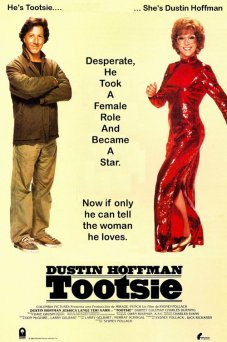
Tootsie (1982)

tootsieDirected by Sydney Pollack

I had seen Tootsie before, when I was probably ten or eleven. At that time in my life, I just thought it was weird. Why in the world would a man dress as a woman? Why could nobody see that Dorothy was a man? I didn’t understand the gender politics at play, either, so I was just left with an impression of oddness. This is why eleven-year-olds shouldn’t review movies made for adults. Tootsie is fabulous and hilarious and still relevant today, which is honestly kind of sad. There should have been more progress made in equality in the workplace in the last thirty-three years.

So what’s the story? Michael Dorsey is an actor who can’t get work. Even though he’s good, he has a reputation of being difficult to work with. Desperately in need of money, Michael decides to become Dorothy Michaels in order to try out for a role on a soap opera that a female friend didn’t get.  Michael soon finds out that when he puts on his dress and his makeup, he also puts on a different personality as Dorothy, inadvertently becoming a crusader for women’s rights. He also finds himself falling for his female coworker, but he can’t tell her who he really is. Will Michael be able to pull off his deception? Does love really conquer all? And will Michael ever lend his dresses to Julie?

The Good: The screenplay is brilliant. Both funny and meaningful, it manages to show Michael’s growth as a person without ever being preachy or obvious. It’s a tough balancing act, and the screenwriters pulled it off. After I watching Tootsie, I’ve been thinking about why more comedies aren’t nominated for best picture; watching lots of heavy dramas isn’t always the most fun. I’ve decided that it’s because the best movies introduce you to a new idea or make you think, and it is much easier to do that with a dramatic story than with a comedic one. The writers for Tootsie managed that, partly by letting the characters in the movie be real people, who sometimes get off killer zingers and who sometimes have no idea what to say. I love it. (Incidentally, this is one of the few times that I have recognized the name of a screenwriter as it flashed on the screen during the opening scenes: Larry Gelbart is one of the writers and producers of the television show M*A*S*H*, which is grew up watching with my parents and then grew to appreciate when I watched reruns on the Hallmark Channel in college. M*A*S*H* balances comedy with hard topics in the same way.)

The acting is fabulous all around. Dustin Hoffman plays Michael Dorsey and Michael Dorsey playing Dorothy Michaels so well that it’s indescribable. It’s a performance that needs to be seen, not just talked about. Teri Garr is wonderful as Sandy, the friend whose role Michael steals. She’s frustrated as an actress and as a woman, but she has hope that maybe things will get better. I love the role, and I love Teri Garr in it. Charles Durning plays Les, a man who falls in love with Dorothy. His reactions later on in the movie are priceless. Bill Murray is Jeff, Michael’s sarcastic playwright roommate. George Gaynes plays John Van Horn, the star of the soap opera who believes that he has the right to kiss all of his female coworkers. Michael’s bewildered agent is played by Sydney Pollack, who also directed the movie. Even the small roles are incredibly well-played. It’s one of those casts that melds together well and plays perfectly off each other. I love it.

The makeup is very good. Dustin Hoffman is listed twice in the credits, both as Michael Dorsey and as Dorothy Michaels. I think that decision was made because Dustin Hoffman is basically unrecognizable when he’s made up as Dorothy. It’s quite the feat.

The Bad: For being a movie about women being powerful, Julie and Sandy are both kind of stereotypical and weak. Sandy gets weepy and hysterical often at the drop of a hat, and Julie doesn’t have much personality. She’s brave to have a baby on her own in the 1980s, and she’s a sweet girl, but she doesn’t go very deep. It’s kind of disappointing that the only woman who is very strong and who bucks female stereotypes is a man.

The Ugly: The soundtrack is everything that is bad about ‘80s music. I’m not sure how it sounded originally, but it hasn’t aged well. The theme song (“It Might Be You”) is over-synthesized, which makes it super-cheesy. It might be a beautiful song if it was a bit more simplified, but it nothing about the 80s was simple or subtle, and the music in Tootsie suffers because of that.

Oscar Won: Best supporting actress (Jessica Lange).

Other Oscar Nominations: Best picture; best actor in a leading role (Dustin Hoffman); best actress is a supporting role (Teri Garr); best director; best writing, screenplay written directly for screen; best cinematography; best sound; best film editing; best music, original song (“It Might Be You”).