I'd like to spank the Academy

Posts tagged ‘romantic’

The Quiet Man (1952)

the-quiet-man-movie-poster-1952-1010203160Directed by John Ford

 As a librarian, I spend a lot of time using the alphabet, so yes, I realize that I by reviewing The Quiet Man today, I am doing things out of order. But Maureen O’Hara died on Saturday, and I’ve been thinking about her and her movies a lot the last couple of days. Because of Miracle on 34th Street and The Parent Trap (the originals of both, NOT the inferior remakes), I grew up admiring Maureen O’Hara as a strong, beautiful woman, completely unafraid to be herself, no matter what society thought. After reading obituaries and tributes to her the last couple of days, I get the feeling that she truly was that way. Since Maureen O’Hara plays another beautiful, strong woman in The Quiet Man, I’m posting my review of it today as my little tribute to a wonderful actress.

I grew up watching John Wayne movies, so I’m not sure how I missed this one. No, it’s not a Western, but I’d seen lots of other non-Western John Wayne movies. But even though I had never actually seen The Quiet Man, I had seen E.T. the Extraterrestrial, so I was really excited to finally know which movie included the dramatic kissing scene that E.T. watches on TV. It was a gap in my movie trivia knowledge, and I was ecstatic to have it filled in. Beyond that bit of trivia, I was glad to finally see The Quiet Man for another reason: it’s a dang good movie!

So what’s the story? Sean Thornton left Ireland for America with his parents when he was three years old, but his mother always talked of Ireland as if it were paradise, so he decides to move back and buy the cottage where he was born. He sees fiery-spirited redhead Mary Kate Danaher as soon as he steps foot in the village of Innesfree and decides that she is the girl for him. Unfortunately, Sean offends Mary Kate’s brother almost as soon. Although Mary Kate makes no secret about her reciprocation of Sean’s feelings, will her brother and her Irish customs keep them apart?

The Good: I’m going to mention cinematography first, because this movie is so beautiful that it literally made me cry. During the race, when the horses are pounding across the beach with the green mountains in the background…oh, it’s amazing. I can’t even begin to describe the beauty of it all. I know that Ireland is beautiful, but photographers still have to have an eye to capture the beauty, and the cinematographer did a fabulous job.

This movie is perfectly cast. I can’t think of another actress who could have done a better job at playing Mary Kate than Maureen O’Hara. She’s strong and proud and just plain wonderful. John Wayne is good as always as the man who is trying to live his dream, but who just doesn’t understand the culture of the woman he loves. He’s confused and frustrated, but so wholly in love. John Wayne and Maureen O’Hara were good friends in real life, and they have excellent on-screen chemistry.

The supporting cast is also so good. Ward Bond makes a surprisingly convincing Irish priest. Victor McLagen, although perhaps a little old to look like Maureen O’Hara’s brother, is full of bluster and silly pride as Will Danaher. Barry Fitzgerald brings a fabulous sense of humor to the role of Michaleen Oge Flynn, and his real-life brother Arthur Shields is excellent as the Protestant Reverend Cyril Playfair. Mrs. Playfair, played by Eileen Crowe, is mischievous and fun. I love them all!

The musical score is gorgeous. Victor Young used a lot of old Irish melodies, but also wrote some beautiful themes of his own. The music complements the movie perfectly.

The story and screenplay are fabulous. I’m not a huge fan of romantic comedies in general, because they’re just so fake. But The Quiet Man is so real. Two proud, stubborn people fall in love, but have a hard time adjusting to each other. Even though they love each other, they don’t completely understand one another. Movies don’t usually show that. Romantic comedies also tend to end with the wedding as the happy ending, but The Quiet Man is not like that. I wish more moviemakers would be brave enough to tell a real story like this one.

The Bad: Because I am a modern woman, I was incredibly uncomfortable with the scene where Sean drags Mary Kate off the train and pulls her across the fields and through the village. Yes, she was asking something of him that he didn’t want to do, but he wasn’t trying to understand her culture, either. Also, I’m not sure how accurate the Irish culture was portrayed. It felt very stereotypical to me, but maybe the stereotype happened because of reality. I don’t know. I just had to turn off the cultural sensitivity part of my brain, and then I was okay.

The Ugly: Nothing, unless you are even more sensitive than I am about the dragging through the fields scene.

Oscars Won: Best director; best cinematography, color.

Other Oscar Nominations: Best picture; best actor in a supporting role (Victor McLaglen); best writing, screenplay; best art direction-set direction, color; best sound, recording.

Random Fact: Even though The Quiet Man won an Oscar for best color cinematography, I once had a library patron who refused to check out the copy we have because it wasn’t in black and white, which, according to her, was the original. I did some research and apparently, ABC only had a black and white print, so that’s what was shown on broadcast TV for a while. The patron never did believe me that The Quiet Man was originally in color. Sigh.

High Noon (1952)

high noonDirected by Fred Zinneman

I love westerns. It’s probably because I watched so many of them growing up that now they make me feel like a little kid again. Whatever the reason, I’m always glad when they show up on the list of best picture nominees. However, High Noon isn’t exactly a western. It’s a thriller that just happens to take place in the Old West. It’s about relationships and small towns and above all, people. I’ve seen it before, but it’s always exciting to watch.

So what’s the story? Will Kane has just married his Quaker sweetheart and given up his marshal’s badge when he gets a telegram that Frank Miller, a murderer that he arrested, has been let out of prison. He’s set to arrive on the noon train and hell-bent on getting revenge on the man who sent him to prison. Miller’s old gang is already waiting for him at the platform. Realizing that a true man faces his problems, Will refuses to run, but can he get the help he needs from the townspeople he’s protected in the past?

The Good: High Noon happens in real time. It’s about 10:40 when Marshal Kane gets his telegram, and an hour and twenty minutes later in real life, the train comes in. This adds to the tension in a way that very few things could have. I’m not sure if High Noon was the first movie to use this tactic, but it’s very effective.

The editing is fantastic. I love really good editing, but sometimes I feel like good editing can be hard to spot. Every once in a while, though, I’m blown away by it. That’s what happened in High Noon. After all the tension has built up and the train is finally coming into town, there are shots of all the different groups waiting for the train to stop. The editing makes that part of the movie so stressful. It’s awesome.

Once again, the acting is superb (can a movie be nominated for best picture without having at least some good acting?). Gary Cooper plays Will Kane, a man committed to his path even though it may cost him the woman he loves. Grace Kelly plays his bride, Amy, who is understandably frightened at the prospect of losing her new husband. Bitter deputy marshal Harvey is played wonderfully by Lloyd Bridges. Even Henry Morgan (aka Colonel Potter in M*A*S*H) has a small role. But the standout actress in High Noon is Katy Jurado as Helen Ramirez. She is ridiculously good in her rather complicated role.

Helen Ramirez is actually another wonderful thing about this movie. Minorities in westerns generally only have tiny roles, and they are usually horrifically stereotypical. However, while Helen is a scarlet woman, she is smart, strong, passionate, and fair. She isn’t scared of anything and she doesn’t take anything from anyone. I love her. She’s a great character.

The cinematography is great. It manages to highlight Will’s forced solitude and the attitudes of the people surrounding him. It does what good cinematography should do.

The Bad: There is nothing bad about High Noon. Everything about this movie is either on fabulous or horrifically bad. I suppose I could say that it’s not fun to watch Thomas Mitchell, one of my favorite character actors, not be awesome. That’s just how the story goes, though.

The Ugly: The title song is awful. I think I could have rationalized it as a 1950s cowboy song if it weren’t for the fact of these two lines:

He made a vow while in state prison
Vowed it would be my life or his’n.

I think it should be a crime against the arts (is that a thing? Can we make it one?) to use “his’n” as a rhyme for “prison”. Bad, bad, bad. Even then, I might have been able to make my peace with it if bits of the song (including that line) didn’t keep playing throughout the movie and reminding me of its existence. The musical score by Dimitri Tiomkin itself is very good, but this song… So bad.

Oscars Won: Best actor in a leading role (Gary Cooper); best film editing; best music, original song (“High Noon [Do Not Forsake Me, Oh My Darlin’]”); best music, scoring of a dramatic or comedy picture.

Other Oscar Nominations: Best picture; best director; best writing, screenplay.

Moulin Rouge! (2001)

moulin rouge!Directed by Baz Luhrmann

I was a freshman in college when Moulin Rouge! came out, and I had a friend who was obsessed with the soundtrack. Whenever we would go and hang out and play games at his apartment, that CD would be playing. It made watching the movie kind of surreal; the music had seeped into my subconscious without my knowledge. I knew all the music, but I had never seen the movie before (overprotective friends again), so I had a strange sense of déjà vu. I’m not sure that helped my general perception of the movie, which was of noise, color, and oddness.

So what’s the story? Young Christian comes to Paris from Great Britain so that he can write about the Bohemians ideals of truth, beauty, freedom, and love. At the famous nightclub Moulin Rouge, he meets and falls for Satine, a performer/prostitute who has dreams of being a real actress. Will they be able to find happiness in the noisy, colorful life that is Paris?

The Good: There was some good acting. Nicole Kidman did a nice job as Satine, even if I did think she was Amy Adams ninety percent of the time. Jim Broadbent was excellent as Zidler, the owner of the Moulin Rouge, who is sympathetic to Satine and Christian’s love, but who also wants his own dreams to come true. Ewan McGregor is a little bit nondescript as Christian at the beginning of the movie, but he does jealousy and heartbreak well towards the end. Toulouse-Lautrec is played by John Leguizamo, who does a good job of showing the yearning for a love that he will never have.

Before I talk about the cinematography, I want to make something clear. I don’t get carsick. I don’t airsick or seasick or rollercoaster sick. But I have known to get sick from certain visual stimuli. I can’t play first-person shooter games, for example, or any first-person games, really. I have run, not walked, out of IMAX movies because I was about to be sick. Moulin Rouge! did the same thing to me. The jerky, constantly moving cinematography did not make agree with my stomach. Or with my head. So I was watching Moulin Rouge through a haze of headache and stomachache. But just because I didn’t like the cinematography and it didn’t agree with my stomach doesn’t mean the cinematography is bad, per se; it’s creative and different and fits with the whirling gaiety of the nightclub. I just didn’t personally like it. I wish I had a section called “Things I didn’t personally like, but can respect for their artistry.” That would make writing reviews easier sometimes. But I since I didn’t feel it was bad, I’m going to leave cinematography in the good category.

The makeup and costumes and production design were over the top and crazy, but so were the lives of the denizens of the Moulin Rouge. Like the crazy cinematography, it worked for the film and what the filmmakers were trying to do accomplish. Again, I’m not sure I liked it that much, but it was admirable.

The Bad: The music rubbed me the wrong way. Yes, it is very clever to use modern music in a movie that takes place over a hundred years ago, but I feel like the filmmakers were a little too clever sometimes, like they were drawing attention to their own cleverness. I feel like they were saying, “Look how clever we are! We used ‘Smells Like Teen Spirit’ to show how immature all these men are who frequent nightclubs! Aren’t we smart?” It became more of a gimmick than something meaningful.

The Ugly: The story was terrible, unoriginal, and uninspired. It was kind of a cheap rip off of Cabaret combined with La bohème. (Possible spoilers ahead) Christian and Satine fell in love for no reason at all. The Duke was silly and not believable as a real person. Also, if you were coughing up blood in 19th century Paris, you knew you were dying of consumption. Tuberculosis wasn’t uncommon then. And while I’m no expert, I’m pretty sure that if you are about to die from tuberculosis, you don’t have the energy to appear in a musical theater production, especially not one based in India with lots of high-energy dancing. The ending is curiously flat. The movie as a whole feels more like an excuse to do crazy musical numbers with modern music than a movie that has anything meaningful to say.

Oscars Won: Best art direction-set decoration; best costume design.

Other Oscar Nominations: Best picture; best actress in a leading role (Nicole Kidman); best cinematography; best film editing; best makeup; best sound.

The Red Shoes (1948)

red-shoes-02Directed by Michael Powell and Emeric Pressburger

This was another movie I first saw on Turner Classic Movies (TCM) about ten years ago. I wonder now if they were spotlighting the movies from 1948, because it seems strange that I would have seen both The Snake Pit and The Red Shoes at the same time if they weren’t. Anyway, when I saw The Red Shoes then, I liked it so much that I when I was home from college on a break, I checked it out from the library and made my younger sisters watch it. I was kind of excited to see it again, but I didn’t like it nearly so much this time around. That made me wonder what has changed about me or my tastes. I’m not sure what it is, but whatever happened in the last ten years, I noticed some definite weaknesses that I hadn’t noticed before.

So what’s the story? Two young artists, composer Julian Craster and dancer Victoria Page, are taken under the wing of ballet master Boris Lermontov. With his guidance and support, both are able to soar to new heights in their respective arts. But when Julian and Victoria fall in love, they will have to live with the consequences of their choices.

The Good: The dancing is beautiful. Moira Shearer, who played Victoria, was a ballerina, not an actress. Her acting is competent, nothing special, but her dancing is glorious. Leonide Massine is Ljubov, the choreographer/featured performer (sorry, I don’t really know ballet terms) of Ballet Lermontov. He’s a fabulous dancer (and a very good actor).

Most of the acting isn’t anything special, but Anton Walbrook does an excellent job as Boris Lermontov, the man who cares about his ballet company more than anything in the world, who only values people for what they can contribute to his art.

I loved the music. The composer, Brian Easdale, had to not only write a score, but also music for ballets. It was all really very lovely.

The Bad: The Red Shoes ballet kind of annoyed me. There were a couple of special effects (like the red shoes suddenly appearing on Victoria’s feet, magicked on by the shoemaker) that wouldn’t have really worked in a real stage ballet. I hate it when a movie is supposed to be showing something real, but takes advantage of movie special effects. It’s cheating. And stupid.

The Ugly: When you take a creative writing class, one of the first things you learn is “Show, don’t tell.” That means that you shouldn’t say, “Victoria and Julian are madly in love;” you should actually show them talking together more than once. You should show meaningful looks and lingering hand holding. This rule should apply to movies, but the writers of The Red Shoes apparently had never heard of it. The love story was extremely weak, which made it hard to believe the rest of the movie. I’m not sure how I missed that the first time around, but I must not have been as discerning when it comes to love stories ten years ago as I am now.

Oscars Won: Best art direction-set decoration, color; best music, scoring of a dramatic or comedy picture.

Other Oscar Nominations: Best picture; best writing, motion picture story; best film editing.

Johnny Belinda (1948)

johnny-belinda-movie-poster-1948-1020435490Directed by Jean Negulesco

When I was a little girl, my family always had a copy of Leonard Maltin’s Movie Guide on hand. This was in the days before IMDb, and we liked to look up people who looked familiar in movies to figure out what other movies they had been in. In the back of the books was a list of the Oscar winners for best picture, actor, actress, and director for every year. Johnny Belinda was on that list because of Jane Wyman’s win, but that was all I knew about the movie before I saw it. I had a vague idea it was about a boxer; I’m not sure why. It most definitely is not. It’s a beautiful and moving story about people in a small town.

So what’s the story? Dr. Robert Richardson is the new doctor in a small fishing village in Nova Scotia. He goes out to the mill to help the mill owner and his sister deliver a calf. There he meets Belinda, the owner’s daughter, who is a deaf-mute. Because she can’t communicate, everyone in town assumes she is mentally incapable, but the doctor recognizes her intelligence and teaches her lip-reading and sign language. Belinda begins to blossom under his tutelage, but when she is raped and becomes pregnant, the town turns on her and the doctor.

The Good: Johnny Belinda was deservedly nominated in all four acting categories. Jane Wyman plays Belinda with sensitivity and tact, never over-acting. It’s a fabulous performance. Lew Ayres is the outsider doctor who ties to a more modern society allow him to help a woman who would have been stuck in her own world for her entire life. Belinda’s father is played by Charles Bickford. He grows from an impatient, rather uncaring father to a man who is proud of his smart, beautiful daughter. Agnes Moorehead, perhaps best known for her role of Endora in Bewitched is Belinda’s aunt Aggie. Aggie isn’t impressed with Belinda’s progress and is unkind to Belinda until Belinda becomes pregnant. At that point, Aggie becomes protective and loving. It’s a quick turnaround, but it’s very realistic. All of those performances were fantastic. And they weren’t the only ones. Stephen McNally is nicely creepy as the cocky Locky McCormick (and yes, his name is Locky, not Lucky; it’s short for Laughlin, apparently), and Jan Sterling plays the vain, pettish Stella perfectly. The whole movie is very well-cast.

The screenplay was also excellent. The story is sad, yes, but there were moments of humor, because that’s life. I loved the part where Dr. Richardson takes Belinda into a bigger city to see a doctor about her deafness. She looks into the window of a store and sees a brassiere for the first time. She has no idea what it is, and asks Dr. Richardson to explain it to her. He has no words for her, and the look on his face is priceless. Moments like that keep the movie from being too depressing. The subject matter is not easy, but the screenplay treats it sensitively. It’s very well done.

The music underscores the movie well. It helps plot Belinda’s moods and her growth as she becomes more a part of her world. The cinematography helped with that, too. Both elements added a lot to the movie.

The Bad: I had a hard time figuring out what time period the movie was set in. The townspeople didn’t look particularly modern, but the doctor’s clothes were completely 1940s. But then I thought about my grandma. She grew up in a small cabin in backwoods Tennessee in the 40s. Her family didn’t have electricity until after World War II. I’m sure her family wasn’t wearing the latest fashions, either. So although it took me awhile, I don’t have a major beef with it. If you’re aware that it’s contemporary to the time that the movie was made, it shouldn’t bother you at all.

The narration at the beginning bothered me, but I can’t think of another way they could have established some of the background without a lot of conversation that would have seemed kind of stilted and pointless, so I guess I can’t really complain.

The Ugly: I have never seen a more obvious stunt dummy than in this movie. I know this movie was made in the 1940s, but still. Real bodies don’t move like that. It makes a high-tension moment a little less dramatic.

Oscar Won: Best actress in a leading role (Jane Wyman).

Other Oscar Nominations: Best picture; best actor in a leading role (Lew Ayres); best actor in a supporting role (Charles Bickford); best actress in a supporting role (Agnes Moorehead); best director; best writing, screenplay; best cinematography, black-and-white; best sound, recording; best film editing; best music, scoring of a dramatic or comedy picture.

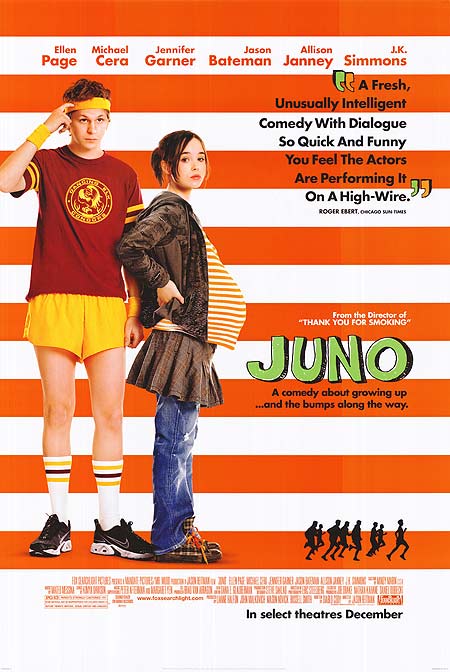
Juno (2007)

JunoDirected by Jason Reitman

When people rave about a quirky independent comedy, I always worry a little. Is the movie really that good, or are people afraid to say they don’t like it for fear of being seen as uncool or unsophisticated? Because let’s face it, not every independent movie is good. Some are downright boring. But because they aren’t made by the established Hollywood studios, independent movies are seen by a certain set of people as being automatically amazing. Then more and more people jump on the bandwagon and suddenly this independent movie is the best movie ever made, according to popular opinion. And then I watch it and I have no clue what everyone sees in it. (Sorry for the tirade. I just hate pretentious people.) Anyway, that wasn’t the case with Juno. It’s a fun, funny, enjoyable movie–and I’m not just saying that to please the hipsters.

So what’s the story? Sixteen-year-old Juno has sex for the first time with her best friend/unacknowledged crush Paulie Bleekman and ends up pregnant. She goes to get an abortion, but just can’t do it. She decides to put the baby up for adoption. She looks for potential adoptive parents in the Penny Saver ads and finds Vanessa and Mark, a seemingly perfect couple. Juno hits it off with Mark right away, but has a harder time connecting to the worried, perfectionist Vanessa. But there are many surprises in store for everyone during Juno’s pregnancy.

The Good: I like the cast. Ellen Page makes a very believable sixteen-year-old who’s trying to figure out life. Michael Cera is at his awkward best as Paulie Bleekman. Jennifer Garner is delightful as uptight Vanessa. Jason Bateman captures just the right attitude as Mark, the man who’s not ready to grow up. Allison Janney is Bren, Juno’s dog-obsessed stepmom who is still unsure of her relationship with Juno, but is willing to support her to the end. I decided I wanted to be friends with J.K. Simmons when he wore a fedora to the Oscars this year; Juno makes me want to be his friend even more. As Juno’s dad, he’s a little rough around the edges, but he loves his daughter and will do anything for her. So yeah. The cast was awesome.

I liked the music, too. I like happy acoustic guitar music. Does that make me a hipster? Ugh! I am having so many mixed feelings about liking anything about this movie.

The screenplay was excellent. Diablo Cody managed to make the viewer like Mark and hate Vanessa at first and then slowly reverse position. That was very clever. There were a lot of good, funny lines, too. Very well done all around.

The Bad: Leah didn’t fit in the movie. She was funny, and the actress was good, but the friendship didn’t feel real. In my experience, cheerleaders aren’t BFFs with quirky, semi-loner musicians.

The Ugly: I didn’t find any in Juno. There were some awkward moments, but awkwardness is a part of adolescence. Juno herself was a little more clever and self-confident than most high school juniors I’ve met, but it’s a movie.

Oscar Won: Best writing, original screenplay.

Other Oscar Nominations: Best motion picture of the year; best performance by an actress in a leading role (Ellen Page); best achievement in directing.

Atonement (2007)

Atonement-movie-posterDirected by Joe Wright

It was five or six years ago when I read Ian McEwan’s novel Atonement, but it has stayed with me. Even though I liked the writing style and thought that the characters were very well drawn, it was a hard book for me to get through. As soon as Robbie handed Briony his note, I knew things were going to take a turn for the worse; I didn’t want that to happen, so I put the book down for a while. I couldn’t stay away, though; I had to find out exactly what happened to all of these great characters. I finished it and loved it, but never felt like I had to emotional strength to read it again. So it was with a feeling of trepidation that I watched Atonement. I didn’t want to see all the bad things happen to the people I cared about. I needn’t have worried. Although it’s a good film, I didn’t get as emotionally caught up with the characters as I did when I read the book. Maybe it’s because I already knew what was going to happen, so I subconsciously made the decision to stay detached.

So what’s the story? On a hot summer’s day in 1935 England, thirteen-year-old Briony witnesses some things that she doesn’t understand and so misinterprets as menacing. When her cousin is attacked, Briony makes an accusation based on what she’s seen earlier. This accusation has serious repercussions for Briony’s sister, Cecelia, and Cecelia’s lover, Robbie, that will echo throughout the rest of their lives.

The Good: The music struck me from the very beginning. I really liked the way that the typewriter was used almost as a percussion instrument. It was very clever and somehow added to the tension of the movie.

The acting was very good. I don’t usually like Keira Knightly, but she really fit her part here. James McAvoy made an excellent Robbie. Saoirse Ronan was nominated for best supporting actress for her role as thirteen-year-old Briony. She has very expressive eyes. Romola Garai plays eighteen-year-old Briony, a young woman haunted by what she did five years before. They are all excellent in their roles.

The cinematography was lovely. The very long tracking shot on the beach emphasized the hopelessness and chaos of the situation. The cinematographer also somehow made the scenes at the country house glow like a long-cherished memory. It’s a very pretty movie.

The screenplay was well-done, too. I was wondering how they were going to show what really happened and also what Briony saw and interpreted. They did an excellent job with that.

The Bad: I kept wondering about the scene between Cecelia and Robbie in the coffee shop/at the bus stop. (SPOILER ALERT): If everything we see in the movie up until the interview is Briony’s story that she’s rewritten for Robbie and Cecelia’s happy ending, how did Briony know about that meeting and the summer cottage? Because when we see Robbie dying, he has the photograph of the beach house. That kind of bugged me.

The Ugly: The movie itself didn’t have anything ugly about it, but the story is frustrating and sad. It’s probably not a good movie for the easily depressed to watch.

Oscar Won: Best achievement in music written for motion pictures, original score.

Other Oscar Nominations: Best motion picture of the year; best performance by an actress in a supporting role (Saoirse Ronan); best writing, adapted screenplay; best achievement in cinematography; best achievement in art direction; best achievement in costume design. (When did the names of the awards get so long?)

Friendly Persuasion (1956)

friendly-persuasion-movie-poster-1956-1020505962Directed by William Wyler

I had a bad day the day I watched this movie. I hadn’t felt well all day at work, but I didn’t feel bad enough to take time off. About five minutes after I got home from work, I was violently ill. It lasted about half an hour. I was feeling sick and weak when I put Friendly Persuasion in the DVD player.  But the moment the opening notes of the theme song started, I felt much better. Watching this movie is like being wrapped in a giant puffy quilt or getting a hug from someone you love. That may be because I was raised on this movie, but I like to think that the sweetness of this movie could make anyone’s day better.

So what’s the story? Jess and Eliza Birdwell are Quakers living in southern Indiana during the Civil War. Their older son, Joshua, is old enough to fight in the war, but the family’s pacifist beliefs keep him from joining up. Their daughter, Martha, is in love with their Methodist neighbor, who is a soldier. And their younger son, Little Jess, is in constant battle with Samantha the Goose. The family tries to simply go about their lives, but the war is about to come to them, forcing them all to make decisions of faith and love and conscience.

The Good: The cast is perfect. Jess is played by Gary Cooper, who makes Jess a slightly mischievous man who believes in his religion, but sometimes struggles to live up to the standards it sets for him. Dorothy McGuire plays Eliza, the Quaker minister who sometimes has to fight to keep her family on the straight and narrow. Anthony Perkins (yes, the same Anthony Perkins who is in Psycho) plays Josh, whose conscience tells him that fighting is a sin, but that his family is worth fighting for. Phyllis Love plays the lovesick Mattie almost uncomfortably perfectly. Robert Middleton plays family friend Sam Jordan with humor and love. Everyone is just good.

Okay, this is a weird thing, but I was struck as I watched  Friendly Persuasion this time by the goose. Or possibly geese? I’m not sure how one goes about training a goose. I can’t imagine that it’s easy. But that goose does all sorts of things. Even if it’s many geese all doing one trick, it would have taken lots of work. So hats off to the animal trainers for this movie!

I love the music for this movie. Pat Boone sings the theme song, and it’s beautiful. It reflects the mood of the movie: slow, yet loving. Dimitri Tiomkin’s score is also good, reinforcing the love and joy found in the Birdwells’ home life.

And speaking of the home life, I love that this family is a family. The children sometimes tease each other. They sometimes fight. The father defers to his wife, but he sometimes teases her and sometimes gangs up with his kids to get her to relax. The writers made the characters real people with faults and virtues. I love that.

The Bad: The plot isn’t perfectly linear. It meanders a bit. There are some scenes that add to the characterization of the people, but don’t necessarily add to the overarching Civil War plot. I’m okay with this in this movie because all these scenes are so delightful, but that also might be because I’ve loved Friendly Persuasion for a long time. Other people might not be so forgiving.

As Quakers, the Birdwells use speech that is a little bit different. They use “thee” and “thy” instead of “you” and “yours”. But to my German-speaking ear, they don’t use them quite correctly. This is apparently accurate for the Quakers, but it bothered me a little bit. It took me about a quarter of the movie to be okay with it.

The Ugly: I don’t think there is anything ugly about Friendly Persuasion, unless you object to a feel-good movie about a family trying to live according to their consciences.

Oscars Won: None

Oscar Nominations: Best picture; best actor in a supporting role (Anthony Perkins); best director; best writing, best screenplay – adapted; best sound, recording; best music, original song (“Friendly Persuasion (Thee I Love)”).

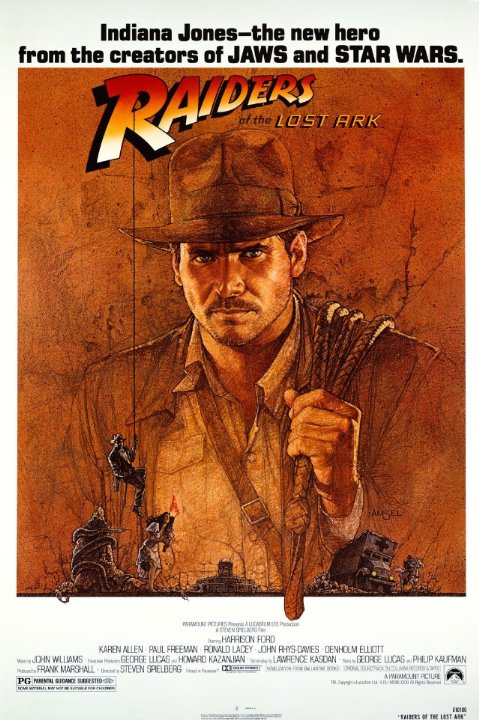
Raiders of the Lost Ark (1981)

raidersDirected by Steven Spielberg

When I was little, I was seriously confused by this movie’s title. For a long time, I thought it was Raiders of the Lost Dark, and I could never figure out how the dark got lost. When I finally figured out it was Raiders of the Lost Ark, I was still confused. There was not a single reference to Noah in the entire movie. That didn’t keep me from liking the movie; I just ignored the confusing title and went along for the ride. And what a ride it is. Raiders of the Lost Ark remains one of the most purely fun movies I have ever seen, even though now it appears to have a new title: Indiana Jones and the Raiders of the Lost Ark.

So what’s the story? Dr. Indiana Jones, a professor of archaeology, is approached by two United States government officials. It seems that the Nazis are looking for the Ark of the Covenant because they believe it has mystical powers. Jones’s old mentor, Abner Ravenwood, is the world’s foremost expert on the Ark, but no one can locate him. Jones is tasked with finding first Ravenwood and then the Ark so that the Ark will be kept out of Nazi hands.

The Good: The thing that really sticks out for me in this movie is the pacing, which is kind of an odd thing to notice first off. But there is never a dull moment. It jumps from action scene to action scene. Even when there is a break from actual action, the scenes aren’t dull. The screenplay is fun enough and light enough to make even the longest talking scenes entertaining. It also means you can’t look away; you’ll miss something important if you do.

The characters in Raiders of the Lost Ark are very well-written, well-rounded characters. Marion Ravenwood is one of the best action movie heroines ever, I think. She never stands around and waits to be rescued. If there is danger, she always jumps in and gives as good as she gets. Yes, sometimes she does end up having to be rescued, but she only gets rescued after she’s done everything she possibly can to get out of the situation herself. She’s kind of an anomaly, not just for action movies, but for movies in general. Karen Allen played her perfectly. Indiana Jones is also a good character. He may be a terrible archaeologist since he is willing to destroy ancient temples to get the artifacts that he wants, but he’s still a good character. He can use a whip and shoot a gun and ride a horse and all those other things that good action heroes can do, but he’s also smart and not invincible. He gets hurt more than once. He would have completely lost that fight against the bald muscular German mechanic if not for the airplane propeller. I like that. What can I say? I’m a fan of imperfect main characters. Harrison Ford was a fabulous choice for the part.

I found myself admiring the production design that had been done for this movie. The designers not only had to make the audience believe that the action was taking place in the 1930s, but in various countries in the 1930s. It was really well done. Everything from the cars to the clothes to the buildings added up to a convincing 1930s.

John Williams wrote an amazing score for Raiders of the Lost Ark. It’s kind of dramatic, but so is the movie. The music underscores the action at the right moments and helps convey emotion. It’s very good, and it’s held up well. It’s as much fun to listen to now as it was thirty years ago.

The Bad: The action moves quickly, which prevents the viewer from asking too many questions. But something has always bothered me: how does Indiana Jones survive on the outside of a submarine that submerges? I know he’s pretty awesome, but I don’t think he can hold his breath that long. There might be other plot holes, too, but the awesomeness of the movie prevents me from thinking too hard about them.

The Ugly: If you don’t like spiders or snakes, beware. Raiders of the Lost Ark has plenty of both. It also has some graphic violence and special effects which hold up amazingly well. When I was a little girl, my parents would always tell me to close my eyes at certain parts so I wouldn’t get scared. As I grew up, I would close my eyes at those points out of habit. I don’t think I had seen the whole movie until I watched it this week. Sure enough, it is not much fun to watch faces melt and heads explode. (Honestly, though, it’s not the most violent or the worst violence I’ve seen in a movie; it’s not even the worst I’ve seen in the Oscar nominees. But I had to find something to put in The Ugly.)

Oscars Won: Best art direction-set direction; best sound; best film editing; best effects, visual effects.

Other Oscar Nominations: Best picture; best director; best cinematography; best music, original score.

Other Oscar Won: Special achievement award to Ben Burtt and Richard L. Anderson for sound effects editing.

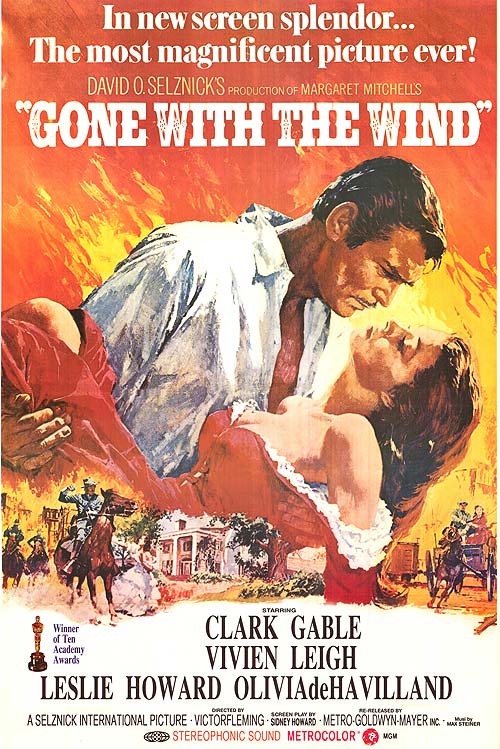
Gone with the Wind (1939)

gone with the windDirected by Victor Fleming

As I’ve been doing this project, I’ve noticed something that a lot of nominees have in common: they are freaking long. I have felt every minute of some of those three-hour movies (I’m looking at you, Thin Red Line!), while others have kept me captivated. Gone with the Wind is almost four hours long, but I didn’t feel it. I had seen bits and pieces growing up, but I watched the whole movie in one sitting when I was eleven. I’ve seen it several times since, including once in the theater when it was re-released for an anniversary event. And every single time I’ve watched it, I’ve been glued to the screen. It doesn’t matter that I know how it ends. The world of Gone with the Wind was so skillfully built that I can’t tear myself out of it. The characters are so real that they almost feel like friends; their triumphs and miseries become ours. That, my friends, is how you make a three-hour-plus movie fly by.

So what’s the story? Spoiled Southern belle Scarlett O’Hara’s world comes crashing down around her when the American Civil War begins. Her life of parties and flirting is over. As she tries to adjust to the harsh realities of her new life, she learns that she will do anything to keep what she loves. (That summary makes it sound boring. Trust me, it’s not.)

The Good: There are so many good things in Gone with the Wind that it’s hard to know where to start. I think I will change it up and start with cinematography. Gone with the Wind is a beautiful movie, full of glowing sunsets and billowing ball gowns. It’s not always pretty, though; the scene at the depot where the soldiers are lying dead in rows is tragic. The birth of Melanie’s son, where everything is shown in silhouette, is exquisitely done. These are just the highlights, though; there are lots of scenes where the camera work more quietly underscores the action or the emotion of the scene.

The costume design is also good. This movie is why I can complain about other movies’ lack of good historical costume. In Gone with the Wind, the fashions change with the times, like fashion does in real life. Not only that, but the clothes are fairly accurate (as far as I know. I am not a fashion historian; I have only picked up tidbits here and there.). I do know that the shape of the hoops change correctly for the times, which may only be a small detail, but it shows that the designer cared enough to do actual research.

The score is sweeping and beautiful and just a little bit over the top, which fits the epicness of this movie. Everything about Scarlett is dramatic, and it’s appropriate that the music in her movie is, too.

It is very easy to forget in this day and age that in 1939, everything in a movie was real. If you wanted a huge crowd of people, you had to hire actual people. If you wanted a fire, you had to burn something. There are some crazy special effects in this movie. I seriously wonder how they managed to film some of the scenes. Special effects took a certain kind of creativity back in the day, and have to give kudos to the special effects people for this movie.

Whoever adapted the giant book Gone with the Wind into a single (albeit long) movie was amazing. He found the most important things, the things that would make a compelling movie and took those out. He knew what to leave out; it was all good stuff – Ellen’s backstory, Scarlett’s other children, Will Benteen – but wasn’t necessary to the movie. Those extra things that fleshed out the novel would have bogged down the movie. It’s an excellent adaptation.

The entire cast of Gone with the Wind is stellar. After I had watched Dark Victory, I was thinking that maybe Bette Davis should have gotten the best actress Oscar, but when I saw Vivien Leigh’s performance again, I had to admit that Vivien Leigh deserved it. Clark Gable as gave an awesome performance as Rhett Butler. He is so good as the strong, manly lover hiding his love behind pride and lust. The flash of hurt on his face when Scarlett admits that she’s marrying him for his money…so sad. And that kind of thing happens more than once. It’s very subtle and very good. Olivia de Havilland plays Melanie Wilkes so beautifully. She manages to be an angelic, self-sacrificing person and yet not make you hate her. And she was only 23 when the movie came out. That was some serious acting for such a young woman. There is some controversy over Hattie McDaniel’s role as Mammy, Scarlett’s nurse/surrogate mother, but she plays the role well and allows us to see the main characters in a different light as she isn’t shy about expressing her opinions.

The Bad: This is an extremely frustrating movie to watch. Rhett loves Scarlett, but is too proud to admit that he’s actually fallen in love. Scarlett is too caught up with her make-believe love for Ashley to notice. When Rhett makes her notice, he is so ashamed of what he’s done that he doesn’t see the opening Scarlett is giving him. When he rejects her at that point, Scarlett is too proud to say anything. Grrrrr. These are two very strong, proud people who are so scared of showing weakness that they can’t allow happiness in. It makes me want to shake them both.

The Ugly: The movie laments the passing of a “beautiful, genteel” culture, but glosses over the evils that that culture is built upon. Slavery made that lifestyle possible, and so it’s hard to feel too sorry for the O’Hara family when they have to pick their own cotton and for Ashley Wilkes when he is splitting rails. Yes, it’s hard, and it’s not what they were brought up to do, but they were brought up to live off of the misery of others. Ashley briefly acknowledges this, but only briefly. Frankly, it was a culture that deserved to die. I can still enjoy the movie, but it doesn’t make me mourn the passing of the Old South.

Oscars Won: Best picture; best actress in a leading role (Vivien Leigh); best actress in a supporting role (Hattie McDaniel); best director; best writing, screenplay; best cinematography, color; best art direction; best film editing.

Other Oscar Nominations: Best actor in a leading role (Clark Gable); best actress in a supporting role (Olivia de Havilland); best sound, recording; best effects, special effects; best music, original score.

Other Oscars Won: Honorary award to William Cameron Menzies “for outstanding achievement in the use of color for the enhancement of dramatic mood in the production of Gone with the Wind”.

Technical Achievement Award to R.D. Musgrave “for pioneering in the use of coordinated equipment in the production Gone with the Wind”.