I'd like to spank the Academy

Posts tagged ‘Mystery’

Crossfire (1947)

Directed by Edward Dmytryk
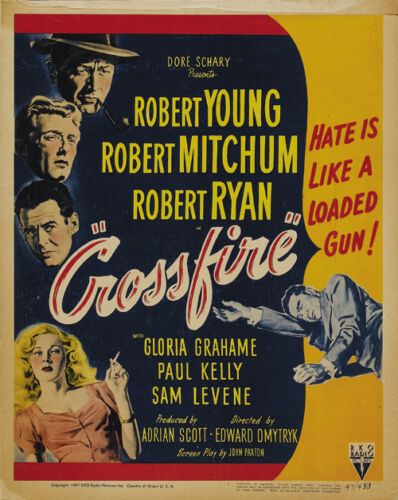
I didn’t know very much about this movie before I watched it. The DVD case made it appear to be a thrilling film noir with Gloria Grahame as the femme fatale. I’d been burned before, though (see: Dead End https://theoscargrouch.wordpress.com/2017/05/18/dead-end-1937/), so I didn’t let myself get my hopes up.

So what’s the story? Crossfire starts with the murder of a man, followed by the murderer running away. There’s confusion with the light and shadows, and we don’t know who the murderer is, but soon an off-duty soldier shows up to the apartment looking for his buddy who had been there earlier. The police zero in on the buddy, but did he really do it?

The Good: This movie may be the noiriest noir I have ever seen. There are so many shadows obscuring everything, figuratively and literally. Sometimes the shadows seem almost overwhelming. Light is used sparingly and very well. 

The music is used very much like the light: sparingly and well. Almost the only music in the movie at all is the music from the activity going on around the soldiers: music in a dance hall, music heard on the street while they pass bars, music in a movie that they watch. The filmmakers did not rely on music to tell you how to feel. 

The acting is great. Apparently, if you were a man who wanted a part in this movie, you had to be named Robert. Robert Ryan is Montgomery, the soldier who points civilian detective Robert Young in the direction of his buddy. Robert Mitchum is a soldier who doesn’t believe Montgomery’s accusation and goes looking for the truth on his own. To be fair, though, the Roberts were not the only good actors, although they were all superb. Sam Levene’s role as Samuels, the murdered man, is small, but he makes the character come alive in a way that his death hits pretty hard. Gloria Grahame plays a very sympathetic femme fatale; she’s less femme fatale and more “hooker with a heart of gold.” 

I rarely comment on the theme or message of a movie, but I feel like it’s important in the current political climate in the United States. Crossfire is about the dangers of vilifying “the other,” about feeling that you or your group is more important than or just straight-up better than another group. It warns about the danger of falling into that trap and says that even if you yourself feel safe, you need to stand up for others in the persecuted group. It’s a good message in a movie that isn’t a feel-good movie.

The Bad: It did drag at times. Not often, but there were a few scenes that could be trimmed just a little bit to make the movie tighter.  

The Ugly: I really did not understand who The Man was or what he was doing in the movie. His character just added unnecessary confusion. 

Oscars Won: None.

Oscar Nominations: Best picture; best actor in a supporting role (Robert Ryan); best actress in a supporting role (Gloria Grahame); best director (Edward Dmytryk); best writing, screenplay. 

Fun Bonus Fact: Although Crossfire deals with antisemitism, the novel that it is based on, The Brick Foxhole, is about homophobia, which is incredibly progressive for a book published in 1945.

The Verdict (1982)

theverdictDirected by Sidney Lumet

I first recognized the existence of The Verdict when it was added to Netflix a little while back. It had Paul Newman! As a drunken lawyer! I had high hopes for it, but when I realized it was a best picture nominee, I made myself wait to watch it until I was actually reviewing the movies of 1982. When I finally got to watch it, I was so disappointed. It’s not terrible, but there’s nothing fabulously special about it, either.

So what’s the story? Ambulance-chasing lawyer Frank Galvin is a rather despicable man. He goes to funerals and tries to drum up business from widows. He spends most of his time drinking and reading the obituaries trying to find his next client. When an ex-partner takes pity on him and sends him an open-and-shut case that will settle out of court, Frank surprises everyone, even himself, when he decides to fight for his client truly deserves instead of taking the easy settlement.

The Good: Paul Newman is fantastic, as always. I’m not used to disliking him, so the first twenty minutes or so of the movie were kind of hard to watch. He’s good at playing a jerk. But the moment that he realizes that his client deserves more was a great bit of acting. I love watching actors show us what is going through their characters’ heads. He does a fabulous job throughout the rest of the movie, showing Frank’s frustration and triumph, nervousness and despair. It’s a very good bit of acting.

The supporting actors were just as good, with Charlotte Rampling playing Galvin’s new love interest, Laura; James Mason playing high-powered opposing attorney Ed Concannon; and Jack Warden as Galvin’s old friend and ex-partner Mickey Morrissey. They were all solid in complicated roles.

I loved the very ending of the movie. It wasn’t the typical ending for a movie like this, and I was glad, because if they had gone with what typically happens, what power this movie had would have been lost. It is so hard to write intelligibly about endings when you are trying so hard not to include spoilers, so please forgive me. But the ending packs a punch.

The Bad: I wouldn’t say it was bad, per se, but the story has nothing new to say. It felt in some ways like a reworking of Mr. Smith Goes to Washington, with Frank Galvin being incompetent instead of naïve like Mr. Smith. In other ways, it was a completely normal courtroom drama, with just the little twist of Galvin’s alcoholism being added.

The Ugly: Because it was so typical, The Verdict didn’t have much of an impact on me. There was nothing I could get worked up over. I was bothered all the way through the movie that Jack Warden didn’t have a moustache, because he looks like the kind of guy who would have one, but that was just a slight annoyance. I was more puzzled over this movie’s best picture nomination than anything else, and that’s not ugliness, just confusion. I expect more from a best picture nominee.

Oscars Won: None.

Oscar Nominations: Best picture; best actor in a leading role (Paul Newman); best actor in a supporting role (James Mason); best director; best writing, screenplay based on material from another medium.

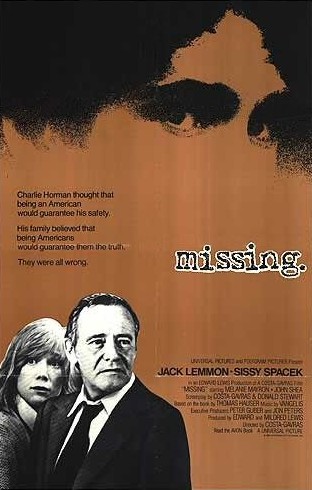
Missing (1982)

Missing_1982_filmDirected by Costa-Gravas

As I’ve been watching these Oscar-nominated movies, there have been many, especially from the 1970s and 1980s, that I haven’t really known anything about. Some of them have been less than stellar, and I can understand why they have fallen by the wayside, even for someone like me who likes watching good movies, no matter how old they are or what language they are in. Missing is not one of those movies. Missing is so awesome I want to show it to everyone I know, and I’ve been telling random people how sad I am that no one seems to have seen it. Missing makes me want to be a high school history or civics teacher so that I could show it to my class to teach them not to be too trusting of government. It makes me so mad that Missing is not a classic; it completely deserves to be one.

So what’s the story? Charlie and Beth Harmon are an idealistic young married couple who have been living in Chile for a couple of years when a right-wing coupe happens. They are going to leave the country soon, so Beth goes to say good-bye to a couple of friends. She gets stuck overnight because of the curfew. When she finally makes it home, Charlie is gone. About two weeks after his disappearance, Charlie’s conservative businessman father, Ed Horman, comes to help Beth navigate the waters of diplomacy and bureaucracy. What they find out together will change their lives forever.

The Good: I’m tired of starting with acting, so I’m going to start with music today. Vangelis’s score is beautiful and haunting. It’s more orchestral than the music in Chariots of Fire, and where he does use the synthesizer, it fits the time much better. The other thing that is great about the music is that it is not constant. Lots of the movie has no music, so that where there is music, it has a much greater impact.

The acting is wonderful. Sissy Spacek is wonderful as Beth, who changes from a vibrant, loving young woman to a frantic wife to a jaded and accepting woman in the course of just a few weeks. It’s a marvelous performance. Jack Lemmon is fantastic as Ed, who starts out so convinced that he’ll be able to fix everything with connections, but slowly comes to realize the truth. I’ve only ever seen Jack Lemmon in comedies, so this was a revelation. John Shea plays idealistic, happy-go-lucky Charlie. He’s not in the movie much, but he leaves an impact when his character is gone. Government agent Captain Ray Tower is played rather chillingly by Charles Cioffi. He’s so scary in part because he’s so friendly, but you can tell he’s hiding the truth.

This is going to sound silly, but the set decoration was so clever at one point. Beth and Ed are at the US Embassy, trying to get answers about what happened to Charlie. The US Ambassador is telling them that he’s probably in hiding and that they shouldn’t worry about him. While he is talking to them, he is standing directly under a picture of Richard Nixon. This movie takes place in 1973, so Nixon was the president then, but by the time Missing was made in 1982, everyone knew that Nixon was a liar. To see a man appointed by that president standing underneath him subtly, yet effectively, underscored the fact that the ambassador was also a liar.

The screenplay was very good. It made the characters come alive. It also made the movie completely gripping. I was so angry that I had to stop watching to go to work. I wanted to know what happened, and I wanted to know NOW! It was fantastic.

I have no concrete examples of why I felt this way, but I though the directing was very good. It’s hard to define good directing, because it’s hard for me to know how much of a hand the director had in various aspects of the movie, but I really felt good directing at play here.

The Bad: The only complaint I have is that Beth and Charlie’s friend Terry has 1980s poufy hair. As a free-spirited 1970s woman, Terry’s hair should have been longer and straighter. I know, tiny quibble. But it bothered me.

The Ugly: War is always ugly, and there are some shocking images and situations in this movie. It’s not the easiest movie to watch because of this, and also because this is a true story. Art that is great tends to bring up issues that might make people uncomfortable, but that doesn’t mean that these issues should be ignored. I think it’s better for people to know what is wrong in their world than to believe that everything is perfect when corruption is hiding underneath.

Oscar Won: Best writing, screenplay based on material from another medium.

Other Oscar Nominations: Best picture; best actor in a leading role (Jack Lemmon); best actress in a leading role (Sissy Spacek).

Gosford Park (2001)

gosford parkDirected by Robert Altman

I read my first Agatha Christie murder mystery when I was twelve. It was the start of a beautiful relationship. Every summer after that, I would check out stacks of Agatha Christie mysteries. The plots were always intricate and watertight, but I also loved the idea of rich British people in country houses dressing for dinner and going shooting and having weekend parties. Gosford Park is basically an Agatha Christie mystery with a twist—it not only shows how the family is affected by the murder, but also how the servants are affected. It could be called Murder at Downton Abbey.

So what’s the story? Sir William McCordle has invited friends and family to Gosford Park for a weekend shooting party. The guests come with their servants, and everyone, both upstairs and down, has a secret.

The Good: The cast reads like a Who’s Who of British actors. Maggie Smith, Helen Mirren, Michael Gambon, Kristin Scott Thomas, Derek Jacobi, Jeremy Northam, Clive Owen, Stephen Fry, and Kelly Macdonald are all in this movie, to name just a few. Everyone is excellent. There isn’t an actor in the movie who was miscast or who isn’t completely believable in their role. It’s a fantastic cast, and the movie is incredibly well-acted.

The screenplay is delightful. I had to laugh when I was watching the credits and realized why I felt it was similar to Downton Abbey. The screenplay was written by Julian Fellowes, the man behind Downton Abbey. The screenplay is fun and funny. Although there are many characters, the screenplay allows them all to show their personalities and problems. It’s very clever and well-written.

The costume design impressed me. The designer, Jenny Beavan, had to not only design clothes for the wealthy and their servants, but also had to show a range of incomes in those different classes. She did so very cleverly and period-appropriately.

I love the music. It’s buoyant and jolly when it needs to be and unobtrusive when more serious things are happening. The cheery piano music made me want to find the sheet music.

The art direction is also excellent. It drew me in to this country house of the 1930s. The cars, the bedrooms, the servants’ quarters, everything felt realistic to me.

The Bad: I got so mad watching this movie at the way people treated their servants. The servants weren’t treated so much like people as they were like useful machines. They are used and abused at their employers’ pleasure. I felt very frustrated. Based on things that I’ve read, I’m fairly sure the attitudes are accurate. Even in my beloved Agatha Christie novels, the servants are almost always discounted from being murder suspects because they couldn’t possibly have a motive; they don’t know the murdered person well enough. I love that this movie shows the relationships between the rich and their servants; the only one who cries at the news of the murder is a servant. But the treatment of the servants still makes me mad.

The Ugly: It was a little hard to keep track of who everyone was. The relationships of the upper-class people were especially hard to figure out. Everyone is introduced so quickly and shallowly at first that it doesn’t all sink in the first time around.

Oscar Won: Best writing, screenplay written directly for the screen.

Other Oscar Nominations: Best picture; best actress in a supporting role (Helen Mirren); best actress in a supporting role (Maggie Smith); best director; best art direction-set decoration; best costume design.

Michael Clayton (2007)

michael claytonDirected by Tony Gilroy

When I was growing up, my dad would turn a movie on while he finished up paperwork at night. When the movie ended, he would simply rewind it and start the same movie over again. It never really bothered me too much (except when the movie was Groundhog Day), but I’ve never had the urge to do that myself until I watched Michael Clayton. It’s a very subtle corporate thriller, and I feel like I didn’t quite pick up on everything the first time through. I would like to watch it a couple more times, but since I have a full-time job which not my blog, I can’t do everything I want.

So what’s the story? Michael Clayton is his law firm’s clean-up man. Whenever anything goes wrong, he’s called on to fix it. So when the firm gets a call that one of the partners who was at a deposition has stripped himself and started chasing a witness through the parking lot, Michael Clayton is sent to see what can be done. When he gets there, Michael finds out that everything is not as it seems…

The Good: There were some fabulous performances in this movie. George Clooney plays Michael Clayton, a man who’s dealing with all kinds of stress at work and in his family life. It’s a very understated performance. His acting in the last few minutes of the movie and into the end credits was incredible. Tilda Swinton is the head legal counsel for the company that Clayton’s team is supposed to be representing. She is a fascinating character; she is smart and capable, but not at all confident. I’ve never been a huge fan of hers, but I have to admit that she is fabulous in Michael Clayton. Tom Wilkinson plays Arthur Edens, the partner whose breakdown leads Michael Clayton on a search for the truth. Movie director Sydney Pollack does a good acting job as one of the heads of the firm, and Austin Williams plays Michael’s fantasy-novel obsessed young son.

The cinematography really set the mood for the movie. It takes place during the late fall or early winter, and the cold, dying landscape and the wintry light reflected Michael’s mood.

The Bad: I like to think that I’m an intelligent person, but I know I missed some plot points. I will admit that I was tired and my brain wasn’t functioning at full capacity, but feel like I shouldn’t have to watch a movie more than once to understand all of what’s going on.

Also, why were the horses in the field bridled? I’m no horse expert, but I have always thought that horses don’t wear their bridles when they are left in the pasture. It’s a silly thing, but it disquieted me for the whole movie.

The Ugly: Even though Michael Clayton was interesting and had good acting, I never connected with the movie on an emotional level. I feel like I should have felt something, but the movie felt more like an intellectual logic puzzle than a work that touched my soul. I think an excellent movie should touch the viewer in some way.

Oscar Won: Best performance by an actress in a supporting role (Tilda Swinton).

Other Oscar Nominations: Best motion picture of the year; best performance by an actor in a leading role (George Clooney); best performance by an actor in a supporting role (Tom Wilkinson); best achievement in directing; best writing, original screenplay; best achievement in music written for motion pictures, original score.

In the Heat of the Night (1967)

In_the_Heat_of_the_Night_(film)Directed by Norman Jewison

I have a hard time sitting still and doing nothing when I watch movies. I get kind of antsy unless I have another project to occupy my time, so I’ll paint my nails or play a game on my phone or crochet a hat while the movie plays in the background. But doing this project has forced me to change all that. If I want to appreciate good acting or interesting camera work or immerse myself in another time through excellent production design, I have to give the movie my full attention. The first time I watched In the Heat of the Night, I was messing around on my computer. I thought it was a good movie, an interesting movie, but not that great. Then I watched it again on my big TV instead of my little computer screen, and I didn’t do anything but watch the movie. I was blown away. It was a totally different experience, and I understood the (well-deserved) acclaim.

So what’s the story? Late one summer’s night in Sparta, Mississippi, a police officer finds the murdered body of a prominent man lying in the street. The police start searching for the murderer, and they soon find and arrest the perfect suspect: Virgil Tibbs, a black man who is sitting in the train station. However, Virgil says he’s not a transient or a criminal, but a police officer from Philadelphia; he was just waiting for his train home. Sheriff Gillespie, the head of police in Sparta, calls Philadelphia to verify this, and the police chief in Philadelphia tells Gillespie that Tibbs is the best homicide detective in Philadelphia and that Tibbs should help on the case. None of the (white) police officers in Sparta want to accept help from black man, but the widow of the murdered man insists that Tibbs remain on the case. Tibbs and Gillespie now have to overcome their prejudices to work together to solve the murder.

The Good: I always seem to start with the acting, but I think that’s because bad acting ruins a  movie so quickly. There was some good acting here. Rod Steiger won an Oscar for his portrayal of Gillespie. I wasn’t completely convinced that he deserved it over Spencer Tracy in Guess Who’s Coming to Dinner until the scene where the four thugs have cornered Tibbs in the warehouse. At that point, something clicked for me, and I realized what a truly stellar job he was doing. Sydney Poitier is excellent as he always is as Virgil Tibbs. Lee Grant plays the widow; she isn’t in the movie much, but she commands every scene she’s in. Her heartbreak when she’s told of her husband’s death is so painful that it’s difficult to watch.

The story here is excellent. It’s based on a novel that I haven’t read, so I’m not sure what’s been changed and what was original, but it makes a great movie. I love how well-developed all the characters are. It would have been so easy to make Tibbs perfect, but he has his flaws, too, which are shown when he fixates so strongly on a suspect (who is admittedly a terrible person) that he loses all perspective on the case. The story and screenplay are so well done. And this movie gave us a classic line: “They call me Mr. Tibbs!”

The cinematography was interesting. I loved the part where Tibbs is examining the body. The camera cuts to his hands to show his skill and confidence as he explains what he will need to do a proper examination. The camera focuses hands in another scene, too. When Tibbs and Gillespie are going to go visit the wealthy cotton planter, they drive past a field of cotton being picked by black workers. Here, the camera’s focus serves to contrast Tibbs’s job and skills with those of the workers. If Tibbs had lived here, it seems to say, this is what he might be doing. At other times, the cinematography feels almost musical. As the cameraman zooms in on a fleeing suspect, for instance, it accentuates the tension almost like a crescendo in a piece of music. It adds a lot to the movie.

The Bad: The only thing that made this movie feel dated was the music. It just screamed the 1960s to me. It might have been groundbreaking at the time, but it feels very old-fashioned now.

The Ugly: The ugliest thing in this movie is the attitudes of the people, from the moment Tibbs is arrested because he’s an unknown black man to the climax where the thugs show up at Mama Caleba’s. But it’s this ugliness that allows the beauty of the eventual mutual acceptance and respect of Tibbs and Gillespie shine through.

Oscars Won: Best picture; best sound; best actor in a leading role (Rod Steiger); best film editing; best writing, screenplay based on material from another medium.

Other Oscar Nominations: Best director; best effects, sound effects.