I'd like to spank the Academy

Posts tagged ‘musical’

One Hundred Men and a Girl (1937)

One-Hundred-Men-and-a-Girl-PosterDirected by Henry Koster

Some things are definitely cute. Babies are cute. Puppies are cute. Pikachu is cute. But I hate it when people call other things cute: “That’s a cute book,” or “It was such a cute movie!” When people work hard on an artistic endeavor, they deserve to hear something more specific than the rather generic “cute”. As much as I hate it, though, I am going to have to use it now: One Hundred Men and a Girl is a cute movie.

So what’s the story? John Cardwell is a trombonist struggling to get work during the Great Depression. Every night, he waits outside the concert hall with the hope of meeting the great conductor Leopold Stokowski and getting an audition with him; however, he is never successful. After an encounter with some wealthy arts patrons who carelessly promise financial backing, his young teenaged Patricia decides she will get all the unemployed musicians together to form their own orchestra. Her grit and tenacity, along with much confusion, lead to a happy ending.

The Great: I know I don’t usually do a “great” section, but Deanna Durbin is so amazing that she needs special mention. The girl can sing. And by sing, I don’t mean that she can carry a tune or sing pop songs; Deanna Durbin had a beautiful operatic voice. She was only fifteen when One Hundred Men and a Girl was released in theaters, and it is hard to believe that she does her own singing. Not only could she sing, but Deanna Durbin could also act. She does a beautiful job in One Hundred Men and a Girl. There are moments when she’s talking fast because she’s so excited, but you can understand every word. She is completely convincing at every moment. This was my first experience with Deanna Durbin, and I remain completely blown away.

The Good: Deanna Durbin may have been the standout, but other great actors were involved in this movie. Adolphe Menjou gives a sweet performance of a man who has been ripped apart by the world, but is willing to hope again for his daughter’s sake. He goes from hopeless to grudgingly hopeful to exultant as the movie goes on. Mischa Auer brings enough humor as Michael to offset the hopelessness of the beginning. Frank Jenks brings some happy seriousness as the encouraging taxi driver, and Alice Brady is fabulous, darling as the rather thoughtless Mrs. Frost. Leopold Stokowski is a surprisingly good actor for a conductor. I have seen other real-life conductors/musicians/dancers in movies, and they are often not convincing, but Stokowski was a good actor as well as being a wonderful conductor.

The story was good. It brought the plight of people out of work because of the Depression into the forefront. It showed the good people who wanted to work, but just couldn’t find anything. It also showed the thoughtlessness of the rich. Mrs. Frost makes an impulsive promise to a young girl, then promptly forgets about it and goes out of town. She doesn’t really care about Patricia; she sees Patricia as something interesting and new in her dull, expensive life. The wealthy men who play practical jokes on each other are just as bad. While the poor are playing poker using matchsticks, these rich men bet significant amounts of money on who has the better joke. It idealizes the honest poor while uncovering the faults of the uncaring rich.

The music was awesome. I’m not sure how it was nominated for original score; most of the music was classical music. But it was amazing. I would have given them an award for best use of classical music in a musical score. The music person (not sure who it was, because there’s not really a credit for it) matched the classical music to the action perfectly. I’ve never seen it done better.

 The Bad: As talented as Deanna Durbin is with both singing and acting, she has no talent for lip-syncing. By saying she’s lip-syncing, I in no way mean to imply that she is not doing her own singing. She’s just lip-syncing to her own pre-recorded singing. And she’s bad at it. At first I just thought the audio was off, but no. It’s Deanna Durbin.

Both Patricia and her father are constantly trying to get past the doorman at the theater where Stokowski works. It gets old after a bit. Repeated jokes are not as funny as people think they are.

Why do I call One Hundred Men and a Girl cute? Because it’s a well-done, happy movie with not much depth. It’s too simplistic to be anything but cute. It’s a movie you would watch when you’re feeling down and don’t want to think too much. It’s fun, but not extraordinary. It’s just…cute.

The Ugly: There is nothing ugly about this movie. It’s too cute to be ugly.

Oscar Won: Best music, score.

Other Oscar Nominations: Best picture; best writing, original story; best sound, recording; best film editing.

The Awful Truth (1937)

awful-truth

This is not the picture that steered me away from the movie. This one is much more fun!

The Awful Truth
Directed by Leo McCarey

I love old movies. I love Cary Grant. I love light-hearted comedies. Even though The Awful Truth fits all of those criteria, I had never wanted to see it. Why? The cover of the DVD that we have at my local library looks like it’s a musical. I couldn’t fathom Cary Grant in a musical; it made me uncomfortable. If it hadn’t been nominated for best picture, I never would have watched it. I would have missed out on a great movie.

So what’s the story? Married couple Lucy and Jerry Warriner have a silly misunderstanding and decided to get divorced. The divorce is granted, but they must wait three months for the divorce to be final. During these three months, both Lucy and Jerry date new people, but they both do everything they can to disrupt the other’s new relationships.

The Good: ASTA!!!! He may have been a dog, but Asta was a minor Hollywood star in the 1930s and 1940s, appearing with such stars as William Powell, Myrna Loy, and Katharine Hepburn. Not only is he adorable, he’s very well-trained. He’s also charming, which I didn’t realize a dog could be, but Asta is.

Asta’s human costars are wonderful, too, even if they aren’t as cute as he is. Although he plays Jerry Warriner with his characteristic suavity, Cary Grant also imbues his character with an inner delight in life. Irene Dunne’s Lucy is full of (justifiably) wounded pride; Dunne draw on this pride to explain both her rebound “love” and her fiendish delight in ruining Jerry’s new relationship. Of course, it’s expected that Dunne and Grant will be good; they weren’t famous just for their good looks. The totally unexpected performance came from Cecil Cunningham, who plays Lucy’s sardonic aunt, Patsy (or Patty; both were used in the movie). I had never heard of her before, but she is hilarious in this movie. She brings good, solid common sense into a screwball situation, letting both main characters know that they are being completely ridiculous.

The costumes and sets are gorgeous. The dresses are beautiful, and it was impossible for me to not admire the furs, even though I am anti-fur. Combined with the sparkling wit of the screenplay, The Awful Truth makes me wish that I were a wealthy person in the 1930s. It’s an impossible wish, I suppose, but it would be fun.

Leo McCarey’s direction was excellent. I don’t write often about whether or not I think the director did a good job, but that’s because I don’t know enough about directing to know how much of a part the director actually plays. I read a little bit about this movie, however, and apparently McCarey would tell people to not follow the script, to just say what they thought their character would say. He looked at things happening around him and encouraged the actors to do things on the set in character when they thought they weren’t being filmed, then used those almost candid scenes in the movie. It worked perfectly in a screwball comedy and added to the realism of the characters.

The Bad: The ending, which uses a cuckoo clock as a symbol, is ridiculous. I’m guessing that the director used it because of the Hays Code, which forbade any “indecency” in motion pictures, but I think this ending went too far in its pursuit to avoid being censored and just ended up being stupid.

The Ugly: There’s a little tiny bit of racial stereotyping, which was unfortunately common in movies from this time.

Oscars Won: Best director.

Other Oscar Nominations: Best picture; best actress in a leading role (Irene Dunne); best actor in a supporting role (Ralph Bellamy); best writing, screenplay; best film editing.

The Greatest Show on Earth (1952)

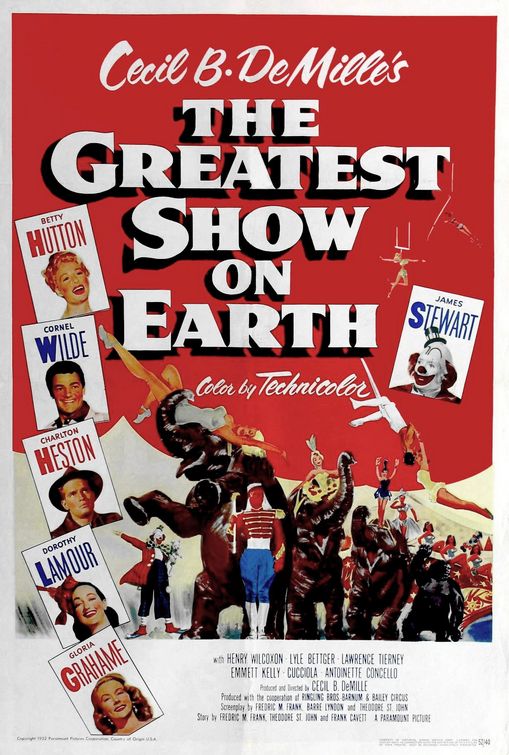
the_greatest_show_on_earth_posterDirected by Cecil B. DeMille

I have only been to the circus once. I was two, I think. The only thing I remember about the circus is the elephants coming in to the ring; that’s all. Because I have so little circus-watching experience, I wasn’t sure what to expect from this movie. I was glad I didn’t have high expectations, because I was able to enjoy it, even though it has its ups and downs.

So what’s the story? The Ringling Brothers-Barnum and Bailey Circus is not doing well. People just don’t want to come to the circus anymore. The backers don’t want to do a full season. Brad, the circus manager, gets them to promise that the circus will stay out as long as they stay in the black. To do this, he hires Sebastian, a famous trapeze artist. This makes unknown, but excellent, trapeze artist Holly angry, because she wanted to be in the center ring. She decides to prove to Brad and Sebastian that she is the best.

The Good: The circus is amazing. I kind of wish Cecil B. DeMille had just made a documentary about the circus and the real circus performers, because the story wasn’t all that interesting. I would have loved to know how people got involved in the circus, how they learned to do some of the incredible things they do, if they would ever consider leaving the circus. The circus was truly the best part of the movie.

The cinematography was well done. It had to be in order to capture the feeling of the circus, the size and the noise and the color and the bustle and the amount of work it is to put a circus on.

Gloria Grahame is fantastic as Angel, a “sadder but wiser” circus performer who loves Brad, but isn’t sure that he will love her back because of her past. Charlton Heston (whom I did not recognize in normal clothes and a hat) is very good as Brad, the manager who will do anything to keep the circus going. Cornel Wilde is charming as the playboy performer Sebastian. It’s always nice to see Jimmy Stewart, even though his role as the clown with a mysterious past isn’t very large. His little dog is adorable, too. Lyle Bettger was good as the Angel-obsessed Klaus. And it is fun to see famous circus people like John Ringling North and Emmett Kelly doing their thing.

The Bad: I did not like Betty Hutton, who played Holly. She was more annoying than anything. Apparently, she was a famous singer at the time, but her acting skills could have used some work.

Since I grew up watching The Ten Commandments, I’m used to Cecil B. DeMille narrating with great weight about serious subjects. It was really odd to hear him narrating about the circus. It wasn’t necessarily bad, per se, but it was really weird for me. It probably wouldn’t bother someone who isn’t familiar with DeMille’s voice.

The Ugly: The story is really weak and not particularly interesting. How the writers managed to win an Oscar for best story is beyond me. It must have been a weak year for that award.

The train wreck at the end was probably good for its day, but it doesn’t hold up well. Klaus is obviously sitting in front of screen when he’s supposedly on the tracks. I try not to let that kind of stuff get to me, but sometimes it does. This is one of those times.

Oscars Won: Best picture; best writing, motion picture story.

Other Oscar Nominations: Best director; best costume design, color; best film editing.