I'd like to spank the Academy

Posts tagged ‘Mental Illness’

The Deer Hunter (1978)

the-deer-hunterThe Deer Hunter
Directed by Michael Cimino

I knew The Deer Hunter was about Vietnam; I didn’t know that it was going to hurt my heart so badly.

So what’s the story? Mike, Steve, Nick, John, Stan, and Axel are a group of regular guys. They celebrate together, drink together, hang out together, hunt together. But then Mike, Nick, and Steve sign up to go fight in Vietnam. Their decision will change everyone’s lives forever.

The Good: In order to hurt the audience so much, the screenplay and actors first had to make us care about this group of very normal friends from a small town in Pennsylvania. Steve’s wedding is the setting to showcase the personalities of this diverse group. Mike (Robert De Niro) is slightly more mature than his friends. He takes things that he cares about very seriously. Nick (Christopher Walken) cares deeply about his friends and his girlfriend, Linda (Meryl Streep). Steven (John Savage) is so in love and so excited to marry Angela (Rutanya Alda) that he is willing to ignore the opinions that his Russian mother has about his fiance. Stan (John Cazale) is a ladies man who can’t understand anyone else’s point of view. John (George Dzundza) sings in the church choir, runs his bar, and is generally content with his life. He takes it upon himself to be the general peacemaker in the group and feels bad that his bad knees prevent him from going to Vietnam with his friends. Axel (Chuck Aspegren) is a good-hearted goofball who only seems to know one phrase. This extended setup not only makes us care, but it makes it hurt so much more when Mike, Steve, and Nick change so much, which the actors portray so heart-breakingly well. There is more that I want to say about the acting and the screenplay, but I’m trying so hard not to spoil anything for anyone. I will say this: some of the changes that people go through are more subtle than others; Christopher Walken does a ridiculously incredible job as Nick; I was glad that The Deer Hunter only showed some of the Vietnam War, because then you were able to feel the atrocities of war without being overwhelmed by them; and if you watch closely, the story mirrors itself, allowing the viewers to see people’s different reactions to the same or similar events. (If you’ve seen it and want to discuss it with me in the comments, be sure to label it if you put in spoilers.)

The music is beautiful and unobtrusive. The soundtrack is more classical than other soundtracks from 1978; no wailing saxophones here. The use of classical and popular music is managed very well. The chosen songs fit the moment they are in exactly. Stanley Meyers’s original theme, “Cavatina (Theme from The Deer Hunter)”, is fabulous, played quietly by guitarist John Williams (no, not THAT John Williams). It is iconic, one of those pieces that will always be associated with this movie. When I write these reviews, I usually like to listen to the soundtrack of the film I’m reviewing, but listening to “Cavatina” breaks my heart all over again, so I had to listen to other instrumental music so that I wasn’t too sad to write.

The editing was brutally disorienting at times. One moment the gang is all happy at home, and the next, Mike is fighting for his life in Vietnam. These cuts happen throughout the movie, and they can be disconcerting because we have no idea how we got there or what happened between the scenes. But life feels that way sometimes when we suddenly look around and realize where we are in life and then wonder how we got there. It’s also how we tell stories to people. No one ever says, “The ground starting shaking, and so I got in my car and drove down Main and then I turned right onto Elm and left onto High Street, went straight for two miles, and then I saw a monster rising out of the ground!” We leave out things that are not pertinent to the story. That’s why this editing works for this movie; it’s a story about everyday people, and the editing reflects that.

The Bad: Mike was a little too mature and heroic to be believable as a person. He’s too close to perfection for my liking.

The Ugly: Scenes of war will always be ugly and brutal and sad, which is why I’m glad The Deer Hunter acknowledges that no one is unaffected by war, and why I am also glad that the filmmakers were somewhat restrained in how much actual brutality they put into this movie.

Oscars Won: Best picture; best actor in a supporting role (Christopher Walken); best director; best sound; best film editing.

Other Oscar Nominations: Best actor in a leading role (Robert De Niro); best actress in a supporting role (Meryl Streep); best writing, screenplay written directly for the screen; best cinematography.
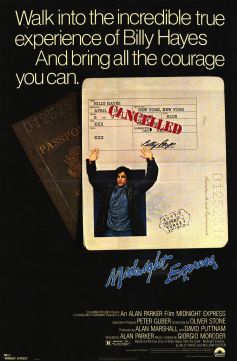
Midnight Express (1978)

midnight_express_ver2_xlgMidnight Express
Directed by Alan Parker

Like most of the other nominees from 1978, I knew nothing about Midnight Express before I watched it. Because it had “express” in the title, just like Murder on the Orient Express, Von Ryan’s Express, and Shanghai Express, I thought I was going to see an exciting train movie. I was disappointed and apprehensive to learn that it was not about trains, but about the horrifying conditions in a Turkish prison. I was fully expecting a movie as brutal as Deliverance, and I was relieved that it wasn’t nearly as bad.

So what’s the story? Young American Billy Hayes is caught trying to smuggle two kilos (or four and a half pounds) of hashish out of Turkey and sentenced to four years in prison there.

The Good: The acting is phenomenal. Brad Davis is truly amazing as Billy as he goes from terror to acceptance to insanity. Randy Quaid plays Jimmy, an inmate who is always coming up with escape plans that go awry.  Norbert Weisser shows subtle sympathy as Kurt the Swede. The sneaky prison snitch Rifki is played with quiet menace by Paolo Bonacelli. John Hurt gives a heartbreaking performance as Kurt, an English prisoner who has been there so long that he has very little hope left to hang on to.

The music is good, with the music in the chase scene being exceptional. It was a bit too synthesized in my opinion, but it’s still good.

I liked that the Turkish wasn’t translated, especially when Billy was first arrested at the airport. It was kind of disorienting, because I wasn’t sure exactly what was going on, and that echoed Billy’s experience.

The Bad: Go straight to ugly. Do not pass Go. Do not collect $200.

The Ugly: I couldn’t connect with Billy Hayes. He came off as an entitled spoiled brat. He was smuggling several pounds of hashish out of Turkey, but he seems to believe that he doesn’t deserve any sentence at all for that. Depending on the state he was in, he’d get about five years in prison for that in the US, especially since he admitted that he had the intent to sell. Smuggling carries an even greater penalty, so when he whined about having to stay four years, my opinion of him went down even more. Unfortunately, if you can’t connect with the main character in some way (or at least have some sympathy for him), a movie gets a little dull. You just want it to be over, because you just don’t care what happens.

I was upset when I found out that most of the movie was made up. If you are purporting to tell a true story,there should be more truth to your movie than the very basic plot. According to Billy Hayes, the conditions weren’t nearly as brutal as Alan Parker and Oliver Stone, who wrote the screenplay, depicted. I feel like you shouldn’t defame an entire country just for the drama.

I rarely do spoilers, but I am going to highlight the most brutal moments here so that you can make a more informed decision about watching it (SPOILERS BELOW):

  1. A cat is hung.
  2. One inmate bites off another’s tongue.
  3. A man’s head is squished on a peg and some grossness ensues.

Those are the three most brutal moments; everything else is basically as tame as the things that happen in the TV show Prison Break.

Oscars Won: Best writing, screenplay based on material from another medium; best music, original score.

Other Oscar Nominations: Best picture; best actor in a supporting role (John Hurt); best director; best film editing.

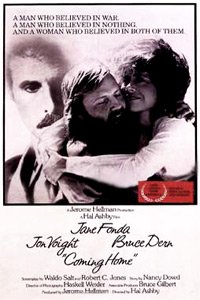
Coming Home (1978)

cominghome1Coming Home
Directed by Hal Ashby

 1978 is kind of a black hole in my movie world. This is another best picture nominated movie that I didn’t know anything about. When I picked it up from the library and saw that it was a movie about Vietnam starring Jane Fonda, I wasn’t thrilled. I’ve never been a fan of hers. But then I reminded myself that I loved watching Jane Fonda (and the rest of the cast) in Grace and Frankie, so I tried to put my prejudices aside and just lose myself in the movie, which turned out to be easy to do.

So what’s the story? Sally’s husband, Bob, is excited to be going to Vietnam to actually start doing his part in the Vietnam War. While he’s gone, Sally starts volunteering at the nearby VA hospital, where she reconnects with Luke, whom she knew in high school. Luke was injured in the war and is now a paraplegic. He is angry about the war, so naïve Sally tries to pull him out of his bitter shell. As they both wrestle with the tragic effects of war on so many different people, they find themselves falling in love.

The Good: Against my own expectations, I found myself very impressed with Jane Fonda’s performance as Sally. Sally grows slowly over the course of the film, and Fonda was able to show Sally’s progression from the little wife to a strong, brave woman. It’s a beautiful, heartbreaking piece of acting.

John Voight was equally good as Luke. I have prejudices against him, too (the Jim Phelps I know would never, ever betray the IM force), but since the long hair and beard helped disguise his face, I was able to appreciate his acting and feel the sadness, bitterness, and anger of a man returned from war, as well as his excitement when he started to feel that his life might get better.

The supporting actors were just as good as the leads. Penelope Milford played Vi, Sally’s free-spirited friend who worked at the hospital to be near her brother Bill, who came back from Vietnam with severe PTSD. Keith Carradine, who played Bill, and Bruce Dern, who played Sally’s husband, Bob, both portray men who can’t handle what happened in Vietnam, although they deal with it in different ways. Everyone in the movie is touched by the war somehow, and they were all able to show the different facets of living with something that can destroy men’s souls.

Both the music and cinematography in Coming Home were unusual in a good way. There was no original score, only songs that were from the time of the Vietnam War. When a song wasn’t playing in the background, there was no music at all, which added to the realism of the movie and forced the viewer to focus more intently on what is happening in the scene. The cinematography had a similar effect. There were a lot of shots of people’s hands as they were talking, underscoring what they were saying. This really stood out to me in the first scene, where actual veterans are having an unscripted conversation about the war, but it happened at other times, too.

The costuming and hair styles also underscored the changes people were making. As Sally found herself, she dressed in more comfortable, practical clothes instead of the dresses, heels, and pearls favored by the other officers’ wives. She let her hair be natural instead of straightening it. But when she went to Hong Kong to see Bob, she once again assumed the dress and appearance of a proper officer’s wife. It was a nice touch.

The Bad: Once again, I am so glad that I live now. The bad things in this movie are not problems with the movie, per se, but with the times. The attitudes towards women are terrible. Yes, I realize that people with the “men know best” attitudes still exist, but they aren’t as prevalent as they were. I’m also glad that PTSD is better understood and treated than it was in the past. I know treatment isn’t perfect, but it’s come a long way since the 1970s.

The Ugly: Coming Home isn’t a perfect movie, but there’s certainly nothing “ugly” about it.

Oscars Won: Best actor in a leading role (John Voight); best actress in a leading role (Jane Fonda); best writing, screenplay written directly for the screen.

Other Oscar Nominations: Best picture; best actor in a supporting role (Bruce Dern); best actress in a supporting role (Penelope Milford); best director; best film editing.

Lincoln (2012)

Lincoln_2012_Teaser_PosterDirected by Steven Spielberg

This is yet another post that I had already written, but lost when I lost my flashdrive. On the bright side, that means I get to celebrate President’s Day by posting about Lincoln, which is a happy coincidence. It’s a great movie about a great man. I feel like I’m gushing, and I’m sorry, but it really is an amazing movie.

So what’s the story? In the last days of the American Civil War, Abraham Lincoln wheels and deals and does everything he can in order to pass the 13th Amendment to the Constitution, which will abolish slavery in the United States forever. He has a deadline, however; if the South rejoins the Union before the amendment passes, they will defeat the amendment and keep slavery legal.

The Good: Daniel Day-Lewis does it again. The man is a chameleon. I could pass him on the street and not have a clue who he is because he always becomes his character. I felt like I was watching real footage of Abraham Lincoln. Before I started watching these Oscar-nominated movies, I thought Daniel Day-Lewis was overrated. I will never think that again. I cannot believe how amazing he is in this part.

I am rarely struck by makeup and hairstyling, but there are so many actors in Lincoln that I am familiar with – and I didn’t recognize any of them except for Tommy Lee Jones. Even Sally Field is practically unrecognizable. Everyone looks period-correct, and it is impressive. The costuming adds to this, of course. You can see the different classes and stations in society through the clothes, and I love it.

Speaking of actors, the supporting cast is fantastic. Sally Field makes a wonderful Mary Todd Lincoln. She shows all the complexities of the woman, including her awareness of how her illness made Lincoln’s life more difficult. Tommy Lee Jones always plays crusty men well, but he is also tender in his portrayal of Thaddeus Stevens. I don’t usually like James Spader, because he always makes me feel slimy, but since his character is slimy, he works so perfectly. I didn’t feel that anyone did a poor job. This is another perfectly-cast movie.

The production design and the sets were another aspect that made the movie historically believable. The rooms were low-ceilinged and dim, even during the day. Everything is slightly dingy, as if covered by the ash of the fires. There is mud and dirt and grime and that’s how life was then.

John William’s score is surprisingly subtle for him. It’s beautiful and stirring and simple and just right for a movie about a brave, simple man.

The Bad: There is nothing bad about this movie. Nothing bothered me about it at all, except perhaps Tommy Lee Jones’ wig, but Thaddeus Stevens had a bad wig in real life, so there wasn’t much choice there.

The Ugly: There are some short ugly war scenes and reminders of the cost of keeping the war going so that the amendment could pass, but that’s realism, not bad filmmaking.

Oscars Won: Best performance by an actor in a leading role (Daniel Day-Lewis); best achievement in production design.

Other Oscar Nominations: Best motion picture of the year; best performance by an actor in a supporting role (Tommy Lee Jones); best performance by an actress in a supporting role (Sally Field); best achievement in directing; best writing, adapted screenplay; best achievement in cinematography; best achievement in film editing; best achievement in costume design; best achievement in music written for motion pictures, original score; best achievement in sound mixing.

Silver Linings Playbook (2012)

silver linings playbookDirected by David O. Russell

I’ve mentioned before that I have mental health issues; depression is what I have to put up with. It’s not fun, and it’s not easy. It has been especially hard in the past because mental illnesses aren’t something you talk about. If you tell someone you have cancer or diabetes, they will sympathize with you, whereas there are still people out there who don’t believe that depression is a real thing. “Just look on the bright side,” they say. “Go running. Eat better. You’re just feeling down.” But people who are just having a bad day don’t seriously fantasize about slitting their wrists or driving their car off a cliff. They haven’t written letters to their families explaining why they felt the need to do this. People who are just feeling down don’t skip their favorite activity of the year for which they have VIP passes because they are crying all day for no particular reason and can’t stop. They don’t sit and think about how worthless they are and how no one really would miss them if they were gone and how their pets would really be happier with another family anyway. Yes, everyone has off days now and then, but for me, those things were my reality. Every. Single. Day. Now that I’ve found an antidepressant that works for me, those things are thankfully not a part of my life as often as they were, but this is why I appreciate movies like Silver Linings Playbook that bring to life people struggling with real issues that are so misunderstood. It’s also why I started this movie three or four times before I could actually watch it all the way through and why I still wouldn’t have seen it if it weren’t for my medication. It’s too real and too painful, too hard to watch when I wasn’t doing well. Sorry for the very long ramble, but it’s a subject close to my heart and I apparently had a lot to say about it.

So what’s the story? Pat Salitano has just been released from a mental institution after fulfilling a court-ordered eight month stint there. He is determined to get his life back to normal and win back his ex-wife, Nikki, who has not only left him, but gotten a restraining order against him. He meets a young woman named Tiffany who wants him to join a dance contest with her. Hoping that this will show Nikki that he has turned his life around, Pat agrees.

The Good: The acting was wonderful. Bradley Cooper as Pat, Jennifer Lawrence as Tiffany, and Robert De Niro and Jacki Weaver as Pat’s parents were amazing. I loved the subtle hints in Robert De Niro’s acting and character that showed that he, too, was dealing with mental health issues, although they were undiagnosed in his case. I thought that casting grumpy-faced Julia Stiles in the part of Veronica, a woman not really satisfied with anything, was brilliant, and I also liked John Oritz in the role of Ronnie, Veronica’s husband.

The music fit the movie perfectly, just kind of laid-back piano and guitar music. Nothing overblown or loud or fancy, because the story isn’t any of those things. It’s a small, intimate story about people working through their problems and finding out that when dreams die, it’s okay to find new ones.

I liked the screenplay. It made all the characters very real, not caricatures of people with mental illness. Or of people living in Philadelphia, for that matter. It helped make the people come alive. I appreciated, too, the humor in the screenplay. Yes, mental illnesses are serious, but funny, random things happen to everyone, regardless of their health. Also, I have felt the same way as Pat about Hemingway (and other authors) at times, so I loved that someone finally said it.

The Bad: I don’t really have anything to complain about here. I really liked the movie, except for two issues that were so bad for me that they have to go in the ugly category.

The Ugly: The age difference between Jennifer Lawrence and Bradley Cooper bothered me throughout the entire movie. I didn’t know at the time what the age difference was, but I would have put Pat at 42 and Tiffany around 23 just looking at them. There is really only a fifteen year age gap between Bradley Cooper and Jennifer Lawrence, but still. It felt kind of icky to me. While Jennifer Lawrence did a fabulous job, I would have been happier with someone a little older.

I would have been fine with it, though, except for the ending.  (SPOILER ALERT) I talked myself into being okay with the age gap because they were just friends, two people who were dealing with similar issues. Age isn’t as big an issue there. But then they were shown being in love and having a relationship, and I didn’t like that. It didn’t seem to fit the movie. I really, really wanted them to just stay friends. I wanted them to each know that they had someone they could depend on who understood them, but somehow by having them fall in love, it cheapened the movie for me. That ending made it seem that unless a man and a woman fall in love, their relationship is pointless. The movie became just another romantic comedy instead of a comedy about people dealing realistically with mental issues, and that bothered me. Silver Linings Playbook is still worth watching, but it became less meaningful to me personally.

Oscars Won: Best performance by an actress in a leading role (Jennifer Lawrence).

Other Oscar Nominations: Best motion picture of the year; best performance by an actor in a leading role (Bradley Cooper); best performance by an actor in a supporting role (Robert De Niro); best performance by an actress in a supporting role (Jacki Weaver); best achievement in directing; best writing, adapted screenplay; best achievement in film editing.

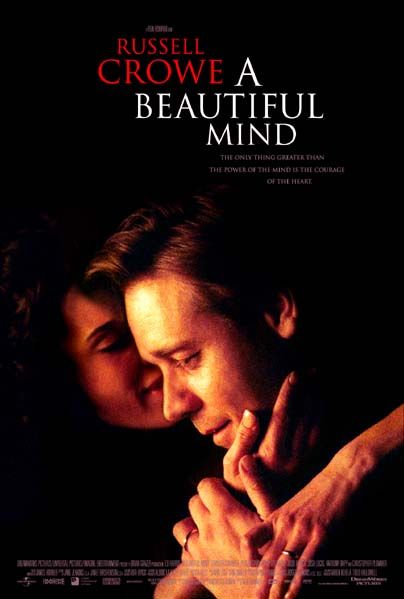
A Beautiful Mind (2001)

beautiful mindDirected by Ron Howard

It was late the night I put this movie in the DVD player, and I wasn’t going to watch the whole thing. But even though it’s not the most action-packed movie ever made, A Beautiful Mind is an extremely gripping movie. As it got later and later (or earlier and earlier in the morning), I kept thinking, “I should really turn this off and go to bed,” but I just couldn’t. I needed to know what happened to John Nash.

So what’s the story? John Nash is a genius mathematician from West Virginia. He doesn’t fit in with all the other Princeton graduate students, mostly because he is completely asocial. He makes a great mathematic breakthrough and gets a job at MIT with the Department of Defense. He meets and marries Alicia, but the top-secret decryption project he’s working on suddenly takes a dark turn.

The Good: The acting was superb. I haven’t seen a lot of Russell Crowe’s movies, and I wasn’t expecting much from him in A Beautiful Mind, mostly because what I’ve seen him in lately is clips from Les Miserables (no, I haven’t seen the whole thing yet, because I don’t want to watch it). Anyway, Russell Crowe became John Nash. I’m always impressed when actors can play a person with a mental disability without overacting. I loved his performance. The supporting cast was great, too. Paul Bettany as Charles, John’s crazy-fun roommate; Jennifer Connelly as John’s wife, Alicia; Ed Harris as John’s government contact; Adam Goldberg, Josh Lucas, and Anthony Rapp as John’s mathematician colleagues; and Christopher Plummer as Dr. Rosen, John’s psychiatrist are all wonderful. I don’t think any of the roles could have been easy to play, but all of the actors did very well.

The costume design was well done, especially since the year in which something happened was rarely given. The clothes were a clue to how many years had passed, and I was very thankful for that. The makeup was good, too. The stars were aged well. I didn’t much care for John Nash’s old look, but that’s because he looked uncomfortably like someone I know, and I couldn’t get past that. But everyone looked definitely, believably older (unlike the people in Giant, which is still my baseline of terribleness when it comes to aging in movies).

The screenplay was good. John Nash’s story could not have been an easy one to tell without giving too much away, but the writers did an excellent job.

The Bad: The music was beautiful, but there were some moments when James Horner copied his own music. At the very beginning of the movie, the music sounded exactly like the music from Sneakers, which I wasn’t even aware James Horner had scored. I had to look it up to be sure. Later on, there are bits from Titanic, which has a brilliant score. It makes me sad that someone who is as obviously talented as James Horner reuses his own stuff.

The Ugly: There wasn’t anything ugly in A Beautiful Mind. It’s a well-made movie that takes a hard topic and treats it sensitivity and tact. Ron Howard deserves major kudos for this movie.

Oscars Won: Best picture; best actress in a supporting role (Jennifer Connelly); best director; best screenplay, screenplay based on material previously produced or published.

Other Oscar Nominations: Best actor in a leading role (Russell Crowe); best film editing; best makeup; best music, original score.

The Snake Pit (1948)

snake pitDirected by Anatole Litvak

My family didn’t have cable TV when I was growing up. We didn’t watch much TV (although we watched lots of movies on the weekends), and my mom thought that cable didn’t have much to offer, so my first real experience with cable was in college, when most of my apartments offered free cable. That’s when I found out that my mother was right; cable didn’t have much to offer. But there is one awesome cable channel that I still miss: Turner Classic Movies. It’s a fabulous station that shows (surprise) classic movies. I couldn’t always convince my roommates that it was a fun station, but when I was home alone sick or just on a quiet night, that was my channel of choice. And that is where I first saw The Snake Pit. At that point, I missed the beginning, but I was still blown away by the honest look at the treatment of the mentally ill in the 1940s.

So what’s the story? Virginia Stuart Cunningham has had a mental breakdown and has been committed to a mental institution in upstate New York. She doesn’t know where she is or why she’s there at first, but with the help of a caring, patient doctor, she slowly discovers what brought upon her breakdown.

The Good: Olivia de Havilland is always good, but she is amazing in this movie. Her acting is never over the top; she makes Virginia a very sympathetic character. She puts a human face on mental illness. Leo Glenn as the understanding Dr. Kik also does a good job. The cruel Nurse Davis is played wonderfully well by Helen Craig.

The story and screenplay were wonderful. There is still a lot of prejudice and misunderstanding when it comes to mental illness, and based on the care Virginia received, I’m sure it was even worse in the 1940s. And yet this movie is very respectful and understanding toward the mentally ill. None of the patients were mocked or despised by the filmmakers themselves. In fact, the villain of the movie, Nurse Davis, is a nurse who openly despises her charges. Her treatment of Virginia and the other patients is shown as cruel and terrible. The sensitivity and kindness that the movie shows towards people with problems gives hope that things will get better.

The Bad: Some of the treatments used on the patients are not nice. Watching people get electroshock therapy or being put in a straightjacket is kind of scary, but it does make me glad that we have come so far in the treatment of mental illness.

The Ugly: There is nothing really ugly about this movie. It’s really very good.

Oscar Won: Best sound, recording.

Other Oscar Nominations: Best picture; best actress in a leading role (Olivia de Havilland); best director; best writing, screenplay; best music, scoring of a dramatic or comedy picture.

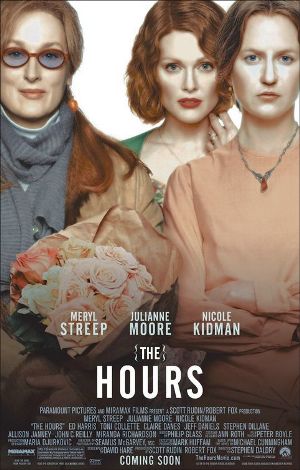
The Hours (2002)

The_Hours_posterDirected by Stephen Daldry

When I saw the poster for this movie, my first thought was, “Wait. It says Nicole Kidman is in this movie, but none of those three women are Nicole Kidman. Why isn’t she on the poster, and why doesn’t the third lady on the poster get higher billing?” So I looked it up on IMDb and realized that the makeup people did an amazing job; they managed to make Nicole Kidman look frumpy.

So what’s the story? Three different women from three different time periods have three parallel days that are all connected by parties, mental illness, and Virginia Woolf’s novel Mrs. Dalloway. I realize that doesn’t sound terribly exciting, but it’s a hard movie to sum up.

The Good: Like I said earlier, the makeup artists were amazing. They did a good job making Nicole Kidman look like Virginia Woolf, but they also did a fabulous job of aging Julianne Moore fifty years. Apparently, they weren’t eligible for an Oscar because a little bit CGI was used to make Nicole Kidman’s false nose look flawless, but still. Major kudos to them.

Major kudos also goes to the editors. The director is telling three different stories, but he jumps around from story to story often. The editing had to make that feel seamless and show the parallels in the different stories. It was very well done.

The soundtrack was beautiful, a lovely piano score. I thought it sounded very similar to the music from The Truman Show; sure enough, Philip Glass did the scores for both. But even though it wasn’t the most original, it was so lovely that it made me want to find some sheet music and learn it.

The acting was excellent. Nicole Kidman completely inhabited Virginia Woolf. Julianne Moore played a frustrated 1950s housewife, and Meryl Streep gave a moving performance as the woman of today (or 2001. But that was today when the movie was made.). John C. Reilly played Moore’s incredibly devoted husband, and Ed Harris was a poet dying of AIDS, a former lover of Meryl Streep’s character. Miranda Richardson felt completely natural as Virginia Woolf’s sister Vanessa.

The Bad: This movie is based on a book (which I haven’t read, so I can’t compare anything), and it shows. All three main character women spend a lot of time staring into space. I’m sure that in the novel, they are having deep thoughts, but those thoughts don’t always make it across on the screen. That got annoying.

I also felt like the three stories didn’t fit together as well as they should. Meryl Streep’s character had many parallels to Mrs. Dalloway, even down to the names, and her story dovetailed neatly with Julianne Moore’s, but the only connection that Julianne Moore had to Virginia Woolf was that she was reading Mrs. Dalloway, and I wanted it to be better than that.

The Ugly: Confession time: I struggle with depression. I have been suicidal in the past. I am a woman who doesn’t quite fit in her society. And even with all that, I never felt a deep connection with this movie. Maybe it was because we couldn’t get a deep look at these women’s inner thoughts, but it felt so shallow. The only woman I really felt like we got a good, sympathetic look at was Virginia Woolf; I would have happily watched an entire Virginia Woolf biopic starring Nicole Kidman and Stephen Dillane because they were the only very well-developed characters. That shouldn’t happen in a character-driven movie.

Oscars Won: Best actress in a leading role (Nicole Kidman).

Other Oscar Nominations: Best picture; best actor in a supporting role (Ed Harris); best actress in a supporting role (Julianne Moore); best director; best writing, adapted screenplay; best costume design; best film editing; best music, original score.