Ivanhoe (1952)
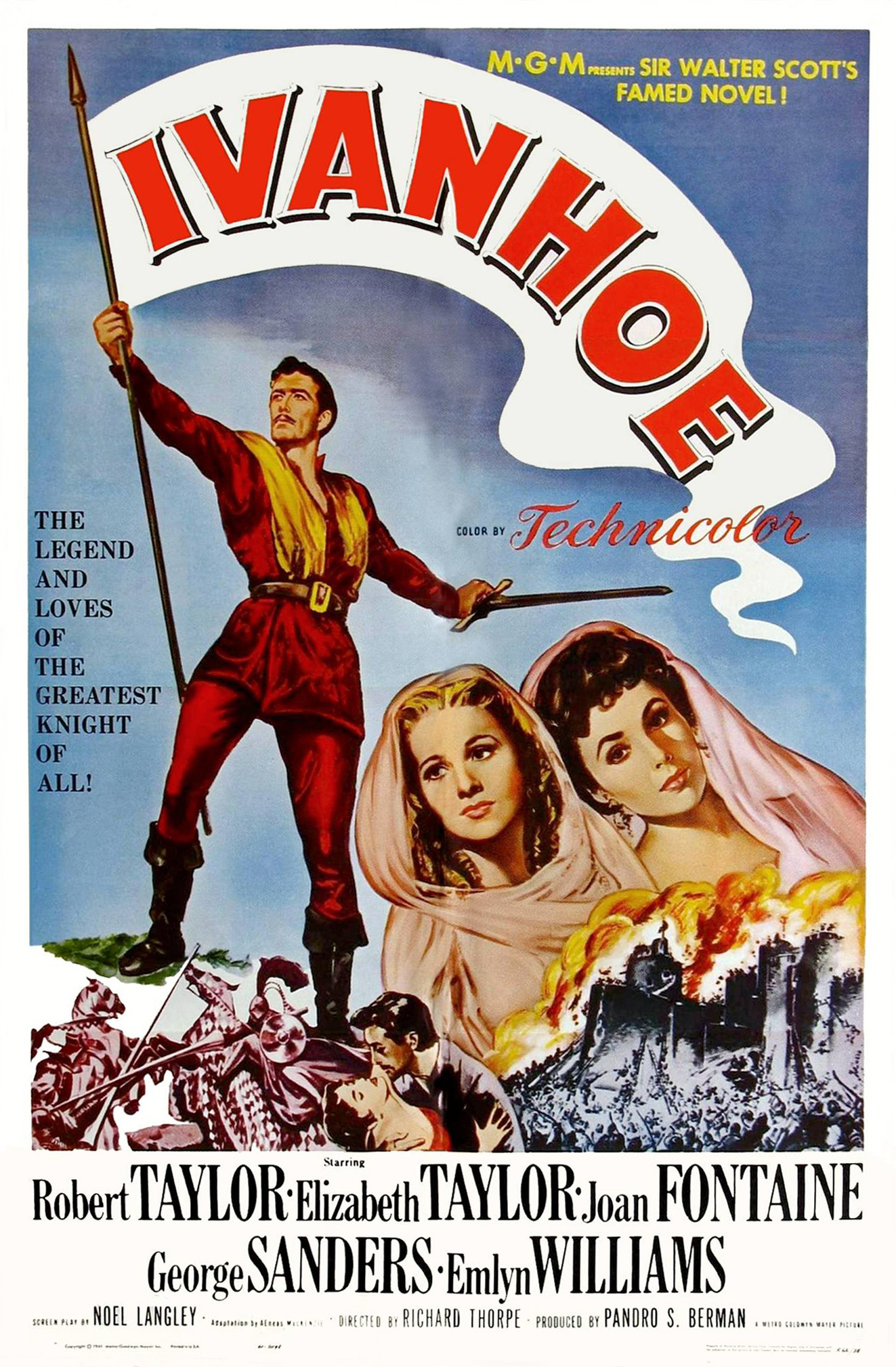
Directed by Richard Thorpe
I read Sir Walter Scott’s novel Ivanhoe when I was fourteen or fifteen, and I thought it was fabulous. It has all the necessary elements for an excellent swashbuckling story: adventure, romance, chivalry, and jousting. I had high hopes for the movie, too, but sadly, they were dashed. The elements were all still there, but something was missing. It didn’t feel alive somehow.
So what’s the story? Saxon knight Ivanhoe, who has been to fight in the Crusades, refuses to believe that King Richard is dead. As he makes his way back to England, he rides past every castle he can find, hoping that his English singing will attract the attention of a captive king. This long and slightly foolish plan works; King Richard throws him a letter explaining that he is being held for random. Prince John knows about the ransom, but refuses to pay it so that he can be king instead of his brother. When Ivanhoe reaches England, he not only has to raise the ransom, but right many wrongs and rescue damsels in distress.
The Good: The music is beautiful. It’s scored by Miklos Rozsa, who would go on to score Ben-Hur several years later. The music is very rich and full. The adjective I want to use is “orchestral,” but I’m not sure that would mean anything to anyone else. Hmm. How to put it? He uses the full orchestra to great effect. That makes it sound really boring, but it’s not. It’s really quite stirring.
The best actors in Ivanhoe were not the main characters. The person whose acting stood out to me the most was George Sanders as the villainous Norman knight De Bois-Guilbert. Even though his character was not the most chivalrous, his emotions rang true and he managed to take his flat character and make viewers pity him. It was impressive.
Other people with smaller parts were also able to make the most of their parts. Emlyn Williams as Ivanhoe’s slave-turned-page, Wamba, provided some welcome comic relief. Cedric, Ivanhoe’s bitter Saxon father, was played excellently by Finlay Currie. And Guy Rolfe was the vilest and scariest Prince John I have ever seen.
Although I read the book several years ago, I remember thinking that Rowena was terribly disappointing for a Saxon princess. She was just so blah. (That impression may have been wrong; like I said, it was a while ago.) But in this version, she has spirit and is a lot more awesome. Joan Fontaine did a very good job of showing her strength, her pride, and her jealousy, even if I thought she was a little old for the part. (Side note – this is the first time I’ve seen Joan Fontaine and thought, “Oh, yeah. She and Olivia de Havilland are totally sisters.” The resemblance really shines in this movie.)
The jousting scenes were pretty cool, even if some of the men’s colours were not manly looking. That was a seriously impressive sport, although I’m glad it’s not a big thing anymore because it also looks incredibly dangerous.
The Bad: Robert Taylor is terribly miscast as Ivanhoe. He doesn’t even bother to try an English accent, which is a little jarring when everyone around him has one. He’s too old to convincingly be a young, dashing knight, and he’s much too solemn.
There is a scene where Ivanhoe has been taken captive, along with Rowena, Rebecca, Cedric, and Wamba. Robin of Locksley (yes, THAT Robin of Locksley) comes with his men to free them. There’s a huge battle with falling rocks and longbows and battering rams and swordfights, and it should be awesome. But it’s not. Watching people fire arrows at each other gets really boring after a while, and the swordplay is not well-choreographed. It may be the most disappointing medieval battle scene in a movie ever.
The Ugly: Elizabeth Taylor is so wooden as the Jewess Rebecca. She is extremely beautiful, but a damsel in distress should show some actual distress once in a while, instead of just looking pretty and putting her hand to her mouth. When she spoke, she sounded like she was reading lines, not speaking from her heart.
The worst thing about this movie was that it was so stiff. There was no sense of fun. There was no swash to the buckle, so to speak. Everything was taken so seriously. I wanted to say, “Hey! People! You’re in a castle! You’re fighting baddies! You’ve got awesome clothes! Smile once in a while. Look like you’re having fun!” No one ever did. Most of the separate elements were fine, but it just didn’t meld in a good way. A movie like this, set in the same time period and with so many of the same elements as The Adventures of Robin Hood (1938), is going to get compared to that movie. It needed to distinguish itself in some way, and sadly, it didn’t.
Oscars Won: None.
Oscar Nominations: Best picture; best cinematography, color; best music, scoring of a dramatic or comedy picture.
 The Oscar Grouch