I'd like to spank the Academy

Posts tagged ‘historical’

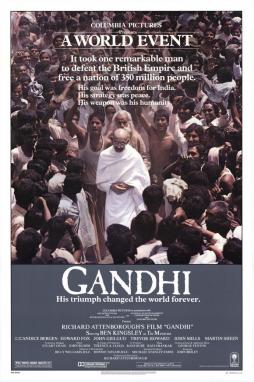
Gandhi (1982)

gandhi-movie-poster-1982-1020195902Directed by Richard Attenborough

I always worry when I’m watching a movie about a culture that isn’t my own, especially when it’s made by someone also outside that culture. I worry that I will “learn” something inaccurate or get the wrong idea about that culture. I had seen Gandhi before, but I was probably fourteen or fifteen and impressionable, so I was worried about how Indians view the movie and whether I could watch it comfortably as an American. But the day I picked it up from the library, an Indian coworker of mine said, “Oh, you are going to watch that movie? It is such an excellent movie. So well done.” Later that night, a British friend of mine whose parents are from India and Pakistan asked me what I was doing. I told him I was watching Gandhi. His response? “I love that movie.” So while there might be historical inaccuracies or only part of the story told, I at least know that Indians do not find this movie offensive, which does make me glad.

So what’s the story? Mohandas Gandhi, a young Indian lawyer educated in London, experiences racial prejudice in South Africa and decides that it is unacceptable for anyone to be treated that way. He begins a protest of the way Indians in South Africa are treated. His activism doesn’t stop there, however. He goes back to India and becomes the leader of the long struggle against British rule.

The Good: Ben Kingsley makes an excellent Gandhi, both young and old. He takes us on the same journey that Gandhi made, from rash young man to wise old leader, full of patience and kindness. It is an excellent performance.

I’m not going to name all of the people who did a good job of acting, because in a three-hour movie with lots of small roles filled by famous or soon-to-be-famous people (including Daniel Day-Lewis!), there is lots of good acting. I will mention Rohini Hattangadi, though. She played Ba, Gandhi’s wife, going from a young woman unsure if her husband is doing the right thing or if he has gone crazy to a woman who believes fully in what he does and supports him completely. She was impressive.

I loved the cinematography. There are times when it shows the grandeur of India, the huge scale of that country, and other times when it is intimate, showing how one man was able to make such a difference in such a large, diverse country. If I hadn’t already wanted to visit India someday, the cinematography of this movie would have made me want to go.

The makeup people did an excellent job of making Gandhi and Ba look older as time passed. I might have thought that the old and young were played by different people, especially as Ben Kingsley looks less like himself and more like Gandhi as he “aged”.

The Bad: Those same makeup people who did such a good job on Gandhi did a less-than-stellar job on Gandhi’s associates Nehru, Jinnah, and Patel. They didn’t age at all until the very end, even though they had been working for independence for thirty years. If this was done on purpose to show how much more quickly people age when they are living a lifestyle of poverty, than I suppose it was okay. But even if you are wealthy, you age over time, not all at once.

What happened to Gandhi’s sons? They are shown at the beginning of the movie in South Africa, but then we never see them again. There was nothing about the sons to make them a huge plot point, but I really did have to wonder if they all died, since they don’t seem to be anywhere around Gandhi and his wife for the rest of his life. Leaving them out altogether would have been one thing, but to show them once and then never again is bad storytelling.

The Ugly: I’m not disputing that Gandhi was a great man. He truly was. It takes an amazing kind of person to struggle for independence without fighting and to inspire an entire nation to do the same. His story is an incredible one. But except for one scene where he is angry at his wife, he is shown as having no weaknesses. He is made out to be a saint. I’m not trying to insult anyone or tear Gandhi down, but no one is that perfect, which made me feel like the movie was only semi-factual. I may be wrong; I know very little about the Mahatma. He may have been perfect. But because I was feeling that throughout the movie, I couldn’t immerse myself completely in the experience, so I’m going to stand firm in my belief that it was a weakness for this movie.

Oscars Won: Best picture; best actor in a leading role (Ben Kingsley); best director; best writing, screenplay written directly for the screen; best cinematography; best art direction-set decoration; best costume design; best film editing.

Other Oscar Nominations: Best sound; best music, original score; best makeup.
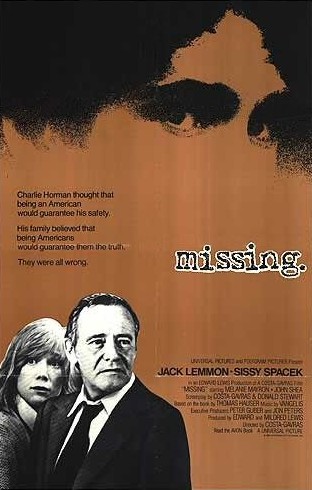
Missing (1982)

Missing_1982_filmDirected by Costa-Gravas

As I’ve been watching these Oscar-nominated movies, there have been many, especially from the 1970s and 1980s, that I haven’t really known anything about. Some of them have been less than stellar, and I can understand why they have fallen by the wayside, even for someone like me who likes watching good movies, no matter how old they are or what language they are in. Missing is not one of those movies. Missing is so awesome I want to show it to everyone I know, and I’ve been telling random people how sad I am that no one seems to have seen it. Missing makes me want to be a high school history or civics teacher so that I could show it to my class to teach them not to be too trusting of government. It makes me so mad that Missing is not a classic; it completely deserves to be one.

So what’s the story? Charlie and Beth Harmon are an idealistic young married couple who have been living in Chile for a couple of years when a right-wing coupe happens. They are going to leave the country soon, so Beth goes to say good-bye to a couple of friends. She gets stuck overnight because of the curfew. When she finally makes it home, Charlie is gone. About two weeks after his disappearance, Charlie’s conservative businessman father, Ed Horman, comes to help Beth navigate the waters of diplomacy and bureaucracy. What they find out together will change their lives forever.

The Good: I’m tired of starting with acting, so I’m going to start with music today. Vangelis’s score is beautiful and haunting. It’s more orchestral than the music in Chariots of Fire, and where he does use the synthesizer, it fits the time much better. The other thing that is great about the music is that it is not constant. Lots of the movie has no music, so that where there is music, it has a much greater impact.

The acting is wonderful. Sissy Spacek is wonderful as Beth, who changes from a vibrant, loving young woman to a frantic wife to a jaded and accepting woman in the course of just a few weeks. It’s a marvelous performance. Jack Lemmon is fantastic as Ed, who starts out so convinced that he’ll be able to fix everything with connections, but slowly comes to realize the truth. I’ve only ever seen Jack Lemmon in comedies, so this was a revelation. John Shea plays idealistic, happy-go-lucky Charlie. He’s not in the movie much, but he leaves an impact when his character is gone. Government agent Captain Ray Tower is played rather chillingly by Charles Cioffi. He’s so scary in part because he’s so friendly, but you can tell he’s hiding the truth.

This is going to sound silly, but the set decoration was so clever at one point. Beth and Ed are at the US Embassy, trying to get answers about what happened to Charlie. The US Ambassador is telling them that he’s probably in hiding and that they shouldn’t worry about him. While he is talking to them, he is standing directly under a picture of Richard Nixon. This movie takes place in 1973, so Nixon was the president then, but by the time Missing was made in 1982, everyone knew that Nixon was a liar. To see a man appointed by that president standing underneath him subtly, yet effectively, underscored the fact that the ambassador was also a liar.

The screenplay was very good. It made the characters come alive. It also made the movie completely gripping. I was so angry that I had to stop watching to go to work. I wanted to know what happened, and I wanted to know NOW! It was fantastic.

I have no concrete examples of why I felt this way, but I though the directing was very good. It’s hard to define good directing, because it’s hard for me to know how much of a hand the director had in various aspects of the movie, but I really felt good directing at play here.

The Bad: The only complaint I have is that Beth and Charlie’s friend Terry has 1980s poufy hair. As a free-spirited 1970s woman, Terry’s hair should have been longer and straighter. I know, tiny quibble. But it bothered me.

The Ugly: War is always ugly, and there are some shocking images and situations in this movie. It’s not the easiest movie to watch because of this, and also because this is a true story. Art that is great tends to bring up issues that might make people uncomfortable, but that doesn’t mean that these issues should be ignored. I think it’s better for people to know what is wrong in their world than to believe that everything is perfect when corruption is hiding underneath.

Oscar Won: Best writing, screenplay based on material from another medium.

Other Oscar Nominations: Best picture; best actor in a leading role (Jack Lemmon); best actress in a leading role (Sissy Spacek).

Moulin Rouge (1952)

Poster - Moulin Rouge (1952)_11Directed by John Huston

I will freely admit that part of the reason I’m doing 1952 right now is because after watching Moulin Rouge! (2001), I was curious about this movie. I wasn’t sure if the 2001 version was a drug-induced remake of the same story or a weird Baz Luhrmann fantasy that had nothing to do with John Huston’s movie. It turns out that except for the setting, they don’t really have much to do with each other. That made me glad, because I much prefer John Huston’s vision over Luhrmann’s, and I hate it when people are more familiar with subpar remakes than with the fantastic originals.

So what’s the story? Aristocrat Henri de Toulouse-Lautrec turns his back on his privileged upbringing to become an artist during the heady days of late 19th century France.

The Good: Josè Ferrer. Toulouse-Lautrec is a complicated character in this movie. He’s an angry drunk who is convinced that life won’t bring him anything good. Ferrer does an excellent job with that.

Henri has two different women in his life: Marie Chalet and Myriamme Hayam. Colette Marchand is Marie Chalet, a beautiful, yet poor, woman who doesn’t mind Henri’s deformities. Marie is a hateful, pettish gold-digger, and Marchand plays her perfectly. The more sympathetic, mature Myriamme is played heart-breakingly well by Suzanne Flon.

Another great thing about this movie is that it has Zsa Zsa Gabor. Even though she has top billing after Jose Ferrer, her role is rather small. But you can tell that she’s having so much fun basically playing herself that you just have to love her. I have to admit, I find the Gabor sisters fascinating; they were kind of like the Kardashians (famous for no good reason), but super classy. I think they would have interesting people to know. And I will stop crushing on Zsa Zsa now and move on.

There is some clever camera work in this movie. In real life, Toulouse-Lautrec was 5’1”. Josè Ferrer was much taller. He spent quite a bit of the movie walking on his knees to be closer to the right height. You can’t tell, and I love that you can’t tell. This movie would have been just silly if they had done a bad job with Henri’s height because it’s so central to the story.

The dancing in the movie is ridiculously amazing. I have never seen the cancan done in real life, but I had a vague idea that it involved high kicks while balancing on one foot. I would suggest that even if you don’t ever watch this movie, at least google the cancan scene from this movie. It takes serious skill and athleticism to do it. I was blown away. Oh, and in case you’re wondering (or worried), no, the dancers don’t wear split bloomers. The movie’s from the 1950s; that would have been too scandalous.

I love how 19th century Paris and Toulouse-Lautrec’s art were brought to life. The clothes and the colors and the costumes are all fantastic. There are rich people and poor people and you can differentiate between them (which isn’t always the case in the movies). The costume and makeup people paid close attention to the art and took some of the clothes, makeup, and hairstyles straight from his paintings. I loved it. I also loved the two interludes where the paintings themselves were flashed on the screen to music that matched them. It was a good way to show passage of time and also to highlight what Toulouse-Lautrec did and what lower-class Paris was like at the time. It was very cool.

Even though I minored in art history in college, I don’t know much about Toulouse-Lautrec’s life in general. Seeing as how this is a biopic based on a novel based on his life, it’s probably not completely accurate. But I liked the story. It didn’t make Henri out to be perfect, but it gave him more dignity than he had in Moulin Rouge! (2001), which was something that really bothered me about that movie.

The Bad: I can’t think of anything about this movie that’s bad. It’s mostly good, except for the ending, which flies past “bad” and lands in “ugly”.

The Ugly: The ending is so cheesily bad. It rivals Goodbye, Mr. Chips for cheesy badness.

Oscars Won: Best art direction-set decoration, color; best costume design, color.

Other Oscar Nominations: Best picture; best actor in a leading role (Josè Ferrer); best actress in a supporting role (Colette Marchand); best director; best film editing.

Random Fact: It is really hard to type “Moulin Rouge”. My fingers want to type “Moulin Rogue,” which works, too, but it sounds like a superhero who patrols the streets of Paris. (“Who was that masked man by the mill?” “Don’t you know? That was the Moulin Rogue!”)

Another Random Fact: Peter Cushing (AKA Grand Moff Tarkin) has a small role in this movie. Watch for him at the horse races!

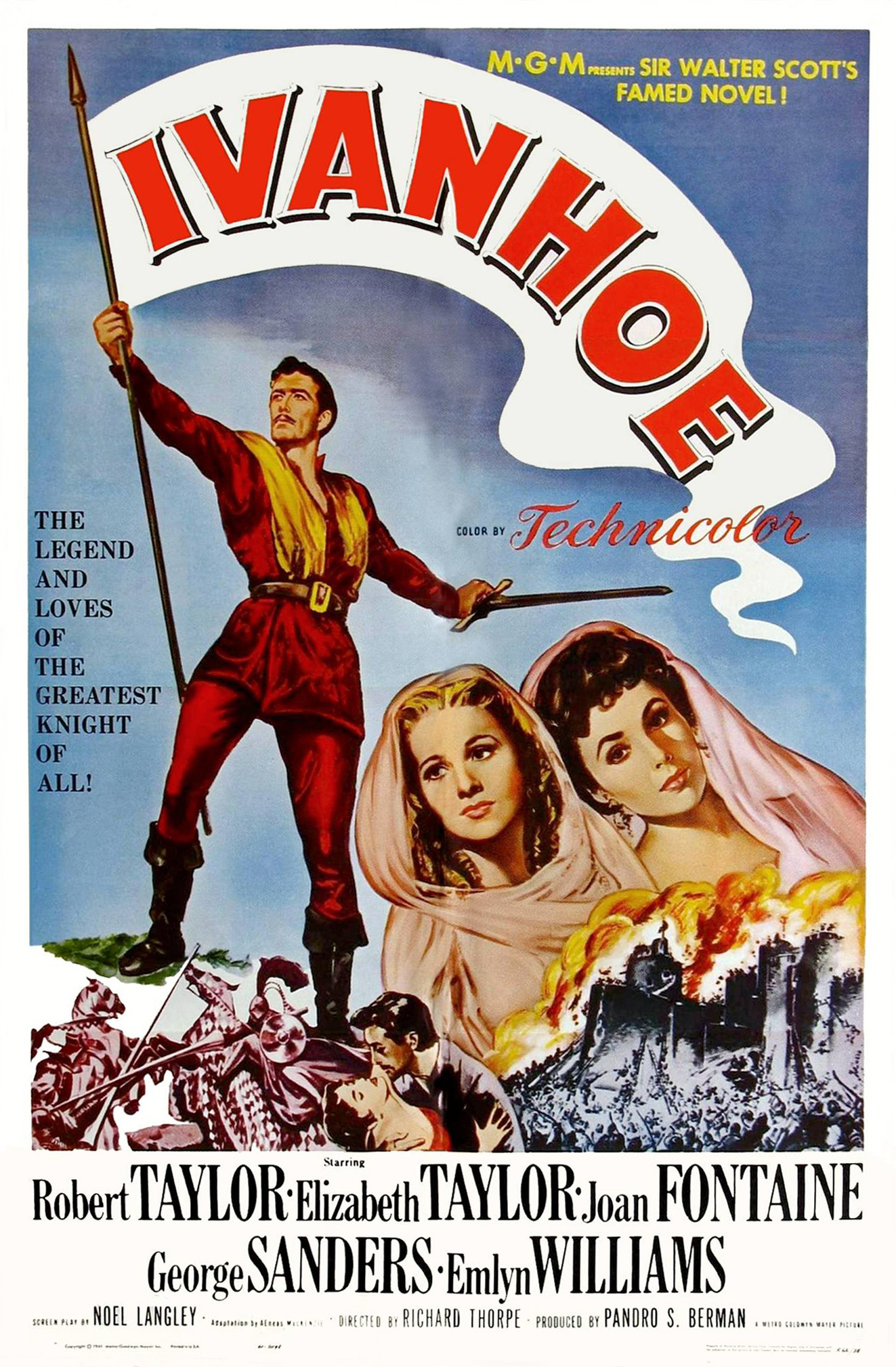
Ivanhoe (1952)

Ivanhoe (1952)_01

Directed by Richard Thorpe

I read Sir Walter Scott’s novel Ivanhoe when I was fourteen or fifteen, and I thought it was fabulous. It has all the necessary elements for an excellent swashbuckling story: adventure, romance, chivalry, and jousting. I had high hopes for the movie, too, but sadly, they were dashed. The elements were all still there, but something was missing. It didn’t feel alive somehow.

So what’s the story? Saxon knight Ivanhoe, who has been to fight in the Crusades, refuses to believe that King Richard is dead. As he makes his way back to England, he rides past every castle he can find, hoping that his English singing will attract the attention of a captive king. This long and slightly foolish plan works; King Richard throws him a letter explaining that he is being held for random. Prince John knows about the ransom, but refuses to pay it so that he can be king instead of his brother. When Ivanhoe reaches England, he not only has to raise the ransom, but right many wrongs and rescue damsels in distress.

The Good: The music is beautiful. It’s scored by Miklos Rozsa, who would go on to score Ben-Hur several years later. The music is very rich and full. The adjective I want to use is “orchestral,” but I’m not sure that would mean anything to anyone else. Hmm. How to put it? He uses the full orchestra to great effect. That makes it sound really boring, but it’s not. It’s really quite stirring.

The best actors in Ivanhoe were not the main characters. The person whose acting stood out to me the most was George Sanders as the villainous Norman knight De Bois-Guilbert. Even though his character was not the most chivalrous, his emotions rang true and he managed to take his flat character and make viewers pity him. It was impressive.

Other people with smaller parts were also able to make the most of their parts. Emlyn Williams as Ivanhoe’s slave-turned-page, Wamba, provided some welcome comic relief. Cedric, Ivanhoe’s bitter Saxon father, was played excellently by Finlay Currie. And Guy Rolfe was the vilest and scariest Prince John I have ever seen.

Although I read the book several years ago, I remember thinking that Rowena was terribly disappointing for a Saxon princess. She was just so blah. (That impression may have been wrong; like I said, it was a while ago.) But in this version, she has spirit and is a lot more awesome. Joan Fontaine did a very good job of showing her strength, her pride, and her jealousy, even if I thought she was a little old for the part. (Side note – this is the first time I’ve seen Joan Fontaine and thought, “Oh, yeah. She and Olivia de Havilland are totally sisters.” The resemblance really shines in this movie.)

The jousting scenes were pretty cool, even if some of the men’s colours were not manly looking. That was a seriously impressive sport, although I’m glad it’s not a big thing anymore because it also looks incredibly dangerous.

 The Bad: Robert Taylor is terribly miscast as Ivanhoe. He doesn’t even bother to try an English accent, which is a little jarring when everyone around him has one. He’s too old to convincingly be a young, dashing knight, and he’s much too solemn.

There is a scene where Ivanhoe has been taken captive, along with Rowena, Rebecca, Cedric, and Wamba. Robin of Locksley (yes, THAT Robin of Locksley) comes with his men to free them. There’s a huge battle with falling rocks and longbows and battering rams and swordfights, and it should be awesome. But it’s not. Watching people fire arrows at each other gets really boring after a while, and the swordplay is not well-choreographed. It may be the most disappointing medieval battle scene in a movie ever.

The Ugly: Elizabeth Taylor is so wooden as the Jewess Rebecca. She is extremely beautiful, but a damsel in distress should show some actual distress once in a while, instead of just looking pretty and putting her hand to her mouth. When she spoke, she sounded like she was reading lines, not speaking from her heart.

The worst thing about this movie was that it was so stiff. There was no sense of fun. There was no swash to the buckle, so to speak. Everything was taken so seriously. I wanted to say, “Hey! People! You’re in a castle! You’re fighting baddies! You’ve got awesome clothes! Smile once in a while. Look like you’re having fun!” No one ever did. Most of the separate elements were fine, but it just didn’t meld in a good way. A movie like this, set in the same time period and with so many of the same elements as The Adventures of Robin Hood (1938), is going to get compared to that movie. It needed to distinguish itself in some way, and sadly, it didn’t.

Oscars Won: None.

Oscar Nominations: Best picture; best cinematography, color; best music, scoring of a dramatic or comedy picture.