I'd like to spank the Academy

Posts tagged ‘France’

The Life of Emile Zola (1937)
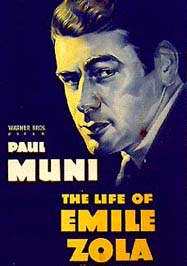
The_Life_of_Emile_Zola_posterDirected by William Dieterle

Alfred Dreyfus=Dreyfus Affair=Emile Zola=J’acusse. Alfred Dreyfus was Jewish and this whole story has nothing to do with Richard Dreyfuss. This is what I remember from the European history class that I took in high school. I could not have told you what the Dreyfus Affair was about, just that it had happened. I knew Zola was an author who championed the lower and middle classes, but even though I’m a librarian and librarians are supposed to have read every book ever, I have never read anything by him. That is everything I knew about Emile Zola before I watched this movie. Yes, I realize it’s a biopic and therefore full of half-truths or stuff made up to make it more interesting, but I will never forget the intricacies of the Dreyfus Affair or the booming character of Emile Zola.

So what’s the story? The young writer Emile Zola has a penchant for getting into trouble.He writes about prostitutes, oppressed coal miners, and the ineptness of the French army. He loses jobs and gets called into the office of the Censor of Paris more than once on account of his controversial books, but he refuses to stop exposing the uncomfortable truths of French society. However, Zola eventually stops writing. His wealth insulates him from the poverty around him. The story stops following Zola at this point, and switches to the story of Alfred Dreyfus. The higher-ups of the French army discover that someone has been passing secret military information to the Germans. They decide to pin the blame on Alfred Dreyfus, mostly because he’s Jewish. Dreyfus proclaims his innocence, but he is convicted and exiled anyway. Evidence is later found that Dreyfus is not the traitor, but the army doesn’t want to admit their mistake and tries to cover up what they have found. At this point, Anatole French, one of Zola’s writer friends, urges Zola to remember his commitment to social justice and intercede on Dreyfus’s account. Zola is reluctant, but eventually writes what would become his most famous and influential piece: J’accuse.

The Good: Emile Zola was quite the character. It would have been easy to overplay him, to ham it up and turn him into a caricature of the man. Paul Muni, however, plays him with more subtlety. His optimism, his despair, his desire to stand up for the underdog, his self-satisfaction in later life, are all brought out brilliantly by Muni. Muni’s delivery of Zola’s last speech in court was so amazing that it brought me to tears. It’s a truly great example of acting.

Paul Muni is not the only great actor in this film. Joseph Schildkraut plays Alfred Dreyfus to perfection, bewildered as to why his beloved France would do this to him, despairing as he realizes that nothing he can do will convince the army that he’s innocent, joyful when he’s released and reinstated into the army. Gale Sondergaard is Dreyfus’s stalwart wife, determined to do everything in her power to reveal the truth and exonerate her husband. Zola’s defense attorney, played by Donald Crisp (not Claude Rains, even though he looks like Claude Rains here), doesn’t have a large role in the movie, but Crisp does such a good job expressing his exasperation with the court that blocks him at every turn. The brave Colonel Georges Piquart, the only officer to stand up for the truth, was very well portrayed by Henry O’Neill. I love a well-cast movie.

The screenplay was very good. The writers managed to be inspiring without crossing the line into cheesiness, there was enough humor to balance out the drama, and I loved the foreshadowing of the (paraphrased) line that if you get too fat, you can’t see past your own stomach. I assume some of Zola’s words were his own, especially his dramatic last speech, but it’s all woven seamlessly together.

The clothing and makeup were well done. The clothing styles changed as the years passed, giving a hint to how much time had gone by. The makeup captured the real-life people excellently. The movie Dreyfus matches photographs of the real Dreyfus so well it’s almost uncanny. The makeup done to age the actors was also good.  I don’t know what happened in the years between 1937 and 1956 when Giant was made, but makeup artists in the 1930s were wonderful at using makeup to make actors look decades older.

The Bad: The actual words that were spoken were good, but the screenplay was rather disjointed. The story started with Zola’s life, and then completely cut Zola out while it explored the Dreyfus affair. Zola came back eventually, but it just felt odd to change perspectives like that.

It was very hard to tell the many mustachioed army officers apart. I know the mustaches were the fashion of the time, and since they were officers, it makes sense that they were in uniform, but I was never exactly sure who was who. Dreyfus wore glasses and Colonel Piquart had a longer face, which helped, but other than that, I could not tell you which officer was which. It got very confusing.

The Ugly: Although there were some slight problems with The Life of Emile Zola, there was nothing so bad that it fell into the ugly category.

Oscars Won: Best picture; best actor in a supporting role (Joseph Schildkraut); best writing, screenplay.

Other Oscar Nominations: Best actor (Paul Muni); best director; best writing, original story; best art direction; best sound, recording; best assistant director; best music, score.

Mind-boggling Fact: The Dreyfus Affair wasn’t completely resolved until 1906, only 31 years before The Life of Emile Zola was made; Alfred Dreyfus himself died in 1935. That means that the Dreyfus Affair was as close in time to the filmmakers as 1986 is to us. 1986 is not that long ago. Crazy, right?

Les Misèrables (2012)

Les-miserables-movie-poster1Directed by Tom Hooper

This was one of the posts that I lost when I lost my flash drive. As much as I hate rewriting things that I’ve already written, I won’t have a hard time rewriting this one. I have a lot to say about Les Misèrables in general, the musical and this movie version of it in particular.

When I went to study in London about ten years ago, I wasn’t planning on seeing the stage version of Les Misèrables. The touring coming comes to my town often enough, and I wanted to see things I wouldn’t have the chance to see at home. But then I saw a poster of the cast, and the man playing Enjolras was really attractive (I might use the term “super hot” if I weren’t trying to be taken seriously), so I let my friends persuade me to go with them. I knew many people who had seen the musical and thought it was the best thing ever, and I had read an abridged version of the book before I saw the play and seen the movie version from the 1930s and knew that there was fantastic material to work with, so I was expecting really good things. I was really disappointed. I kind of wish I could find the scathing essay I wrote about it. I told my friends that I didn’t really like it, and that got spread around the entire group I had come with, kind of like in the claymation version of Rudolph the Red-Nosed Reindeer when they find out that Herbie doesn’t like to make toys.  (“Melanie didn’t like Les Misèrables!”) I got a lot of weird looks after that from people in my study abroad group, but I didn’t care. I got that same kind of look when I told people I had no desire to see this movie because I didn’t much care for the musical, kind of a mix of shock and disgust. I was never planning on seeing this movie. Stupid best picture nomination. I wasted three hours of my life to see a subpar version of a subpar play.

So what’s the story? Convict Jean Valjean is released from prison. He steals some silver from a priest, who tells the police that he gave Jean Valjean the silver. The priest then tells Valjean that he has to turn his life around. Valjean does so, changing his name so that the stigma of having been a convict won’t follow him throughout his life. However, Javert, a policeman who worked at the prison, recognizes Jean Valjean for who he was, and Valjean must go on the run, taking the daughter of a factory worker with him.

The Good: Les Misèrables has some truly beautiful music. They may not be all completely memorable, and some are hard to tell from others (when I’m not actively listening to them, I always get “Bring Him Home” and “On My Own” mixed up), but they are beautiful nonetheless. I have never forgotten “Castle on a Cloud,” which I learned over twenty years ago in school, and “Stars,” “Empty Chairs at Empty Tables,” and “Do You Hear the People Sing” always give me goosebumps.

There was some decent acting. Hugh Jackman and Russell Crowe both did fine jobs as Valjean and Javert, respectively. Crowe does especially well as Javert, who is perfectly convinced that the law is always right and simply cannot reconcile justice and mercy. Anne Hathaway and Samantha Barks both gave excellent performances as women torn apart by the way French society works. Aaron Tveit and Eddie Redmayne were very good as young revolutionaries Enjolras and Marius, and although I think they took up too much time in the movie, Helena Bonham Carter and Sacha Baron Cohen were perfectly cast as the comic relief-bringing Thènardiers.

The costuming, production design, and makeup were all admirable. Early 19th century France was brought to life thanks to those elements. I always like seeing a historical movie that doesn’t only involve wealthy people. It always makes me happy to have people acknowledge that a)poor people existed, and b)that poor people had different hairstyles, homes, and clothes than wealthy people.

The Bad: I don’t whose idea it was to have the actors sing live instead of lip-synching and putting in the songs later, but it was a bad idea. This movie would have been so much easier to watch if there hadn’t been so many cringe-worthy notes. I think the only person who pulled off all her singing with no problems was Samantha Barks, who played Èponine.

I have never understood the ending. It makes no sense to me to have all the people who have died throughout the movie/Jean Valjean’s life would be together in one place singing about the same thing. All those various people weren’t fighting for the same future, exactly. Also, if Heaven is a barricade as the finale hints, I don’t really want to go to Heaven.

The Ugly: Amanda Seyfried should never have been cast in this movie. Her singing is terrible to the point of distraction. She does have the right look, but I’m sure there are other innocent-looking blondes who could have sung the part much, much better.

Most of the other reasons I didn’t like the movie have to do with the weaknesses of the musical itself. Way too much time is spent on the Thènardiers at the expense of other things from the novel that would have made things make more sense. I wish a bit more time had been spent on the bishop, for example; that felt kind of glossed over. I hated that Javert didn’t recognize Valjean because of his face, but because he was strong. I can understand that people change after twenty years, but I’m sure that Javert had met other strong men in prison before. There was nothing really special for Javert to recognize him. (In the novel, in case you’re wondering, Valjean acts like a human jack to get carts off of men. That’s not something you see often, and makes a lot more sense. Not sure why that was changed.) I was annoyed by Marius and Cosette’s literal love at first sight. They did nothing except see each other, and suddenly life wasn’t worth living without each other? There are other little bits and pieces like that throughout the movie that just add up to me being annoyed with the whole thing.

Okay, now I get to talk about how the book compares to the movie. Since seeing the musical ten years ago, I have read the unabridged version. It’s not perfect. Victor Hugo needed a friend to tell him that when your characters are racing through the sewers in a life-and-death situation, you don’t need to cut from the action to give an entire history of the sewers of Paris. But one amazing, amazing thing that Hugo did do was give everyone a history. The first fifty to one hundred pages are not about Jean Valjean at all, but about the bishop, who, we learn, has given up all of his privileges and only keeps enough of his salary to keep himself fed. The rest he gives to the poor. The only thing he kept was his silver, so when he not only allows Jean Valjean to keep the plate, but also gives him the candlesticks, it’s a huge deal. The students all have back stories, so we care a lot more when they die so uselessly. The Thènardiers are not funny at all. They show the corruption and evil that can happen in poorer classes. They are menacing and horrible. Also, they are the parents of Gavroche, which gets skipped over in the movie completely. There are more connections which make everything that happens much more meaningful. I realize that not everything from a 1500 page book can make it into a three-hour movie, but that’s why making  Les Misèrables into a musical was just a bad idea to begin with. My final advice? If you haven’t seen the movie already, skip it and read the unabridged book. If you have seen the movie already, read the unabridged book. You will be amazed at the depth of feeling.

Oscars Won: Best performance by an actress in a supporting role (Anne Hathaway); best achievement in makeup and hairstyling; best achievement in sound mixing.

Other Oscar Nominations: Best motion picture of the year; best performance by an actor in a leading role (Hugh Jackman); best achievement in costume design; best achievement in music written for motion pictures, original song (“Suddenly”); best achievement in production design.

Amour (2012)

amourDirected by Michael Haneke

I wasn’t planning on taking this last week off. I had watched several of the movies and was reviewing my notes to write my posts when I got hit by a migraine that didn’t wear off for a few days. This meant that I got ahead in the audiobooks I’m currently listening to (Pinocchio: bizarre and pedantic; and Two Years Eight Months and Twenty-Eight Nights: bizarre and amazing, in case you were curious), but it was not helpful for blogging. But it’s gone and I’m glad to be back writing again.

I’m not hugely familiar with French cinema, but I like to think that I’ve seen more French movies than the average American. The French movies I have seen tend to be move a little more slowly, be a little more introspective, and end much more depressingly than American movies, so I wasn’t expecting a happy love story about an elderly French couple when I watched this movie, no matter what the cover looked like. But Amour was so much sadder than I would have been able to anticipate, mostly because it was so heartbreakingly real.

So what’s the story? Anne and Georges are a happily married couple. They are elderly retired music teachers, but they still live in their beautiful apartment by themselves. They read books and go to concerts and see their friends and play Chopin on their beloved piano. All that changes when Anne has a stroke and the realities of old age intrude upon their lives.

The Good: The acting is superb. Emmanuelle Riva was so perfect as Anne that I forgot that she was an actress playing a stroke victim; I thought that I was truly watching a woman whose body and mind had failed her. Jean-Louis Trintignant was amazing as Georges, a man watching his beloved wife slip away, but stubbornly doing his best to fight for her and care for her.

The soundtrack for the movie was also perfect. The only music in the movie was music that the couple played themselves on the piano or that they  were actually listening to. It added to the realism of the film. Any musical score that had played in the background to underscore the emotions or tell the viewer what they were supposed to be feeling would have detracted from the emotion that the movie brings just from the subject matter and acting.

The Bad: Because the movie is so realistic and captures so perfectly the burden of caring for a disabled loved one, it drags sometimes. Taking care of sick people isn’t fun or glamorous, and sometimes it’s downright dull. Amour needed to be that way, but watching people do dull things isn’t a completely fascinating way to spend two hours. I will admit to nodding off a couple of times. (And no, I do not wish to hear any comments along of the lines of “if you think this is boring, go watch Transformers!” Life is boring sometimes, and watching someone else’s life is boring. This truth doesn’t detract from my intelligence or from the beauty of the movie.)

The Ugly: There is nothing lovely about physical and mental decline. It is a horrible thing to see. Just like life can be boring, life can be horrible. This movie is very hard to watch because of that. Amour is a stark reminder of reality and not for the faint of heart, for those who only wish to see movies about the young and happy. It’s a beautiful portrayal of a terrible subject. Although I’m glad that I saw it, I don’t think I will ever be able to watch it again.

Oscar Won: Best foreign language film of the year.

Other Oscar Nominations: Best motion picture of the year; best performance by an actress in a leading role (Emmanuelle Riva); best achievement in directing; best writing, original screenplay.

Moulin Rouge (1952)

Poster - Moulin Rouge (1952)_11Directed by John Huston

I will freely admit that part of the reason I’m doing 1952 right now is because after watching Moulin Rouge! (2001), I was curious about this movie. I wasn’t sure if the 2001 version was a drug-induced remake of the same story or a weird Baz Luhrmann fantasy that had nothing to do with John Huston’s movie. It turns out that except for the setting, they don’t really have much to do with each other. That made me glad, because I much prefer John Huston’s vision over Luhrmann’s, and I hate it when people are more familiar with subpar remakes than with the fantastic originals.

So what’s the story? Aristocrat Henri de Toulouse-Lautrec turns his back on his privileged upbringing to become an artist during the heady days of late 19th century France.

The Good: Josè Ferrer. Toulouse-Lautrec is a complicated character in this movie. He’s an angry drunk who is convinced that life won’t bring him anything good. Ferrer does an excellent job with that.

Henri has two different women in his life: Marie Chalet and Myriamme Hayam. Colette Marchand is Marie Chalet, a beautiful, yet poor, woman who doesn’t mind Henri’s deformities. Marie is a hateful, pettish gold-digger, and Marchand plays her perfectly. The more sympathetic, mature Myriamme is played heart-breakingly well by Suzanne Flon.

Another great thing about this movie is that it has Zsa Zsa Gabor. Even though she has top billing after Jose Ferrer, her role is rather small. But you can tell that she’s having so much fun basically playing herself that you just have to love her. I have to admit, I find the Gabor sisters fascinating; they were kind of like the Kardashians (famous for no good reason), but super classy. I think they would have interesting people to know. And I will stop crushing on Zsa Zsa now and move on.

There is some clever camera work in this movie. In real life, Toulouse-Lautrec was 5’1”. Josè Ferrer was much taller. He spent quite a bit of the movie walking on his knees to be closer to the right height. You can’t tell, and I love that you can’t tell. This movie would have been just silly if they had done a bad job with Henri’s height because it’s so central to the story.

The dancing in the movie is ridiculously amazing. I have never seen the cancan done in real life, but I had a vague idea that it involved high kicks while balancing on one foot. I would suggest that even if you don’t ever watch this movie, at least google the cancan scene from this movie. It takes serious skill and athleticism to do it. I was blown away. Oh, and in case you’re wondering (or worried), no, the dancers don’t wear split bloomers. The movie’s from the 1950s; that would have been too scandalous.

I love how 19th century Paris and Toulouse-Lautrec’s art were brought to life. The clothes and the colors and the costumes are all fantastic. There are rich people and poor people and you can differentiate between them (which isn’t always the case in the movies). The costume and makeup people paid close attention to the art and took some of the clothes, makeup, and hairstyles straight from his paintings. I loved it. I also loved the two interludes where the paintings themselves were flashed on the screen to music that matched them. It was a good way to show passage of time and also to highlight what Toulouse-Lautrec did and what lower-class Paris was like at the time. It was very cool.

Even though I minored in art history in college, I don’t know much about Toulouse-Lautrec’s life in general. Seeing as how this is a biopic based on a novel based on his life, it’s probably not completely accurate. But I liked the story. It didn’t make Henri out to be perfect, but it gave him more dignity than he had in Moulin Rouge! (2001), which was something that really bothered me about that movie.

The Bad: I can’t think of anything about this movie that’s bad. It’s mostly good, except for the ending, which flies past “bad” and lands in “ugly”.

The Ugly: The ending is so cheesily bad. It rivals Goodbye, Mr. Chips for cheesy badness.

Oscars Won: Best art direction-set decoration, color; best costume design, color.

Other Oscar Nominations: Best picture; best actor in a leading role (Josè Ferrer); best actress in a supporting role (Colette Marchand); best director; best film editing.

Random Fact: It is really hard to type “Moulin Rouge”. My fingers want to type “Moulin Rogue,” which works, too, but it sounds like a superhero who patrols the streets of Paris. (“Who was that masked man by the mill?” “Don’t you know? That was the Moulin Rogue!”)

Another Random Fact: Peter Cushing (AKA Grand Moff Tarkin) has a small role in this movie. Watch for him at the horse races!