I'd like to spank the Academy

Posts tagged ‘Foreign Language’

Amour (2012)

amourDirected by Michael Haneke

I wasn’t planning on taking this last week off. I had watched several of the movies and was reviewing my notes to write my posts when I got hit by a migraine that didn’t wear off for a few days. This meant that I got ahead in the audiobooks I’m currently listening to (Pinocchio: bizarre and pedantic; and Two Years Eight Months and Twenty-Eight Nights: bizarre and amazing, in case you were curious), but it was not helpful for blogging. But it’s gone and I’m glad to be back writing again.

I’m not hugely familiar with French cinema, but I like to think that I’ve seen more French movies than the average American. The French movies I have seen tend to be move a little more slowly, be a little more introspective, and end much more depressingly than American movies, so I wasn’t expecting a happy love story about an elderly French couple when I watched this movie, no matter what the cover looked like. But Amour was so much sadder than I would have been able to anticipate, mostly because it was so heartbreakingly real.

So what’s the story? Anne and Georges are a happily married couple. They are elderly retired music teachers, but they still live in their beautiful apartment by themselves. They read books and go to concerts and see their friends and play Chopin on their beloved piano. All that changes when Anne has a stroke and the realities of old age intrude upon their lives.

The Good: The acting is superb. Emmanuelle Riva was so perfect as Anne that I forgot that she was an actress playing a stroke victim; I thought that I was truly watching a woman whose body and mind had failed her. Jean-Louis Trintignant was amazing as Georges, a man watching his beloved wife slip away, but stubbornly doing his best to fight for her and care for her.

The soundtrack for the movie was also perfect. The only music in the movie was music that the couple played themselves on the piano or that they  were actually listening to. It added to the realism of the film. Any musical score that had played in the background to underscore the emotions or tell the viewer what they were supposed to be feeling would have detracted from the emotion that the movie brings just from the subject matter and acting.

The Bad: Because the movie is so realistic and captures so perfectly the burden of caring for a disabled loved one, it drags sometimes. Taking care of sick people isn’t fun or glamorous, and sometimes it’s downright dull. Amour needed to be that way, but watching people do dull things isn’t a completely fascinating way to spend two hours. I will admit to nodding off a couple of times. (And no, I do not wish to hear any comments along of the lines of “if you think this is boring, go watch Transformers!” Life is boring sometimes, and watching someone else’s life is boring. This truth doesn’t detract from my intelligence or from the beauty of the movie.)

The Ugly: There is nothing lovely about physical and mental decline. It is a horrible thing to see. Just like life can be boring, life can be horrible. This movie is very hard to watch because of that. Amour is a stark reminder of reality and not for the faint of heart, for those who only wish to see movies about the young and happy. It’s a beautiful portrayal of a terrible subject. Although I’m glad that I saw it, I don’t think I will ever be able to watch it again.

Oscar Won: Best foreign language film of the year.

Other Oscar Nominations: Best motion picture of the year; best performance by an actress in a leading role (Emmanuelle Riva); best achievement in directing; best writing, original screenplay.
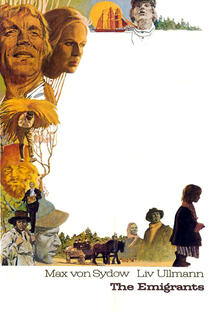
Utvandrarna – The Emigrants (1971)

emgrants posterDirected by Jan Troell

I knew when I started this project that I would have trouble finding some of the movies, but I thought that the ones that would be hard to find would be some of the more obscure ones from the 1930s and 40s, not from the 70s. And I wouldn’t even say that Utvandrarna is obscure; some of my library coworkers remembered seeing it when it came out. Not only that, the Academy thought this movie was so awesome that it was nominated for Best Foreign Language Film the year it came out in Sweden, and then for Best Picture when it was released in America the following year. Despite all this awesomeness, none of the three library systems that I have cards for had it. I had to order it from a university library in Minnesota. The fact that it’s so hard to get makes me really sad, because it’s a fabulous movie.

So what’s the story? Life in Sweden is hard in the 19th century. Abusive employers, failed crops, and a strict religion give different members of a family different reasons to leave Sweden for America. Utvandrarna chronicles this family’s journey from Sweden to Minnesota.

The Good: The acting is amazing. Liv Ullman is Kristina, who grows from a young newlywed to a mother of many children. She has some heartbreaking moments as she portrays the struggles of daily life in Sweden and the trials of moving a large family to an utterly foreign country. Kristina’s husband is Karl Oskar. He yearns for a better life for his family, but is unsure of how to reach that goal. Max von Sydow does an excellent job at showing Karl Oskar’s torment. The other standout in my mind was Monica Zetterlund as Ulrika, a reformed prostitute. She’s an outcast because of her past, but she both wants and disdains acceptance. She’s a fascinating character and Zetterlund’s performance was fantastic. The other actors were all just as good. No one seemed out of place or bad at acting.

I loved the set design. I’m kind of obsessed with ships, and I’ve always thought it would be kind of cool to sail across the Atlantic in a reenactment of what some of my immigrant ancestors did, but after seeing Utvandrarna, I’m not sure I could do it. I really got a sense of the tininess of the ship and the cramped quarters. The scenes on the ship were almost claustrophobic. The other sets were just as good at building the world of the 1840s. The costumes were good, too. I’m not an expert on Swedish farming clothes of the 1840s, but at they felt right for the time and place.

The Bad: While the set design and costume design seemed authentically 1840s, the hair screamed 1970s. The men’s haircuts were especially bad. They all had Luke Skywalker hair. (And yes, I realize Star Wars came later than this movie, but they still had Luke Skywalker hair.)

The Ugly: Utvandrarna was nominated for five Oscars over two separate years. It has a compelling story and great acting. And yet it is unavailable here in North America except for in an edited, DUBBED form. Dubbing is the worst. I thought this was what The Criterion Collection was for – to preserve fantastic movies that may not be the most popular at the moment. Come on, Criterion Collection people! If the movie is that impressive with dubbing, how amazing would it be in Swedish with English subtitles?

Oscars Won: None.

Oscar Nominations 1973: Best picture; best actress in a leading role (Liv Ullman); best director; best writing, screenplay based on material from another medium.

Oscar Nominations 1972: Best foreign language film.

La vita è bella-Life is Beautiful (1998)

life is beautiful posterDirected by Roberto Benigni

When I was a sophomore in high school, my history teacher broke precedent and offered us extra credit if we went to a certain movie that was playing at the arthouse cinema downtown. Getting extra credit for watching a movie was a no-brainer to me, so one cold, snowy Saturday night in January, I called up my best friend to see if she wanted to go see it with me. Her mom asked what the movie was about, and when Tiffany said that it was a comedy about the Holocaust, her mom flipped out and almost refused to let her go. The extra credit was too good to pass up, though, so my brother drove us down to the theater. When we got there, my jaw dropped. The line for tickets wound out the door, filled the sidewalk, and bumped up onto the street. We didn’t get in to the early showing and barely made it into the late one. But after I had seen Life is Beautiful, I understood. I knew why people were willing to stand on the sidewalk in the dark and the freezing cold to experience this movie.

So what’s the story? Guido is a young man who moves to the city hoping to open a bookshop but willing to work as a waiter until that dream comes true. He meets the beautiful Dora, his “pricipessa,” and wins her heart when he shares with her the joy he finds in life. Despite the disapproval of Dora’s mother, they marry and have a little boy, Giosuè. But it’s not safe to be a Jew in Italy during World War II, and Guido, his uncle, and Giosuè are taken to a labor camp. Dora insists on going, even though she is not Jewish. Giosuè is too young to understand what’s going on, and Guido is determined to keep Giosuè in the dark. He invents a story that the camp is game with challenges to be won. Life in the camp gets harder and darker, but Guido keeps up his spirits and humor so that his child won’t see the horrors of the concentration camp.

The Good: Roberto Benigni had to tread very carefully with this film. When you are making a comedy about such a serious topic, everything has to be perfect. If it’s too over the top, it will be disrespectful. If it’s too subtle, people are going to wonder if it was meant to be funny. I think Nicola Piovani managed to walk that line perfectly with his musical score. The music underscored the darker moments, but also brightened the happier ones.

The acting was also marvelous. Roberto Benigni showed so many facets of a complex man, a man willing to do anything and everything for love. Nicoletta Braschi, Benigni’s real-life wife, did an excellent job playing a woman who finds the courage to accept love and fight to keep it when she finds it. Giorgio Cantarini is adorable as Giosuè. The rest of the cast was excellent, as well.

The Bad: The only thing I don’t like about this movie is that Guido’s friend Ferruccio disappears. Once Dora and Guido leave the restaurant, he never shows up again. While I realize that friendships shift and change over time, I would have liked to have seen him again. But really, that’s a tiny quibble.

The Ugly: Never ever ever watch this movie dubbed. Only watch it in its original Italian with subtitles. I checked the movie out on VHS not long after it was released on video, and I was shocked that it wasn’t in Italian. The dubbing made me almost physically sick. It loses so much of its charm and life when its dubbed. Don’t do it!

Oscars Won: Best foreign language film; best actor in a leading role (Roberto Benigni); best music, original dramatic score

Other Oscar Nominations: Best picture; best director; best writing, screenplay written directly for the screen; best film editing