I'd like to spank the Academy

Posts tagged ‘Families’

The Quiet Man (1952)

the-quiet-man-movie-poster-1952-1010203160Directed by John Ford

 As a librarian, I spend a lot of time using the alphabet, so yes, I realize that I by reviewing The Quiet Man today, I am doing things out of order. But Maureen O’Hara died on Saturday, and I’ve been thinking about her and her movies a lot the last couple of days. Because of Miracle on 34th Street and The Parent Trap (the originals of both, NOT the inferior remakes), I grew up admiring Maureen O’Hara as a strong, beautiful woman, completely unafraid to be herself, no matter what society thought. After reading obituaries and tributes to her the last couple of days, I get the feeling that she truly was that way. Since Maureen O’Hara plays another beautiful, strong woman in The Quiet Man, I’m posting my review of it today as my little tribute to a wonderful actress.

I grew up watching John Wayne movies, so I’m not sure how I missed this one. No, it’s not a Western, but I’d seen lots of other non-Western John Wayne movies. But even though I had never actually seen The Quiet Man, I had seen E.T. the Extraterrestrial, so I was really excited to finally know which movie included the dramatic kissing scene that E.T. watches on TV. It was a gap in my movie trivia knowledge, and I was ecstatic to have it filled in. Beyond that bit of trivia, I was glad to finally see The Quiet Man for another reason: it’s a dang good movie!

So what’s the story? Sean Thornton left Ireland for America with his parents when he was three years old, but his mother always talked of Ireland as if it were paradise, so he decides to move back and buy the cottage where he was born. He sees fiery-spirited redhead Mary Kate Danaher as soon as he steps foot in the village of Innesfree and decides that she is the girl for him. Unfortunately, Sean offends Mary Kate’s brother almost as soon. Although Mary Kate makes no secret about her reciprocation of Sean’s feelings, will her brother and her Irish customs keep them apart?

The Good: I’m going to mention cinematography first, because this movie is so beautiful that it literally made me cry. During the race, when the horses are pounding across the beach with the green mountains in the background…oh, it’s amazing. I can’t even begin to describe the beauty of it all. I know that Ireland is beautiful, but photographers still have to have an eye to capture the beauty, and the cinematographer did a fabulous job.

This movie is perfectly cast. I can’t think of another actress who could have done a better job at playing Mary Kate than Maureen O’Hara. She’s strong and proud and just plain wonderful. John Wayne is good as always as the man who is trying to live his dream, but who just doesn’t understand the culture of the woman he loves. He’s confused and frustrated, but so wholly in love. John Wayne and Maureen O’Hara were good friends in real life, and they have excellent on-screen chemistry.

The supporting cast is also so good. Ward Bond makes a surprisingly convincing Irish priest. Victor McLagen, although perhaps a little old to look like Maureen O’Hara’s brother, is full of bluster and silly pride as Will Danaher. Barry Fitzgerald brings a fabulous sense of humor to the role of Michaleen Oge Flynn, and his real-life brother Arthur Shields is excellent as the Protestant Reverend Cyril Playfair. Mrs. Playfair, played by Eileen Crowe, is mischievous and fun. I love them all!

The musical score is gorgeous. Victor Young used a lot of old Irish melodies, but also wrote some beautiful themes of his own. The music complements the movie perfectly.

The story and screenplay are fabulous. I’m not a huge fan of romantic comedies in general, because they’re just so fake. But The Quiet Man is so real. Two proud, stubborn people fall in love, but have a hard time adjusting to each other. Even though they love each other, they don’t completely understand one another. Movies don’t usually show that. Romantic comedies also tend to end with the wedding as the happy ending, but The Quiet Man is not like that. I wish more moviemakers would be brave enough to tell a real story like this one.

The Bad: Because I am a modern woman, I was incredibly uncomfortable with the scene where Sean drags Mary Kate off the train and pulls her across the fields and through the village. Yes, she was asking something of him that he didn’t want to do, but he wasn’t trying to understand her culture, either. Also, I’m not sure how accurate the Irish culture was portrayed. It felt very stereotypical to me, but maybe the stereotype happened because of reality. I don’t know. I just had to turn off the cultural sensitivity part of my brain, and then I was okay.

The Ugly: Nothing, unless you are even more sensitive than I am about the dragging through the fields scene.

Oscars Won: Best director; best cinematography, color.

Other Oscar Nominations: Best picture; best actor in a supporting role (Victor McLaglen); best writing, screenplay; best art direction-set direction, color; best sound, recording.

Random Fact: Even though The Quiet Man won an Oscar for best color cinematography, I once had a library patron who refused to check out the copy we have because it wasn’t in black and white, which, according to her, was the original. I did some research and apparently, ABC only had a black and white print, so that’s what was shown on broadcast TV for a while. The patron never did believe me that The Quiet Man was originally in color. Sigh.
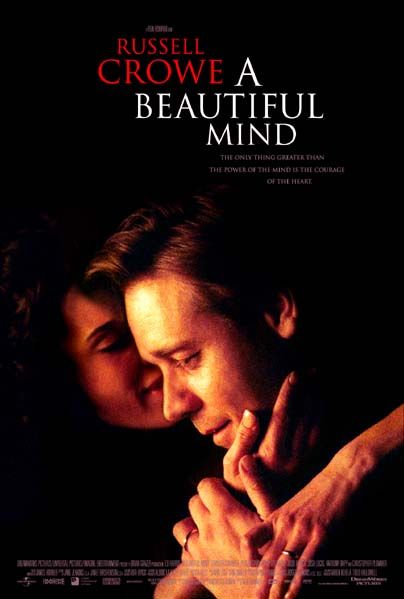
A Beautiful Mind (2001)

beautiful mindDirected by Ron Howard

It was late the night I put this movie in the DVD player, and I wasn’t going to watch the whole thing. But even though it’s not the most action-packed movie ever made, A Beautiful Mind is an extremely gripping movie. As it got later and later (or earlier and earlier in the morning), I kept thinking, “I should really turn this off and go to bed,” but I just couldn’t. I needed to know what happened to John Nash.

So what’s the story? John Nash is a genius mathematician from West Virginia. He doesn’t fit in with all the other Princeton graduate students, mostly because he is completely asocial. He makes a great mathematic breakthrough and gets a job at MIT with the Department of Defense. He meets and marries Alicia, but the top-secret decryption project he’s working on suddenly takes a dark turn.

The Good: The acting was superb. I haven’t seen a lot of Russell Crowe’s movies, and I wasn’t expecting much from him in A Beautiful Mind, mostly because what I’ve seen him in lately is clips from Les Miserables (no, I haven’t seen the whole thing yet, because I don’t want to watch it). Anyway, Russell Crowe became John Nash. I’m always impressed when actors can play a person with a mental disability without overacting. I loved his performance. The supporting cast was great, too. Paul Bettany as Charles, John’s crazy-fun roommate; Jennifer Connelly as John’s wife, Alicia; Ed Harris as John’s government contact; Adam Goldberg, Josh Lucas, and Anthony Rapp as John’s mathematician colleagues; and Christopher Plummer as Dr. Rosen, John’s psychiatrist are all wonderful. I don’t think any of the roles could have been easy to play, but all of the actors did very well.

The costume design was well done, especially since the year in which something happened was rarely given. The clothes were a clue to how many years had passed, and I was very thankful for that. The makeup was good, too. The stars were aged well. I didn’t much care for John Nash’s old look, but that’s because he looked uncomfortably like someone I know, and I couldn’t get past that. But everyone looked definitely, believably older (unlike the people in Giant, which is still my baseline of terribleness when it comes to aging in movies).

The screenplay was good. John Nash’s story could not have been an easy one to tell without giving too much away, but the writers did an excellent job.

The Bad: The music was beautiful, but there were some moments when James Horner copied his own music. At the very beginning of the movie, the music sounded exactly like the music from Sneakers, which I wasn’t even aware James Horner had scored. I had to look it up to be sure. Later on, there are bits from Titanic, which has a brilliant score. It makes me sad that someone who is as obviously talented as James Horner reuses his own stuff.

The Ugly: There wasn’t anything ugly in A Beautiful Mind. It’s a well-made movie that takes a hard topic and treats it sensitivity and tact. Ron Howard deserves major kudos for this movie.

Oscars Won: Best picture; best actress in a supporting role (Jennifer Connelly); best director; best screenplay, screenplay based on material previously produced or published.

Other Oscar Nominations: Best actor in a leading role (Russell Crowe); best film editing; best makeup; best music, original score.

In the Bedroom (2001)

in the bedroomDirected by Todd Field

Even when I recognize the titles of the movies that I’m watching, I don’t always know anything else about them. Sometimes, though, the title gives me a very good idea of what the movie is about. Other times, I am completely wrong. I had never really wanted to see In the Bedroom because I was convinced it was a raunchy sex comedy. That couldn’t be farther from the truth. I was surprised to find that it is instead a slow-moving drama about how a family deals with tragedy. I think I will have to stop judging movies based on their titles.

So what’s the story? Frank Fowler is a college student home for the summer. To his mother’s dismay, he starts dating Natalie, an older woman with two little boys. Natalie also has an ex-husband with a temper. As the summer heats up, tensions mount, and tragedy soon follows.

The Good: In Ian McEwan’s (rather dull) novel Saturday, two people are discussing Tolstoy, and one says, “The genius is in the details.” I feel that way about In the Bedroom. Everyone is believable, partly because the screenplay allows for details. When she’s depressed, Ruth Fowler sits on her couch, watching pointless TV and smoking. Matt Fowler likes to meet his son, Frank, for lunch. Natalie makes awkward conversation with her boyfriend’s college-educated parents, trying to get them to like and accept them. These little scenes, while not action-packed, reveal character and make the people real. The realism makes the sadness later much more real.

Because the screenplay moves so slowly, the acting had to be incredible. Tom Wilkinson and Sissy Spacek are Matt and Ruth Fowler, who are trying to understand and be supportive of their son’s choices, while at the same time not being happy about them. Marisa Tomei is Natalie, a woman who enjoys dating a younger man, but can also see his naiveté. Frank is played by Nick Stahl. He makes Frank a very sweet young man who is enthusiastic about life, but doesn’t really understand that choices have consequences. They are all a joy to watch.

The cinematography was interesting. It would have been very easy to film this movie about a normal family with straightforward camera angles, but instead the filmmakers took the opportunity to use the camera to show that people have inner lives and thoughts. I liked that a lot.

The Bad: Because this movie allows for the details, for the normal conversations between ordinary people, it gets a little boring sometimes. But guess what? Life is boring sometimes. I’m still trying to figure out how I feel about the ending, though. It might have been too exciting to be believable.

The Ugly: I spent a lot of time being annoyed that Natalie and Frank spent so much time with her boys when both Frank and Natalie kept insisting it was only a summer fling. It seemed like such an irresponsible thing to do, to let kids get attached to a boyfriend you’re only planning on dating for a few months. It made me grumpy.

Oscars Won: None.

Oscar Nominations: Best picture; best actor in a leading role (Tom Wilkinson); best actress in a leading role (Sissy Spacek); best actress in a supporting role (Marisa Tomei); best writing, screenplay based on material previously produced or published.

Gosford Park (2001)

gosford parkDirected by Robert Altman

I read my first Agatha Christie murder mystery when I was twelve. It was the start of a beautiful relationship. Every summer after that, I would check out stacks of Agatha Christie mysteries. The plots were always intricate and watertight, but I also loved the idea of rich British people in country houses dressing for dinner and going shooting and having weekend parties. Gosford Park is basically an Agatha Christie mystery with a twist—it not only shows how the family is affected by the murder, but also how the servants are affected. It could be called Murder at Downton Abbey.

So what’s the story? Sir William McCordle has invited friends and family to Gosford Park for a weekend shooting party. The guests come with their servants, and everyone, both upstairs and down, has a secret.

The Good: The cast reads like a Who’s Who of British actors. Maggie Smith, Helen Mirren, Michael Gambon, Kristin Scott Thomas, Derek Jacobi, Jeremy Northam, Clive Owen, Stephen Fry, and Kelly Macdonald are all in this movie, to name just a few. Everyone is excellent. There isn’t an actor in the movie who was miscast or who isn’t completely believable in their role. It’s a fantastic cast, and the movie is incredibly well-acted.

The screenplay is delightful. I had to laugh when I was watching the credits and realized why I felt it was similar to Downton Abbey. The screenplay was written by Julian Fellowes, the man behind Downton Abbey. The screenplay is fun and funny. Although there are many characters, the screenplay allows them all to show their personalities and problems. It’s very clever and well-written.

The costume design impressed me. The designer, Jenny Beavan, had to not only design clothes for the wealthy and their servants, but also had to show a range of incomes in those different classes. She did so very cleverly and period-appropriately.

I love the music. It’s buoyant and jolly when it needs to be and unobtrusive when more serious things are happening. The cheery piano music made me want to find the sheet music.

The art direction is also excellent. It drew me in to this country house of the 1930s. The cars, the bedrooms, the servants’ quarters, everything felt realistic to me.

The Bad: I got so mad watching this movie at the way people treated their servants. The servants weren’t treated so much like people as they were like useful machines. They are used and abused at their employers’ pleasure. I felt very frustrated. Based on things that I’ve read, I’m fairly sure the attitudes are accurate. Even in my beloved Agatha Christie novels, the servants are almost always discounted from being murder suspects because they couldn’t possibly have a motive; they don’t know the murdered person well enough. I love that this movie shows the relationships between the rich and their servants; the only one who cries at the news of the murder is a servant. But the treatment of the servants still makes me mad.

The Ugly: It was a little hard to keep track of who everyone was. The relationships of the upper-class people were especially hard to figure out. Everyone is introduced so quickly and shallowly at first that it doesn’t all sink in the first time around.

Oscar Won: Best writing, screenplay written directly for the screen.

Other Oscar Nominations: Best picture; best actress in a supporting role (Helen Mirren); best actress in a supporting role (Maggie Smith); best director; best art direction-set decoration; best costume design.

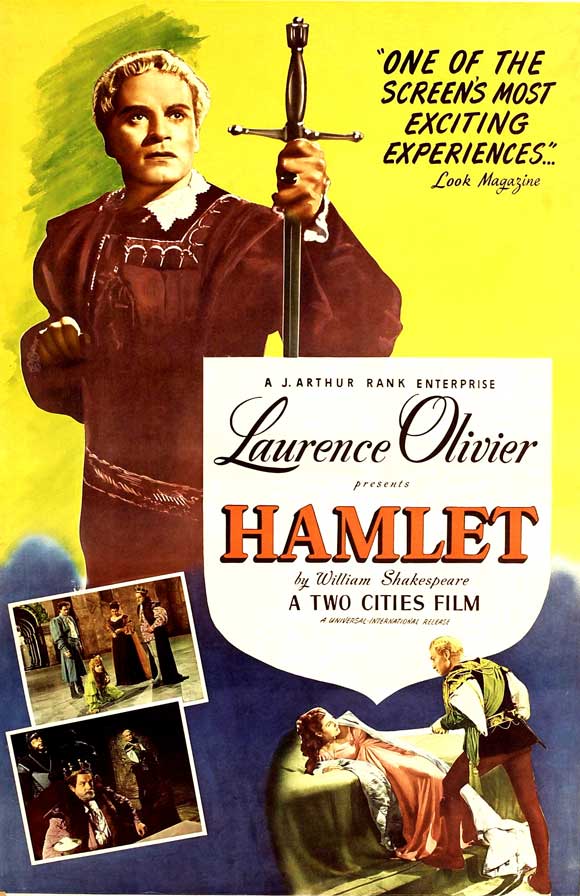
Hamlet (1948)

laurence_olivier_hamlet_movie_poster_b_2aDirected by Laurence Olivier

There are lots of versions of Hamlet. Kenneth Branagh starred in one; so did Ethan Hawke. David Tennant and Patrick Stewart did an excellent Hamlet onstage a few years ago that was made into a Masterpiece Theatre production. Even Mel Gibson has played Hamlet. And those were all made in the last twenty years or so. There are so many others. Why is Hamlet so popular? I’m guessing because it’s a great story. It’s so psychologically dramatic, and it has the potential to have some really great moments. I like Hamlet. I like Shakespeare in general. I think there’s a reason why his plays have been celebrated for the past 400 years. And yet, I found this production dull. It has all the ingredients for greatness, but it somehow misses the mark.

So what’s the story? Prince Hamlet is depressed and reeling. His father died not long ago, and his mother is already remarried—to Hamlet’s uncle, Claudius, his father’s brother. It only gets worse when the ghost of his father appears and tells Hamlet that he didn’t die of natural causes; Claudius murdered him. Hamlet’s father gives Hamlet a mission – avenge his death.

The Good: The acting is excellent. I’m guessing (because I haven’t done the research) that many of the actors and actresses were well-trained stage actors. They all do a wonderful job. Laurence Olivier has some good moments as Hamlet. Jean Simmons does crazy beautifully as Ophelia. Felix Aylmer is appropriately stuffy and self-important as Polonius. Eileen Herlie shows sorrow, remorse, and confusion as Queen Gertrude. Norman Wooland is a sensitive Horatio. Plus this movie has nerd cred. Patrick Troughton (aka the Second Doctor), Peter Cushing (Grand Moff Tarkin and Doctor Who),  and Christopher Lee (Saruman and Count Dukoo) all have small roles. It’s kind of fun to pick them out.

The costumes are beautifully sumptuous. It’s almost enough to make me want to be a noble in Denmark in the Middle Ages. (Or at least in Laurence Olivier’s Middle Ages. Because I’m not sure on the accuracy of the costumes. But they are gorgeous.)

The Bad: In all the other versions of Hamlet I have seen, the filmmakers take advantage of the fact that they although they are making a movie based on play, they don’t have the constraints of a play; they don’t have to shoot on a stage, but can move outside or shoot on location or do anything their imagination tells them to do. In this Hamlet, I felt like I was always looking at a stage set. It wasn’t particularly impressive.

I will probably never say this about a movie again, but it needed more music. I’m usually a fan of restraint in movie soundtracks, but I think more music would have helped it feel less stark and dull. Don’t get me wrong; the music itself isn’t bad. It’s quite good, in fact, but there should have been more to help the movie along.

While Laurence Olivier is a great actor, and he did a marvelous job in the role, I feel like he was too old to make a convincing Hamlet at that point in his life. It might have worked on stage where the audience doesn’t get any close-up views of him, but his age shows in the film. Also, he does not make a convincing blond.

The Ugly: It is so boring. I can’t put my finger on what makes it that way, but I had to rewind at least five times because I kept falling asleep. I wasn’t mentally captivated by this film. It was a fine film, but it didn’t stand out in a particularly memorable way.

Oscars Won: Best picture; best actor in a leading role (Laurence Olivier); best art direction-set decoration, black-and-white; best costume design, black-and-white.

Other Oscar Nominations: Best actress in a supporting role (Jean Simmons); best director; best music, scoring of a dramatic or comedy picture.

Fun fact: I didn’t plan it this way, but today is actually Laurence Olivier’s birthday. Happy 108th birthday, Mr. Olivier!

Johnny Belinda (1948)

johnny-belinda-movie-poster-1948-1020435490Directed by Jean Negulesco

When I was a little girl, my family always had a copy of Leonard Maltin’s Movie Guide on hand. This was in the days before IMDb, and we liked to look up people who looked familiar in movies to figure out what other movies they had been in. In the back of the books was a list of the Oscar winners for best picture, actor, actress, and director for every year. Johnny Belinda was on that list because of Jane Wyman’s win, but that was all I knew about the movie before I saw it. I had a vague idea it was about a boxer; I’m not sure why. It most definitely is not. It’s a beautiful and moving story about people in a small town.

So what’s the story? Dr. Robert Richardson is the new doctor in a small fishing village in Nova Scotia. He goes out to the mill to help the mill owner and his sister deliver a calf. There he meets Belinda, the owner’s daughter, who is a deaf-mute. Because she can’t communicate, everyone in town assumes she is mentally incapable, but the doctor recognizes her intelligence and teaches her lip-reading and sign language. Belinda begins to blossom under his tutelage, but when she is raped and becomes pregnant, the town turns on her and the doctor.

The Good: Johnny Belinda was deservedly nominated in all four acting categories. Jane Wyman plays Belinda with sensitivity and tact, never over-acting. It’s a fabulous performance. Lew Ayres is the outsider doctor who ties to a more modern society allow him to help a woman who would have been stuck in her own world for her entire life. Belinda’s father is played by Charles Bickford. He grows from an impatient, rather uncaring father to a man who is proud of his smart, beautiful daughter. Agnes Moorehead, perhaps best known for her role of Endora in Bewitched is Belinda’s aunt Aggie. Aggie isn’t impressed with Belinda’s progress and is unkind to Belinda until Belinda becomes pregnant. At that point, Aggie becomes protective and loving. It’s a quick turnaround, but it’s very realistic. All of those performances were fantastic. And they weren’t the only ones. Stephen McNally is nicely creepy as the cocky Locky McCormick (and yes, his name is Locky, not Lucky; it’s short for Laughlin, apparently), and Jan Sterling plays the vain, pettish Stella perfectly. The whole movie is very well-cast.

The screenplay was also excellent. The story is sad, yes, but there were moments of humor, because that’s life. I loved the part where Dr. Richardson takes Belinda into a bigger city to see a doctor about her deafness. She looks into the window of a store and sees a brassiere for the first time. She has no idea what it is, and asks Dr. Richardson to explain it to her. He has no words for her, and the look on his face is priceless. Moments like that keep the movie from being too depressing. The subject matter is not easy, but the screenplay treats it sensitively. It’s very well done.

The music underscores the movie well. It helps plot Belinda’s moods and her growth as she becomes more a part of her world. The cinematography helped with that, too. Both elements added a lot to the movie.

The Bad: I had a hard time figuring out what time period the movie was set in. The townspeople didn’t look particularly modern, but the doctor’s clothes were completely 1940s. But then I thought about my grandma. She grew up in a small cabin in backwoods Tennessee in the 40s. Her family didn’t have electricity until after World War II. I’m sure her family wasn’t wearing the latest fashions, either. So although it took me awhile, I don’t have a major beef with it. If you’re aware that it’s contemporary to the time that the movie was made, it shouldn’t bother you at all.

The narration at the beginning bothered me, but I can’t think of another way they could have established some of the background without a lot of conversation that would have seemed kind of stilted and pointless, so I guess I can’t really complain.

The Ugly: I have never seen a more obvious stunt dummy than in this movie. I know this movie was made in the 1940s, but still. Real bodies don’t move like that. It makes a high-tension moment a little less dramatic.

Oscar Won: Best actress in a leading role (Jane Wyman).

Other Oscar Nominations: Best picture; best actor in a leading role (Lew Ayres); best actor in a supporting role (Charles Bickford); best actress in a supporting role (Agnes Moorehead); best director; best writing, screenplay; best cinematography, black-and-white; best sound, recording; best film editing; best music, scoring of a dramatic or comedy picture.

The Godfather (1972)

godfatherDirected by Francis Ford Coppola

Even though I’m a library person, and librarians have a reputation for having Views about reading being the only worthwhile activity, I’m not like that. I like reading, but I also really like movies. However, when it comes to books based on movies, I almost always like the book better. Books can just get into characters’ heads in a way that movies can’t. I can list dozens of books that I like better than the movies that are based on them. The Godfather is not on that list. I read Mario Puzo’s novel five or six years ago, and I was not impressed. Before I read the book, I had really wanted to see the movie, but after I read the novel, I was a little bit worried. I wondered if a movie based on such a mediocre book could really be all it is hyped up to be. After I watched The Godfather, I found that yes, it can.

So what’s the story? Michael Corleone, son of Mafia Don Vito Corleone, resists joining the family business until an attempt on his father’s life leaves Michael in charge.

The Good: I’m gonna mix things up today and go with cinematography first. The cinematography was awesome. Whatever the cinematographer did, he made me feel like I was peering over someone’s shoulder and peeking into the lives of the Corleones. The scene that this stood out to me most was in the hospital when Michael realizes that there’s about to be another assassination attempt. It was so good.

The acting! What can I say about the acting that hasn’t been said before? Not much, I think, but I’m still going to talk about it. Watching Al Pacino take Michael Corleone from a straight-arrow war hero to a cold, calculating Mafia Don was amazing. He was just fantastic. James Caan as hot-headed brother Sonny Corleone was excellent, as was Robert Duvall as adopted brother Tom Hagen. Richard S. Castellano did a fantastic job as the high-up mob man Clemenza, and Lenny Montana made his short role as Luca Brasi very memorable. It was all great. I love it when a movie has not only great leads, but also a great supporting cast.

The music is beautiful. It captures the moods and the culture and the action very well. It wasn’t eligible for an Oscar because it was basically reworked from another movie’s soundtrack, but it is lovely and poignant and memorable.

The Bad: I had a hard time with Marlon Brando. I don’t necessarily think he did a bad job, but I was really distracted by whatever the makeup artists put in his cheeks to make them puffy at the bottom. It doesn’t look real, and so every time there was a close up on Brando’s face, that was all I could think about.

Diane Keaton also did not do a bad job, but after watching Reds, I realized I don’t really care for her as an actress. I was kind of bummed when I realized she was in The Godfather. And yes, I realize I will have to watch three more movies with her before I’m done. Oh, well. Life is like that sometimes.

The Ugly: It’s a movie about the Mafia, so it’s violent. It’s somehow not as shockingly violent to me as No Country for Old Men, but it’s still got some strong violence. It never felt gratuitous, though, except possibly for the amount of blood in the infamous horse head scene (which, by the way, is much more dramatic to see on the screen than to read in a book).

Oscars Won: Best picture; best actor in a leading role (Marlon Brando); best writing, screenplay based on material from another medium.

Other Oscar Nominations: Best actor in a supporting role (James Caan); best actor in a supporting role (Robert Duvall); best actor in a supporting role (Al Pacino); best director; best costume design; best sound; best film editing.The Godfather

Utvandrarna – The Emigrants (1971)

emgrants posterDirected by Jan Troell

I knew when I started this project that I would have trouble finding some of the movies, but I thought that the ones that would be hard to find would be some of the more obscure ones from the 1930s and 40s, not from the 70s. And I wouldn’t even say that Utvandrarna is obscure; some of my library coworkers remembered seeing it when it came out. Not only that, the Academy thought this movie was so awesome that it was nominated for Best Foreign Language Film the year it came out in Sweden, and then for Best Picture when it was released in America the following year. Despite all this awesomeness, none of the three library systems that I have cards for had it. I had to order it from a university library in Minnesota. The fact that it’s so hard to get makes me really sad, because it’s a fabulous movie.

So what’s the story? Life in Sweden is hard in the 19th century. Abusive employers, failed crops, and a strict religion give different members of a family different reasons to leave Sweden for America. Utvandrarna chronicles this family’s journey from Sweden to Minnesota.

The Good: The acting is amazing. Liv Ullman is Kristina, who grows from a young newlywed to a mother of many children. She has some heartbreaking moments as she portrays the struggles of daily life in Sweden and the trials of moving a large family to an utterly foreign country. Kristina’s husband is Karl Oskar. He yearns for a better life for his family, but is unsure of how to reach that goal. Max von Sydow does an excellent job at showing Karl Oskar’s torment. The other standout in my mind was Monica Zetterlund as Ulrika, a reformed prostitute. She’s an outcast because of her past, but she both wants and disdains acceptance. She’s a fascinating character and Zetterlund’s performance was fantastic. The other actors were all just as good. No one seemed out of place or bad at acting.

I loved the set design. I’m kind of obsessed with ships, and I’ve always thought it would be kind of cool to sail across the Atlantic in a reenactment of what some of my immigrant ancestors did, but after seeing Utvandrarna, I’m not sure I could do it. I really got a sense of the tininess of the ship and the cramped quarters. The scenes on the ship were almost claustrophobic. The other sets were just as good at building the world of the 1840s. The costumes were good, too. I’m not an expert on Swedish farming clothes of the 1840s, but at they felt right for the time and place.

The Bad: While the set design and costume design seemed authentically 1840s, the hair screamed 1970s. The men’s haircuts were especially bad. They all had Luke Skywalker hair. (And yes, I realize Star Wars came later than this movie, but they still had Luke Skywalker hair.)

The Ugly: Utvandrarna was nominated for five Oscars over two separate years. It has a compelling story and great acting. And yet it is unavailable here in North America except for in an edited, DUBBED form. Dubbing is the worst. I thought this was what The Criterion Collection was for – to preserve fantastic movies that may not be the most popular at the moment. Come on, Criterion Collection people! If the movie is that impressive with dubbing, how amazing would it be in Swedish with English subtitles?

Oscars Won: None.

Oscar Nominations 1973: Best picture; best actress in a leading role (Liv Ullman); best director; best writing, screenplay based on material from another medium.

Oscar Nominations 1972: Best foreign language film.

Sounder (1972)

sounderDirected by Martin Ritt

I think my third grade teacher hated children. What is my evidence for this? She made us read not only The Red Pony by John Steinbeck, but also Sounder by William H. Armstrong. While both are good books (SPOILER ALERT), the beloved animal dies at the end of both books. It does not make for happy reading for eight and nine year old children. The only thing that could have made the year worse was if we had also read Where the Red Fern Grows by Wilson Rawls. (We read Summer of the Monkeys instead.) Because I remembered how depressing and sad that year was, I wasn’t particularly looking forward to watching Sounder. But the screenwriter was smart, and the movie ends much more happily than the book does.

So what’s the story? During the Depression, sharecroppers David Lee and his father Nathan spend their nights hunting with their dog, Sounder, hoping to get any kind of meat to put on the table. One day, in desperation, Nathan steals a ham from his work. He is arrested and sent to a work camp. The town sheriff won’t tell David Lee and his mother and younger siblings where Nathan has been sent, so David Lee and Sounder go off in search of Nathan.

The Good: There are some nice performances in this movie. Kevin Hooks did a great job of carrying the movie as David Lee, which is a hard job for a teenager. Cicely Tyson plays Rebecca, Nathan’s wife, who is determined to keep the farming going without her husband. She does a beautiful job as the tough, yet loving woman. Paul Winfield is Nathan, a man trying so hard to provide for his family in an impossible time. The major standout for me, though, was Janet MacLachlan, who plays Camille, a teacher who cares. She shone in every scene she was in.

I liked the plot. I like seeing movies about people who love each other and who try to help each other through bad times. Sounder managed to tell the story without being cheesy, which is a hard thing to do.

The Bad: Even though all the performances were lovely, and even though I liked the story of the family, I felt like the movie rambled some. There were some unnecessary scenes. Or maybe they were necessary, but they just didn’t feel like they tied in to the rest of the movie. It dragged a bit, and that made it hard for me to connect with the movie, even though I felt for the people and their plight.

The Ugly: This is a G-rated movie, and there’s not anything horribly offensive in it, but it’s sad. Black sharecroppers in the South during the Depression did not have an easy time of it. This is a so-called “family movie,” but I would suggest not letting small children watch it on their own. I think it’s a movie that parents should talk about with their children so that children can understand what the family was going through.

Oscars Won: None.

Oscar Nominations: Best picture; best actor in a leading role (Paul Winfield); best actress in a leading role (Cicely Tyson); best writing, screenplay based on material from another medium.

There Will Be Blood (2007)

600full-there-will-be-blood-poster-finalDirected by Paul Thomas Anderson

I knew two things about There Will Be Blood before I watched it: 1)it was based on a book by Upton Sinclair; 2)it was a Coen brothers film. As I watched it, I couldn’t help but think it was a very odd film for the Coen brothers. It was just so serious and everything was played completely straight. About midway through, I looked it up on IMDb and realized that I had only known one thing about There Will Be Blood: it was based on a book by Upton Sinclair.

So what’s the story? On a tip from a young man named Paul Sunday, prospector-turned-oilman Daniel Plainview travels with his son to the community of Little Boston to see if he can start some oil wells. The land is promising, but Paul’s creepy twin brother, Eli Sunday, has a strange hold over the people of Little Boston.

The Good: I’m not very familiar with Daniel Day-Lewis as an actor, but I didn’t think very much of his performance in Gangs of New York, so I wasn’t exactly jumping with excitement to see him in There Will Be Blood. But his performance as Daniel Plainview was excellent. It had to be; Daniel is in almost the entire movie and for some of the movie, he’s the only person onscreen. The movie wouldn’t have worked with a lesser actor.

I really liked the soundtrack. It wasn’t constant; at times there was no music at all. I like that. It makes it feel more real and less manipulative. I liked, too, that the music was usually played by a smaller group, not necessarily a full orchestra. It reflected the bare bones of the frontier places Plainview was.

The Bad: There were a couple questions I had that never really got answered. Why did HW stop talking? He had the capability to speak. Why did he not? And what happened to Paul Sunday? I suppose if I had a creepy brother like Eli, I might leave and never come back, but why does his family never mention him again? I kept waiting for him to show up again, but he never did. I felt like other people disappeared, too, like Ciaran Hinds’ character. What happened to all those people?

The Ugly: I’m not a big fan of violence, whether it’s intentional or accidental, and many distressingly violent things happen in this movie. My cat finally moved off my lap in disgust because I kept jumping and gasping at things that were happening. Mining and oil well-digging were very dangerous jobs back then, and I didn’t like seeing what could happen to people while they practiced those professions. I’m not mortally offended by it; I’m just not good at handling that kind of stuff.

Oscars Won: Best performance by an actor in a leading role (Daniel Day-Lewis); best achievement in cinematography.

Other Oscar Nominations: Best motion picture of the year; best achievement in directing; best writing, adapted screenplay; best achievement in film editing; best achievement in art direction; best achievement in sound editing.