I'd like to spank the Academy

Posts tagged ‘drama’

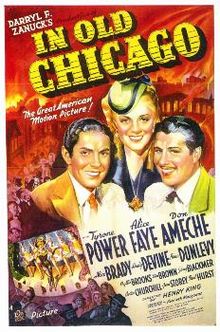
In Old Chicago (1937)

In old chicagoDirected by Henry King

Chicago politics. The Chicago Fire of 1871. Close brothers who become rivals. With all of these elements, what could go wrong? A lot, actually. While there were some exciting scenes, In Old Chicago left much to be desired.

So what’s the story? The O’Leary brothers are polar opposites. Straight-arrow Jack is an attorney who always fights for the underdog. Charmingly roguish Dion runs a saloon, but he has bigger plans. He will use anyone and anything to get what he wants. Jack and Dion’s ideals will be tested for once and all on the night of the Great Chicago Fire of 1871.

The Good: There was some good acting. Alice Brady stole the show as Mrs. O’Leary (yes, THAT Mrs. O’Leary). Don Ameche is strong as Jack, and Alice Faye makes a wonderful singer/saloon owner/woman in love with Dion. Dion’s character is a little inconsistent, but Tyrone Power does an excellent job with what he’s given.

The production design was impressive. There is a huge contrast in all the buildings, from the opulence of the saloons to the humble O’Leary home to the elegance of the Mayor’s office. It brought to life the different factions of Chicago society. Also, the streets were disgustingly muddy. Historical films don’t always remember to put in small details like that. I loved it.

I wasn’t going to be impressed with the actual fire scenes; it was 1937. How convincing could it be? That was a bad call on my part. The fire is amazing, possibly even better than the burning of Atlanta in Gone with the Wind two years later. It was just…wow.

The Bad: While I acknowledge that several scenes take place in saloons and that the producers were trying to showcase Alice Faye’s famous voice, there were too many musical numbers. They slowed down the conniving and the action, and they weren’t particularly entertaining.

While In Old Chicago has a good story with lots of potential drama, the movie felt really shallow. The screenplay left the characters feeling flat and uninteresting, except for Dion. He has the opposite problem. His character changes at the drop of a hat. One minute he’s a rogue with a twinkle in his eye, the next he’s completely evil. Then suddenly, he remembers how much he loves his brother and is perfectly good. It’s just not believable.

The Ugly: Rape isn’t a joke, although they play attempted rape as funny twice. Forcing a girl to kiss you and then threatening to rape her will not get you a business partner or a loving wife. Not cool, 1937.

Oscars Won: Best actress in a supporting role (Alice Brady); best assistant director.

Other Oscar Nominations: Best picture; best writing, original story; best sound, recording; best music, score.

The Good Earth (1937)

good earthDirected by Sidney Franklin

I read the novel The Good Earth for the first time when I was fourteen, which is longer ago than I’d like to admit. Even though I was so young, I felt the love and respect that Pearl S. Buck had for the people and culture of China, along with some of her criticism (which is fair, because no culture is perfect). I was nervous about watching this movie, because I wasn’t sure what Hollywood would do to such a sensitive book about such a different place. Although the filmmakers did make some horrifying decisions (more on that later), The Good Earth is both an excellent movie on its own and an excellent adaptation of the book, which is an incredibly difficult thing to do.

So what’s the story? Poor farmer Wang Lung marries O-lan, a mistreated slave from a wealthy household. For many years, they work side by side on his small farm, buying more land whenever they can scrape the money together to do so. They stick together through storms, famine, and locusts. When Wang forgets what is truly important in life, O-lan is there to remind him. (This is basically the storyline, but the movie is much more exciting and subtle than this summary makes it sound.)

The Good: Luise Rainer makes an excellent O-lan. O-lan is a very quiet, shy character; she never has much to say. Rainer finds O-lan’s soul and brings out her inner strength for the world to see. Her expressions and body language are incredible; they let the viewer get a glimpse of O-lan’s inner workings.

Paul Muni shows boyish delight as Wang. He takes pride in the beautiful things that are his – his farm, his wife, his children. He loves the land and all it gives him. When the land betrays Wang and later, when he becomes wealthy, Muni is able to show the despair and hubris Wang experiences. Yes, Wang has more to say than O-lan, but he, too, has his inner struggles.

The cinematography is exceptional. Karl Freund, the cinematographer, makes excellent use of light and shadow. The scene where O-lan is having her baby during a thunderstorm with lightning as the only light is incredible. Freund also does wonderful work with wide-angle lenses. The panoramic views of people travelling during the famine adds to the feeling of despair, while the views of the locusts make it seem like the entire world is about to end. It’s amazing.

I know I’m not supposed to compare movies to books, but there are so few good adaptations that I have to mention it when I see it. Yes, some things get left out, but that’s because no one wants to sit through a five hour long movie. The story that is left is rich and full and draws the viewer in. So maybe I’ll excuse my indulgence by saying The Good Earth has an excellent screenplay.

There was no Oscar for special effects in 1937, but if there had been, The Good Earth would have deserved it for the locust scene alone. It was frightening on the 19 inch screen I watched in on in 2017. It must have been terrifying on a big screen in 1937, when people weren’t jaded by the CGI monsters that are so common now.

 The Bad:  Most of the music is very stereotypically Chinese; it uses the “Oriental” chords to evoke the strangeness of China. However, I did like music during the scene where O-lan kills the bull. The sweeping chords and building melody were how heroism was often underscored in the 1930s, and it echoes the O-lan’s heroism in the face of starvation.

The makeup was sketchy. While the makeup artists did a fabulous job using makeup to age the characters, they did not do a great job of making Paul Muni and Luise Rainer look Asian, which leads us to…

The Ugly: Let’s talk about the whitewashing. Yes, Paul Muni and Luise Rainer were wonderful in their parts. I’m not going to blame them for starring in the movie. But I do have a problem with the fact that the prominent roles of Wang, O-lan, Wang’s father, Wang’s uncle, and Wang’s second wife, along with a few less-prominent characters, were not played by people of Chinese descent, or even people from other Asian countries. They were all white. I recognize that the Hollywood of the day would not have even auditioned actual Asians to star in a story about China even though there were plenty of Asians living in California, but it still bothers me. It still happens today in Hollywood, which doesn’t make a lot of sense, because there are lots of very good Asian-American actors to choose from. I would have like to have been able to see The Good Earth with actors of the proper race. Since I can’t, I hope Hollywood will get over itself and let Asians play Asians.

Oscars Won: Best actress in a leading role (Luise Rainer); best cinematography.

Other Oscar Nominations: Best picture; best director; best film editing.

Fun Fact: With her Oscar for this role, Luise Rainer became the first person to win Oscars for a leading role back-to-back.

The Deer Hunter (1978)

the-deer-hunterThe Deer Hunter
Directed by Michael Cimino

I knew The Deer Hunter was about Vietnam; I didn’t know that it was going to hurt my heart so badly.

So what’s the story? Mike, Steve, Nick, John, Stan, and Axel are a group of regular guys. They celebrate together, drink together, hang out together, hunt together. But then Mike, Nick, and Steve sign up to go fight in Vietnam. Their decision will change everyone’s lives forever.

The Good: In order to hurt the audience so much, the screenplay and actors first had to make us care about this group of very normal friends from a small town in Pennsylvania. Steve’s wedding is the setting to showcase the personalities of this diverse group. Mike (Robert De Niro) is slightly more mature than his friends. He takes things that he cares about very seriously. Nick (Christopher Walken) cares deeply about his friends and his girlfriend, Linda (Meryl Streep). Steven (John Savage) is so in love and so excited to marry Angela (Rutanya Alda) that he is willing to ignore the opinions that his Russian mother has about his fiance. Stan (John Cazale) is a ladies man who can’t understand anyone else’s point of view. John (George Dzundza) sings in the church choir, runs his bar, and is generally content with his life. He takes it upon himself to be the general peacemaker in the group and feels bad that his bad knees prevent him from going to Vietnam with his friends. Axel (Chuck Aspegren) is a good-hearted goofball who only seems to know one phrase. This extended setup not only makes us care, but it makes it hurt so much more when Mike, Steve, and Nick change so much, which the actors portray so heart-breakingly well. There is more that I want to say about the acting and the screenplay, but I’m trying so hard not to spoil anything for anyone. I will say this: some of the changes that people go through are more subtle than others; Christopher Walken does a ridiculously incredible job as Nick; I was glad that The Deer Hunter only showed some of the Vietnam War, because then you were able to feel the atrocities of war without being overwhelmed by them; and if you watch closely, the story mirrors itself, allowing the viewers to see people’s different reactions to the same or similar events. (If you’ve seen it and want to discuss it with me in the comments, be sure to label it if you put in spoilers.)

The music is beautiful and unobtrusive. The soundtrack is more classical than other soundtracks from 1978; no wailing saxophones here. The use of classical and popular music is managed very well. The chosen songs fit the moment they are in exactly. Stanley Meyers’s original theme, “Cavatina (Theme from The Deer Hunter)”, is fabulous, played quietly by guitarist John Williams (no, not THAT John Williams). It is iconic, one of those pieces that will always be associated with this movie. When I write these reviews, I usually like to listen to the soundtrack of the film I’m reviewing, but listening to “Cavatina” breaks my heart all over again, so I had to listen to other instrumental music so that I wasn’t too sad to write.

The editing was brutally disorienting at times. One moment the gang is all happy at home, and the next, Mike is fighting for his life in Vietnam. These cuts happen throughout the movie, and they can be disconcerting because we have no idea how we got there or what happened between the scenes. But life feels that way sometimes when we suddenly look around and realize where we are in life and then wonder how we got there. It’s also how we tell stories to people. No one ever says, “The ground starting shaking, and so I got in my car and drove down Main and then I turned right onto Elm and left onto High Street, went straight for two miles, and then I saw a monster rising out of the ground!” We leave out things that are not pertinent to the story. That’s why this editing works for this movie; it’s a story about everyday people, and the editing reflects that.

The Bad: Mike was a little too mature and heroic to be believable as a person. He’s too close to perfection for my liking.

The Ugly: Scenes of war will always be ugly and brutal and sad, which is why I’m glad The Deer Hunter acknowledges that no one is unaffected by war, and why I am also glad that the filmmakers were somewhat restrained in how much actual brutality they put into this movie.

Oscars Won: Best picture; best actor in a supporting role (Christopher Walken); best director; best sound; best film editing.

Other Oscar Nominations: Best actor in a leading role (Robert De Niro); best actress in a supporting role (Meryl Streep); best writing, screenplay written directly for the screen; best cinematography.

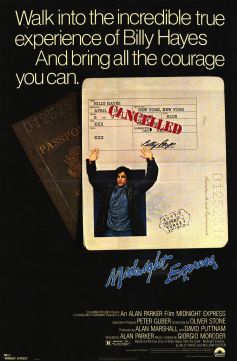
Midnight Express (1978)

midnight_express_ver2_xlgMidnight Express
Directed by Alan Parker

Like most of the other nominees from 1978, I knew nothing about Midnight Express before I watched it. Because it had “express” in the title, just like Murder on the Orient Express, Von Ryan’s Express, and Shanghai Express, I thought I was going to see an exciting train movie. I was disappointed and apprehensive to learn that it was not about trains, but about the horrifying conditions in a Turkish prison. I was fully expecting a movie as brutal as Deliverance, and I was relieved that it wasn’t nearly as bad.

So what’s the story? Young American Billy Hayes is caught trying to smuggle two kilos (or four and a half pounds) of hashish out of Turkey and sentenced to four years in prison there.

The Good: The acting is phenomenal. Brad Davis is truly amazing as Billy as he goes from terror to acceptance to insanity. Randy Quaid plays Jimmy, an inmate who is always coming up with escape plans that go awry.  Norbert Weisser shows subtle sympathy as Kurt the Swede. The sneaky prison snitch Rifki is played with quiet menace by Paolo Bonacelli. John Hurt gives a heartbreaking performance as Kurt, an English prisoner who has been there so long that he has very little hope left to hang on to.

The music is good, with the music in the chase scene being exceptional. It was a bit too synthesized in my opinion, but it’s still good.

I liked that the Turkish wasn’t translated, especially when Billy was first arrested at the airport. It was kind of disorienting, because I wasn’t sure exactly what was going on, and that echoed Billy’s experience.

The Bad: Go straight to ugly. Do not pass Go. Do not collect $200.

The Ugly: I couldn’t connect with Billy Hayes. He came off as an entitled spoiled brat. He was smuggling several pounds of hashish out of Turkey, but he seems to believe that he doesn’t deserve any sentence at all for that. Depending on the state he was in, he’d get about five years in prison for that in the US, especially since he admitted that he had the intent to sell. Smuggling carries an even greater penalty, so when he whined about having to stay four years, my opinion of him went down even more. Unfortunately, if you can’t connect with the main character in some way (or at least have some sympathy for him), a movie gets a little dull. You just want it to be over, because you just don’t care what happens.

I was upset when I found out that most of the movie was made up. If you are purporting to tell a true story,there should be more truth to your movie than the very basic plot. According to Billy Hayes, the conditions weren’t nearly as brutal as Alan Parker and Oliver Stone, who wrote the screenplay, depicted. I feel like you shouldn’t defame an entire country just for the drama.

I rarely do spoilers, but I am going to highlight the most brutal moments here so that you can make a more informed decision about watching it (SPOILERS BELOW):

  1. A cat is hung.
  2. One inmate bites off another’s tongue.
  3. A man’s head is squished on a peg and some grossness ensues.

Those are the three most brutal moments; everything else is basically as tame as the things that happen in the TV show Prison Break.

Oscars Won: Best writing, screenplay based on material from another medium; best music, original score.

Other Oscar Nominations: Best picture; best actor in a supporting role (John Hurt); best director; best film editing.

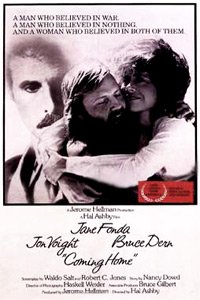
Coming Home (1978)

cominghome1Coming Home
Directed by Hal Ashby

 1978 is kind of a black hole in my movie world. This is another best picture nominated movie that I didn’t know anything about. When I picked it up from the library and saw that it was a movie about Vietnam starring Jane Fonda, I wasn’t thrilled. I’ve never been a fan of hers. But then I reminded myself that I loved watching Jane Fonda (and the rest of the cast) in Grace and Frankie, so I tried to put my prejudices aside and just lose myself in the movie, which turned out to be easy to do.

So what’s the story? Sally’s husband, Bob, is excited to be going to Vietnam to actually start doing his part in the Vietnam War. While he’s gone, Sally starts volunteering at the nearby VA hospital, where she reconnects with Luke, whom she knew in high school. Luke was injured in the war and is now a paraplegic. He is angry about the war, so naïve Sally tries to pull him out of his bitter shell. As they both wrestle with the tragic effects of war on so many different people, they find themselves falling in love.

The Good: Against my own expectations, I found myself very impressed with Jane Fonda’s performance as Sally. Sally grows slowly over the course of the film, and Fonda was able to show Sally’s progression from the little wife to a strong, brave woman. It’s a beautiful, heartbreaking piece of acting.

John Voight was equally good as Luke. I have prejudices against him, too (the Jim Phelps I know would never, ever betray the IM force), but since the long hair and beard helped disguise his face, I was able to appreciate his acting and feel the sadness, bitterness, and anger of a man returned from war, as well as his excitement when he started to feel that his life might get better.

The supporting actors were just as good as the leads. Penelope Milford played Vi, Sally’s free-spirited friend who worked at the hospital to be near her brother Bill, who came back from Vietnam with severe PTSD. Keith Carradine, who played Bill, and Bruce Dern, who played Sally’s husband, Bob, both portray men who can’t handle what happened in Vietnam, although they deal with it in different ways. Everyone in the movie is touched by the war somehow, and they were all able to show the different facets of living with something that can destroy men’s souls.

Both the music and cinematography in Coming Home were unusual in a good way. There was no original score, only songs that were from the time of the Vietnam War. When a song wasn’t playing in the background, there was no music at all, which added to the realism of the movie and forced the viewer to focus more intently on what is happening in the scene. The cinematography had a similar effect. There were a lot of shots of people’s hands as they were talking, underscoring what they were saying. This really stood out to me in the first scene, where actual veterans are having an unscripted conversation about the war, but it happened at other times, too.

The costuming and hair styles also underscored the changes people were making. As Sally found herself, she dressed in more comfortable, practical clothes instead of the dresses, heels, and pearls favored by the other officers’ wives. She let her hair be natural instead of straightening it. But when she went to Hong Kong to see Bob, she once again assumed the dress and appearance of a proper officer’s wife. It was a nice touch.

The Bad: Once again, I am so glad that I live now. The bad things in this movie are not problems with the movie, per se, but with the times. The attitudes towards women are terrible. Yes, I realize that people with the “men know best” attitudes still exist, but they aren’t as prevalent as they were. I’m also glad that PTSD is better understood and treated than it was in the past. I know treatment isn’t perfect, but it’s come a long way since the 1970s.

The Ugly: Coming Home isn’t a perfect movie, but there’s certainly nothing “ugly” about it.

Oscars Won: Best actor in a leading role (John Voight); best actress in a leading role (Jane Fonda); best writing, screenplay written directly for the screen.

Other Oscar Nominations: Best picture; best actor in a supporting role (Bruce Dern); best actress in a supporting role (Penelope Milford); best director; best film editing.

An Unmarried Woman (1978)

unmarried_womanAn Unmarried Woman
Directed by Paul Mazursky

Before I watched An Unmarried Woman, I knew two things about it: that it was about a woman going through a divorce, and that it hadn’t been released on DVD. These two little pieces of information made me assume that it wasn’t going to be very good. There are lots of mediocre movies about divorced women, and if it had never been released on DVD, how good could it be, really? And then I actually watched it, and I was blown away.

So what’s the story? Erica loves her life. She loves her husband, he loves her, and they have an amazing sex life. She has wonderful friends, a great relationship with her teenaged daughter, and the financial freedom to work a part-time job at an art gallery. When her husband tells her he’s leaving her for a younger woman, Erica’s life is turned upside down. She’s been with him for most of her adult life and doesn’t know who she is without him. With the support of her daughter, friends, therapist, and new men in her life, Erica learns for the first time in her life how to be herself.

The Good: The screenplay is amazing. It is so completely real, both emotionally and conversationally. It’s not dated at all; only three things would have to be changed to make it completely up to date: Erica’s friend refers to herself as “manic depressive,” where today we would use “bipolar;” the same friend uses lithium to deal with her mental illness, which is not commonly used today; and Erica’s daughter Patti tells her mother that her friend got an abortion for $200, but (based on an internet search), abortions are more expensive than that now. Setting those tiny details aside, Paul Mazursky’s screenplay could have been written today. It captures exactly what it feels like to be a woman in transition. As a woman whose life has not turned out how she planned it, I could completely relate.

The cast was wonderful. Jill Clayburgh was utterly fantastic as Erica, showing the range of emotions that a woman goes through when the life that she knew was gone. Erica’s husband, Martin, is played by Michael Murphy, who shows the nuances of emotion that people feel when they are trying to make themselves happy, even when it ends up hurting others. Lisa Lucas, who plays Patti, Erica and Martin’s daughter, is equally good at portraying the emotions of a teenager who is dealing not only with her parents’ breakup, but with the minefield of teenage life. Cliff Gorman plays the role of the sleazy artist perfectly. Kelly Bishop gives a wonderful performance as Erica’s supportive, feminist, manic depressive friend Elaine. Another thing I really love about the cast is that besides being incredibly talented, they are all normal-looking. They look like people you could run into on the street in any city in America. I find it much easier to believe a story about normal (albeit fairly wealthy) people when they look like normal people than when they look like models.

The music in An Unmarried Woman reflected the story in a way that I’m not sure I’ve ever seen before. There is really only one melody (I would call it Erica’s leitmotif), but the instrumentation and key are changed based on the situation. Sometimes it is happy, sometimes it is angry, sometimes sad. It reflects Erica’s mood and emotions throughout the movie.

Because this is a character-driven movie as opposed to a plot-driven one, some of the scenes don’t seem to advance the plot. They are basically little vignettes of moments in Erica’s life. But because of the placement of these little scenes throughout the movie, these moments are able to subtly show Erica’s growth and development as she accepts her new life. That is one of the wonders of editing.

The Bad: Although I loved what the music did, I didn’t always love the music itself. While I loved having the emotions portrayed through one melody, the saxophone-heavy instrumentation was one of the few things that made me remember that this movie came out almost forty years ago. It’s very dated and sometimes distracting.

I had a problem with some of the things that Erica’s daughter Patti said. Some of her lines were flat-out perfect, but I have a hard time believing that Patti, a fifteen-year-old girl, would tell her mother’s boyfriend, whom Patti has just met, that she (Patti) is still a virgin. I was never in the situation of meeting a parent’s new love interest, so maybe some people would do it, but it didn’t feel natural to me. There were a couple of interactions like that throughout the movie that made me feel that although Mazursky apparently understands women incredibly well, he doesn’t know that much about teenaged girls.

The Ugly: Beyond some of the clothes, there is nothing that can be called ugly in this movie. (And the clothes are really more dated than ugly. I think there is a difference.)

Oscars Won: None.

Oscar Nominations: Best picture; best actress in a leading role (Jill Clayburgh); best writing, screenplay written directly for the screen.

Justification: Yes, I fully realize that An Unmarried Woman only comes first in alphabetical order if we throw out one of the rules of alphabetization and don’t ignore the “an”. But it gets to come first because it was the first best picture nominee that I had watched in a long time. So I will stifle my librarian instincts and acknowledge the “an”.

Star Wars (1977)

star warsDirected by George Lucas

Happy Star Wars Day! Because it’s May the Fourth, I decided I needed to review Star Wars today. Yes, it was nominated for best picture. Even though Star Wars is an awesome movie, it seems kind of odd today when Star Wars is just a fact of life. Also, the Academy doesn’t always recognize the amazing science fiction blockbusters; it tends to skew towards the brooding independent dramas nowadays. Anyway, Star Wars blew everyone away when it came out. I’m too young to remember that. Like most of my generation, I grew up watching Star Wars. I literally don’t remember not knowing that SPOILER ALERT Darth Vader is Luke’s father. My personal favorite of the original trilogy was Return of the Jedi, because I really liked watching the primitive Ewoks destroy the Stormtroopers. Also, the Ewoks are cute. But I grew up watching them all. Often. I was incredibly excited when the movies were rereleased on big screen in 1997, although I was incredibly disappointed at some of the changes George Lucas made. I was super excited for the new trilogy that started with The Phantom Menace, but now I pretend those movies just don’t exist. I cried last December when I sat in a theatre and watched those yellow letters move across the screen. I cried when Han and Leia saw each other again. So yeah. You could say I like Star Wars. That made it really hard to write an objective review. But I have tried my best, and for those who think I am being too hard on Star Wars, reach out with your feelings, and you’ll know the truth.

So what’s the story? For those of you who don’t know, farm boy Luke Skywalker accidentally becomes embroiled in a fight for the freedom of the galaxy when two droids with the plans to destroy the evil Empire come into his life.

The Good: There really are many amazing things about Star Wars that I think even a non-fan would admit to. The soundtrack, for example. John William’s score may be one of the best movie scores ever written. I love that many of the characters have their own musical themes, or leitmotifs, if we want to be fancy about it. And the orchestrations are wonderful. It seems like the perfect instrument is always chosen to play at a particular time. It’s truly a magical soundtrack.

For the most part, the acting is good. Alec Guinness was apparently annoyed that he was remembered for Star Wars instead of his other movies (if you haven’t seen it, I recommend Kind Hearts and Coronets; it’s hilarious and Guinness is amazing), but he did a good job anyway. Harrison Ford was perfectly cast as Han Solo, the mercenary smuggler with a conscience. Carrie Fisher is fabulously fierce as Princess Leia, a princess with attitude who withstands torture to protect what she believes in. Leia may be a diplomat, but she’s not a prim and proper princess. She’s fantastic. All of the other roles, from the droids to the aliens to denizens of the Empire, are also well cast. There are too many people to mention in one post, but everyone does wonderful work (with one exception that I discuss later).

Once again, special effects win over CGI. Most of the special effects still look good almost forty years later. That’s just amazing to me. When so many movies nowadays looking dated after two or three years because they used CGI, it makes me happy that older movies still look realistic because of old-fashioned effects. The sound effects were also ridiculously good. Every alien race, every droid sounds different. That must have taken some serious creativity to be able to come up with sounds for all of those different creatures.

The story might not be original (more on that later), but the screenplay is. Lucas managed to balance humor and seriousness perfectly. I also think that it’s very clever how George Lucas let us know what Chewbacca and R2-D2 are saying by the reactions of Han Solo and C-3PO, respectively, instead of using subtitles. It draws the viewer more into the movie, I think. And honestly, who doesn’t know at least one quote from Star Wars? It’s a very memorable screenplay.

All of these elements – the music, the acting, the special effects, the screenplay – are great, but what really makes Star Wars so special is the world building. George Lucas created an entire galaxy and filled it with all sorts of different aliens and droids and humans. He imagined different sorts of planets, from planets that are nothing but deserts to swamp planets inhabited by seven-foot-tall furry aliens to planets that are completely peaceful and have no weapons. He imagined a princess who rescues her rescuers when their plan goes wrong. There are good guys and bad guys, yes, but there are also people who couldn’t care less about the Empire and are just trying to live their lives the best way they know how. The many books that have been written that take place in the Star Wars galaxy is a testament to what a fertile field it is for all kinds of stories. To me, that is the most amazing thing about Star Wars.

The Bad: The story is completely unoriginal. George Lucas himself has admitted that he closely followed elements of Joseph Campbell’s book The Hero with a Thousand Faces as he wrote the story of Star Wars. Of course, having Luke follow the same familiar pattern that we’ve seen heroes go through throughout literature for thousands of years may be what makes the story so endearing. One could argue that even though much of the “far, far away” galaxy is unfamiliar, placing Luke in the story pattern as many of our myths connects the story back to us. Still, if you’re looking for story originality, you will not find it in Star Wars.

Like I said before, most of the actors are great. However, Mark Hamill has some cringe-worthy moments as Luke Skywalker. He doesn’t do quiet sadness very well. He’s not terrible throughout the entire movie, but sometimes it’s so bad.

The Ugly: Even though Star Wars takes place “a long time ago, in a galaxy far, far away”, the men all have Earth-style 1970s haircuts. The style isn’t really flattering on anyone, even the swoon-worthy rogue Han Solo. That was a bad call by the hair and makeup people.

Another thing that I find terrible is how hard it is to find the original 1977 theatrical version instead of the updated one released in the late 1990s. People should be able to have access to the movie that they fell in love with. My theory is that once an artist releases his work to the public, it belongs to the public as much as it belongs to the artist. Thanks to my awesome brother who was far-sighted enough to snap up the originals on DVD during the short time they were available, I was able to see the movie I grew up with (Thanks, Jon!). But even on those DVDs, the original movies are only on the bonus disc. They aren’t the main event. I would really like to see a beautifully restored edition of the original versions on DVD. (Are you listening, Disney? Or Fox? Or whoever owns the original movies? It would be a big money-maker. Lots of people would love you. Please?)

Oscars Won: Best art direction-set direction; best costume design; best sound; best film editing; best effects, visual effects; best music, original score; special achievement award for Ben Burtt for sound effects for the creation of the alien, creature, and robot voices.

Other Oscar Nominations: Best picture; best actor in a supporting role (Alec Guinness); best director; best writing, screenplay written directly for the screen.
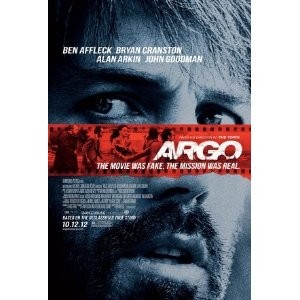
Argo (2012)

Directed by Ben Affleck

Okay, so argoit’s been awhile again. Apparently, because I wrote about my depression and how it was doing so much better in my Silver Linings Playbook post, my depression decided to remind me how powerful it actually can be. So yeah. Sorry if you’ve been waiting and hoping and wishing for my Argo review and my wrap-up of 2012; I’ve been trying not to slit my wrists. But at least I’ve been successful!

As I said in my Zero Dark Thirty review, I was excited for the 2012 movies because I got to watch two action movies that had been nominated for best picture. But just like Zero Dark Thirty, Argo is also not an action movie. It’s exciting, and it’s fun, and it has wonderfully tense moments, but it’s not an action movie. I think I might have watched the only action movie ever nominated when I watched Raiders of the Lost Ark. Argo is a fantastic movie, and I truly enjoyed it, but it’s not an action movie. It was also weird watching it on the heels of Zero Dark Thirty because they are so similar. Both movies are more spy film than action flick, both are based on true stories, both take place in the Middle East, both even have Kyle Chandler. So while I recommend seeing both films, don’t watch them back to back.

So what’s the story? During the takeover of the American embassy in Iran in 1979, six Americans manage to escape to the home of the Canadian ambassador. As the occupation of the embassy drags on, the U.S. government tries frantically to come up with an idea to get the six out before the Iranians realize that they aren’t in the embassy with the other civil servants they have taken hostage. Tony Mendez, a CIA officer whose job is extracting people from bad situations, finally comes up with “the best bad idea”—produce a fake movie, complete with screenplay, casting, and movie posters. He will then fly to Iran to “scout locations” and fly back with the six Americans as members of the production company. It’s a risky plan; can they pull it off?

The Good: I don’t know the term for what I’m about to admire, but I love that Argo looks like a movie from the late seventies or early eighties. The film quality is grainier, less sharp than current movies. No high definition here! I liked that the old Warner Brothers logo was used at the beginning of the film, too. It was a small thing, but helped set the tone for the movie.

Argo was a well-cast film. Everyone from Ben Affleck as Tony Mendez to John Goodman as legendary make-up artist John Chambers to Bryan Cranston as Mendez’s boss, Jack O’Donnell was fantastic. I was especially glad to see Victor Garber playing a sympathetic character (the Canadian ambassador) for once. He seems like the nicest man, but in the movies I’ve seen him in, his characters are always jerks (Mayor Shinn in The Music Man, the lecherous professor in Legally Blond, the money-grubbing lawyer in Eli Stone). Alan Arkin is a delight as the “producer” of Mendez’s movie, and the people playing the six non-hostages were also good. I didn’t feel like there was a false note in the casting.

The pacing of the movie was great. The director managed to keep the feeling of a lot of time going by balanced with the tension of having to get the people out. It would have been very easy to err in either direction – either with the movie dragging as the hostages stayed inside for months, or with the action happening too quickly to be believable.

Even though I feel like I know more about history than the average American, I didn’t know much about the Iran Hostage Crisis. We didn’t tend to get to more recent things in any of my history classes just because there was so much to cover in a year, and I wasn’t alive when it actually happened, so I appreciated the overview of the modern history of Iran at the beginning. Some of the movie wouldn’t have made sense without that background.

Alexandre Desplat’s score was a haunting, beautiful mix of Middle Eastern and Western music. It was subtle enough to underscore the drama of the situation without being overwhelming.

The Bad: While the casting was all good, I had a hard time keeping the six escapees straight. They didn’t get enough screen time for the viewers to understand their characters, so they all kind of blended together. I would have liked to have seen more of John Goodman and Alan Arkin and the Hollywood end of things, also. I feel like a lot of that was glossed over to give Ben Affleck more screen time and make Mendez seem more heroic.

Because I put off writing this review, I had to watch Argo twice in order to feel like I could give it an honest, helpful review. The first time, I loved it. It was one of those moments when you want to tell everyone you know that they should see it. A few weeks later, when I saw it for the second time, I just couldn’t get into it. I already knew what was going to happen, so there was no tension for me. This seems to be a flaw in the movie, but I can’t put my finger on why I didn’t care so much the second time around. It might be because I felt no connection to the characters; I’m not sure. But I feel like a movie that is named the best picture of the year should be able to be enjoyed more than once.

The Ugly: I didn’t find anything bad enough about Argo to be in this category. It’s flaws were minor.

Oscars Won: Best motion picture of the year; best writing, adapted screenplay; best achievement in film editing.

Other Oscar Nominations: Best performance by an actor in a supporting role (Alan Arkin); best achievement in music written for motion pictures, original score; best achievement in sound mixing; best achievement in sound editing.

Lincoln (2012)

Lincoln_2012_Teaser_PosterDirected by Steven Spielberg

This is yet another post that I had already written, but lost when I lost my flashdrive. On the bright side, that means I get to celebrate President’s Day by posting about Lincoln, which is a happy coincidence. It’s a great movie about a great man. I feel like I’m gushing, and I’m sorry, but it really is an amazing movie.

So what’s the story? In the last days of the American Civil War, Abraham Lincoln wheels and deals and does everything he can in order to pass the 13th Amendment to the Constitution, which will abolish slavery in the United States forever. He has a deadline, however; if the South rejoins the Union before the amendment passes, they will defeat the amendment and keep slavery legal.

The Good: Daniel Day-Lewis does it again. The man is a chameleon. I could pass him on the street and not have a clue who he is because he always becomes his character. I felt like I was watching real footage of Abraham Lincoln. Before I started watching these Oscar-nominated movies, I thought Daniel Day-Lewis was overrated. I will never think that again. I cannot believe how amazing he is in this part.

I am rarely struck by makeup and hairstyling, but there are so many actors in Lincoln that I am familiar with – and I didn’t recognize any of them except for Tommy Lee Jones. Even Sally Field is practically unrecognizable. Everyone looks period-correct, and it is impressive. The costuming adds to this, of course. You can see the different classes and stations in society through the clothes, and I love it.

Speaking of actors, the supporting cast is fantastic. Sally Field makes a wonderful Mary Todd Lincoln. She shows all the complexities of the woman, including her awareness of how her illness made Lincoln’s life more difficult. Tommy Lee Jones always plays crusty men well, but he is also tender in his portrayal of Thaddeus Stevens. I don’t usually like James Spader, because he always makes me feel slimy, but since his character is slimy, he works so perfectly. I didn’t feel that anyone did a poor job. This is another perfectly-cast movie.

The production design and the sets were another aspect that made the movie historically believable. The rooms were low-ceilinged and dim, even during the day. Everything is slightly dingy, as if covered by the ash of the fires. There is mud and dirt and grime and that’s how life was then.

John William’s score is surprisingly subtle for him. It’s beautiful and stirring and simple and just right for a movie about a brave, simple man.

The Bad: There is nothing bad about this movie. Nothing bothered me about it at all, except perhaps Tommy Lee Jones’ wig, but Thaddeus Stevens had a bad wig in real life, so there wasn’t much choice there.

The Ugly: There are some short ugly war scenes and reminders of the cost of keeping the war going so that the amendment could pass, but that’s realism, not bad filmmaking.

Oscars Won: Best performance by an actor in a leading role (Daniel Day-Lewis); best achievement in production design.

Other Oscar Nominations: Best motion picture of the year; best performance by an actor in a supporting role (Tommy Lee Jones); best performance by an actress in a supporting role (Sally Field); best achievement in directing; best writing, adapted screenplay; best achievement in cinematography; best achievement in film editing; best achievement in costume design; best achievement in music written for motion pictures, original score; best achievement in sound mixing.

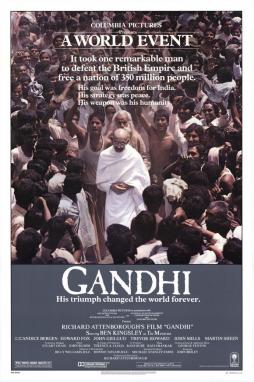
Gandhi (1982)

gandhi-movie-poster-1982-1020195902Directed by Richard Attenborough

I always worry when I’m watching a movie about a culture that isn’t my own, especially when it’s made by someone also outside that culture. I worry that I will “learn” something inaccurate or get the wrong idea about that culture. I had seen Gandhi before, but I was probably fourteen or fifteen and impressionable, so I was worried about how Indians view the movie and whether I could watch it comfortably as an American. But the day I picked it up from the library, an Indian coworker of mine said, “Oh, you are going to watch that movie? It is such an excellent movie. So well done.” Later that night, a British friend of mine whose parents are from India and Pakistan asked me what I was doing. I told him I was watching Gandhi. His response? “I love that movie.” So while there might be historical inaccuracies or only part of the story told, I at least know that Indians do not find this movie offensive, which does make me glad.

So what’s the story? Mohandas Gandhi, a young Indian lawyer educated in London, experiences racial prejudice in South Africa and decides that it is unacceptable for anyone to be treated that way. He begins a protest of the way Indians in South Africa are treated. His activism doesn’t stop there, however. He goes back to India and becomes the leader of the long struggle against British rule.

The Good: Ben Kingsley makes an excellent Gandhi, both young and old. He takes us on the same journey that Gandhi made, from rash young man to wise old leader, full of patience and kindness. It is an excellent performance.

I’m not going to name all of the people who did a good job of acting, because in a three-hour movie with lots of small roles filled by famous or soon-to-be-famous people (including Daniel Day-Lewis!), there is lots of good acting. I will mention Rohini Hattangadi, though. She played Ba, Gandhi’s wife, going from a young woman unsure if her husband is doing the right thing or if he has gone crazy to a woman who believes fully in what he does and supports him completely. She was impressive.

I loved the cinematography. There are times when it shows the grandeur of India, the huge scale of that country, and other times when it is intimate, showing how one man was able to make such a difference in such a large, diverse country. If I hadn’t already wanted to visit India someday, the cinematography of this movie would have made me want to go.

The makeup people did an excellent job of making Gandhi and Ba look older as time passed. I might have thought that the old and young were played by different people, especially as Ben Kingsley looks less like himself and more like Gandhi as he “aged”.

The Bad: Those same makeup people who did such a good job on Gandhi did a less-than-stellar job on Gandhi’s associates Nehru, Jinnah, and Patel. They didn’t age at all until the very end, even though they had been working for independence for thirty years. If this was done on purpose to show how much more quickly people age when they are living a lifestyle of poverty, than I suppose it was okay. But even if you are wealthy, you age over time, not all at once.

What happened to Gandhi’s sons? They are shown at the beginning of the movie in South Africa, but then we never see them again. There was nothing about the sons to make them a huge plot point, but I really did have to wonder if they all died, since they don’t seem to be anywhere around Gandhi and his wife for the rest of his life. Leaving them out altogether would have been one thing, but to show them once and then never again is bad storytelling.

The Ugly: I’m not disputing that Gandhi was a great man. He truly was. It takes an amazing kind of person to struggle for independence without fighting and to inspire an entire nation to do the same. His story is an incredible one. But except for one scene where he is angry at his wife, he is shown as having no weaknesses. He is made out to be a saint. I’m not trying to insult anyone or tear Gandhi down, but no one is that perfect, which made me feel like the movie was only semi-factual. I may be wrong; I know very little about the Mahatma. He may have been perfect. But because I was feeling that throughout the movie, I couldn’t immerse myself completely in the experience, so I’m going to stand firm in my belief that it was a weakness for this movie.

Oscars Won: Best picture; best actor in a leading role (Ben Kingsley); best director; best writing, screenplay written directly for the screen; best cinematography; best art direction-set decoration; best costume design; best film editing.

Other Oscar Nominations: Best sound; best music, original score; best makeup.