I'd like to spank the Academy

Posts tagged ‘Crime’

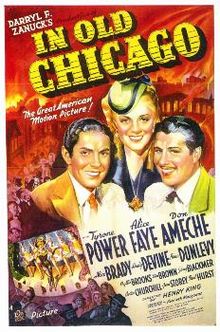
In Old Chicago (1937)

In old chicagoDirected by Henry King

Chicago politics. The Chicago Fire of 1871. Close brothers who become rivals. With all of these elements, what could go wrong? A lot, actually. While there were some exciting scenes, In Old Chicago left much to be desired.

So what’s the story? The O’Leary brothers are polar opposites. Straight-arrow Jack is an attorney who always fights for the underdog. Charmingly roguish Dion runs a saloon, but he has bigger plans. He will use anyone and anything to get what he wants. Jack and Dion’s ideals will be tested for once and all on the night of the Great Chicago Fire of 1871.

The Good: There was some good acting. Alice Brady stole the show as Mrs. O’Leary (yes, THAT Mrs. O’Leary). Don Ameche is strong as Jack, and Alice Faye makes a wonderful singer/saloon owner/woman in love with Dion. Dion’s character is a little inconsistent, but Tyrone Power does an excellent job with what he’s given.

The production design was impressive. There is a huge contrast in all the buildings, from the opulence of the saloons to the humble O’Leary home to the elegance of the Mayor’s office. It brought to life the different factions of Chicago society. Also, the streets were disgustingly muddy. Historical films don’t always remember to put in small details like that. I loved it.

I wasn’t going to be impressed with the actual fire scenes; it was 1937. How convincing could it be? That was a bad call on my part. The fire is amazing, possibly even better than the burning of Atlanta in Gone with the Wind two years later. It was just…wow.

The Bad: While I acknowledge that several scenes take place in saloons and that the producers were trying to showcase Alice Faye’s famous voice, there were too many musical numbers. They slowed down the conniving and the action, and they weren’t particularly entertaining.

While In Old Chicago has a good story with lots of potential drama, the movie felt really shallow. The screenplay left the characters feeling flat and uninteresting, except for Dion. He has the opposite problem. His character changes at the drop of a hat. One minute he’s a rogue with a twinkle in his eye, the next he’s completely evil. Then suddenly, he remembers how much he loves his brother and is perfectly good. It’s just not believable.

The Ugly: Rape isn’t a joke, although they play attempted rape as funny twice. Forcing a girl to kiss you and then threatening to rape her will not get you a business partner or a loving wife. Not cool, 1937.

Oscars Won: Best actress in a supporting role (Alice Brady); best assistant director.

Other Oscar Nominations: Best picture; best writing, original story; best sound, recording; best music, score.

Dead End (1937)

dead endDirected by William Wyler

“There was blood on his hands…and a price on his head!” I knew absolutely nothing about Dead End before I watched it, but this tagline made me pretty sure it was film noir. I was so excited; I love film noir. Turns out Dead End is not film noir, but something better: a look at the life of poverty-stricken people in New York’s Lower East Side.

So what’s the story? Drina is single and poor, struggling to raise her younger brother, Tommy. She has always been in love with Dave, a man who worked hard to put himself through college so he could escape the slums, but who can’t get a job now. Dave is falling for Kay, a young woman living in the fancy new apartment building that backs onto Drina and Dave’s block. Tommy is the leader of a street gang; he’s getting into more and more trouble lately. One day, a mysterious man comes to the block. On that one fateful day, the tensions between rich and poor, wealth and poverty, and law and crime all come to a head.

The Good: The lead actors (Sylvia Sydney as Drina and Joel McCrae as Dave) were amazing. Their performances were so good that I can’t figure out why I wasn’t familiar with their names. They both deserved to have much bigger careers than they did. Humphrey Bogart did a good job as always, as did some of the teens in Tommy’s gang.

The filmmakers used several elements to contrast the realities in the lives of the rich and poor. At the beginning, they use editing to show alternating scenes as both groups get ready for the day. The costumes also show class contrast. Drina has one dress on throughout the day, and although it’s clean and pressed, it’s not fashionable. We see Kay in a couple of dresses: a fashionably simple, blindingly white day dress, and a beautiful evening gown. The gang of teenage boys wear a variety of clothes, many of which are obviously hand-me-downs, while the teen boy who lives in the apartment house wears a tailored suit. Martin wears (and brags about) his expensive clothes, while Dave wears worn shirts and trousers. Those living in the poor neighborhood use more slang than the wealthy apartment dwellers; their grammar is also not always perfect. These things all come together to subtly remind viewers of the contrasting lives.

The musical score in Dead End is perfect for the movie; there isn’t one. Sure, there’s some music over the opening credits, and again at the “The End” placard, but the only other music in the movie is the naturally occurring music throughout the day: the player piano in the bar; the kazoo that one of the boys joyfully plays; the songs people sing; the jazz records of the wealthy. This adds to the realism of the movie.

More than anything else, though, the story and screenplay made me love this movie. Dead End speaks for people who don’t have voices, people who are doing their best but who can’t make it out of poverty. It shows why people get stuck in the poverty cycle. It explores that while all people have dreams, sometimes you can’t have all of your dreams. Fighting for your dreams is important, but that doesn’t mean that you’ll get what you’re fighting for. Doing your best isn’t always good enough. The wealthy are not only privileged in their money, but also with the law. They have connections that can get them what they want. On the other hand, just because they are wealthy doesn’t mean that they don’t deserve the protections of the law. All of this was packed into one movie that takes place in one day. That was extraordinarily well done.

The Bad: While Tommy’s gang has some good actors in their midst, some of them are not so great. Also, some of them have such thick New York accents that it’s hard for this person from “out West” to tell what they are saying sometimes.

There were a few parts that felt a little bit slow, but everything is important at some point, so don’t let your attention wander.

The Ugly: This is still happening. People are still living in poor, crime-ridden parts of town. They want to move to a nicer place, but they don’t have the money. Kids still get in over their heads in gangs. Some people decide that they would rather have the money that comes with a life of crime than live an honest life. Some people try to get out of the life, but society makes it hard for them. The justice system comes down harder on poverty-stricken people. I have never ever said that a movie should be remade, but I think this one should be. Not because it’s a bad movie, but because many people won’t watch a black-and-white movie to save their lives. I also think some of the parallels to today might be lost on some people. But this is partially what the humanities are for: to help people understand other people whose lives are so completely different than their own.

Oscars Won: None.

Oscar Nominations: Best picture; best actress in a supporting role (Clair Trevor); best cinematography; best art direction.

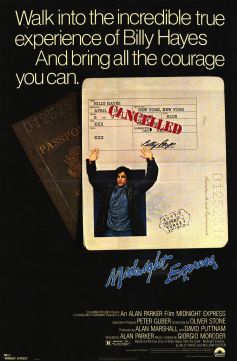
Midnight Express (1978)

midnight_express_ver2_xlgMidnight Express
Directed by Alan Parker

Like most of the other nominees from 1978, I knew nothing about Midnight Express before I watched it. Because it had “express” in the title, just like Murder on the Orient Express, Von Ryan’s Express, and Shanghai Express, I thought I was going to see an exciting train movie. I was disappointed and apprehensive to learn that it was not about trains, but about the horrifying conditions in a Turkish prison. I was fully expecting a movie as brutal as Deliverance, and I was relieved that it wasn’t nearly as bad.

So what’s the story? Young American Billy Hayes is caught trying to smuggle two kilos (or four and a half pounds) of hashish out of Turkey and sentenced to four years in prison there.

The Good: The acting is phenomenal. Brad Davis is truly amazing as Billy as he goes from terror to acceptance to insanity. Randy Quaid plays Jimmy, an inmate who is always coming up with escape plans that go awry.  Norbert Weisser shows subtle sympathy as Kurt the Swede. The sneaky prison snitch Rifki is played with quiet menace by Paolo Bonacelli. John Hurt gives a heartbreaking performance as Kurt, an English prisoner who has been there so long that he has very little hope left to hang on to.

The music is good, with the music in the chase scene being exceptional. It was a bit too synthesized in my opinion, but it’s still good.

I liked that the Turkish wasn’t translated, especially when Billy was first arrested at the airport. It was kind of disorienting, because I wasn’t sure exactly what was going on, and that echoed Billy’s experience.

The Bad: Go straight to ugly. Do not pass Go. Do not collect $200.

The Ugly: I couldn’t connect with Billy Hayes. He came off as an entitled spoiled brat. He was smuggling several pounds of hashish out of Turkey, but he seems to believe that he doesn’t deserve any sentence at all for that. Depending on the state he was in, he’d get about five years in prison for that in the US, especially since he admitted that he had the intent to sell. Smuggling carries an even greater penalty, so when he whined about having to stay four years, my opinion of him went down even more. Unfortunately, if you can’t connect with the main character in some way (or at least have some sympathy for him), a movie gets a little dull. You just want it to be over, because you just don’t care what happens.

I was upset when I found out that most of the movie was made up. If you are purporting to tell a true story,there should be more truth to your movie than the very basic plot. According to Billy Hayes, the conditions weren’t nearly as brutal as Alan Parker and Oliver Stone, who wrote the screenplay, depicted. I feel like you shouldn’t defame an entire country just for the drama.

I rarely do spoilers, but I am going to highlight the most brutal moments here so that you can make a more informed decision about watching it (SPOILERS BELOW):

  1. A cat is hung.
  2. One inmate bites off another’s tongue.
  3. A man’s head is squished on a peg and some grossness ensues.

Those are the three most brutal moments; everything else is basically as tame as the things that happen in the TV show Prison Break.

Oscars Won: Best writing, screenplay based on material from another medium; best music, original score.

Other Oscar Nominations: Best picture; best actor in a supporting role (John Hurt); best director; best film editing.

Les Misèrables (2012)

Les-miserables-movie-poster1Directed by Tom Hooper

This was one of the posts that I lost when I lost my flash drive. As much as I hate rewriting things that I’ve already written, I won’t have a hard time rewriting this one. I have a lot to say about Les Misèrables in general, the musical and this movie version of it in particular.

When I went to study in London about ten years ago, I wasn’t planning on seeing the stage version of Les Misèrables. The touring coming comes to my town often enough, and I wanted to see things I wouldn’t have the chance to see at home. But then I saw a poster of the cast, and the man playing Enjolras was really attractive (I might use the term “super hot” if I weren’t trying to be taken seriously), so I let my friends persuade me to go with them. I knew many people who had seen the musical and thought it was the best thing ever, and I had read an abridged version of the book before I saw the play and seen the movie version from the 1930s and knew that there was fantastic material to work with, so I was expecting really good things. I was really disappointed. I kind of wish I could find the scathing essay I wrote about it. I told my friends that I didn’t really like it, and that got spread around the entire group I had come with, kind of like in the claymation version of Rudolph the Red-Nosed Reindeer when they find out that Herbie doesn’t like to make toys.  (“Melanie didn’t like Les Misèrables!”) I got a lot of weird looks after that from people in my study abroad group, but I didn’t care. I got that same kind of look when I told people I had no desire to see this movie because I didn’t much care for the musical, kind of a mix of shock and disgust. I was never planning on seeing this movie. Stupid best picture nomination. I wasted three hours of my life to see a subpar version of a subpar play.

So what’s the story? Convict Jean Valjean is released from prison. He steals some silver from a priest, who tells the police that he gave Jean Valjean the silver. The priest then tells Valjean that he has to turn his life around. Valjean does so, changing his name so that the stigma of having been a convict won’t follow him throughout his life. However, Javert, a policeman who worked at the prison, recognizes Jean Valjean for who he was, and Valjean must go on the run, taking the daughter of a factory worker with him.

The Good: Les Misèrables has some truly beautiful music. They may not be all completely memorable, and some are hard to tell from others (when I’m not actively listening to them, I always get “Bring Him Home” and “On My Own” mixed up), but they are beautiful nonetheless. I have never forgotten “Castle on a Cloud,” which I learned over twenty years ago in school, and “Stars,” “Empty Chairs at Empty Tables,” and “Do You Hear the People Sing” always give me goosebumps.

There was some decent acting. Hugh Jackman and Russell Crowe both did fine jobs as Valjean and Javert, respectively. Crowe does especially well as Javert, who is perfectly convinced that the law is always right and simply cannot reconcile justice and mercy. Anne Hathaway and Samantha Barks both gave excellent performances as women torn apart by the way French society works. Aaron Tveit and Eddie Redmayne were very good as young revolutionaries Enjolras and Marius, and although I think they took up too much time in the movie, Helena Bonham Carter and Sacha Baron Cohen were perfectly cast as the comic relief-bringing Thènardiers.

The costuming, production design, and makeup were all admirable. Early 19th century France was brought to life thanks to those elements. I always like seeing a historical movie that doesn’t only involve wealthy people. It always makes me happy to have people acknowledge that a)poor people existed, and b)that poor people had different hairstyles, homes, and clothes than wealthy people.

The Bad: I don’t whose idea it was to have the actors sing live instead of lip-synching and putting in the songs later, but it was a bad idea. This movie would have been so much easier to watch if there hadn’t been so many cringe-worthy notes. I think the only person who pulled off all her singing with no problems was Samantha Barks, who played Èponine.

I have never understood the ending. It makes no sense to me to have all the people who have died throughout the movie/Jean Valjean’s life would be together in one place singing about the same thing. All those various people weren’t fighting for the same future, exactly. Also, if Heaven is a barricade as the finale hints, I don’t really want to go to Heaven.

The Ugly: Amanda Seyfried should never have been cast in this movie. Her singing is terrible to the point of distraction. She does have the right look, but I’m sure there are other innocent-looking blondes who could have sung the part much, much better.

Most of the other reasons I didn’t like the movie have to do with the weaknesses of the musical itself. Way too much time is spent on the Thènardiers at the expense of other things from the novel that would have made things make more sense. I wish a bit more time had been spent on the bishop, for example; that felt kind of glossed over. I hated that Javert didn’t recognize Valjean because of his face, but because he was strong. I can understand that people change after twenty years, but I’m sure that Javert had met other strong men in prison before. There was nothing really special for Javert to recognize him. (In the novel, in case you’re wondering, Valjean acts like a human jack to get carts off of men. That’s not something you see often, and makes a lot more sense. Not sure why that was changed.) I was annoyed by Marius and Cosette’s literal love at first sight. They did nothing except see each other, and suddenly life wasn’t worth living without each other? There are other little bits and pieces like that throughout the movie that just add up to me being annoyed with the whole thing.

Okay, now I get to talk about how the book compares to the movie. Since seeing the musical ten years ago, I have read the unabridged version. It’s not perfect. Victor Hugo needed a friend to tell him that when your characters are racing through the sewers in a life-and-death situation, you don’t need to cut from the action to give an entire history of the sewers of Paris. But one amazing, amazing thing that Hugo did do was give everyone a history. The first fifty to one hundred pages are not about Jean Valjean at all, but about the bishop, who, we learn, has given up all of his privileges and only keeps enough of his salary to keep himself fed. The rest he gives to the poor. The only thing he kept was his silver, so when he not only allows Jean Valjean to keep the plate, but also gives him the candlesticks, it’s a huge deal. The students all have back stories, so we care a lot more when they die so uselessly. The Thènardiers are not funny at all. They show the corruption and evil that can happen in poorer classes. They are menacing and horrible. Also, they are the parents of Gavroche, which gets skipped over in the movie completely. There are more connections which make everything that happens much more meaningful. I realize that not everything from a 1500 page book can make it into a three-hour movie, but that’s why making  Les Misèrables into a musical was just a bad idea to begin with. My final advice? If you haven’t seen the movie already, skip it and read the unabridged book. If you have seen the movie already, read the unabridged book. You will be amazed at the depth of feeling.

Oscars Won: Best performance by an actress in a supporting role (Anne Hathaway); best achievement in makeup and hairstyling; best achievement in sound mixing.

Other Oscar Nominations: Best motion picture of the year; best performance by an actor in a leading role (Hugh Jackman); best achievement in costume design; best achievement in music written for motion pictures, original song (“Suddenly”); best achievement in production design.
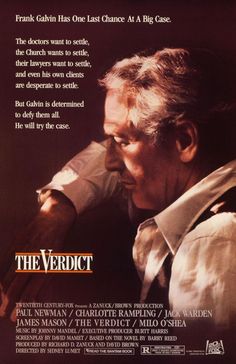
The Verdict (1982)

theverdictDirected by Sidney Lumet

I first recognized the existence of The Verdict when it was added to Netflix a little while back. It had Paul Newman! As a drunken lawyer! I had high hopes for it, but when I realized it was a best picture nominee, I made myself wait to watch it until I was actually reviewing the movies of 1982. When I finally got to watch it, I was so disappointed. It’s not terrible, but there’s nothing fabulously special about it, either.

So what’s the story? Ambulance-chasing lawyer Frank Galvin is a rather despicable man. He goes to funerals and tries to drum up business from widows. He spends most of his time drinking and reading the obituaries trying to find his next client. When an ex-partner takes pity on him and sends him an open-and-shut case that will settle out of court, Frank surprises everyone, even himself, when he decides to fight for his client truly deserves instead of taking the easy settlement.

The Good: Paul Newman is fantastic, as always. I’m not used to disliking him, so the first twenty minutes or so of the movie were kind of hard to watch. He’s good at playing a jerk. But the moment that he realizes that his client deserves more was a great bit of acting. I love watching actors show us what is going through their characters’ heads. He does a fabulous job throughout the rest of the movie, showing Frank’s frustration and triumph, nervousness and despair. It’s a very good bit of acting.

The supporting actors were just as good, with Charlotte Rampling playing Galvin’s new love interest, Laura; James Mason playing high-powered opposing attorney Ed Concannon; and Jack Warden as Galvin’s old friend and ex-partner Mickey Morrissey. They were all solid in complicated roles.

I loved the very ending of the movie. It wasn’t the typical ending for a movie like this, and I was glad, because if they had gone with what typically happens, what power this movie had would have been lost. It is so hard to write intelligibly about endings when you are trying so hard not to include spoilers, so please forgive me. But the ending packs a punch.

The Bad: I wouldn’t say it was bad, per se, but the story has nothing new to say. It felt in some ways like a reworking of Mr. Smith Goes to Washington, with Frank Galvin being incompetent instead of naïve like Mr. Smith. In other ways, it was a completely normal courtroom drama, with just the little twist of Galvin’s alcoholism being added.

The Ugly: Because it was so typical, The Verdict didn’t have much of an impact on me. There was nothing I could get worked up over. I was bothered all the way through the movie that Jack Warden didn’t have a moustache, because he looks like the kind of guy who would have one, but that was just a slight annoyance. I was more puzzled over this movie’s best picture nomination than anything else, and that’s not ugliness, just confusion. I expect more from a best picture nominee.

Oscars Won: None.

Oscar Nominations: Best picture; best actor in a leading role (Paul Newman); best actor in a supporting role (James Mason); best director; best writing, screenplay based on material from another medium.

High Noon (1952)

high noonDirected by Fred Zinneman

I love westerns. It’s probably because I watched so many of them growing up that now they make me feel like a little kid again. Whatever the reason, I’m always glad when they show up on the list of best picture nominees. However, High Noon isn’t exactly a western. It’s a thriller that just happens to take place in the Old West. It’s about relationships and small towns and above all, people. I’ve seen it before, but it’s always exciting to watch.

So what’s the story? Will Kane has just married his Quaker sweetheart and given up his marshal’s badge when he gets a telegram that Frank Miller, a murderer that he arrested, has been let out of prison. He’s set to arrive on the noon train and hell-bent on getting revenge on the man who sent him to prison. Miller’s old gang is already waiting for him at the platform. Realizing that a true man faces his problems, Will refuses to run, but can he get the help he needs from the townspeople he’s protected in the past?

The Good: High Noon happens in real time. It’s about 10:40 when Marshal Kane gets his telegram, and an hour and twenty minutes later in real life, the train comes in. This adds to the tension in a way that very few things could have. I’m not sure if High Noon was the first movie to use this tactic, but it’s very effective.

The editing is fantastic. I love really good editing, but sometimes I feel like good editing can be hard to spot. Every once in a while, though, I’m blown away by it. That’s what happened in High Noon. After all the tension has built up and the train is finally coming into town, there are shots of all the different groups waiting for the train to stop. The editing makes that part of the movie so stressful. It’s awesome.

Once again, the acting is superb (can a movie be nominated for best picture without having at least some good acting?). Gary Cooper plays Will Kane, a man committed to his path even though it may cost him the woman he loves. Grace Kelly plays his bride, Amy, who is understandably frightened at the prospect of losing her new husband. Bitter deputy marshal Harvey is played wonderfully by Lloyd Bridges. Even Henry Morgan (aka Colonel Potter in M*A*S*H) has a small role. But the standout actress in High Noon is Katy Jurado as Helen Ramirez. She is ridiculously good in her rather complicated role.

Helen Ramirez is actually another wonderful thing about this movie. Minorities in westerns generally only have tiny roles, and they are usually horrifically stereotypical. However, while Helen is a scarlet woman, she is smart, strong, passionate, and fair. She isn’t scared of anything and she doesn’t take anything from anyone. I love her. She’s a great character.

The cinematography is great. It manages to highlight Will’s forced solitude and the attitudes of the people surrounding him. It does what good cinematography should do.

The Bad: There is nothing bad about High Noon. Everything about this movie is either on fabulous or horrifically bad. I suppose I could say that it’s not fun to watch Thomas Mitchell, one of my favorite character actors, not be awesome. That’s just how the story goes, though.

The Ugly: The title song is awful. I think I could have rationalized it as a 1950s cowboy song if it weren’t for the fact of these two lines:

He made a vow while in state prison
Vowed it would be my life or his’n.

I think it should be a crime against the arts (is that a thing? Can we make it one?) to use “his’n” as a rhyme for “prison”. Bad, bad, bad. Even then, I might have been able to make my peace with it if bits of the song (including that line) didn’t keep playing throughout the movie and reminding me of its existence. The musical score by Dimitri Tiomkin itself is very good, but this song… So bad.

Oscars Won: Best actor in a leading role (Gary Cooper); best film editing; best music, original song (“High Noon [Do Not Forsake Me, Oh My Darlin’]”); best music, scoring of a dramatic or comedy picture.

Other Oscar Nominations: Best picture; best director; best writing, screenplay.

In the Bedroom (2001)

in the bedroomDirected by Todd Field

Even when I recognize the titles of the movies that I’m watching, I don’t always know anything else about them. Sometimes, though, the title gives me a very good idea of what the movie is about. Other times, I am completely wrong. I had never really wanted to see In the Bedroom because I was convinced it was a raunchy sex comedy. That couldn’t be farther from the truth. I was surprised to find that it is instead a slow-moving drama about how a family deals with tragedy. I think I will have to stop judging movies based on their titles.

So what’s the story? Frank Fowler is a college student home for the summer. To his mother’s dismay, he starts dating Natalie, an older woman with two little boys. Natalie also has an ex-husband with a temper. As the summer heats up, tensions mount, and tragedy soon follows.

The Good: In Ian McEwan’s (rather dull) novel Saturday, two people are discussing Tolstoy, and one says, “The genius is in the details.” I feel that way about In the Bedroom. Everyone is believable, partly because the screenplay allows for details. When she’s depressed, Ruth Fowler sits on her couch, watching pointless TV and smoking. Matt Fowler likes to meet his son, Frank, for lunch. Natalie makes awkward conversation with her boyfriend’s college-educated parents, trying to get them to like and accept them. These little scenes, while not action-packed, reveal character and make the people real. The realism makes the sadness later much more real.

Because the screenplay moves so slowly, the acting had to be incredible. Tom Wilkinson and Sissy Spacek are Matt and Ruth Fowler, who are trying to understand and be supportive of their son’s choices, while at the same time not being happy about them. Marisa Tomei is Natalie, a woman who enjoys dating a younger man, but can also see his naiveté. Frank is played by Nick Stahl. He makes Frank a very sweet young man who is enthusiastic about life, but doesn’t really understand that choices have consequences. They are all a joy to watch.

The cinematography was interesting. It would have been very easy to film this movie about a normal family with straightforward camera angles, but instead the filmmakers took the opportunity to use the camera to show that people have inner lives and thoughts. I liked that a lot.

The Bad: Because this movie allows for the details, for the normal conversations between ordinary people, it gets a little boring sometimes. But guess what? Life is boring sometimes. I’m still trying to figure out how I feel about the ending, though. It might have been too exciting to be believable.

The Ugly: I spent a lot of time being annoyed that Natalie and Frank spent so much time with her boys when both Frank and Natalie kept insisting it was only a summer fling. It seemed like such an irresponsible thing to do, to let kids get attached to a boyfriend you’re only planning on dating for a few months. It made me grumpy.

Oscars Won: None.

Oscar Nominations: Best picture; best actor in a leading role (Tom Wilkinson); best actress in a leading role (Sissy Spacek); best actress in a supporting role (Marisa Tomei); best writing, screenplay based on material previously produced or published.

Gosford Park (2001)

gosford parkDirected by Robert Altman

I read my first Agatha Christie murder mystery when I was twelve. It was the start of a beautiful relationship. Every summer after that, I would check out stacks of Agatha Christie mysteries. The plots were always intricate and watertight, but I also loved the idea of rich British people in country houses dressing for dinner and going shooting and having weekend parties. Gosford Park is basically an Agatha Christie mystery with a twist—it not only shows how the family is affected by the murder, but also how the servants are affected. It could be called Murder at Downton Abbey.

So what’s the story? Sir William McCordle has invited friends and family to Gosford Park for a weekend shooting party. The guests come with their servants, and everyone, both upstairs and down, has a secret.

The Good: The cast reads like a Who’s Who of British actors. Maggie Smith, Helen Mirren, Michael Gambon, Kristin Scott Thomas, Derek Jacobi, Jeremy Northam, Clive Owen, Stephen Fry, and Kelly Macdonald are all in this movie, to name just a few. Everyone is excellent. There isn’t an actor in the movie who was miscast or who isn’t completely believable in their role. It’s a fantastic cast, and the movie is incredibly well-acted.

The screenplay is delightful. I had to laugh when I was watching the credits and realized why I felt it was similar to Downton Abbey. The screenplay was written by Julian Fellowes, the man behind Downton Abbey. The screenplay is fun and funny. Although there are many characters, the screenplay allows them all to show their personalities and problems. It’s very clever and well-written.

The costume design impressed me. The designer, Jenny Beavan, had to not only design clothes for the wealthy and their servants, but also had to show a range of incomes in those different classes. She did so very cleverly and period-appropriately.

I love the music. It’s buoyant and jolly when it needs to be and unobtrusive when more serious things are happening. The cheery piano music made me want to find the sheet music.

The art direction is also excellent. It drew me in to this country house of the 1930s. The cars, the bedrooms, the servants’ quarters, everything felt realistic to me.

The Bad: I got so mad watching this movie at the way people treated their servants. The servants weren’t treated so much like people as they were like useful machines. They are used and abused at their employers’ pleasure. I felt very frustrated. Based on things that I’ve read, I’m fairly sure the attitudes are accurate. Even in my beloved Agatha Christie novels, the servants are almost always discounted from being murder suspects because they couldn’t possibly have a motive; they don’t know the murdered person well enough. I love that this movie shows the relationships between the rich and their servants; the only one who cries at the news of the murder is a servant. But the treatment of the servants still makes me mad.

The Ugly: It was a little hard to keep track of who everyone was. The relationships of the upper-class people were especially hard to figure out. Everyone is introduced so quickly and shallowly at first that it doesn’t all sink in the first time around.

Oscar Won: Best writing, screenplay written directly for the screen.

Other Oscar Nominations: Best picture; best actress in a supporting role (Helen Mirren); best actress in a supporting role (Maggie Smith); best director; best art direction-set decoration; best costume design.

The Treasure of the Sierra Madre (1948)

the-treasure-of-the-sierra-madre-poster-11Directed by John Huston

The Treasure of the Sierra Madre was one of the few movies I had already seen but had no desire to see again. I checked it out from the library a while ago, probably because I had been told it was an adventure movie, which I tend to love, starring Humphrey Bogart, who is awesome. It was so boring that I didn’t even make it halfway through before giving up. So I was really surprised this time around at how much I liked this movie. It’s amazing. Now I’m wondering what was wrong with me the day I watched it the first time.

So what’s the story? Dobbs and Curtain are two American men down on their luck in Mexico. Both of them just want to make enough money to make it back to America, but they can’t find work. They meet Howard, an old prospector, who is willing to help them find gold, but he warns them that gold always carries a curse.

The Good: Like I said before, Humphrey Bogart is awesome, but I’ve never seen him quite like this before. He often plays crusty people on the fringes of society, but he always seems to have a heart of gold underneath. Not here. He’s a little frightening, really. I’m not sure why he wasn’t nominated for a best actor Oscar. Tim Holt plays Curtain, who is just an all-around nice guy with dreams of a bigger life. Howard is played by Walter Huston, director John Huston’s father. Normally I’m not a fan of nepotism, but I think this was a case where the perfect person for the role just happened to be related to the director. Huston did such a good job. He was patient with the greenhorns, yet you could see him waiting for the other shoe to drop. He had enough experience and wisdom to know how things were going to go. Huston managed to show all of that without getting annoying, which can be tricky in situations like that.

The cinematography is gorgeous. It was shot on location in Mexico, and the cinematographer took advantage of that. But there are also lots of intriguing camera angles and good moody lighting which help contribute to the movie.

The excellent score was masterfully written by Max Steiner. I’ve decided he could score pretty much anything and it would be amazing. He could score a movie of someone silently reading a phone book and it would become interesting.

The Bad: The Treasure of the Sierra Madre has the usual first half of the 20th century problem with racism, but it’s not the worst I’ve seen. It also moves a little bit slowly at times.

The Ugly: This movie has the single worst fistfight I have seen in any movie ever. The camera angles are all wrong, and you can see that the punches aren’t actually connecting, even though the foley artist is making the correct sounds. It’s sooooo bad. I was cringing all the way through.

Oscars Won: Best actor in a supporting role (Walter Huston); best director; best writing, screenplay.

Other Oscar Nominations: Best picture.

Johnny Belinda (1948)

johnny-belinda-movie-poster-1948-1020435490Directed by Jean Negulesco

When I was a little girl, my family always had a copy of Leonard Maltin’s Movie Guide on hand. This was in the days before IMDb, and we liked to look up people who looked familiar in movies to figure out what other movies they had been in. In the back of the books was a list of the Oscar winners for best picture, actor, actress, and director for every year. Johnny Belinda was on that list because of Jane Wyman’s win, but that was all I knew about the movie before I saw it. I had a vague idea it was about a boxer; I’m not sure why. It most definitely is not. It’s a beautiful and moving story about people in a small town.

So what’s the story? Dr. Robert Richardson is the new doctor in a small fishing village in Nova Scotia. He goes out to the mill to help the mill owner and his sister deliver a calf. There he meets Belinda, the owner’s daughter, who is a deaf-mute. Because she can’t communicate, everyone in town assumes she is mentally incapable, but the doctor recognizes her intelligence and teaches her lip-reading and sign language. Belinda begins to blossom under his tutelage, but when she is raped and becomes pregnant, the town turns on her and the doctor.

The Good: Johnny Belinda was deservedly nominated in all four acting categories. Jane Wyman plays Belinda with sensitivity and tact, never over-acting. It’s a fabulous performance. Lew Ayres is the outsider doctor who ties to a more modern society allow him to help a woman who would have been stuck in her own world for her entire life. Belinda’s father is played by Charles Bickford. He grows from an impatient, rather uncaring father to a man who is proud of his smart, beautiful daughter. Agnes Moorehead, perhaps best known for her role of Endora in Bewitched is Belinda’s aunt Aggie. Aggie isn’t impressed with Belinda’s progress and is unkind to Belinda until Belinda becomes pregnant. At that point, Aggie becomes protective and loving. It’s a quick turnaround, but it’s very realistic. All of those performances were fantastic. And they weren’t the only ones. Stephen McNally is nicely creepy as the cocky Locky McCormick (and yes, his name is Locky, not Lucky; it’s short for Laughlin, apparently), and Jan Sterling plays the vain, pettish Stella perfectly. The whole movie is very well-cast.

The screenplay was also excellent. The story is sad, yes, but there were moments of humor, because that’s life. I loved the part where Dr. Richardson takes Belinda into a bigger city to see a doctor about her deafness. She looks into the window of a store and sees a brassiere for the first time. She has no idea what it is, and asks Dr. Richardson to explain it to her. He has no words for her, and the look on his face is priceless. Moments like that keep the movie from being too depressing. The subject matter is not easy, but the screenplay treats it sensitively. It’s very well done.

The music underscores the movie well. It helps plot Belinda’s moods and her growth as she becomes more a part of her world. The cinematography helped with that, too. Both elements added a lot to the movie.

The Bad: I had a hard time figuring out what time period the movie was set in. The townspeople didn’t look particularly modern, but the doctor’s clothes were completely 1940s. But then I thought about my grandma. She grew up in a small cabin in backwoods Tennessee in the 40s. Her family didn’t have electricity until after World War II. I’m sure her family wasn’t wearing the latest fashions, either. So although it took me awhile, I don’t have a major beef with it. If you’re aware that it’s contemporary to the time that the movie was made, it shouldn’t bother you at all.

The narration at the beginning bothered me, but I can’t think of another way they could have established some of the background without a lot of conversation that would have seemed kind of stilted and pointless, so I guess I can’t really complain.

The Ugly: I have never seen a more obvious stunt dummy than in this movie. I know this movie was made in the 1940s, but still. Real bodies don’t move like that. It makes a high-tension moment a little less dramatic.

Oscar Won: Best actress in a leading role (Jane Wyman).

Other Oscar Nominations: Best picture; best actor in a leading role (Lew Ayres); best actor in a supporting role (Charles Bickford); best actress in a supporting role (Agnes Moorehead); best director; best writing, screenplay; best cinematography, black-and-white; best sound, recording; best film editing; best music, scoring of a dramatic or comedy picture.