I'd like to spank the Academy

Posts tagged ‘Based on a short story’

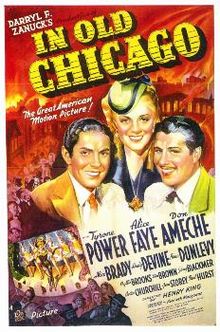
In Old Chicago (1937)

In old chicagoDirected by Henry King

Chicago politics. The Chicago Fire of 1871. Close brothers who become rivals. With all of these elements, what could go wrong? A lot, actually. While there were some exciting scenes, In Old Chicago left much to be desired.

So what’s the story? The O’Leary brothers are polar opposites. Straight-arrow Jack is an attorney who always fights for the underdog. Charmingly roguish Dion runs a saloon, but he has bigger plans. He will use anyone and anything to get what he wants. Jack and Dion’s ideals will be tested for once and all on the night of the Great Chicago Fire of 1871.

The Good: There was some good acting. Alice Brady stole the show as Mrs. O’Leary (yes, THAT Mrs. O’Leary). Don Ameche is strong as Jack, and Alice Faye makes a wonderful singer/saloon owner/woman in love with Dion. Dion’s character is a little inconsistent, but Tyrone Power does an excellent job with what he’s given.

The production design was impressive. There is a huge contrast in all the buildings, from the opulence of the saloons to the humble O’Leary home to the elegance of the Mayor’s office. It brought to life the different factions of Chicago society. Also, the streets were disgustingly muddy. Historical films don’t always remember to put in small details like that. I loved it.

I wasn’t going to be impressed with the actual fire scenes; it was 1937. How convincing could it be? That was a bad call on my part. The fire is amazing, possibly even better than the burning of Atlanta in Gone with the Wind two years later. It was just…wow.

The Bad: While I acknowledge that several scenes take place in saloons and that the producers were trying to showcase Alice Faye’s famous voice, there were too many musical numbers. They slowed down the conniving and the action, and they weren’t particularly entertaining.

While In Old Chicago has a good story with lots of potential drama, the movie felt really shallow. The screenplay left the characters feeling flat and uninteresting, except for Dion. He has the opposite problem. His character changes at the drop of a hat. One minute he’s a rogue with a twinkle in his eye, the next he’s completely evil. Then suddenly, he remembers how much he loves his brother and is perfectly good. It’s just not believable.

The Ugly: Rape isn’t a joke, although they play attempted rape as funny twice. Forcing a girl to kiss you and then threatening to rape her will not get you a business partner or a loving wife. Not cool, 1937.

Oscars Won: Best actress in a supporting role (Alice Brady); best assistant director.

Other Oscar Nominations: Best picture; best writing, original story; best sound, recording; best music, score.

The Quiet Man (1952)

the-quiet-man-movie-poster-1952-1010203160Directed by John Ford

 As a librarian, I spend a lot of time using the alphabet, so yes, I realize that I by reviewing The Quiet Man today, I am doing things out of order. But Maureen O’Hara died on Saturday, and I’ve been thinking about her and her movies a lot the last couple of days. Because of Miracle on 34th Street and The Parent Trap (the originals of both, NOT the inferior remakes), I grew up admiring Maureen O’Hara as a strong, beautiful woman, completely unafraid to be herself, no matter what society thought. After reading obituaries and tributes to her the last couple of days, I get the feeling that she truly was that way. Since Maureen O’Hara plays another beautiful, strong woman in The Quiet Man, I’m posting my review of it today as my little tribute to a wonderful actress.

I grew up watching John Wayne movies, so I’m not sure how I missed this one. No, it’s not a Western, but I’d seen lots of other non-Western John Wayne movies. But even though I had never actually seen The Quiet Man, I had seen E.T. the Extraterrestrial, so I was really excited to finally know which movie included the dramatic kissing scene that E.T. watches on TV. It was a gap in my movie trivia knowledge, and I was ecstatic to have it filled in. Beyond that bit of trivia, I was glad to finally see The Quiet Man for another reason: it’s a dang good movie!

So what’s the story? Sean Thornton left Ireland for America with his parents when he was three years old, but his mother always talked of Ireland as if it were paradise, so he decides to move back and buy the cottage where he was born. He sees fiery-spirited redhead Mary Kate Danaher as soon as he steps foot in the village of Innesfree and decides that she is the girl for him. Unfortunately, Sean offends Mary Kate’s brother almost as soon. Although Mary Kate makes no secret about her reciprocation of Sean’s feelings, will her brother and her Irish customs keep them apart?

The Good: I’m going to mention cinematography first, because this movie is so beautiful that it literally made me cry. During the race, when the horses are pounding across the beach with the green mountains in the background…oh, it’s amazing. I can’t even begin to describe the beauty of it all. I know that Ireland is beautiful, but photographers still have to have an eye to capture the beauty, and the cinematographer did a fabulous job.

This movie is perfectly cast. I can’t think of another actress who could have done a better job at playing Mary Kate than Maureen O’Hara. She’s strong and proud and just plain wonderful. John Wayne is good as always as the man who is trying to live his dream, but who just doesn’t understand the culture of the woman he loves. He’s confused and frustrated, but so wholly in love. John Wayne and Maureen O’Hara were good friends in real life, and they have excellent on-screen chemistry.

The supporting cast is also so good. Ward Bond makes a surprisingly convincing Irish priest. Victor McLagen, although perhaps a little old to look like Maureen O’Hara’s brother, is full of bluster and silly pride as Will Danaher. Barry Fitzgerald brings a fabulous sense of humor to the role of Michaleen Oge Flynn, and his real-life brother Arthur Shields is excellent as the Protestant Reverend Cyril Playfair. Mrs. Playfair, played by Eileen Crowe, is mischievous and fun. I love them all!

The musical score is gorgeous. Victor Young used a lot of old Irish melodies, but also wrote some beautiful themes of his own. The music complements the movie perfectly.

The story and screenplay are fabulous. I’m not a huge fan of romantic comedies in general, because they’re just so fake. But The Quiet Man is so real. Two proud, stubborn people fall in love, but have a hard time adjusting to each other. Even though they love each other, they don’t completely understand one another. Movies don’t usually show that. Romantic comedies also tend to end with the wedding as the happy ending, but The Quiet Man is not like that. I wish more moviemakers would be brave enough to tell a real story like this one.

The Bad: Because I am a modern woman, I was incredibly uncomfortable with the scene where Sean drags Mary Kate off the train and pulls her across the fields and through the village. Yes, she was asking something of him that he didn’t want to do, but he wasn’t trying to understand her culture, either. Also, I’m not sure how accurate the Irish culture was portrayed. It felt very stereotypical to me, but maybe the stereotype happened because of reality. I don’t know. I just had to turn off the cultural sensitivity part of my brain, and then I was okay.

The Ugly: Nothing, unless you are even more sensitive than I am about the dragging through the fields scene.

Oscars Won: Best director; best cinematography, color.

Other Oscar Nominations: Best picture; best actor in a supporting role (Victor McLaglen); best writing, screenplay; best art direction-set direction, color; best sound, recording.

Random Fact: Even though The Quiet Man won an Oscar for best color cinematography, I once had a library patron who refused to check out the copy we have because it wasn’t in black and white, which, according to her, was the original. I did some research and apparently, ABC only had a black and white print, so that’s what was shown on broadcast TV for a while. The patron never did believe me that The Quiet Man was originally in color. Sigh.
High Noon (1952)

high noonDirected by Fred Zinneman

I love westerns. It’s probably because I watched so many of them growing up that now they make me feel like a little kid again. Whatever the reason, I’m always glad when they show up on the list of best picture nominees. However, High Noon isn’t exactly a western. It’s a thriller that just happens to take place in the Old West. It’s about relationships and small towns and above all, people. I’ve seen it before, but it’s always exciting to watch.

So what’s the story? Will Kane has just married his Quaker sweetheart and given up his marshal’s badge when he gets a telegram that Frank Miller, a murderer that he arrested, has been let out of prison. He’s set to arrive on the noon train and hell-bent on getting revenge on the man who sent him to prison. Miller’s old gang is already waiting for him at the platform. Realizing that a true man faces his problems, Will refuses to run, but can he get the help he needs from the townspeople he’s protected in the past?

The Good: High Noon happens in real time. It’s about 10:40 when Marshal Kane gets his telegram, and an hour and twenty minutes later in real life, the train comes in. This adds to the tension in a way that very few things could have. I’m not sure if High Noon was the first movie to use this tactic, but it’s very effective.

The editing is fantastic. I love really good editing, but sometimes I feel like good editing can be hard to spot. Every once in a while, though, I’m blown away by it. That’s what happened in High Noon. After all the tension has built up and the train is finally coming into town, there are shots of all the different groups waiting for the train to stop. The editing makes that part of the movie so stressful. It’s awesome.

Once again, the acting is superb (can a movie be nominated for best picture without having at least some good acting?). Gary Cooper plays Will Kane, a man committed to his path even though it may cost him the woman he loves. Grace Kelly plays his bride, Amy, who is understandably frightened at the prospect of losing her new husband. Bitter deputy marshal Harvey is played wonderfully by Lloyd Bridges. Even Henry Morgan (aka Colonel Potter in M*A*S*H) has a small role. But the standout actress in High Noon is Katy Jurado as Helen Ramirez. She is ridiculously good in her rather complicated role.

Helen Ramirez is actually another wonderful thing about this movie. Minorities in westerns generally only have tiny roles, and they are usually horrifically stereotypical. However, while Helen is a scarlet woman, she is smart, strong, passionate, and fair. She isn’t scared of anything and she doesn’t take anything from anyone. I love her. She’s a great character.

The cinematography is great. It manages to highlight Will’s forced solitude and the attitudes of the people surrounding him. It does what good cinematography should do.

The Bad: There is nothing bad about High Noon. Everything about this movie is either on fabulous or horrifically bad. I suppose I could say that it’s not fun to watch Thomas Mitchell, one of my favorite character actors, not be awesome. That’s just how the story goes, though.

The Ugly: The title song is awful. I think I could have rationalized it as a 1950s cowboy song if it weren’t for the fact of these two lines:

He made a vow while in state prison
Vowed it would be my life or his’n.

I think it should be a crime against the arts (is that a thing? Can we make it one?) to use “his’n” as a rhyme for “prison”. Bad, bad, bad. Even then, I might have been able to make my peace with it if bits of the song (including that line) didn’t keep playing throughout the movie and reminding me of its existence. The musical score by Dimitri Tiomkin itself is very good, but this song… So bad.

Oscars Won: Best actor in a leading role (Gary Cooper); best film editing; best music, original song (“High Noon [Do Not Forsake Me, Oh My Darlin’]”); best music, scoring of a dramatic or comedy picture.

Other Oscar Nominations: Best picture; best director; best writing, screenplay.

In the Bedroom (2001)

in the bedroomDirected by Todd Field

Even when I recognize the titles of the movies that I’m watching, I don’t always know anything else about them. Sometimes, though, the title gives me a very good idea of what the movie is about. Other times, I am completely wrong. I had never really wanted to see In the Bedroom because I was convinced it was a raunchy sex comedy. That couldn’t be farther from the truth. I was surprised to find that it is instead a slow-moving drama about how a family deals with tragedy. I think I will have to stop judging movies based on their titles.

So what’s the story? Frank Fowler is a college student home for the summer. To his mother’s dismay, he starts dating Natalie, an older woman with two little boys. Natalie also has an ex-husband with a temper. As the summer heats up, tensions mount, and tragedy soon follows.

The Good: In Ian McEwan’s (rather dull) novel Saturday, two people are discussing Tolstoy, and one says, “The genius is in the details.” I feel that way about In the Bedroom. Everyone is believable, partly because the screenplay allows for details. When she’s depressed, Ruth Fowler sits on her couch, watching pointless TV and smoking. Matt Fowler likes to meet his son, Frank, for lunch. Natalie makes awkward conversation with her boyfriend’s college-educated parents, trying to get them to like and accept them. These little scenes, while not action-packed, reveal character and make the people real. The realism makes the sadness later much more real.

Because the screenplay moves so slowly, the acting had to be incredible. Tom Wilkinson and Sissy Spacek are Matt and Ruth Fowler, who are trying to understand and be supportive of their son’s choices, while at the same time not being happy about them. Marisa Tomei is Natalie, a woman who enjoys dating a younger man, but can also see his naiveté. Frank is played by Nick Stahl. He makes Frank a very sweet young man who is enthusiastic about life, but doesn’t really understand that choices have consequences. They are all a joy to watch.

The cinematography was interesting. It would have been very easy to film this movie about a normal family with straightforward camera angles, but instead the filmmakers took the opportunity to use the camera to show that people have inner lives and thoughts. I liked that a lot.

The Bad: Because this movie allows for the details, for the normal conversations between ordinary people, it gets a little boring sometimes. But guess what? Life is boring sometimes. I’m still trying to figure out how I feel about the ending, though. It might have been too exciting to be believable.

The Ugly: I spent a lot of time being annoyed that Natalie and Frank spent so much time with her boys when both Frank and Natalie kept insisting it was only a summer fling. It seemed like such an irresponsible thing to do, to let kids get attached to a boyfriend you’re only planning on dating for a few months. It made me grumpy.

Oscars Won: None.

Oscar Nominations: Best picture; best actor in a leading role (Tom Wilkinson); best actress in a leading role (Sissy Spacek); best actress in a supporting role (Marisa Tomei); best writing, screenplay based on material previously produced or published.

The Red Shoes (1948)

red-shoes-02Directed by Michael Powell and Emeric Pressburger

This was another movie I first saw on Turner Classic Movies (TCM) about ten years ago. I wonder now if they were spotlighting the movies from 1948, because it seems strange that I would have seen both The Snake Pit and The Red Shoes at the same time if they weren’t. Anyway, when I saw The Red Shoes then, I liked it so much that I when I was home from college on a break, I checked it out from the library and made my younger sisters watch it. I was kind of excited to see it again, but I didn’t like it nearly so much this time around. That made me wonder what has changed about me or my tastes. I’m not sure what it is, but whatever happened in the last ten years, I noticed some definite weaknesses that I hadn’t noticed before.

So what’s the story? Two young artists, composer Julian Craster and dancer Victoria Page, are taken under the wing of ballet master Boris Lermontov. With his guidance and support, both are able to soar to new heights in their respective arts. But when Julian and Victoria fall in love, they will have to live with the consequences of their choices.

The Good: The dancing is beautiful. Moira Shearer, who played Victoria, was a ballerina, not an actress. Her acting is competent, nothing special, but her dancing is glorious. Leonide Massine is Ljubov, the choreographer/featured performer (sorry, I don’t really know ballet terms) of Ballet Lermontov. He’s a fabulous dancer (and a very good actor).

Most of the acting isn’t anything special, but Anton Walbrook does an excellent job as Boris Lermontov, the man who cares about his ballet company more than anything in the world, who only values people for what they can contribute to his art.

I loved the music. The composer, Brian Easdale, had to not only write a score, but also music for ballets. It was all really very lovely.

The Bad: The Red Shoes ballet kind of annoyed me. There were a couple of special effects (like the red shoes suddenly appearing on Victoria’s feet, magicked on by the shoemaker) that wouldn’t have really worked in a real stage ballet. I hate it when a movie is supposed to be showing something real, but takes advantage of movie special effects. It’s cheating. And stupid.

The Ugly: When you take a creative writing class, one of the first things you learn is “Show, don’t tell.” That means that you shouldn’t say, “Victoria and Julian are madly in love;” you should actually show them talking together more than once. You should show meaningful looks and lingering hand holding. This rule should apply to movies, but the writers of The Red Shoes apparently had never heard of it. The love story was extremely weak, which made it hard to believe the rest of the movie. I’m not sure how I missed that the first time around, but I must not have been as discerning when it comes to love stories ten years ago as I am now.

Oscars Won: Best art direction-set decoration, color; best music, scoring of a dramatic or comedy picture.

Other Oscar Nominations: Best picture; best writing, motion picture story; best film editing.

Mr. Smith Goes to Washington (1939)

Mr. Smith Goes to WashingtonDirected by Frank Capra

Mr. Smith Goes to Washington is one of the movies I had seen before I started this project and was happy to watch again because it’s so good. I was also happy in a really weird way that I couldn’t get it from the library I work at; there was a waiting list. For a movie from 1939. So I have hope for the future now, even though I had to get the movie from a different library.

So what’s the story? A senator from an unnamed state dies, and the governor needs to appoint a replacement. The corrupt political boss that got him elected tells him to pick one person, while the unions and other state leaders give him another name. His savvy kids (all eight of them!) tell him to appoint their local scout leader, Jefferson Smith. Not wanting to offend anyone, the governor appoints Jefferson Smith. Jeff is a naive patriot who loves his country and believes in the Constitution, but the rest of the elected officials from his state are corrupt and trying to push graft through. It’s up to him and his cynical assistant to stop the evil political machine from succeeding.

The Good: There is lots of good acting in the movie. Jimmy Stewart plays Jefferson Smith, and he’s always good. Jean Arthur is the cynical assistant Saunders who is slowly won over by Smith’s naivety. The corrupt senior senator is Claude Rains, who is one of my personal favorites, and I think it’s a shame that he never won an Oscar. He did get a best supporting actor nomination for this movie, though. So did Harry Carey , who is listed as President of the Senate, but if I remember my Constitution correctly, doesn’t that make him Vice President of the United States? Anyway, he has almost no lines in this movie, but his face is incredibly expressive.

I actually wrote a paper in college about the music in this movie for an American history class where they required us to watch Mr. Smith Goes to Washington; the music is very instrumental (hahaha) to the drama of the movie. Dimitri Tiomkin used lots of American folk songs and patriotic songs to underscore Smith’s fight against corruption.

I’m going to award kudos to the makeup people for this movie, too. I had always thought that Mr. Smith Goes to Washington was made in the late forties, many years after The Adventures of Robin Hood (1938) and Casablanca (1942). I assumed this because of Claude Rains, who looks so much older in this movie than in the other two. But since that is all down to the makeup department and not natural aging, I have to congratulate the makeup department for fooling me.

While I was watching this movie, I assumed that they had gotten permission to film on location at the Capitol Building. Nope! They just rebuilt the Senate Chamber in complete detail in a studio in California. It’s crazy good, and it says to me that Frank Capra cared a lot about this movie.

Another detail that I appreciated was that Capra never named the state that Smith is from or the which political party any of the politicians belong to. He made it so that no one could say, “Well, it didn’t happen in my state or my party, so I’m fine.” He didn’t allow anyone to be complacent about corruption in the government.

The Bad: As Jefferson Smith is trying to expose the corruption, his Boy Rangers back home try to spread the word about what he’s doing. The political machine shuts them down, and it’s very hard to watch. It’s not graphic, but if you’re sensitive to children in danger, be warned. Watch the movie anyway, but know that that’s coming.

The (Possibly) Ugly: Patriotism, idealism, and optimism aren’t always highly regarded now. People are more cynical, especially about the government. Some people might say that this movie is unbearably cheesy because of that. I don’t find it so; I kind of wish there were more people now who did believe that what they do can make a difference.

Oscar Won: Best writing, original story.

Other Oscar Nominations: Best picture; best actor in a leading role(James Stewart); best actor in a supporting role (Harry Carey); best actor in a supporting role (Claude Rains); best director; best writing, screenplay; best art direction; best sound, recording; best film editing; best music, scoring.