I'd like to spank the Academy

Posts tagged ‘Based on a book’

No Country for Old Men (2007)
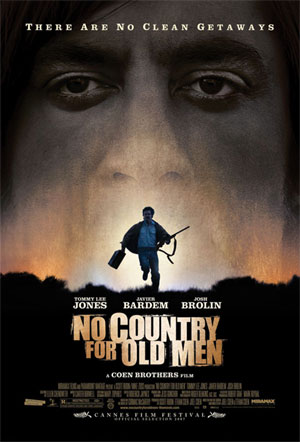
No_Country_for_Old_Men_posterDirected by Ethan Coen and Joel Coen

I know it’s been a little while since I’ve posted, and I feel very bad about that. I know I left all my adoring fans hanging in 2007 (hahaha! Look at me, pretending I have fans!), but writing when you have a fever rarely produces anything that makes any sense, let alone anything readable. So in the future, I will attempt to not get sick until I’ve posted an entire week’s worth of reviews so that you, my loyal readers, will not be left without my wisdom.

I knew two things about this movie before I watched it: 1) It was based on a book by Cormac McCarthy and 2) It was a Coen brothers film. And this time, I was right on both counts! This movie makes a lot more sense for the Coen brothers. Although it’s a drama, it still has enough quirky characters and funny lines to bring that Coen brothers feel to it. Of course, that makes me extremely curious about the book that it’s based on. Does it have that same quirky feeling to it? Maybe one day when I have time in my life, I will find out.

So what’s the story? One day while he is out hunting (or poaching, maybe?) in the desert, Llewelyn Moss stumbles across the bloody aftermath of a drug deal gone wrong. He finds a case containing two million dollars, and instead of reporting it to the police, he decides to keep the money and run. Because he leaves his truck at the scene, he is soon being pursued by both the county sheriff and a psychopathic killer who works for the drug lord.

The Good: It’s extremely well-acted. Josh Brolin is Llewelyn Moss, a Vietnam veteran who wants more in his life. Tommy Lee Jones plays Ed Tom, the county sheriff who just can’t understand the mindless violence that has entered his life. And Javier Bardem won an Oscar for his portrayal of Anton Chigurh, the incredibly scary psychopathic killer. Side note: I realized while I was watching this movie that although Javier Bardem is an attractive man, I’ve only seen him in movies where he plays a really bad guy, so I’m a little bit scared of him. I’m sure he’s a perfectly nice man in real life, but I would need to see him being nice in real life to overcome the scary people I’ve seen him play. Kelly MacDonald is Moss’s innocent young wife with a backbone of steel. Her scene at the end was so well-played, I had to watch it twice.

I don’t know whether it was the acting or the screenplay or the direction, but No Country for Old Men is a gripping movie. I couldn’t stop watching. I got a phone call in the middle of the movie from someone I love, and getting pulled out of the movie made me really frustrated. I was so annoyed that I had to pause it; I was so into it and so absorbed in the world of the movie that coming out for a phone call was almost painful. And that was to talk to someone I care about. If it had been a telemarketer, I’m not sure what I would have done.

The Bad: Although I love Kelly MacDonald and think she’s a great actress, she looked so young that when I first saw her, I thought she was Josh Brolin’s teenaged daughter, which made it really creepy when he told her that if she didn’t stop talking, he was going to take her to the bedroom. It honestly took me a bit to realize she was supposed to be his wife. I think that’s more the fault of the makeup and costume people than anything. Everything else makeup and costumey worked, even Chigurh’s creepy haircut, but something needed to be done to make Kelly MacDonald not look like a sixteen-year-old.

I also felt like there was a lot of backstory to everyone which we as viewers never really get told about. Backstory is a good thing; it adds a lot of richness to a movie. But it left me with the feeling that there were things going on that I didn’t understand, and that frustrated me a bit. The questions didn’t all get answered, either. WHAT HAPPENED TO THE MONEY?

The Ugly: After watching No Country for Old Men, I feel kind of silly saying that There Will Be Blood was violent. No Country for Old Men is so much worse. People get shot left and right for no discernable purpose. I am also now afraid of oxygen tanks, although I recognize that Chigurh’s was a special cattle tool. Still. They are scary. And because there were so many deaths, I was left feeling empty at the end. I thought, “Wait. That’s it? That’s all there is to this story? What? How? Who? No, there has to be another ten minutes or so.” I didn’t have a feeling of closure; the movie just…ended. I didn’t like that at all. I felt like if that’s how it was going to end, then there wasn’t much point to the two hours that led up to the ending.

Oscars Won: Best motion picture of the year; best performance by an actor in a supporting role (Javier Bardem); best achievement in directing; best writing, adapted screenplay.

Other Oscar Nominations: Best achievement in cinematography; best achievement in film editing; best achievement in sound mixing; best achievement in sound editing.

There Will Be Blood (2007)

600full-there-will-be-blood-poster-finalDirected by Paul Thomas Anderson

I knew two things about There Will Be Blood before I watched it: 1)it was based on a book by Upton Sinclair; 2)it was a Coen brothers film. As I watched it, I couldn’t help but think it was a very odd film for the Coen brothers. It was just so serious and everything was played completely straight. About midway through, I looked it up on IMDb and realized that I had only known one thing about There Will Be Blood: it was based on a book by Upton Sinclair.

So what’s the story? On a tip from a young man named Paul Sunday, prospector-turned-oilman Daniel Plainview travels with his son to the community of Little Boston to see if he can start some oil wells. The land is promising, but Paul’s creepy twin brother, Eli Sunday, has a strange hold over the people of Little Boston.

The Good: I’m not very familiar with Daniel Day-Lewis as an actor, but I didn’t think very much of his performance in Gangs of New York, so I wasn’t exactly jumping with excitement to see him in There Will Be Blood. But his performance as Daniel Plainview was excellent. It had to be; Daniel is in almost the entire movie and for some of the movie, he’s the only person onscreen. The movie wouldn’t have worked with a lesser actor.

I really liked the soundtrack. It wasn’t constant; at times there was no music at all. I like that. It makes it feel more real and less manipulative. I liked, too, that the music was usually played by a smaller group, not necessarily a full orchestra. It reflected the bare bones of the frontier places Plainview was.

The Bad: There were a couple questions I had that never really got answered. Why did HW stop talking? He had the capability to speak. Why did he not? And what happened to Paul Sunday? I suppose if I had a creepy brother like Eli, I might leave and never come back, but why does his family never mention him again? I kept waiting for him to show up again, but he never did. I felt like other people disappeared, too, like Ciaran Hinds’ character. What happened to all those people?

The Ugly: I’m not a big fan of violence, whether it’s intentional or accidental, and many distressingly violent things happen in this movie. My cat finally moved off my lap in disgust because I kept jumping and gasping at things that were happening. Mining and oil well-digging were very dangerous jobs back then, and I didn’t like seeing what could happen to people while they practiced those professions. I’m not mortally offended by it; I’m just not good at handling that kind of stuff.

Oscars Won: Best performance by an actor in a leading role (Daniel Day-Lewis); best achievement in cinematography.

Other Oscar Nominations: Best motion picture of the year; best achievement in directing; best writing, adapted screenplay; best achievement in film editing; best achievement in art direction; best achievement in sound editing.

Atonement (2007)

Atonement-movie-posterDirected by Joe Wright

It was five or six years ago when I read Ian McEwan’s novel Atonement, but it has stayed with me. Even though I liked the writing style and thought that the characters were very well drawn, it was a hard book for me to get through. As soon as Robbie handed Briony his note, I knew things were going to take a turn for the worse; I didn’t want that to happen, so I put the book down for a while. I couldn’t stay away, though; I had to find out exactly what happened to all of these great characters. I finished it and loved it, but never felt like I had to emotional strength to read it again. So it was with a feeling of trepidation that I watched Atonement. I didn’t want to see all the bad things happen to the people I cared about. I needn’t have worried. Although it’s a good film, I didn’t get as emotionally caught up with the characters as I did when I read the book. Maybe it’s because I already knew what was going to happen, so I subconsciously made the decision to stay detached.

So what’s the story? On a hot summer’s day in 1935 England, thirteen-year-old Briony witnesses some things that she doesn’t understand and so misinterprets as menacing. When her cousin is attacked, Briony makes an accusation based on what she’s seen earlier. This accusation has serious repercussions for Briony’s sister, Cecelia, and Cecelia’s lover, Robbie, that will echo throughout the rest of their lives.

The Good: The music struck me from the very beginning. I really liked the way that the typewriter was used almost as a percussion instrument. It was very clever and somehow added to the tension of the movie.

The acting was very good. I don’t usually like Keira Knightly, but she really fit her part here. James McAvoy made an excellent Robbie. Saoirse Ronan was nominated for best supporting actress for her role as thirteen-year-old Briony. She has very expressive eyes. Romola Garai plays eighteen-year-old Briony, a young woman haunted by what she did five years before. They are all excellent in their roles.

The cinematography was lovely. The very long tracking shot on the beach emphasized the hopelessness and chaos of the situation. The cinematographer also somehow made the scenes at the country house glow like a long-cherished memory. It’s a very pretty movie.

The screenplay was well-done, too. I was wondering how they were going to show what really happened and also what Briony saw and interpreted. They did an excellent job with that.

The Bad: I kept wondering about the scene between Cecelia and Robbie in the coffee shop/at the bus stop. (SPOILER ALERT): If everything we see in the movie up until the interview is Briony’s story that she’s rewritten for Robbie and Cecelia’s happy ending, how did Briony know about that meeting and the summer cottage? Because when we see Robbie dying, he has the photograph of the beach house. That kind of bugged me.

The Ugly: The movie itself didn’t have anything ugly about it, but the story is frustrating and sad. It’s probably not a good movie for the easily depressed to watch.

Oscar Won: Best achievement in music written for motion pictures, original score.

Other Oscar Nominations: Best motion picture of the year; best performance by an actress in a supporting role (Saoirse Ronan); best writing, adapted screenplay; best achievement in cinematography; best achievement in art direction; best achievement in costume design. (When did the names of the awards get so long?)

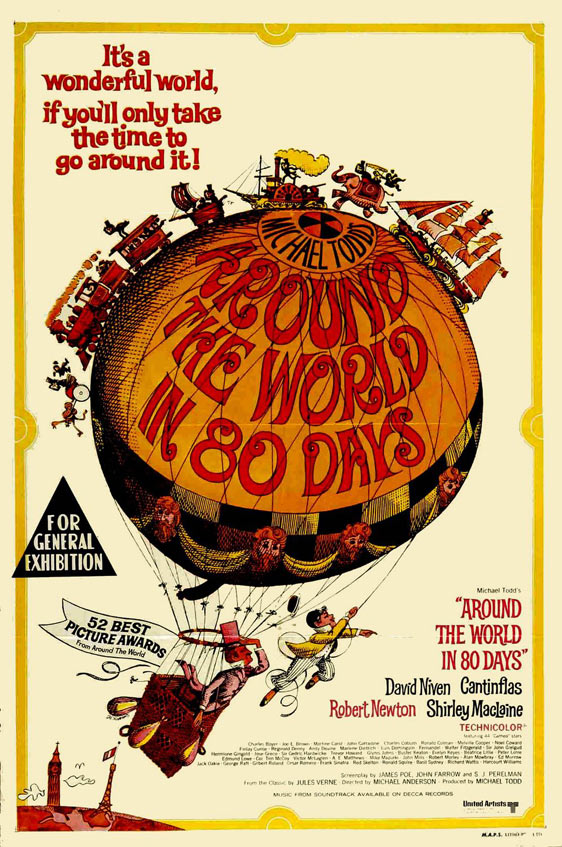
Around the World in Eighty Days (1956)

around_world_80_daysDirected by Michael Anderson

I had a patron come into the library where I work one day and ask for Cantinflas movies. I had no clue what he was talking about. He wrote the name down for me because I couldn’t spell it well enough to look it up in the catalogue, and I found some Spanish-language movies for him. The patron was honestly surprised that I had never heard of Cantinflas. I was surprised, but very pleased, to find Cantinflas in Around the World in Eighty Days. I’ve read the book, but I hadn’t seen the film before this week. The entire movie was a delightful surprise.

So what’s the story? Phileas Fogg, a wealthy, eccentric Englishman, bets the men in his club that he can travel all the way around the world in just eighty days. With nothing more than his newly hired manservant Passepartout and a carpetbag full of money, Fogg sets out on an amazing adventure.

The Good: This is another epic with thousands and thousands of people in it. It seriously boggles the mind that movies like this can come together. Coordinating all the details must have been ridiculous, but the work paid off. There are very many good things in this movie.

The cinematography is gorgeous. Many scenes were filmed on location, which takes extra work, but was absolutely worth it. Besides the beautiful scenery they were able to capture, it means that there were no places where you could tell that the actors were standing in front of a screen with a movie projected behind them. (I’m sure there’s a technical term for that, but I have no idea what it is. If anyone knows, please enlighten me!)

The music, by Victor Young, is also fabulous. At times it is sweeping and beautiful; other times, it is cheerful and jaunty. It fits the movie very well.

The cast was fun. Cantinflas, a Mexican comedic actor, is really good as Passepartout. He has a wide range of skills that fit the role and brought some good comedy to the movie. David Niven is good as a very English Englishman. But what is really fun about this movie is the cameos. So many famous people are in this movie, from Noel Coward to Marlene Dietrich to Frank Sinatra. My personal favorite was Buster Keaton, who talks! I’ve seen lots of his movies, but I’ve never heard him talk before. And he was a train conductor like in The General, which may be literally the funniest movie I have ever seen. Anyway, if you like classic movies, then you will enjoy spotting the stars.

The Bad: Shirley MacLaine was cast as an Indian (eastern, not American) princess. It was an odd choice. She didn’t do a horrible job, but she never convinced me that she was Indian, either.

The Ugly:  This movie needed some more editing. Some scenes are fine for a while, but then they don’t end. The bullfighting scene was the worst offender here. It just went on and on.  Around the World in Eighty Days didn’t need to be a three-hour movie. It would have been just fine at two and a half hours. As it is, there are some boring times.

Again, there is some ugly racial stereotyping because not only was this movie made in the 1950s, it is based on a book written in 1872. It’s not surprising, but it’s not good, either.

The Ten Commandments (1956)

ten_commandments_ver2Directed by Cecil B. DeMille

I was brought up in a religious family, and when I was growing up, TV and movies were not allowed on Sunday. The only exception was religious movies. I am from a family that loves movies, so I have seen The Ten Commandments a ridiculous amount of times. (Well, I’ve seen the first couple hours many times; I was usually sent to bed before the very end, so I’ve only seen the end probably five times.) My sisters and I can do entire scenes from memory, and we each have our favorite lines (“To me you’re a lily, and I want water!”). So the only way I could watch The Ten Commandments this time was in my parents’ basement with my family. We had two big bowls of popcorn and a solemn oath that we wouldn’t quote the lines before they happened because my brother-in-law had never seen it before. That was a hard promise to keep. Man, I love this movie.

So what’s the story? This epic (and epically long) movie tells the story of Moses from his birth to his death. It tells of his young manhood in Pharaoh’s palace, his banishment to the desert, his marriage to a shepherd girl and subsequent return to Egypt to free the Hebrew slaves. And yes, in the end he receives the Ten Commandments.

The Good: I think I will always marvel that epic movies with casts of thousands were made at all. For a movie this scale to work, so many people have to be involved. And The Ten Commandments takes this a step further. I felt like Cecil B. DeMille wanted everything to be as authentic as possible, so many things were meticulously researched. As I watched the opening credits, I was impressed not just by the number of experts that were consulted, but also their caliber. DeMille didn’t just make stuff up or go for a vaguely Egyptian feel. He found people who knew what they were talking about so that things would be authentic. This leads to amazing production design and great costumes.

Elmer Berstein’s score is amazing. It is at times melodramatic (Nefretiri’s theme, anyone?), but that is the nature of the film. The score manages to be dramatic and sweeping, but also reverent when it deals with religious things. That’s an impressive thing to do. Also, I have apparently seen this movie so many times that I can listen to the soundtrack and know what lines are being said. But that means that although the music has themes, Bernstein doesn’t repeat himself too much.

The acting is good all around. Charlton Heston does a good job playing a man trying to figure out who he is and what his place is in the world. Yul Brynner plays another man in authority, but Rameses is a totally different king than the one in The King and I, even though both men think Moses is a fool. I think that displays how good an actor Brynner really was. Anne Baxter schemes most convincingly, playing woman who is not necessarily bad, but willing to do whatever it takes to get what she wants (did she get this role because she was typecast after All About Eve?). Yvonne de Carlo as Sephora, Moses’s wife, Nina Foch as Bithiah, Cedric Hardwicke as Sethi –everyone is so good in this movie. I would name everyone, but again, there is a huge cast.

The special effects were amazing for their time. Some haven’t held up, of course, because The Ten Commandments was made almost sixty years ago. But some have held up surprisingly well. The hail that turns to fire still looks believable. That’s incredible to me.

The Bad: As much as I love this movie, I will be the first to admit that the screenplay is not the best. There are many, many cheesy lines.  These lines make the movie really fun to watch, but they are not an example of fabulous writing.

The Ugly: I didn’t find anything ugly in this movie. I enjoyed watching it as much this last time as I did when I was a kid. That’s not always the case for me.

Oscar Won: Best effects, special effects.

Other Oscar Nominations: Best picture; best cinematography, color; best art direction-set direction, color; best costume design, color; best sound, recording; best film editing.

The King and I (1956)

king and iDirected by Walter Lang

This is the second movie I’ve watched this week that I’ve seen more times than I can count, but it’s the first movie this week that was based on a play which was based on a book which was based on a true story. I loved musicals when I was young(which I think is funny considering how little patience I have with them now), and this was one of my favorite musicals. I can still sing along with all of the songs, and I think it will always have a special place in my heart.

So what’s the story? Anna Leonowens, a widowed Englishwoman, comes to Siam (now Thailand) to be the governess to the children of the king.

The Good: I love the music in this movie. I don’t love all of the songs, because I think there are one or two that slow the movie down, but most of them are enjoyable. And the score is amazing. All I have to do is see the cover of this movie and I have “The March of the Siamese Children” in my head. Not only that, but I am happy to have that song in my head. That never happens.

I like the lead actors in this movie. Yul Brynner plays a man who is trying to hold on to tradition and effect change at the same time. His inner struggle is plain on his face as he tries to make hard decisions. Deborah Kerr makes an excellent Anna. She is smart and determined and compassionate and courageous.

The costumes are gorgeous. Because of this movie, I have had a lifelong dream of polkaing in a dress with a giant hoopskirt. But Anna’s dresses are not the only beautiful ones in The King and I. The women of the court also wear lovely things. Even the king’s clothes are very sumptuous. It’s all very fun.

As impatient as I am with musical numbers that don’t help advance the plot or at least help with characterization, I love the Uncle Tom’s Cabin ballet. It’s different and beautiful and mesmerizing. I’m glad it’s in the movie.

The Bad: It bothers me a little bit that many of the “Asian” people in The King and I were played by Latinos. I can see the reasoning behind hiring Rita Moreno, because she’s amazing, and who wouldn’t pick Rita Moreno if she were a choice? But were the producers really unable to find enough children to play the king’s children who were, if not Thai, at least Asian? There weren’t ten to fifteen Asian kids living in California in 1956?

The Ugly: I have seen this movie many times, and it never bothered me before, so maybe I’m being ultra picky, but the attitude of the movie toward Siam in general and the king in particular is very condescending. There is very much an air of “everything in European culture is good because the Europeans are so enlightened, but there is nothing good about Siamese culture.” The king is only admired because he is trying to westernize his country. He makes silly mistakes (like wanting to send only male elephants to America) that are then corrected by the superior Englishwoman. At one point, Anna tells her young son, Louis, that in many ways, the king was no older than Louis. Really? This is a grown man who had ruled a country and managed to keep it independent in a time of colonization. He is very different from an eight-year-old. I think this might not bother me so much if these characters weren’t based on real people, but since they are, I feel like the characterization of the king and the attitude toward Siam in general is very disrespectful. And yes, I understand that The King and I is from a different era, which is why I can still enjoy this movie. But I can also understand why it’s banned in Thailand. Not that I advocate banning, but I can sympathize with the feelings behind the banning in this particular case.

Oscars Won: Best actor in a leading role (Yul Brynner); best art direction-set direction, color; best costume design, color; best sound, recording; best music, scoring of a musical picture.

Other Oscar Nominations: Best picture; best actress in a leading role (Deborah Kerr); best director; best cinematography, color.

Giant (1956)

giantDirected by George Stevens

I had seen Giant before I watched it for my blog, but only once. I was probably seventeen, and while I was seriously underwhemed with the way the stars were aged, I liked the movie overall. But now that I’m older and more analytical (and possibly more cynical), I’m not as impressed with it as I once was.

So what’s the story? Texas rancher Jordan “Bick” Benedict, Jr. has come to Maryland to buy a stallion to improve his breeding stock. There he meets Leslie, a lovely and spirited society girl. After talking to each other for less than ten minutes, they are deeply in love. They marry and go back to Reata, Jordan’s ranch in dry, dusty Texas. They spend the next 25 years adjusting not only to each other, but to the changing world around them.

The Good: Perhaps because of his early death, James Dean still haunts pop culture. Before I actually saw him in anything, I thought people were overreacting a bit when they talked about how a great young actor was lost. But he really was that good. He brings a pathos to Jett Rink, a low-class ranch hand who strikes oil. Without James Dean, Jett would have been a slightly ridiculous character, but James Dean allows us to see his motivations, his dreams and desires. He makes him human. James Dean died before the filming of Giant was completed, but he left his mark on the film and on film history.

Three supporting actors really stood out. Mercedes McCambridge is Luz Benedict, Jordan’s crusty older sister. She loves Reata more than anything and can do anything a man can do on the ranch. (SPOILER ALERT)Her death, which happens so conveniently soon after Leslie comes to Texas, is really quite touching. Chill Wills plays Uncle Bawley, a kindly older gentleman who helps Leslie understand Texas and the Benedict children understand life. Jordan Benedict III is played by Dennis Hopper in what must have been one of his first big movie roles. Jordy is a rather quiet young man, but he is deeply passionate below the surface. It’s a very fine performance.

The Bad: I really enjoyed the first half of Giant. Up until the point where Jett finds his oil, it’s tight and focused. After that, it feels looser and more meandering. It doesn’t feel like it has a central focus. Jordan and Leslie and their relationship aren’t as important as they were, but nothing steps up to fill that vacuum. I don’t know if that’s how it is in the novel that Giant is based on, but it made the second half feel less meaningful and somewhat disconnected from the first half.

Giant must begin sometime in the 1920s since the movie spans 25 or 30 years, but you can’t really tell from the costume design. Elizabeth Taylor’s clothes are waaaay too 1950s-fashionable for the 1920s. The other costumes are not as bad. I guess it was decided that it wouldn’t do to have Elizabeth Taylor wearing thirty-year-old fashions. But I want Luz II’s white formal. It’s gorgeous.

The Ugly: The makeup in this movie is so bad that I have been using it as my standard of bad makeup for fifteen years. Elizabeth Taylor, Rock Hudson, and James Dean are “aged” thirty years by wearing grey wigs. That’s about it. That makes it hard to believe that Elizabeth Taylor and Rock Hudson are parents with grown children, let alone grandparents. It’s a little bit silly.

The thing I hated most about this movie is Leslie. She doesn’t grow or change at all in the course of the movie, even though she’s supposed to be about eighteen when she marries Jordan. She swoops in from Maryland and teaches all the ignorant, backward Texans what is acceptable in life. Yes, the Texans do have some deplorable attitudes, but the fact that Leslie is the only enlightened one is very grating. How exactly did a rich doctor’s daughter have so much life experience at eighteen that she has so much wisdom? It’s hard to watch a three-hour movie with a paragon as the main character. It makes it hard to suspend your disbelief.

Oscars Won: Best director.

Other Oscar Nominations: Best picture; best actor in a leading role (James Dean); best actor in a leading role (Rock Hudson); best actress in a supporting role (Mercedes McCambridge); best writing, best screenplay – adapted; best art direction-set direction, color; best costume design, color; best film editing; best music, scoring of a dramatic or comedy picture.

Friendly Persuasion (1956)

friendly-persuasion-movie-poster-1956-1020505962Directed by William Wyler

I had a bad day the day I watched this movie. I hadn’t felt well all day at work, but I didn’t feel bad enough to take time off. About five minutes after I got home from work, I was violently ill. It lasted about half an hour. I was feeling sick and weak when I put Friendly Persuasion in the DVD player.  But the moment the opening notes of the theme song started, I felt much better. Watching this movie is like being wrapped in a giant puffy quilt or getting a hug from someone you love. That may be because I was raised on this movie, but I like to think that the sweetness of this movie could make anyone’s day better.

So what’s the story? Jess and Eliza Birdwell are Quakers living in southern Indiana during the Civil War. Their older son, Joshua, is old enough to fight in the war, but the family’s pacifist beliefs keep him from joining up. Their daughter, Martha, is in love with their Methodist neighbor, who is a soldier. And their younger son, Little Jess, is in constant battle with Samantha the Goose. The family tries to simply go about their lives, but the war is about to come to them, forcing them all to make decisions of faith and love and conscience.

The Good: The cast is perfect. Jess is played by Gary Cooper, who makes Jess a slightly mischievous man who believes in his religion, but sometimes struggles to live up to the standards it sets for him. Dorothy McGuire plays Eliza, the Quaker minister who sometimes has to fight to keep her family on the straight and narrow. Anthony Perkins (yes, the same Anthony Perkins who is in Psycho) plays Josh, whose conscience tells him that fighting is a sin, but that his family is worth fighting for. Phyllis Love plays the lovesick Mattie almost uncomfortably perfectly. Robert Middleton plays family friend Sam Jordan with humor and love. Everyone is just good.

Okay, this is a weird thing, but I was struck as I watched  Friendly Persuasion this time by the goose. Or possibly geese? I’m not sure how one goes about training a goose. I can’t imagine that it’s easy. But that goose does all sorts of things. Even if it’s many geese all doing one trick, it would have taken lots of work. So hats off to the animal trainers for this movie!

I love the music for this movie. Pat Boone sings the theme song, and it’s beautiful. It reflects the mood of the movie: slow, yet loving. Dimitri Tiomkin’s score is also good, reinforcing the love and joy found in the Birdwells’ home life.

And speaking of the home life, I love that this family is a family. The children sometimes tease each other. They sometimes fight. The father defers to his wife, but he sometimes teases her and sometimes gangs up with his kids to get her to relax. The writers made the characters real people with faults and virtues. I love that.

The Bad: The plot isn’t perfectly linear. It meanders a bit. There are some scenes that add to the characterization of the people, but don’t necessarily add to the overarching Civil War plot. I’m okay with this in this movie because all these scenes are so delightful, but that also might be because I’ve loved Friendly Persuasion for a long time. Other people might not be so forgiving.

As Quakers, the Birdwells use speech that is a little bit different. They use “thee” and “thy” instead of “you” and “yours”. But to my German-speaking ear, they don’t use them quite correctly. This is apparently accurate for the Quakers, but it bothered me a little bit. It took me about a quarter of the movie to be okay with it.

The Ugly: I don’t think there is anything ugly about Friendly Persuasion, unless you object to a feel-good movie about a family trying to live according to their consciences.

Oscars Won: None

Oscar Nominations: Best picture; best actor in a supporting role (Anthony Perkins); best director; best writing, best screenplay – adapted; best sound, recording; best music, original song (“Friendly Persuasion (Thee I Love)”).

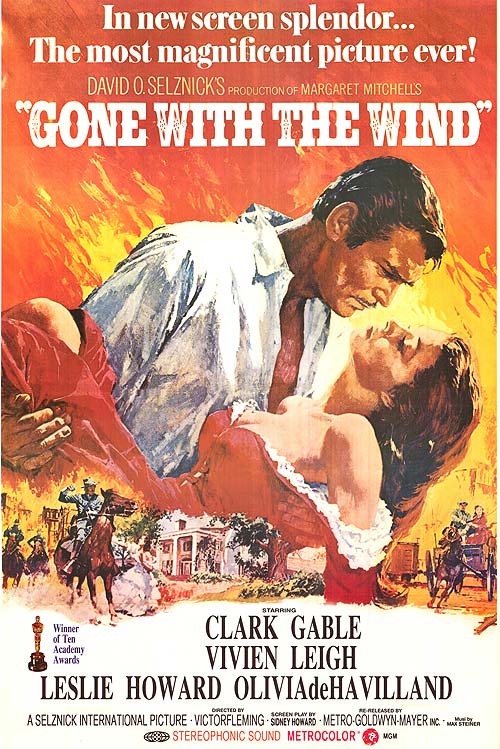
Gone with the Wind (1939)

gone with the windDirected by Victor Fleming

As I’ve been doing this project, I’ve noticed something that a lot of nominees have in common: they are freaking long. I have felt every minute of some of those three-hour movies (I’m looking at you, Thin Red Line!), while others have kept me captivated. Gone with the Wind is almost four hours long, but I didn’t feel it. I had seen bits and pieces growing up, but I watched the whole movie in one sitting when I was eleven. I’ve seen it several times since, including once in the theater when it was re-released for an anniversary event. And every single time I’ve watched it, I’ve been glued to the screen. It doesn’t matter that I know how it ends. The world of Gone with the Wind was so skillfully built that I can’t tear myself out of it. The characters are so real that they almost feel like friends; their triumphs and miseries become ours. That, my friends, is how you make a three-hour-plus movie fly by.

So what’s the story? Spoiled Southern belle Scarlett O’Hara’s world comes crashing down around her when the American Civil War begins. Her life of parties and flirting is over. As she tries to adjust to the harsh realities of her new life, she learns that she will do anything to keep what she loves. (That summary makes it sound boring. Trust me, it’s not.)

The Good: There are so many good things in Gone with the Wind that it’s hard to know where to start. I think I will change it up and start with cinematography. Gone with the Wind is a beautiful movie, full of glowing sunsets and billowing ball gowns. It’s not always pretty, though; the scene at the depot where the soldiers are lying dead in rows is tragic. The birth of Melanie’s son, where everything is shown in silhouette, is exquisitely done. These are just the highlights, though; there are lots of scenes where the camera work more quietly underscores the action or the emotion of the scene.

The costume design is also good. This movie is why I can complain about other movies’ lack of good historical costume. In Gone with the Wind, the fashions change with the times, like fashion does in real life. Not only that, but the clothes are fairly accurate (as far as I know. I am not a fashion historian; I have only picked up tidbits here and there.). I do know that the shape of the hoops change correctly for the times, which may only be a small detail, but it shows that the designer cared enough to do actual research.

The score is sweeping and beautiful and just a little bit over the top, which fits the epicness of this movie. Everything about Scarlett is dramatic, and it’s appropriate that the music in her movie is, too.

It is very easy to forget in this day and age that in 1939, everything in a movie was real. If you wanted a huge crowd of people, you had to hire actual people. If you wanted a fire, you had to burn something. There are some crazy special effects in this movie. I seriously wonder how they managed to film some of the scenes. Special effects took a certain kind of creativity back in the day, and have to give kudos to the special effects people for this movie.

Whoever adapted the giant book Gone with the Wind into a single (albeit long) movie was amazing. He found the most important things, the things that would make a compelling movie and took those out. He knew what to leave out; it was all good stuff – Ellen’s backstory, Scarlett’s other children, Will Benteen – but wasn’t necessary to the movie. Those extra things that fleshed out the novel would have bogged down the movie. It’s an excellent adaptation.

The entire cast of Gone with the Wind is stellar. After I had watched Dark Victory, I was thinking that maybe Bette Davis should have gotten the best actress Oscar, but when I saw Vivien Leigh’s performance again, I had to admit that Vivien Leigh deserved it. Clark Gable as gave an awesome performance as Rhett Butler. He is so good as the strong, manly lover hiding his love behind pride and lust. The flash of hurt on his face when Scarlett admits that she’s marrying him for his money…so sad. And that kind of thing happens more than once. It’s very subtle and very good. Olivia de Havilland plays Melanie Wilkes so beautifully. She manages to be an angelic, self-sacrificing person and yet not make you hate her. And she was only 23 when the movie came out. That was some serious acting for such a young woman. There is some controversy over Hattie McDaniel’s role as Mammy, Scarlett’s nurse/surrogate mother, but she plays the role well and allows us to see the main characters in a different light as she isn’t shy about expressing her opinions.

The Bad: This is an extremely frustrating movie to watch. Rhett loves Scarlett, but is too proud to admit that he’s actually fallen in love. Scarlett is too caught up with her make-believe love for Ashley to notice. When Rhett makes her notice, he is so ashamed of what he’s done that he doesn’t see the opening Scarlett is giving him. When he rejects her at that point, Scarlett is too proud to say anything. Grrrrr. These are two very strong, proud people who are so scared of showing weakness that they can’t allow happiness in. It makes me want to shake them both.

The Ugly: The movie laments the passing of a “beautiful, genteel” culture, but glosses over the evils that that culture is built upon. Slavery made that lifestyle possible, and so it’s hard to feel too sorry for the O’Hara family when they have to pick their own cotton and for Ashley Wilkes when he is splitting rails. Yes, it’s hard, and it’s not what they were brought up to do, but they were brought up to live off of the misery of others. Ashley briefly acknowledges this, but only briefly. Frankly, it was a culture that deserved to die. I can still enjoy the movie, but it doesn’t make me mourn the passing of the Old South.

Oscars Won: Best picture; best actress in a leading role (Vivien Leigh); best actress in a supporting role (Hattie McDaniel); best director; best writing, screenplay; best cinematography, color; best art direction; best film editing.

Other Oscar Nominations: Best actor in a leading role (Clark Gable); best actress in a supporting role (Olivia de Havilland); best sound, recording; best effects, special effects; best music, original score.

Other Oscars Won: Honorary award to William Cameron Menzies “for outstanding achievement in the use of color for the enhancement of dramatic mood in the production of Gone with the Wind”.

Technical Achievement Award to R.D. Musgrave “for pioneering in the use of coordinated equipment in the production Gone with the Wind”.

The Wizard of Oz (1939)

wizard of ozDirected by Victor Fleming

I don’t remember the first time I saw The Wizard of Oz. It must have been before I was six, because that’s when I read the book for the first time, and I definitely noticed the differences. I have seen it many times since the first, as I sure many people in the United States have. My mom reminisced about how it always used to be on TV on Easter. It’s a classic that I think will never really leave the public consciousness.

So what’s the story? Dorothy Gale is running away from her Kansas farm when she gets caught in a tornado and transported to the magical land of Oz. She sings, dances, makes friends and learns a valuable lesson as she tries to avoid the Wicked Witch of the West.

The Good: Watching this as an adult, I was struck by the costumes and makeup. It must have taken serious creativity to make three grown men into a scarecrow, a tin man, and a lion. And those costumes are fairly convincing. Okay, so the Cowardly Lion walks on two legs instead of all fours, but watch carefully when he first appears; he is on four legs then, and it’s really quite impressive. The flying monkeys also must have taken some serious work. I don’t even want to know how long it took everyone to get into their makeup every day. The fantasy would have failed without those two things, so it’s a good thing they were both excellent.

I was very impressed by Ray Bolger, who plays the Scarecrow. He moves like his legs are really made of straw. It’s just a tiny detail, but I think it shows his ability. Also, I’m going to allow myself to be impressed with Frank Morgan, who plays five roles in this movie, which I didn’t realize until just now when I saw it on IMDb. It’s obvious that he plays the Wizard of Oz and Professor Marvel, but he also has three other parts. The costumes and makeup helped there, too, but his acting skills also needed to come into play.

I can’t decide how I feel about the music. I feel like just about everyone in the English-speaking world can sing along with many of them, but it is so easy for them to get stuck in your head. I’m not sure if that’s a sign of a good song or a bad song or if it means nothing at all, but it’s annoying. But the songs are fun, even if they don’t usually advance the plot or reveal much character. I’m guess I’m kind of neutral on the subject of the songs in the movie. I do like the background music, though.

The Bad: Some of the acting is hammy by today’s standards. I’m guessing it’s because they were making a movie based on a children’s book and were aiming to appeal to children, but occasionally I cringed.

I was also sad about the screenplay. L. Frank Baum’s book is not only a great adventure story, but it’s also a satire, and there are some lovely lines about people with no brains working in the government, etc. I wish the writers had kept some of those pointed little jabs in.

The Ugly: I hate the ending. It has always made me so mad that it’s just a dream. Why can’t it have been real? What’s wrong with having a little bit of magic in the world? It’s not a dream in the book. Dorothy really goes to Oz and eventually moves there with Uncle Henry and Aunt Em. I know it will probably never happen since this is a major classic, but I would love it if someone made another movie version of The Wonderful Wizard of Oz and stuck a little bit more closely to the source material.

Oscars Won: Best music, original song (“Somewhere Over the Rainbow”); best music, original score.

Other Oscar Nominations: Best picture; best cinematography, color; best art direction; best effects, special effects.