I'd like to spank the Academy

Posts tagged ‘Based on a book’

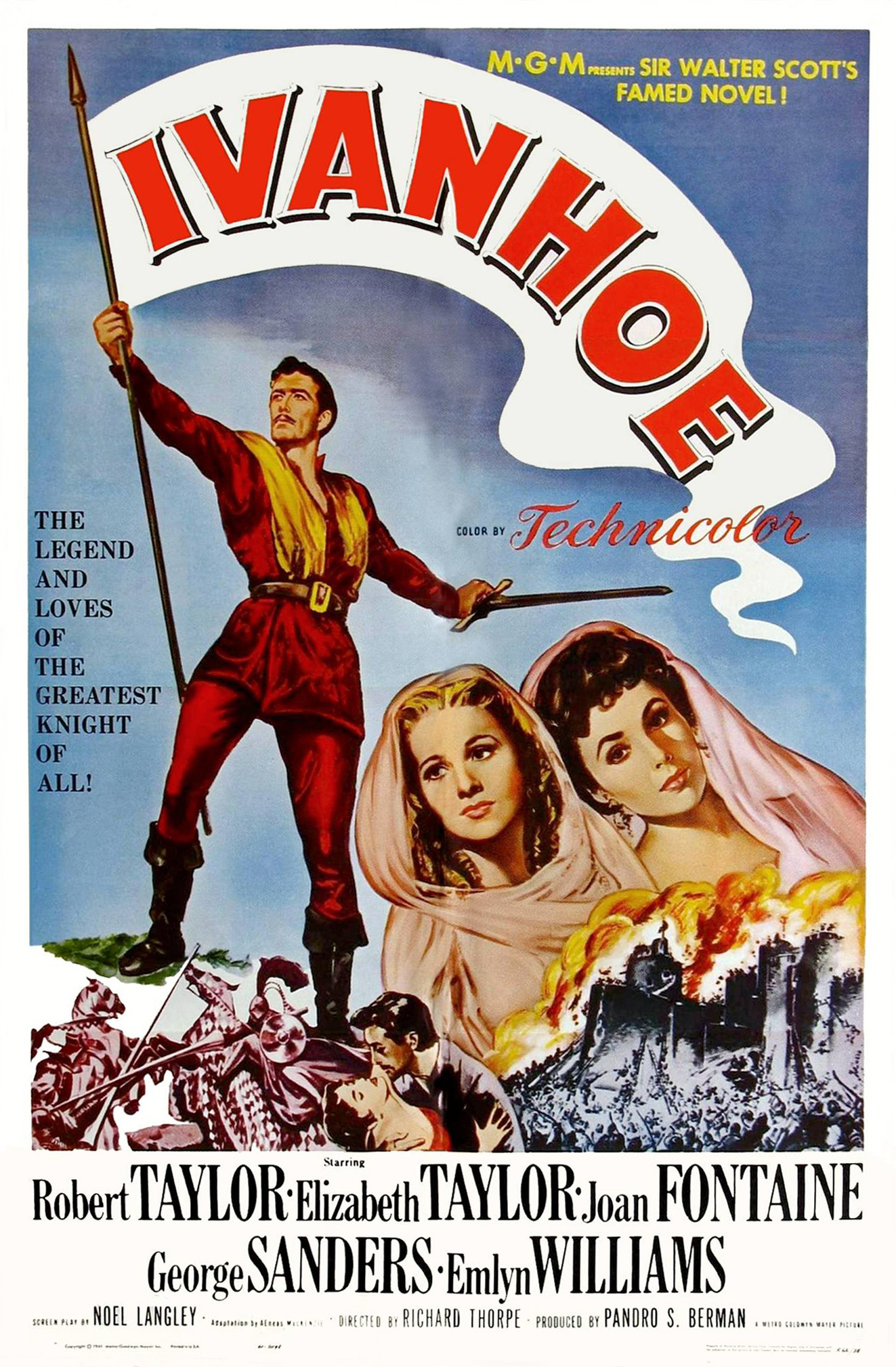
Ivanhoe (1952)

Ivanhoe (1952)_01

Directed by Richard Thorpe

I read Sir Walter Scott’s novel Ivanhoe when I was fourteen or fifteen, and I thought it was fabulous. It has all the necessary elements for an excellent swashbuckling story: adventure, romance, chivalry, and jousting. I had high hopes for the movie, too, but sadly, they were dashed. The elements were all still there, but something was missing. It didn’t feel alive somehow.

So what’s the story? Saxon knight Ivanhoe, who has been to fight in the Crusades, refuses to believe that King Richard is dead. As he makes his way back to England, he rides past every castle he can find, hoping that his English singing will attract the attention of a captive king. This long and slightly foolish plan works; King Richard throws him a letter explaining that he is being held for random. Prince John knows about the ransom, but refuses to pay it so that he can be king instead of his brother. When Ivanhoe reaches England, he not only has to raise the ransom, but right many wrongs and rescue damsels in distress.

The Good: The music is beautiful. It’s scored by Miklos Rozsa, who would go on to score Ben-Hur several years later. The music is very rich and full. The adjective I want to use is “orchestral,” but I’m not sure that would mean anything to anyone else. Hmm. How to put it? He uses the full orchestra to great effect. That makes it sound really boring, but it’s not. It’s really quite stirring.

The best actors in Ivanhoe were not the main characters. The person whose acting stood out to me the most was George Sanders as the villainous Norman knight De Bois-Guilbert. Even though his character was not the most chivalrous, his emotions rang true and he managed to take his flat character and make viewers pity him. It was impressive.

Other people with smaller parts were also able to make the most of their parts. Emlyn Williams as Ivanhoe’s slave-turned-page, Wamba, provided some welcome comic relief. Cedric, Ivanhoe’s bitter Saxon father, was played excellently by Finlay Currie. And Guy Rolfe was the vilest and scariest Prince John I have ever seen.

Although I read the book several years ago, I remember thinking that Rowena was terribly disappointing for a Saxon princess. She was just so blah. (That impression may have been wrong; like I said, it was a while ago.) But in this version, she has spirit and is a lot more awesome. Joan Fontaine did a very good job of showing her strength, her pride, and her jealousy, even if I thought she was a little old for the part. (Side note – this is the first time I’ve seen Joan Fontaine and thought, “Oh, yeah. She and Olivia de Havilland are totally sisters.” The resemblance really shines in this movie.)

The jousting scenes were pretty cool, even if some of the men’s colours were not manly looking. That was a seriously impressive sport, although I’m glad it’s not a big thing anymore because it also looks incredibly dangerous.

 The Bad: Robert Taylor is terribly miscast as Ivanhoe. He doesn’t even bother to try an English accent, which is a little jarring when everyone around him has one. He’s too old to convincingly be a young, dashing knight, and he’s much too solemn.

There is a scene where Ivanhoe has been taken captive, along with Rowena, Rebecca, Cedric, and Wamba. Robin of Locksley (yes, THAT Robin of Locksley) comes with his men to free them. There’s a huge battle with falling rocks and longbows and battering rams and swordfights, and it should be awesome. But it’s not. Watching people fire arrows at each other gets really boring after a while, and the swordplay is not well-choreographed. It may be the most disappointing medieval battle scene in a movie ever.

The Ugly: Elizabeth Taylor is so wooden as the Jewess Rebecca. She is extremely beautiful, but a damsel in distress should show some actual distress once in a while, instead of just looking pretty and putting her hand to her mouth. When she spoke, she sounded like she was reading lines, not speaking from her heart.

The worst thing about this movie was that it was so stiff. There was no sense of fun. There was no swash to the buckle, so to speak. Everything was taken so seriously. I wanted to say, “Hey! People! You’re in a castle! You’re fighting baddies! You’ve got awesome clothes! Smile once in a while. Look like you’re having fun!” No one ever did. Most of the separate elements were fine, but it just didn’t meld in a good way. A movie like this, set in the same time period and with so many of the same elements as The Adventures of Robin Hood (1938), is going to get compared to that movie. It needed to distinguish itself in some way, and sadly, it didn’t.

Oscars Won: None.

Oscar Nominations: Best picture; best cinematography, color; best music, scoring of a dramatic or comedy picture.
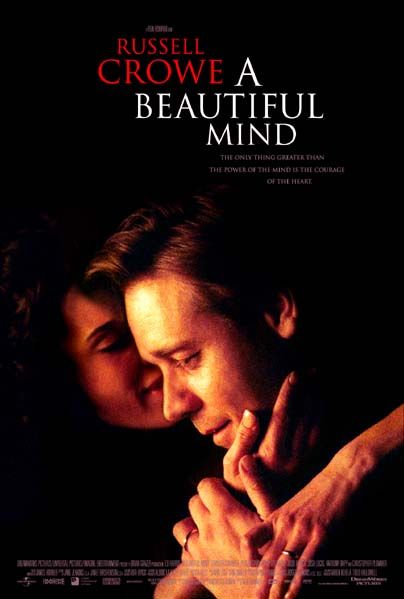
A Beautiful Mind (2001)

beautiful mindDirected by Ron Howard

It was late the night I put this movie in the DVD player, and I wasn’t going to watch the whole thing. But even though it’s not the most action-packed movie ever made, A Beautiful Mind is an extremely gripping movie. As it got later and later (or earlier and earlier in the morning), I kept thinking, “I should really turn this off and go to bed,” but I just couldn’t. I needed to know what happened to John Nash.

So what’s the story? John Nash is a genius mathematician from West Virginia. He doesn’t fit in with all the other Princeton graduate students, mostly because he is completely asocial. He makes a great mathematic breakthrough and gets a job at MIT with the Department of Defense. He meets and marries Alicia, but the top-secret decryption project he’s working on suddenly takes a dark turn.

The Good: The acting was superb. I haven’t seen a lot of Russell Crowe’s movies, and I wasn’t expecting much from him in A Beautiful Mind, mostly because what I’ve seen him in lately is clips from Les Miserables (no, I haven’t seen the whole thing yet, because I don’t want to watch it). Anyway, Russell Crowe became John Nash. I’m always impressed when actors can play a person with a mental disability without overacting. I loved his performance. The supporting cast was great, too. Paul Bettany as Charles, John’s crazy-fun roommate; Jennifer Connelly as John’s wife, Alicia; Ed Harris as John’s government contact; Adam Goldberg, Josh Lucas, and Anthony Rapp as John’s mathematician colleagues; and Christopher Plummer as Dr. Rosen, John’s psychiatrist are all wonderful. I don’t think any of the roles could have been easy to play, but all of the actors did very well.

The costume design was well done, especially since the year in which something happened was rarely given. The clothes were a clue to how many years had passed, and I was very thankful for that. The makeup was good, too. The stars were aged well. I didn’t much care for John Nash’s old look, but that’s because he looked uncomfortably like someone I know, and I couldn’t get past that. But everyone looked definitely, believably older (unlike the people in Giant, which is still my baseline of terribleness when it comes to aging in movies).

The screenplay was good. John Nash’s story could not have been an easy one to tell without giving too much away, but the writers did an excellent job.

The Bad: The music was beautiful, but there were some moments when James Horner copied his own music. At the very beginning of the movie, the music sounded exactly like the music from Sneakers, which I wasn’t even aware James Horner had scored. I had to look it up to be sure. Later on, there are bits from Titanic, which has a brilliant score. It makes me sad that someone who is as obviously talented as James Horner reuses his own stuff.

The Ugly: There wasn’t anything ugly in A Beautiful Mind. It’s a well-made movie that takes a hard topic and treats it sensitivity and tact. Ron Howard deserves major kudos for this movie.

Oscars Won: Best picture; best actress in a supporting role (Jennifer Connelly); best director; best screenplay, screenplay based on material previously produced or published.

Other Oscar Nominations: Best actor in a leading role (Russell Crowe); best film editing; best makeup; best music, original score.

The Lord of the Rings: The Fellowship of the Ring (2001)

The_Fellowship_Of_The_RingDirected by Peter Jackson

Although I usually plan out which movies I’m going to watch a couple of weeks in advance, I don’t always. I found myself this week with a couple different years’ worth of movies out from the library; I had choices. I was kind of leaning toward 1997, but I realized on Saturday night that I really wanted to watch Gosford Park. I hesitated, though, because I also knew that that meant I would have to watch another Lord of the Rings movie. I had seen this one before (twice, even), but I had disliked Peter Jackson’s interpretation enough that I didn’t want to see the rest of the movies. My desire to watch Gosford Park overcame my negativity about Fellowship, so here I am trying to write unbiasedly about another movie that is apparently universally beloved, but I don’t quite get why.

So what’s the story? Frodo Baggins, an Hobbit living in the idyllic Shire, discovers that a family heirloom is actually a dangerous artifact belonging to an ancient evil sorcerer. Frodo sets out on a journey with his friends to destroy the ring and save the world.

The Good: The production design is fantastic. There are many different races in Middle Earth, and the design gives each race their own look for everything, from clothing to dwellings. It’s all done very well, very beautifully. I don’t necessarily agree with all their decisions, but I still admire the look of the film.

Howard Shore’s music is beautiful. It captures everything from the naiveté and joy of the Shire to the heroism of Aragorn to the eerie beauty of the Mines of Moria. I may not care much for the movie in general, but I do love the music.

Ian McKellen does some seriously good acting as Gandalf, the wizard who sets the events in motion. The moment where Frodo volunteers to take the ring and Gandalf’s face falls…just beautiful. Gandalf is many things – jolly firework-maker, stern counselor, frightened man betrayed by his master. Ian McKellen shows all of those facets very convincingly. Sean Astin is the other acting standout. He plays Samwise Gamgee, Frodo’s gardener and faithful friend. He isn’t glad to leave the Shire, but he refuses to abandon Frodo, no matter how dark the journey gets or how scared he is. It’s fabulous work.

The Bad: The Elves all talk like Jareth the Goblin King (aka David Bowie) from Labyrinth. I think they’re supposed to be showing how wise and calm they are, but because they also kind of look like Jareth, especially Elrond, it’s kind of distracting.

I wasn’t a big fan of how much time was spent on Aragorn and Arwen’s love story. I felt like there were other things that must have been cut to explore that at length. Boromir, for example, didn’t get much backstory, only a line or two about how his people are already fighting for survival. This lack of development made it hard to see him as anything but a bad guy, when he was really a proud, desperate Man who wanted to save his city and his people.

Some of the acting in Fellowship of the Ring is good; some is indifferent. But some is downright bad. Elijah Wood never showed much emotion as Frodo; he was just kind of….there. Orlando Bloom was just as wooden as Legolas. He looked nice, but luckily he didn’t have much to do beyond yelling out dangers (“Wargs!” “Orcs!”) in a noble voice.

The Ugly: There were a couple of glaring plot holes and inconsistencies. (Possible spoilers here, although I feel like everyone in the world has seen this movie, so…) For example, if the chain Frodo was wearing the ring on fell off his neck when he stumbled and fell on the mountain, how in the world did it stay on when the lake hydra-creature had him by the ankle and was waving him back and forth in the air? The ring should have been lost in the lake. And why did Pippin and Merry go to Bree and beyond with Frodo and Sam? They had no reason to. And why did Elrond let them go as part of the Fellowship? They had no training in any kind of weapons, no survival skills, nothing. They would really be more of a hindrance than an asset. And why did the Hobbits trust Strider in the first place? He gave them no sign, no reason for them to trust him. It really bugged me. How did Strider know to have four Hobbit-sized swords ready? Pippin and Merry were impulsive last-minute additions. Grrrr.

Oscars Won: Best cinematography; best makeup; best music, original score; best effects, visual effects.

Other Oscar Nominations: Best picture; best actor in a supporting role (Ian McKellen); best director; best writing, screenplay based on material previously produced or published; best art direction-set decoration; best costume design; best film editing; best music, original song (“May It Be”); best sound.

The part where I get to whine about how different the movie is from the book: Actually, The Fellowship of the Ring follows the book much more closely than The Two Towers does. Things are left out, and Glorfindel is sacrificed to give Arwen more screen time, but at least there is no Aragorn-goes-over-a-cliff-but-is-saved-by-his-horse moment. I wasn’t a big fan of changing Arwen so much, but the lack of female characters in the trilogy could be a concern for this day and age, so it’s kind of understandable. I also don’t like that Tom Bombadil was left out. He himself is perhaps not important to the story, but the Hobbits did need to stumble into the Barrow-Wights to find the swords that can break the spell on the Ringwraiths, and Tom saves them from the Wights. I haven’t seen The Return of the King, so I can’t say how Peter Jackson overcomes that important plot point, but it should have been set up in this movie.

The Treasure of the Sierra Madre (1948)

the-treasure-of-the-sierra-madre-poster-11Directed by John Huston

The Treasure of the Sierra Madre was one of the few movies I had already seen but had no desire to see again. I checked it out from the library a while ago, probably because I had been told it was an adventure movie, which I tend to love, starring Humphrey Bogart, who is awesome. It was so boring that I didn’t even make it halfway through before giving up. So I was really surprised this time around at how much I liked this movie. It’s amazing. Now I’m wondering what was wrong with me the day I watched it the first time.

So what’s the story? Dobbs and Curtain are two American men down on their luck in Mexico. Both of them just want to make enough money to make it back to America, but they can’t find work. They meet Howard, an old prospector, who is willing to help them find gold, but he warns them that gold always carries a curse.

The Good: Like I said before, Humphrey Bogart is awesome, but I’ve never seen him quite like this before. He often plays crusty people on the fringes of society, but he always seems to have a heart of gold underneath. Not here. He’s a little frightening, really. I’m not sure why he wasn’t nominated for a best actor Oscar. Tim Holt plays Curtain, who is just an all-around nice guy with dreams of a bigger life. Howard is played by Walter Huston, director John Huston’s father. Normally I’m not a fan of nepotism, but I think this was a case where the perfect person for the role just happened to be related to the director. Huston did such a good job. He was patient with the greenhorns, yet you could see him waiting for the other shoe to drop. He had enough experience and wisdom to know how things were going to go. Huston managed to show all of that without getting annoying, which can be tricky in situations like that.

The cinematography is gorgeous. It was shot on location in Mexico, and the cinematographer took advantage of that. But there are also lots of intriguing camera angles and good moody lighting which help contribute to the movie.

The excellent score was masterfully written by Max Steiner. I’ve decided he could score pretty much anything and it would be amazing. He could score a movie of someone silently reading a phone book and it would become interesting.

The Bad: The Treasure of the Sierra Madre has the usual first half of the 20th century problem with racism, but it’s not the worst I’ve seen. It also moves a little bit slowly at times.

The Ugly: This movie has the single worst fistfight I have seen in any movie ever. The camera angles are all wrong, and you can see that the punches aren’t actually connecting, even though the foley artist is making the correct sounds. It’s sooooo bad. I was cringing all the way through.

Oscars Won: Best actor in a supporting role (Walter Huston); best director; best writing, screenplay.

Other Oscar Nominations: Best picture.

The Snake Pit (1948)

snake pitDirected by Anatole Litvak

My family didn’t have cable TV when I was growing up. We didn’t watch much TV (although we watched lots of movies on the weekends), and my mom thought that cable didn’t have much to offer, so my first real experience with cable was in college, when most of my apartments offered free cable. That’s when I found out that my mother was right; cable didn’t have much to offer. But there is one awesome cable channel that I still miss: Turner Classic Movies. It’s a fabulous station that shows (surprise) classic movies. I couldn’t always convince my roommates that it was a fun station, but when I was home alone sick or just on a quiet night, that was my channel of choice. And that is where I first saw The Snake Pit. At that point, I missed the beginning, but I was still blown away by the honest look at the treatment of the mentally ill in the 1940s.

So what’s the story? Virginia Stuart Cunningham has had a mental breakdown and has been committed to a mental institution in upstate New York. She doesn’t know where she is or why she’s there at first, but with the help of a caring, patient doctor, she slowly discovers what brought upon her breakdown.

The Good: Olivia de Havilland is always good, but she is amazing in this movie. Her acting is never over the top; she makes Virginia a very sympathetic character. She puts a human face on mental illness. Leo Glenn as the understanding Dr. Kik also does a good job. The cruel Nurse Davis is played wonderfully well by Helen Craig.

The story and screenplay were wonderful. There is still a lot of prejudice and misunderstanding when it comes to mental illness, and based on the care Virginia received, I’m sure it was even worse in the 1940s. And yet this movie is very respectful and understanding toward the mentally ill. None of the patients were mocked or despised by the filmmakers themselves. In fact, the villain of the movie, Nurse Davis, is a nurse who openly despises her charges. Her treatment of Virginia and the other patients is shown as cruel and terrible. The sensitivity and kindness that the movie shows towards people with problems gives hope that things will get better.

The Bad: Some of the treatments used on the patients are not nice. Watching people get electroshock therapy or being put in a straightjacket is kind of scary, but it does make me glad that we have come so far in the treatment of mental illness.

The Ugly: There is nothing really ugly about this movie. It’s really very good.

Oscar Won: Best sound, recording.

Other Oscar Nominations: Best picture; best actress in a leading role (Olivia de Havilland); best director; best writing, screenplay; best music, scoring of a dramatic or comedy picture.

The Godfather (1972)

godfatherDirected by Francis Ford Coppola

Even though I’m a library person, and librarians have a reputation for having Views about reading being the only worthwhile activity, I’m not like that. I like reading, but I also really like movies. However, when it comes to books based on movies, I almost always like the book better. Books can just get into characters’ heads in a way that movies can’t. I can list dozens of books that I like better than the movies that are based on them. The Godfather is not on that list. I read Mario Puzo’s novel five or six years ago, and I was not impressed. Before I read the book, I had really wanted to see the movie, but after I read the novel, I was a little bit worried. I wondered if a movie based on such a mediocre book could really be all it is hyped up to be. After I watched The Godfather, I found that yes, it can.

So what’s the story? Michael Corleone, son of Mafia Don Vito Corleone, resists joining the family business until an attempt on his father’s life leaves Michael in charge.

The Good: I’m gonna mix things up today and go with cinematography first. The cinematography was awesome. Whatever the cinematographer did, he made me feel like I was peering over someone’s shoulder and peeking into the lives of the Corleones. The scene that this stood out to me most was in the hospital when Michael realizes that there’s about to be another assassination attempt. It was so good.

The acting! What can I say about the acting that hasn’t been said before? Not much, I think, but I’m still going to talk about it. Watching Al Pacino take Michael Corleone from a straight-arrow war hero to a cold, calculating Mafia Don was amazing. He was just fantastic. James Caan as hot-headed brother Sonny Corleone was excellent, as was Robert Duvall as adopted brother Tom Hagen. Richard S. Castellano did a fantastic job as the high-up mob man Clemenza, and Lenny Montana made his short role as Luca Brasi very memorable. It was all great. I love it when a movie has not only great leads, but also a great supporting cast.

The music is beautiful. It captures the moods and the culture and the action very well. It wasn’t eligible for an Oscar because it was basically reworked from another movie’s soundtrack, but it is lovely and poignant and memorable.

The Bad: I had a hard time with Marlon Brando. I don’t necessarily think he did a bad job, but I was really distracted by whatever the makeup artists put in his cheeks to make them puffy at the bottom. It doesn’t look real, and so every time there was a close up on Brando’s face, that was all I could think about.

Diane Keaton also did not do a bad job, but after watching Reds, I realized I don’t really care for her as an actress. I was kind of bummed when I realized she was in The Godfather. And yes, I realize I will have to watch three more movies with her before I’m done. Oh, well. Life is like that sometimes.

The Ugly: It’s a movie about the Mafia, so it’s violent. It’s somehow not as shockingly violent to me as No Country for Old Men, but it’s still got some strong violence. It never felt gratuitous, though, except possibly for the amount of blood in the infamous horse head scene (which, by the way, is much more dramatic to see on the screen than to read in a book).

Oscars Won: Best picture; best actor in a leading role (Marlon Brando); best writing, screenplay based on material from another medium.

Other Oscar Nominations: Best actor in a supporting role (James Caan); best actor in a supporting role (Robert Duvall); best actor in a supporting role (Al Pacino); best director; best costume design; best sound; best film editing.The Godfather

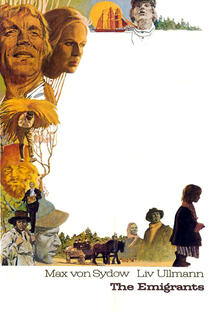
Utvandrarna – The Emigrants (1971)

emgrants posterDirected by Jan Troell

I knew when I started this project that I would have trouble finding some of the movies, but I thought that the ones that would be hard to find would be some of the more obscure ones from the 1930s and 40s, not from the 70s. And I wouldn’t even say that Utvandrarna is obscure; some of my library coworkers remembered seeing it when it came out. Not only that, the Academy thought this movie was so awesome that it was nominated for Best Foreign Language Film the year it came out in Sweden, and then for Best Picture when it was released in America the following year. Despite all this awesomeness, none of the three library systems that I have cards for had it. I had to order it from a university library in Minnesota. The fact that it’s so hard to get makes me really sad, because it’s a fabulous movie.

So what’s the story? Life in Sweden is hard in the 19th century. Abusive employers, failed crops, and a strict religion give different members of a family different reasons to leave Sweden for America. Utvandrarna chronicles this family’s journey from Sweden to Minnesota.

The Good: The acting is amazing. Liv Ullman is Kristina, who grows from a young newlywed to a mother of many children. She has some heartbreaking moments as she portrays the struggles of daily life in Sweden and the trials of moving a large family to an utterly foreign country. Kristina’s husband is Karl Oskar. He yearns for a better life for his family, but is unsure of how to reach that goal. Max von Sydow does an excellent job at showing Karl Oskar’s torment. The other standout in my mind was Monica Zetterlund as Ulrika, a reformed prostitute. She’s an outcast because of her past, but she both wants and disdains acceptance. She’s a fascinating character and Zetterlund’s performance was fantastic. The other actors were all just as good. No one seemed out of place or bad at acting.

I loved the set design. I’m kind of obsessed with ships, and I’ve always thought it would be kind of cool to sail across the Atlantic in a reenactment of what some of my immigrant ancestors did, but after seeing Utvandrarna, I’m not sure I could do it. I really got a sense of the tininess of the ship and the cramped quarters. The scenes on the ship were almost claustrophobic. The other sets were just as good at building the world of the 1840s. The costumes were good, too. I’m not an expert on Swedish farming clothes of the 1840s, but at they felt right for the time and place.

The Bad: While the set design and costume design seemed authentically 1840s, the hair screamed 1970s. The men’s haircuts were especially bad. They all had Luke Skywalker hair. (And yes, I realize Star Wars came later than this movie, but they still had Luke Skywalker hair.)

The Ugly: Utvandrarna was nominated for five Oscars over two separate years. It has a compelling story and great acting. And yet it is unavailable here in North America except for in an edited, DUBBED form. Dubbing is the worst. I thought this was what The Criterion Collection was for – to preserve fantastic movies that may not be the most popular at the moment. Come on, Criterion Collection people! If the movie is that impressive with dubbing, how amazing would it be in Swedish with English subtitles?

Oscars Won: None.

Oscar Nominations 1973: Best picture; best actress in a leading role (Liv Ullman); best director; best writing, screenplay based on material from another medium.

Oscar Nominations 1972: Best foreign language film.

Sounder (1972)

sounderDirected by Martin Ritt

I think my third grade teacher hated children. What is my evidence for this? She made us read not only The Red Pony by John Steinbeck, but also Sounder by William H. Armstrong. While both are good books (SPOILER ALERT), the beloved animal dies at the end of both books. It does not make for happy reading for eight and nine year old children. The only thing that could have made the year worse was if we had also read Where the Red Fern Grows by Wilson Rawls. (We read Summer of the Monkeys instead.) Because I remembered how depressing and sad that year was, I wasn’t particularly looking forward to watching Sounder. But the screenwriter was smart, and the movie ends much more happily than the book does.

So what’s the story? During the Depression, sharecroppers David Lee and his father Nathan spend their nights hunting with their dog, Sounder, hoping to get any kind of meat to put on the table. One day, in desperation, Nathan steals a ham from his work. He is arrested and sent to a work camp. The town sheriff won’t tell David Lee and his mother and younger siblings where Nathan has been sent, so David Lee and Sounder go off in search of Nathan.

The Good: There are some nice performances in this movie. Kevin Hooks did a great job of carrying the movie as David Lee, which is a hard job for a teenager. Cicely Tyson plays Rebecca, Nathan’s wife, who is determined to keep the farming going without her husband. She does a beautiful job as the tough, yet loving woman. Paul Winfield is Nathan, a man trying so hard to provide for his family in an impossible time. The major standout for me, though, was Janet MacLachlan, who plays Camille, a teacher who cares. She shone in every scene she was in.

I liked the plot. I like seeing movies about people who love each other and who try to help each other through bad times. Sounder managed to tell the story without being cheesy, which is a hard thing to do.

The Bad: Even though all the performances were lovely, and even though I liked the story of the family, I felt like the movie rambled some. There were some unnecessary scenes. Or maybe they were necessary, but they just didn’t feel like they tied in to the rest of the movie. It dragged a bit, and that made it hard for me to connect with the movie, even though I felt for the people and their plight.

The Ugly: This is a G-rated movie, and there’s not anything horribly offensive in it, but it’s sad. Black sharecroppers in the South during the Depression did not have an easy time of it. This is a so-called “family movie,” but I would suggest not letting small children watch it on their own. I think it’s a movie that parents should talk about with their children so that children can understand what the family was going through.

Oscars Won: None.

Oscar Nominations: Best picture; best actor in a leading role (Paul Winfield); best actress in a leading role (Cicely Tyson); best writing, screenplay based on material from another medium.

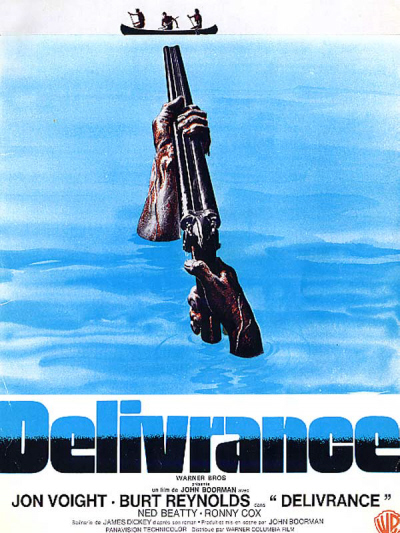
Deliverance (1972)

deliverance_posterDirected by John Boorman

I don’t know a lot about most of the Oscar-nominated movies from the 70s and 80s. I was raised on movies from the 30s through the 60s; I became at least semi-aware of the movies in the early 90s. But the 70s and 80s are just kind of a big, unexplored wilderness to me. Sometimes that’s a good thing; it means that I don’t have any preconceived ideas about the movies. But sometimes it means I get a nasty shock when something traumatic happens that I am not at all prepared for. That’s what happened to me with Deliverance, and that is why there will be a couple spoilers in this post. Normally I hate spoilers, and I try very hard to keep my posts spoiler-free, but I really wish someone had spoiled certain points about Deliverance for me.

So what’s the story? A dam is about to be built on a river in Georgia, so four friends decide to go canoeing down the river before the natural beauty of the area is destroyed. Although they are prepared for the dangers of nature, they aren’t ready for the dangerous men they will encounter.

The Good: The men who play the four friends do a phenomenal job. Burt Reynolds plays Lewis, the tough outdoor man who convinces everyone else to go on the trip. John Voight is his best buddy Ed. Gentle, music-loving Drew is played by Ronny Cox. Ned Beatty perfectly captures the cocky braggart Bobby. All four actors were terrific. I think the best scene was right after the tragedy when all four are reacting to it and trying to make a decision. Their personalities really shone through.

The cinematography was beautiful. Beautiful scenery makes gorgeous cinematography easier, so they definitely had a leg up when filming this movie, but the scenery wasn’t all there was to the cinematography. There were interesting and clever shooting angles. It was really cool.

The Bad: There were a couple of times in the movie that I had to rewind and watch very, very carefully to figure out what had just happened because it wasn’t clear.

Also, this movie has an awesome scene with the song “Dueling Banjos,” but because this movie left such a bad impression on me overall, I don’t think I will ever be able to listen to that happy song without thinking of this horrifying movie.

The Ugly: Okay, here’s the spoiler. If you don’t like spoilers, skip this section. If you read my blog regularly, you know that I’m not a huge fan of violence. Deliverance has one of the most horribly violent scenes I have ever seen. A man gets raped by another man. It was a terribly uncomfortable scene to watch, and the sick feeling it gave me made it hard to concentrate on the rest of the movie. I just can’t handle stuff like that, and not knowing that it was going to happen made it so much worse. I know not everyone is as sensitive to violence as I am, so it might not bother you, but it really bothered me. So there is my public service announcement about Deliverance.

Oscars Won: None.

Oscar Nominations: Best picture; best director; best film editing.

Cabaret (1972)

cabaretDirected by Bob Fosse

Okay, I’m back. I’m finally better enough that my writing once again makes sense. And I’m glad, because I’ve missed this. Now on to 1972!

I liked musicals when I was young. I’m not sure why. Maybe I liked believing in a place where people burst spontaneously into song and dancing with your enemy could solve problems. Maybe I didn’t notice that story and character development tend to suffer when the director has to make room for musical numbers. Maybe I liked the happy endings. But whatever it was that I liked as a child is gone now. Musicals make me very impatient. I still retain a nostalgic liking for the musicals I liked growing up, but I have a hard time with musicals that I am seeing for the first time. Since Cabaret has adult themes, it is not a musical I grew up with. Although I can see some of what people like about it, I didn’t particularly care for it.

So what’s the story? Young English author Brian Roberts moves to Germany in the 1930s. At his boardinghouse, he meets Sally Bowles, an effervescent American nightclub singer/aspiring actress. Together they experience the heady turmoil of pre-World War II Berlin.

The Good: I will give Cabaret props because even though it has musical numbers, all of the musical numbers take place in the nightclub. No one randomly breaks into song on the street or anywhere else. I did like that aspect of Cabaret as a musical. It made it realistic enough that I didn’t want to throw something at the TV.

The acting was good. Liza Minelli made a wonderful Sally, a woman who finds every experience in life worth trying, a woman who just loves life for life’s sake. I quite liked Michael York as Brian, the quiet Englishman who’s not quite sure of his sexuality or what he wants out of life. But the people who I really loved (and whose story I found more interesting than that of Sally and Brian’s) were Fritz Wepper and Marisa Berenson as a gold-digging man and a rich young woman, respectively. Both characters were extremely compelling, and being unsure if they will get a happy ending after all makes them semi-tragic.

The Bad: Even though the characters didn’t randomly burst into song, I didn’t feel like the songs added anything to the movie. The songs could have all been cut, and the only thing it would have done to the movie is make it shorter. There wasn’t even any fabulous dancing to make the musical numbers worth it. And I think some of the cabaret dancers were men in drag, but I couldn’t ever be sure, so I was distracted during the musical numbers trying to figure it out.

The Ugly: There wasn’t anything ugly about Cabaret per se, but I had a really hard time connecting to the movie at all. I can’t even blame being sick, because I was really into other movies I watched while I was sick. Anyway, I’m just going to have to risk the wrath of the internet and say I think Cabaret is overrated.

Oscars Won: Best actress in a leading role (Liza Minnelli); best actor in a supporting role (Joel Grey); best director; best cinematography; best art direction-set direction; best sound; best film editing; best music, scoring original song score and/or adaptation.

Other Oscar Nominations: Best picture; best writing, screenplay based on material from another medium.