I'd like to spank the Academy

Posts tagged ‘animals’

Life of Pi (2012)

Life_of_Pi_2012_PosterDirected by Ang Lee

Just as there are movies that I’m watching for this blog that I have been wanting to see for a long time, there are movies for that I’m watching for this blog that I have never had any intention of seeing. These are not the movies that I haven’t heard of before or ones that I think are violent, but movies that for some reason or other I really, really don’t want to see. Life of Pi was one of those movies. I read the book about ten years ago, and I loved it – until the part where Pi comes to the mysterious island. After that happened, I lost my ability to suspend my disbelief. Because of this, I developed an antipathy towards the book, and I really didn’t care to see the movie. But since I make sacrifices to fulfill my goals, I watched Life of Pi.

So what’s the story? Teenager Pi’s family, along with their literal zoo full of animals, is moving from India to Canada. Before they make it to their new home, there is a shipwreck, and Pi ends up as the only human survivor on a lifeboat with four of the animals, including a Bengal tiger named Richard Parker.

The Good: Life of Pi is based on a rather complex book. It’s not just the story of a boy on a lifeboat with a tiger. His unusual name is explained, as is his conversion to three different religions. I was impressed at how well the book was adapted as a screenplay. The writer, David Magee, managed to fit in the frame story as well as the flashbacks to great effect.

I didn’t see the 3D version of Life of Pi, so I can’t judge that aspect of the cinematography, but what I would call the “regular” cinematography was fabulous. The shots were so beautiful and so carefully set up; it was almost like watching a living painting.

The acting was very good. Pi was played by several different people, young and old, and all were good. Pi’s mother Gita and father Santosh were played by Tabu and Adil Hussain respectively. They made a good couple did a wonderful job playing off each other, the mother trying to protect her son by keeping him safe from the world, the father trying to protect his son by showing him harsh realities of life.

The Bad: I don’t know if it was because I had already knew the book and therefore knew what was going to happen, but I found Life of Pi to be rather tedious. I loved the first hour or so; in fact, it made me wish that I had been born in a zoo in India. But not long after the shipwreck happened, I realized that I was no longer mentally involved in the movie. I’m not sure exactly why I stopped caring about Pi, but I just wanted it all to be over.

I also felt that Pi’s conversion to Islam was glossed over. His first introduction to Hinduism was fully covered, as were the beginnings of his interest in Christianity, but we don’t really know how he became interested in Islam. Since all his religions were important to him, I feel like they all should have been given equal weight.

I was a little annoyed at how small Gerard Depardieu’s role was. He’s an amazing actor, and his part was little more than a cameo. I seem to remember the cook having a larger role in the book, and I wish they had taken advantage of the great actor they had hired and let him do more.

The Ugly: Three years ago, this movie won the Academy Award for best visual effects. Today, it looks fake. This is why I am so against CGI; it just doesn’t hold up well. ET, made over thirty years ago with puppets and green screens, looks more real today than Life of Pi. During many of the ocean scenes, I couldn’t help but think of The Truman Show (1998), where Truman believes himself to be sailing on the ocean but is in reality in an artificial pool of water that is nowhere near as deep as the ocean. The animals were sometimes obviously, disappointingly fake, too. It niggled at my mind and kept me from enjoying the movie as fully as I wanted to.

Oscars Won: Best achievement in directing; best achievement in cinematography; best achievement in music written for motion pictures, original score; best achievement in visual effects.

Other Oscar Nominations: Best motion picture of the year; best writing, adapted screenplay; best achievement in film editing; best achievement in sound mixing; best achievement in sound editing; best achievement in music written for motion pictures, original song (“Pi’s Lullaby”); best achievement in production design.
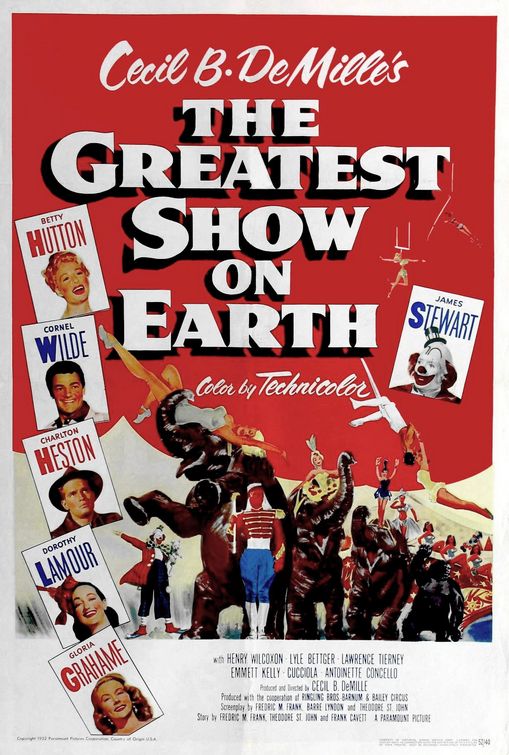
The Greatest Show on Earth (1952)

the_greatest_show_on_earth_posterDirected by Cecil B. DeMille

I have only been to the circus once. I was two, I think. The only thing I remember about the circus is the elephants coming in to the ring; that’s all. Because I have so little circus-watching experience, I wasn’t sure what to expect from this movie. I was glad I didn’t have high expectations, because I was able to enjoy it, even though it has its ups and downs.

So what’s the story? The Ringling Brothers-Barnum and Bailey Circus is not doing well. People just don’t want to come to the circus anymore. The backers don’t want to do a full season. Brad, the circus manager, gets them to promise that the circus will stay out as long as they stay in the black. To do this, he hires Sebastian, a famous trapeze artist. This makes unknown, but excellent, trapeze artist Holly angry, because she wanted to be in the center ring. She decides to prove to Brad and Sebastian that she is the best.

The Good: The circus is amazing. I kind of wish Cecil B. DeMille had just made a documentary about the circus and the real circus performers, because the story wasn’t all that interesting. I would have loved to know how people got involved in the circus, how they learned to do some of the incredible things they do, if they would ever consider leaving the circus. The circus was truly the best part of the movie.

The cinematography was well done. It had to be in order to capture the feeling of the circus, the size and the noise and the color and the bustle and the amount of work it is to put a circus on.

Gloria Grahame is fantastic as Angel, a “sadder but wiser” circus performer who loves Brad, but isn’t sure that he will love her back because of her past. Charlton Heston (whom I did not recognize in normal clothes and a hat) is very good as Brad, the manager who will do anything to keep the circus going. Cornel Wilde is charming as the playboy performer Sebastian. It’s always nice to see Jimmy Stewart, even though his role as the clown with a mysterious past isn’t very large. His little dog is adorable, too. Lyle Bettger was good as the Angel-obsessed Klaus. And it is fun to see famous circus people like John Ringling North and Emmett Kelly doing their thing.

The Bad: I did not like Betty Hutton, who played Holly. She was more annoying than anything. Apparently, she was a famous singer at the time, but her acting skills could have used some work.

Since I grew up watching The Ten Commandments, I’m used to Cecil B. DeMille narrating with great weight about serious subjects. It was really odd to hear him narrating about the circus. It wasn’t necessarily bad, per se, but it was really weird for me. It probably wouldn’t bother someone who isn’t familiar with DeMille’s voice.

The Ugly: The story is really weak and not particularly interesting. How the writers managed to win an Oscar for best story is beyond me. It must have been a weak year for that award.

The train wreck at the end was probably good for its day, but it doesn’t hold up well. Klaus is obviously sitting in front of screen when he’s supposedly on the tracks. I try not to let that kind of stuff get to me, but sometimes it does. This is one of those times.

Oscars Won: Best picture; best writing, motion picture story.

Other Oscar Nominations: Best director; best costume design, color; best film editing.

Sounder (1972)

sounderDirected by Martin Ritt

I think my third grade teacher hated children. What is my evidence for this? She made us read not only The Red Pony by John Steinbeck, but also Sounder by William H. Armstrong. While both are good books (SPOILER ALERT), the beloved animal dies at the end of both books. It does not make for happy reading for eight and nine year old children. The only thing that could have made the year worse was if we had also read Where the Red Fern Grows by Wilson Rawls. (We read Summer of the Monkeys instead.) Because I remembered how depressing and sad that year was, I wasn’t particularly looking forward to watching Sounder. But the screenwriter was smart, and the movie ends much more happily than the book does.

So what’s the story? During the Depression, sharecroppers David Lee and his father Nathan spend their nights hunting with their dog, Sounder, hoping to get any kind of meat to put on the table. One day, in desperation, Nathan steals a ham from his work. He is arrested and sent to a work camp. The town sheriff won’t tell David Lee and his mother and younger siblings where Nathan has been sent, so David Lee and Sounder go off in search of Nathan.

The Good: There are some nice performances in this movie. Kevin Hooks did a great job of carrying the movie as David Lee, which is a hard job for a teenager. Cicely Tyson plays Rebecca, Nathan’s wife, who is determined to keep the farming going without her husband. She does a beautiful job as the tough, yet loving woman. Paul Winfield is Nathan, a man trying so hard to provide for his family in an impossible time. The major standout for me, though, was Janet MacLachlan, who plays Camille, a teacher who cares. She shone in every scene she was in.

I liked the plot. I like seeing movies about people who love each other and who try to help each other through bad times. Sounder managed to tell the story without being cheesy, which is a hard thing to do.

The Bad: Even though all the performances were lovely, and even though I liked the story of the family, I felt like the movie rambled some. There were some unnecessary scenes. Or maybe they were necessary, but they just didn’t feel like they tied in to the rest of the movie. It dragged a bit, and that made it hard for me to connect with the movie, even though I felt for the people and their plight.

The Ugly: This is a G-rated movie, and there’s not anything horribly offensive in it, but it’s sad. Black sharecroppers in the South during the Depression did not have an easy time of it. This is a so-called “family movie,” but I would suggest not letting small children watch it on their own. I think it’s a movie that parents should talk about with their children so that children can understand what the family was going through.

Oscars Won: None.

Oscar Nominations: Best picture; best actor in a leading role (Paul Winfield); best actress in a leading role (Cicely Tyson); best writing, screenplay based on material from another medium.

The Wizard of Oz (1939)

wizard of ozDirected by Victor Fleming

I don’t remember the first time I saw The Wizard of Oz. It must have been before I was six, because that’s when I read the book for the first time, and I definitely noticed the differences. I have seen it many times since the first, as I sure many people in the United States have. My mom reminisced about how it always used to be on TV on Easter. It’s a classic that I think will never really leave the public consciousness.

So what’s the story? Dorothy Gale is running away from her Kansas farm when she gets caught in a tornado and transported to the magical land of Oz. She sings, dances, makes friends and learns a valuable lesson as she tries to avoid the Wicked Witch of the West.

The Good: Watching this as an adult, I was struck by the costumes and makeup. It must have taken serious creativity to make three grown men into a scarecrow, a tin man, and a lion. And those costumes are fairly convincing. Okay, so the Cowardly Lion walks on two legs instead of all fours, but watch carefully when he first appears; he is on four legs then, and it’s really quite impressive. The flying monkeys also must have taken some serious work. I don’t even want to know how long it took everyone to get into their makeup every day. The fantasy would have failed without those two things, so it’s a good thing they were both excellent.

I was very impressed by Ray Bolger, who plays the Scarecrow. He moves like his legs are really made of straw. It’s just a tiny detail, but I think it shows his ability. Also, I’m going to allow myself to be impressed with Frank Morgan, who plays five roles in this movie, which I didn’t realize until just now when I saw it on IMDb. It’s obvious that he plays the Wizard of Oz and Professor Marvel, but he also has three other parts. The costumes and makeup helped there, too, but his acting skills also needed to come into play.

I can’t decide how I feel about the music. I feel like just about everyone in the English-speaking world can sing along with many of them, but it is so easy for them to get stuck in your head. I’m not sure if that’s a sign of a good song or a bad song or if it means nothing at all, but it’s annoying. But the songs are fun, even if they don’t usually advance the plot or reveal much character. I’m guess I’m kind of neutral on the subject of the songs in the movie. I do like the background music, though.

The Bad: Some of the acting is hammy by today’s standards. I’m guessing it’s because they were making a movie based on a children’s book and were aiming to appeal to children, but occasionally I cringed.

I was also sad about the screenplay. L. Frank Baum’s book is not only a great adventure story, but it’s also a satire, and there are some lovely lines about people with no brains working in the government, etc. I wish the writers had kept some of those pointed little jabs in.

The Ugly: I hate the ending. It has always made me so mad that it’s just a dream. Why can’t it have been real? What’s wrong with having a little bit of magic in the world? It’s not a dream in the book. Dorothy really goes to Oz and eventually moves there with Uncle Henry and Aunt Em. I know it will probably never happen since this is a major classic, but I would love it if someone made another movie version of The Wonderful Wizard of Oz and stuck a little bit more closely to the source material.

Oscars Won: Best music, original song (“Somewhere Over the Rainbow”); best music, original score.

Other Oscar Nominations: Best picture; best cinematography, color; best art direction; best effects, special effects.

Doctor Dolittle (1967)

doctor dolittleDirected by Richard Fleischer

An actual conversation:

Me: Guess what I watched last night! Doctor Dolittle! The one with Rex Harrison.

My mother (in a horrified voice): WHY?

Me: For my blog. It was nominated for best picture.

My mother: Well, you really took one for the team on that one.

Contrary to the way this conversation makes it sound, Doctor Dolittle is not an evil movie. It is, however, a rather tedious movie in which forty-five minutes’ worth of plot is stretched to fill two and half hours.

So what’s the story? Dr. Dolittle is a kindly country doctor who learns to talk to animals with the help of his parrot, Polynesia. Because he can communicate with animals better than humans, he decides to be a vet instead of a doctor. For reasons not made clear in the movie, he wants to find the Great Pink Sea Snail and talk to it, so after he gets enough money and breaks out of the insane asylum, he goes on a voyage to find it.

The Good: As I watched this movie, I kept thinking what a nightmare it must have been to make. It was the 1960s, so the animals aren’t CGI or puppets, but real live animals. If you count the ducks and the goats and the pigs and the cows and the bears and the ridiculously cute lion cubs and all the other animals, there must be hundreds of animals.  I can’t even imagine trying to orchestrate such a thing. That alone is very impressive.

There was some fun humor. I even laughed out loud a couple of times. I enjoyed the song that Emma sang as she was storming away from meeting Dr. Dolittle for the first time.

I will also admit that Rex Harrison did a good job. Although on the surface the role of Dr. Dolittle is quite similar to that of Henry Higgins in My Fair Lady (a middle-aged linguist who doesn’t get on well with people), he didn’t play the roles the same way. Dr. Dolittle is much kinder and gentler, and it showed in Harrison’s face.

The Bad: There wasn’t much of a story. The movie kind of meandered around various vignettes. There’s the house scene, where we and Stubbins are introduced to the doctor and his many animal friends. There’s the ugly scene between Bellowes and the doctor. There’s the courtroom scene. There’s the breaking out of jail scene. There’s the voyaging scene and the island scene. I remember being amused by the book when I was a child, which makes me think that there was good source material, but the writers couldn’t seem to find a straightforward linear story from it.

Also, the love triangle was…odd. I could see no reason for Emma to fall for Dr. Dolittle, the middle-aged linguist, over Matthew, the charming young Irishman. I don’t care what My Fair Lady teaches us. Attractive young women do not fall in love with middle-aged linguists who don’t get on with people and can’t sing. I don’t buy it.

The Ugly: It was two and one-half hours long. With fourteen mediocre musical numbers. Enough said.

Oscars Won: Best effects, special effects; best music, original song (“Talk to the Animals”).

Other Oscar Nominations: Best picture; best cinematography; best film editing; best sound; best music, original music score; best music, scoring of music, adaptation or treatment; best art direction-set direction.

A Curiosity: Richard Attenborough is in this movie for about as long as Judi Dench is in Shakespeare in Love, but Richard Attenborough sings a song. He got a Golden Globe for best supporting actor for this. I didn’t know he could sing. And I’m not sure that what he did counted as being a supporting actor. I wish I knew how these things are judged.