I'd like to spank the Academy

Posts tagged ‘1930s’

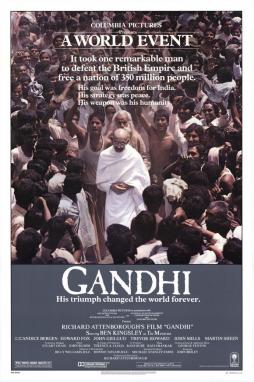
Gandhi (1982)

gandhi-movie-poster-1982-1020195902Directed by Richard Attenborough

I always worry when I’m watching a movie about a culture that isn’t my own, especially when it’s made by someone also outside that culture. I worry that I will “learn” something inaccurate or get the wrong idea about that culture. I had seen Gandhi before, but I was probably fourteen or fifteen and impressionable, so I was worried about how Indians view the movie and whether I could watch it comfortably as an American. But the day I picked it up from the library, an Indian coworker of mine said, “Oh, you are going to watch that movie? It is such an excellent movie. So well done.” Later that night, a British friend of mine whose parents are from India and Pakistan asked me what I was doing. I told him I was watching Gandhi. His response? “I love that movie.” So while there might be historical inaccuracies or only part of the story told, I at least know that Indians do not find this movie offensive, which does make me glad.

So what’s the story? Mohandas Gandhi, a young Indian lawyer educated in London, experiences racial prejudice in South Africa and decides that it is unacceptable for anyone to be treated that way. He begins a protest of the way Indians in South Africa are treated. His activism doesn’t stop there, however. He goes back to India and becomes the leader of the long struggle against British rule.

The Good: Ben Kingsley makes an excellent Gandhi, both young and old. He takes us on the same journey that Gandhi made, from rash young man to wise old leader, full of patience and kindness. It is an excellent performance.

I’m not going to name all of the people who did a good job of acting, because in a three-hour movie with lots of small roles filled by famous or soon-to-be-famous people (including Daniel Day-Lewis!), there is lots of good acting. I will mention Rohini Hattangadi, though. She played Ba, Gandhi’s wife, going from a young woman unsure if her husband is doing the right thing or if he has gone crazy to a woman who believes fully in what he does and supports him completely. She was impressive.

I loved the cinematography. There are times when it shows the grandeur of India, the huge scale of that country, and other times when it is intimate, showing how one man was able to make such a difference in such a large, diverse country. If I hadn’t already wanted to visit India someday, the cinematography of this movie would have made me want to go.

The makeup people did an excellent job of making Gandhi and Ba look older as time passed. I might have thought that the old and young were played by different people, especially as Ben Kingsley looks less like himself and more like Gandhi as he “aged”.

The Bad: Those same makeup people who did such a good job on Gandhi did a less-than-stellar job on Gandhi’s associates Nehru, Jinnah, and Patel. They didn’t age at all until the very end, even though they had been working for independence for thirty years. If this was done on purpose to show how much more quickly people age when they are living a lifestyle of poverty, than I suppose it was okay. But even if you are wealthy, you age over time, not all at once.

What happened to Gandhi’s sons? They are shown at the beginning of the movie in South Africa, but then we never see them again. There was nothing about the sons to make them a huge plot point, but I really did have to wonder if they all died, since they don’t seem to be anywhere around Gandhi and his wife for the rest of his life. Leaving them out altogether would have been one thing, but to show them once and then never again is bad storytelling.

The Ugly: I’m not disputing that Gandhi was a great man. He truly was. It takes an amazing kind of person to struggle for independence without fighting and to inspire an entire nation to do the same. His story is an incredible one. But except for one scene where he is angry at his wife, he is shown as having no weaknesses. He is made out to be a saint. I’m not trying to insult anyone or tear Gandhi down, but no one is that perfect, which made me feel like the movie was only semi-factual. I may be wrong; I know very little about the Mahatma. He may have been perfect. But because I was feeling that throughout the movie, I couldn’t immerse myself completely in the experience, so I’m going to stand firm in my belief that it was a weakness for this movie.

Oscars Won: Best picture; best actor in a leading role (Ben Kingsley); best director; best writing, screenplay written directly for the screen; best cinematography; best art direction-set decoration; best costume design; best film editing.

Other Oscar Nominations: Best sound; best music, original score; best makeup.

Gosford Park (2001)

gosford parkDirected by Robert Altman

I read my first Agatha Christie murder mystery when I was twelve. It was the start of a beautiful relationship. Every summer after that, I would check out stacks of Agatha Christie mysteries. The plots were always intricate and watertight, but I also loved the idea of rich British people in country houses dressing for dinner and going shooting and having weekend parties. Gosford Park is basically an Agatha Christie mystery with a twist—it not only shows how the family is affected by the murder, but also how the servants are affected. It could be called Murder at Downton Abbey.

So what’s the story? Sir William McCordle has invited friends and family to Gosford Park for a weekend shooting party. The guests come with their servants, and everyone, both upstairs and down, has a secret.

The Good: The cast reads like a Who’s Who of British actors. Maggie Smith, Helen Mirren, Michael Gambon, Kristin Scott Thomas, Derek Jacobi, Jeremy Northam, Clive Owen, Stephen Fry, and Kelly Macdonald are all in this movie, to name just a few. Everyone is excellent. There isn’t an actor in the movie who was miscast or who isn’t completely believable in their role. It’s a fantastic cast, and the movie is incredibly well-acted.

The screenplay is delightful. I had to laugh when I was watching the credits and realized why I felt it was similar to Downton Abbey. The screenplay was written by Julian Fellowes, the man behind Downton Abbey. The screenplay is fun and funny. Although there are many characters, the screenplay allows them all to show their personalities and problems. It’s very clever and well-written.

The costume design impressed me. The designer, Jenny Beavan, had to not only design clothes for the wealthy and their servants, but also had to show a range of incomes in those different classes. She did so very cleverly and period-appropriately.

I love the music. It’s buoyant and jolly when it needs to be and unobtrusive when more serious things are happening. The cheery piano music made me want to find the sheet music.

The art direction is also excellent. It drew me in to this country house of the 1930s. The cars, the bedrooms, the servants’ quarters, everything felt realistic to me.

The Bad: I got so mad watching this movie at the way people treated their servants. The servants weren’t treated so much like people as they were like useful machines. They are used and abused at their employers’ pleasure. I felt very frustrated. Based on things that I’ve read, I’m fairly sure the attitudes are accurate. Even in my beloved Agatha Christie novels, the servants are almost always discounted from being murder suspects because they couldn’t possibly have a motive; they don’t know the murdered person well enough. I love that this movie shows the relationships between the rich and their servants; the only one who cries at the news of the murder is a servant. But the treatment of the servants still makes me mad.

The Ugly: It was a little hard to keep track of who everyone was. The relationships of the upper-class people were especially hard to figure out. Everyone is introduced so quickly and shallowly at first that it doesn’t all sink in the first time around.

Oscar Won: Best writing, screenplay written directly for the screen.

Other Oscar Nominations: Best picture; best actress in a supporting role (Helen Mirren); best actress in a supporting role (Maggie Smith); best director; best art direction-set decoration; best costume design.

Sounder (1972)

sounderDirected by Martin Ritt

I think my third grade teacher hated children. What is my evidence for this? She made us read not only The Red Pony by John Steinbeck, but also Sounder by William H. Armstrong. While both are good books (SPOILER ALERT), the beloved animal dies at the end of both books. It does not make for happy reading for eight and nine year old children. The only thing that could have made the year worse was if we had also read Where the Red Fern Grows by Wilson Rawls. (We read Summer of the Monkeys instead.) Because I remembered how depressing and sad that year was, I wasn’t particularly looking forward to watching Sounder. But the screenwriter was smart, and the movie ends much more happily than the book does.

So what’s the story? During the Depression, sharecroppers David Lee and his father Nathan spend their nights hunting with their dog, Sounder, hoping to get any kind of meat to put on the table. One day, in desperation, Nathan steals a ham from his work. He is arrested and sent to a work camp. The town sheriff won’t tell David Lee and his mother and younger siblings where Nathan has been sent, so David Lee and Sounder go off in search of Nathan.

The Good: There are some nice performances in this movie. Kevin Hooks did a great job of carrying the movie as David Lee, which is a hard job for a teenager. Cicely Tyson plays Rebecca, Nathan’s wife, who is determined to keep the farming going without her husband. She does a beautiful job as the tough, yet loving woman. Paul Winfield is Nathan, a man trying so hard to provide for his family in an impossible time. The major standout for me, though, was Janet MacLachlan, who plays Camille, a teacher who cares. She shone in every scene she was in.

I liked the plot. I like seeing movies about people who love each other and who try to help each other through bad times. Sounder managed to tell the story without being cheesy, which is a hard thing to do.

The Bad: Even though all the performances were lovely, and even though I liked the story of the family, I felt like the movie rambled some. There were some unnecessary scenes. Or maybe they were necessary, but they just didn’t feel like they tied in to the rest of the movie. It dragged a bit, and that made it hard for me to connect with the movie, even though I felt for the people and their plight.

The Ugly: This is a G-rated movie, and there’s not anything horribly offensive in it, but it’s sad. Black sharecroppers in the South during the Depression did not have an easy time of it. This is a so-called “family movie,” but I would suggest not letting small children watch it on their own. I think it’s a movie that parents should talk about with their children so that children can understand what the family was going through.

Oscars Won: None.

Oscar Nominations: Best picture; best actor in a leading role (Paul Winfield); best actress in a leading role (Cicely Tyson); best writing, screenplay based on material from another medium.

Cabaret (1972)

cabaretDirected by Bob Fosse

Okay, I’m back. I’m finally better enough that my writing once again makes sense. And I’m glad, because I’ve missed this. Now on to 1972!

I liked musicals when I was young. I’m not sure why. Maybe I liked believing in a place where people burst spontaneously into song and dancing with your enemy could solve problems. Maybe I didn’t notice that story and character development tend to suffer when the director has to make room for musical numbers. Maybe I liked the happy endings. But whatever it was that I liked as a child is gone now. Musicals make me very impatient. I still retain a nostalgic liking for the musicals I liked growing up, but I have a hard time with musicals that I am seeing for the first time. Since Cabaret has adult themes, it is not a musical I grew up with. Although I can see some of what people like about it, I didn’t particularly care for it.

So what’s the story? Young English author Brian Roberts moves to Germany in the 1930s. At his boardinghouse, he meets Sally Bowles, an effervescent American nightclub singer/aspiring actress. Together they experience the heady turmoil of pre-World War II Berlin.

The Good: I will give Cabaret props because even though it has musical numbers, all of the musical numbers take place in the nightclub. No one randomly breaks into song on the street or anywhere else. I did like that aspect of Cabaret as a musical. It made it realistic enough that I didn’t want to throw something at the TV.

The acting was good. Liza Minelli made a wonderful Sally, a woman who finds every experience in life worth trying, a woman who just loves life for life’s sake. I quite liked Michael York as Brian, the quiet Englishman who’s not quite sure of his sexuality or what he wants out of life. But the people who I really loved (and whose story I found more interesting than that of Sally and Brian’s) were Fritz Wepper and Marisa Berenson as a gold-digging man and a rich young woman, respectively. Both characters were extremely compelling, and being unsure if they will get a happy ending after all makes them semi-tragic.

The Bad: Even though the characters didn’t randomly burst into song, I didn’t feel like the songs added anything to the movie. The songs could have all been cut, and the only thing it would have done to the movie is make it shorter. There wasn’t even any fabulous dancing to make the musical numbers worth it. And I think some of the cabaret dancers were men in drag, but I couldn’t ever be sure, so I was distracted during the musical numbers trying to figure it out.

The Ugly: There wasn’t anything ugly about Cabaret per se, but I had a really hard time connecting to the movie at all. I can’t even blame being sick, because I was really into other movies I watched while I was sick. Anyway, I’m just going to have to risk the wrath of the internet and say I think Cabaret is overrated.

Oscars Won: Best actress in a leading role (Liza Minnelli); best actor in a supporting role (Joel Grey); best director; best cinematography; best art direction-set direction; best sound; best film editing; best music, scoring original song score and/or adaptation.

Other Oscar Nominations: Best picture; best writing, screenplay based on material from another medium.

Atonement (2007)

Atonement-movie-posterDirected by Joe Wright

It was five or six years ago when I read Ian McEwan’s novel Atonement, but it has stayed with me. Even though I liked the writing style and thought that the characters were very well drawn, it was a hard book for me to get through. As soon as Robbie handed Briony his note, I knew things were going to take a turn for the worse; I didn’t want that to happen, so I put the book down for a while. I couldn’t stay away, though; I had to find out exactly what happened to all of these great characters. I finished it and loved it, but never felt like I had to emotional strength to read it again. So it was with a feeling of trepidation that I watched Atonement. I didn’t want to see all the bad things happen to the people I cared about. I needn’t have worried. Although it’s a good film, I didn’t get as emotionally caught up with the characters as I did when I read the book. Maybe it’s because I already knew what was going to happen, so I subconsciously made the decision to stay detached.

So what’s the story? On a hot summer’s day in 1935 England, thirteen-year-old Briony witnesses some things that she doesn’t understand and so misinterprets as menacing. When her cousin is attacked, Briony makes an accusation based on what she’s seen earlier. This accusation has serious repercussions for Briony’s sister, Cecelia, and Cecelia’s lover, Robbie, that will echo throughout the rest of their lives.

The Good: The music struck me from the very beginning. I really liked the way that the typewriter was used almost as a percussion instrument. It was very clever and somehow added to the tension of the movie.

The acting was very good. I don’t usually like Keira Knightly, but she really fit her part here. James McAvoy made an excellent Robbie. Saoirse Ronan was nominated for best supporting actress for her role as thirteen-year-old Briony. She has very expressive eyes. Romola Garai plays eighteen-year-old Briony, a young woman haunted by what she did five years before. They are all excellent in their roles.

The cinematography was lovely. The very long tracking shot on the beach emphasized the hopelessness and chaos of the situation. The cinematographer also somehow made the scenes at the country house glow like a long-cherished memory. It’s a very pretty movie.

The screenplay was well-done, too. I was wondering how they were going to show what really happened and also what Briony saw and interpreted. They did an excellent job with that.

The Bad: I kept wondering about the scene between Cecelia and Robbie in the coffee shop/at the bus stop. (SPOILER ALERT): If everything we see in the movie up until the interview is Briony’s story that she’s rewritten for Robbie and Cecelia’s happy ending, how did Briony know about that meeting and the summer cottage? Because when we see Robbie dying, he has the photograph of the beach house. That kind of bugged me.

The Ugly: The movie itself didn’t have anything ugly about it, but the story is frustrating and sad. It’s probably not a good movie for the easily depressed to watch.

Oscar Won: Best achievement in music written for motion pictures, original score.

Other Oscar Nominations: Best motion picture of the year; best performance by an actress in a supporting role (Saoirse Ronan); best writing, adapted screenplay; best achievement in cinematography; best achievement in art direction; best achievement in costume design. (When did the names of the awards get so long?)

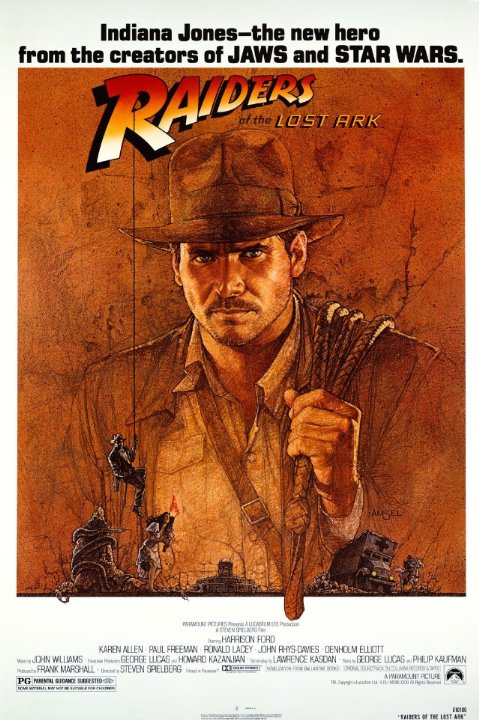
Raiders of the Lost Ark (1981)

raidersDirected by Steven Spielberg

When I was little, I was seriously confused by this movie’s title. For a long time, I thought it was Raiders of the Lost Dark, and I could never figure out how the dark got lost. When I finally figured out it was Raiders of the Lost Ark, I was still confused. There was not a single reference to Noah in the entire movie. That didn’t keep me from liking the movie; I just ignored the confusing title and went along for the ride. And what a ride it is. Raiders of the Lost Ark remains one of the most purely fun movies I have ever seen, even though now it appears to have a new title: Indiana Jones and the Raiders of the Lost Ark.

So what’s the story? Dr. Indiana Jones, a professor of archaeology, is approached by two United States government officials. It seems that the Nazis are looking for the Ark of the Covenant because they believe it has mystical powers. Jones’s old mentor, Abner Ravenwood, is the world’s foremost expert on the Ark, but no one can locate him. Jones is tasked with finding first Ravenwood and then the Ark so that the Ark will be kept out of Nazi hands.

The Good: The thing that really sticks out for me in this movie is the pacing, which is kind of an odd thing to notice first off. But there is never a dull moment. It jumps from action scene to action scene. Even when there is a break from actual action, the scenes aren’t dull. The screenplay is fun enough and light enough to make even the longest talking scenes entertaining. It also means you can’t look away; you’ll miss something important if you do.

The characters in Raiders of the Lost Ark are very well-written, well-rounded characters. Marion Ravenwood is one of the best action movie heroines ever, I think. She never stands around and waits to be rescued. If there is danger, she always jumps in and gives as good as she gets. Yes, sometimes she does end up having to be rescued, but she only gets rescued after she’s done everything she possibly can to get out of the situation herself. She’s kind of an anomaly, not just for action movies, but for movies in general. Karen Allen played her perfectly. Indiana Jones is also a good character. He may be a terrible archaeologist since he is willing to destroy ancient temples to get the artifacts that he wants, but he’s still a good character. He can use a whip and shoot a gun and ride a horse and all those other things that good action heroes can do, but he’s also smart and not invincible. He gets hurt more than once. He would have completely lost that fight against the bald muscular German mechanic if not for the airplane propeller. I like that. What can I say? I’m a fan of imperfect main characters. Harrison Ford was a fabulous choice for the part.

I found myself admiring the production design that had been done for this movie. The designers not only had to make the audience believe that the action was taking place in the 1930s, but in various countries in the 1930s. It was really well done. Everything from the cars to the clothes to the buildings added up to a convincing 1930s.

John Williams wrote an amazing score for Raiders of the Lost Ark. It’s kind of dramatic, but so is the movie. The music underscores the action at the right moments and helps convey emotion. It’s very good, and it’s held up well. It’s as much fun to listen to now as it was thirty years ago.

The Bad: The action moves quickly, which prevents the viewer from asking too many questions. But something has always bothered me: how does Indiana Jones survive on the outside of a submarine that submerges? I know he’s pretty awesome, but I don’t think he can hold his breath that long. There might be other plot holes, too, but the awesomeness of the movie prevents me from thinking too hard about them.

The Ugly: If you don’t like spiders or snakes, beware. Raiders of the Lost Ark has plenty of both. It also has some graphic violence and special effects which hold up amazingly well. When I was a little girl, my parents would always tell me to close my eyes at certain parts so I wouldn’t get scared. As I grew up, I would close my eyes at those points out of habit. I don’t think I had seen the whole movie until I watched it this week. Sure enough, it is not much fun to watch faces melt and heads explode. (Honestly, though, it’s not the most violent or the worst violence I’ve seen in a movie; it’s not even the worst I’ve seen in the Oscar nominees. But I had to find something to put in The Ugly.)

Oscars Won: Best art direction-set direction; best sound; best film editing; best effects, visual effects.

Other Oscar Nominations: Best picture; best director; best cinematography; best music, original score.

Other Oscar Won: Special achievement award to Ben Burtt and Richard L. Anderson for sound effects editing.

Of Mice and Men (1939)

1939 Of mice and men - La fuerza bruta (ing) 03Directed by Lewis Milestone

I read the book Of Mice and Men when I was a junior in high school. I didn’t care for it much; I couldn’t figure out how John Steinbeck could fit so much misery into such a short book. And I haven’t read it since, but watching this movie made me want to, because even though the movie Of Mice and Men is still sad due to the utter hopelessness of these men’s lives, the fact that someone out there understands their situation and dreams and feelings gives hope back to those who feel downtrodden by life. I’m not a Depression-era drifter, but this movie gave me some hope. It made me realize that I am not alone in what I want out of life. That’s a very powerful thing for a work of art to do.

So what’s the story? During the Depression, friends George and Lennie go from ranch to ranch looking for work. George is a small guy, but he’s smart. Lennie is hulking giant; he’s mentally slow, but he works hard and is very kind-hearted, especially towards small animals. George and Lennie have a dream of having their own small place where they can farm for themselves and do what they want to do when they want to do it. They are starting work on a new ranch. Curly, the ranch owner’s proud, jealous son, has a wife, Mae, whom he constantly suspects of cheating. Being the only woman on the ranch is lonely for her, but it’s even worse because none of the ranch hands will talk to her because Curly doesn’t like it when they do. The tensions on the ranch are about to explode and take away George and Lennie’s dreams.

The Good: This movie was exceptionally well-cast. Lon Chaney, Jr. plays Lennie and does a wonderful job of playing a kind man who truly doesn’t understand his own strength. His performance is powerful, and I’m really trying to decide why he didn’t get nominated for an Oscar for it. Burgess Meredith plays George very well. He gives a very good performance of a man torn between his love and loyalty to a friend and his frustration when that friend makes mistakes that pull them both down. Betty Field, who plays Mae, also does a good job. Mae is kind of crass and low-class, but she’s also so lonely. Her desire to really live life is just bursting out of her. I felt much sorrier for her than I remember feeling when I read the book. The rest of the cast is good, too. The hands are especially sympathetic. I don’t know how they got such perfect people for every role, but it happened.

I noticed the music from the beginning. I kept thinking it sounded more symphonic, more complex somehow than a typical 1930s movie score. I found out that Aaron Copland wrote the music, and it suddenly made sense. It was beautiful music, and it didn’t overwhelm the movie like some scores did in the 1930s. It fit the movie just perfectly.

The Bad: I can’t exactly put my finger on just why I felt this way, but I feel like it dragged a bit in some places. I can’t really think of a boring scene, but the pacing was off somehow. Maybe it’s because when I watched it, my mind wasn’t the sharpest it’s ever been. So yeah. Take that comment with a grain of salt. Or better yet, watch the movie and tell me in the comments if I was right or wrong!

The Ugly: This is not a happy story. It’s the story of men living on the fringes of society, wanting no more than the freedom to make their own decisions about life, but who can’t rise above where their circumstances have placed them. The ending is heart-wrenching, because John Steinbeck understood life, and life is not easy.

Oscars Won: None.

Oscar Nominations: Best picture; best sound, recording; best music, scoring; best music, original score.

Random Fact: This movie was adapted from the play that was based on the book. Weird, huh?