I'd like to spank the Academy

Posts tagged ‘1920s’

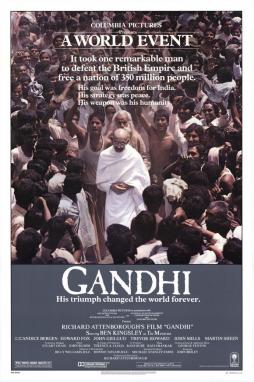
Gandhi (1982)

gandhi-movie-poster-1982-1020195902Directed by Richard Attenborough

I always worry when I’m watching a movie about a culture that isn’t my own, especially when it’s made by someone also outside that culture. I worry that I will “learn” something inaccurate or get the wrong idea about that culture. I had seen Gandhi before, but I was probably fourteen or fifteen and impressionable, so I was worried about how Indians view the movie and whether I could watch it comfortably as an American. But the day I picked it up from the library, an Indian coworker of mine said, “Oh, you are going to watch that movie? It is such an excellent movie. So well done.” Later that night, a British friend of mine whose parents are from India and Pakistan asked me what I was doing. I told him I was watching Gandhi. His response? “I love that movie.” So while there might be historical inaccuracies or only part of the story told, I at least know that Indians do not find this movie offensive, which does make me glad.

So what’s the story? Mohandas Gandhi, a young Indian lawyer educated in London, experiences racial prejudice in South Africa and decides that it is unacceptable for anyone to be treated that way. He begins a protest of the way Indians in South Africa are treated. His activism doesn’t stop there, however. He goes back to India and becomes the leader of the long struggle against British rule.

The Good: Ben Kingsley makes an excellent Gandhi, both young and old. He takes us on the same journey that Gandhi made, from rash young man to wise old leader, full of patience and kindness. It is an excellent performance.

I’m not going to name all of the people who did a good job of acting, because in a three-hour movie with lots of small roles filled by famous or soon-to-be-famous people (including Daniel Day-Lewis!), there is lots of good acting. I will mention Rohini Hattangadi, though. She played Ba, Gandhi’s wife, going from a young woman unsure if her husband is doing the right thing or if he has gone crazy to a woman who believes fully in what he does and supports him completely. She was impressive.

I loved the cinematography. There are times when it shows the grandeur of India, the huge scale of that country, and other times when it is intimate, showing how one man was able to make such a difference in such a large, diverse country. If I hadn’t already wanted to visit India someday, the cinematography of this movie would have made me want to go.

The makeup people did an excellent job of making Gandhi and Ba look older as time passed. I might have thought that the old and young were played by different people, especially as Ben Kingsley looks less like himself and more like Gandhi as he “aged”.

The Bad: Those same makeup people who did such a good job on Gandhi did a less-than-stellar job on Gandhi’s associates Nehru, Jinnah, and Patel. They didn’t age at all until the very end, even though they had been working for independence for thirty years. If this was done on purpose to show how much more quickly people age when they are living a lifestyle of poverty, than I suppose it was okay. But even if you are wealthy, you age over time, not all at once.

What happened to Gandhi’s sons? They are shown at the beginning of the movie in South Africa, but then we never see them again. There was nothing about the sons to make them a huge plot point, but I really did have to wonder if they all died, since they don’t seem to be anywhere around Gandhi and his wife for the rest of his life. Leaving them out altogether would have been one thing, but to show them once and then never again is bad storytelling.

The Ugly: I’m not disputing that Gandhi was a great man. He truly was. It takes an amazing kind of person to struggle for independence without fighting and to inspire an entire nation to do the same. His story is an incredible one. But except for one scene where he is angry at his wife, he is shown as having no weaknesses. He is made out to be a saint. I’m not trying to insult anyone or tear Gandhi down, but no one is that perfect, which made me feel like the movie was only semi-factual. I may be wrong; I know very little about the Mahatma. He may have been perfect. But because I was feeling that throughout the movie, I couldn’t immerse myself completely in the experience, so I’m going to stand firm in my belief that it was a weakness for this movie.

Oscars Won: Best picture; best actor in a leading role (Ben Kingsley); best director; best writing, screenplay written directly for the screen; best cinematography; best art direction-set decoration; best costume design; best film editing.

Other Oscar Nominations: Best sound; best music, original score; best makeup.

The Treasure of the Sierra Madre (1948)

the-treasure-of-the-sierra-madre-poster-11Directed by John Huston

The Treasure of the Sierra Madre was one of the few movies I had already seen but had no desire to see again. I checked it out from the library a while ago, probably because I had been told it was an adventure movie, which I tend to love, starring Humphrey Bogart, who is awesome. It was so boring that I didn’t even make it halfway through before giving up. So I was really surprised this time around at how much I liked this movie. It’s amazing. Now I’m wondering what was wrong with me the day I watched it the first time.

So what’s the story? Dobbs and Curtain are two American men down on their luck in Mexico. Both of them just want to make enough money to make it back to America, but they can’t find work. They meet Howard, an old prospector, who is willing to help them find gold, but he warns them that gold always carries a curse.

The Good: Like I said before, Humphrey Bogart is awesome, but I’ve never seen him quite like this before. He often plays crusty people on the fringes of society, but he always seems to have a heart of gold underneath. Not here. He’s a little frightening, really. I’m not sure why he wasn’t nominated for a best actor Oscar. Tim Holt plays Curtain, who is just an all-around nice guy with dreams of a bigger life. Howard is played by Walter Huston, director John Huston’s father. Normally I’m not a fan of nepotism, but I think this was a case where the perfect person for the role just happened to be related to the director. Huston did such a good job. He was patient with the greenhorns, yet you could see him waiting for the other shoe to drop. He had enough experience and wisdom to know how things were going to go. Huston managed to show all of that without getting annoying, which can be tricky in situations like that.

The cinematography is gorgeous. It was shot on location in Mexico, and the cinematographer took advantage of that. But there are also lots of intriguing camera angles and good moody lighting which help contribute to the movie.

The excellent score was masterfully written by Max Steiner. I’ve decided he could score pretty much anything and it would be amazing. He could score a movie of someone silently reading a phone book and it would become interesting.

The Bad: The Treasure of the Sierra Madre has the usual first half of the 20th century problem with racism, but it’s not the worst I’ve seen. It also moves a little bit slowly at times.

The Ugly: This movie has the single worst fistfight I have seen in any movie ever. The camera angles are all wrong, and you can see that the punches aren’t actually connecting, even though the foley artist is making the correct sounds. It’s sooooo bad. I was cringing all the way through.

Oscars Won: Best actor in a supporting role (Walter Huston); best director; best writing, screenplay.

Other Oscar Nominations: Best picture.

There Will Be Blood (2007)

600full-there-will-be-blood-poster-finalDirected by Paul Thomas Anderson

I knew two things about There Will Be Blood before I watched it: 1)it was based on a book by Upton Sinclair; 2)it was a Coen brothers film. As I watched it, I couldn’t help but think it was a very odd film for the Coen brothers. It was just so serious and everything was played completely straight. About midway through, I looked it up on IMDb and realized that I had only known one thing about There Will Be Blood: it was based on a book by Upton Sinclair.

So what’s the story? On a tip from a young man named Paul Sunday, prospector-turned-oilman Daniel Plainview travels with his son to the community of Little Boston to see if he can start some oil wells. The land is promising, but Paul’s creepy twin brother, Eli Sunday, has a strange hold over the people of Little Boston.

The Good: I’m not very familiar with Daniel Day-Lewis as an actor, but I didn’t think very much of his performance in Gangs of New York, so I wasn’t exactly jumping with excitement to see him in There Will Be Blood. But his performance as Daniel Plainview was excellent. It had to be; Daniel is in almost the entire movie and for some of the movie, he’s the only person onscreen. The movie wouldn’t have worked with a lesser actor.

I really liked the soundtrack. It wasn’t constant; at times there was no music at all. I like that. It makes it feel more real and less manipulative. I liked, too, that the music was usually played by a smaller group, not necessarily a full orchestra. It reflected the bare bones of the frontier places Plainview was.

The Bad: There were a couple questions I had that never really got answered. Why did HW stop talking? He had the capability to speak. Why did he not? And what happened to Paul Sunday? I suppose if I had a creepy brother like Eli, I might leave and never come back, but why does his family never mention him again? I kept waiting for him to show up again, but he never did. I felt like other people disappeared, too, like Ciaran Hinds’ character. What happened to all those people?

The Ugly: I’m not a big fan of violence, whether it’s intentional or accidental, and many distressingly violent things happen in this movie. My cat finally moved off my lap in disgust because I kept jumping and gasping at things that were happening. Mining and oil well-digging were very dangerous jobs back then, and I didn’t like seeing what could happen to people while they practiced those professions. I’m not mortally offended by it; I’m just not good at handling that kind of stuff.

Oscars Won: Best performance by an actor in a leading role (Daniel Day-Lewis); best achievement in cinematography.

Other Oscar Nominations: Best motion picture of the year; best achievement in directing; best writing, adapted screenplay; best achievement in film editing; best achievement in art direction; best achievement in sound editing.

Giant (1956)

giantDirected by George Stevens

I had seen Giant before I watched it for my blog, but only once. I was probably seventeen, and while I was seriously underwhemed with the way the stars were aged, I liked the movie overall. But now that I’m older and more analytical (and possibly more cynical), I’m not as impressed with it as I once was.

So what’s the story? Texas rancher Jordan “Bick” Benedict, Jr. has come to Maryland to buy a stallion to improve his breeding stock. There he meets Leslie, a lovely and spirited society girl. After talking to each other for less than ten minutes, they are deeply in love. They marry and go back to Reata, Jordan’s ranch in dry, dusty Texas. They spend the next 25 years adjusting not only to each other, but to the changing world around them.

The Good: Perhaps because of his early death, James Dean still haunts pop culture. Before I actually saw him in anything, I thought people were overreacting a bit when they talked about how a great young actor was lost. But he really was that good. He brings a pathos to Jett Rink, a low-class ranch hand who strikes oil. Without James Dean, Jett would have been a slightly ridiculous character, but James Dean allows us to see his motivations, his dreams and desires. He makes him human. James Dean died before the filming of Giant was completed, but he left his mark on the film and on film history.

Three supporting actors really stood out. Mercedes McCambridge is Luz Benedict, Jordan’s crusty older sister. She loves Reata more than anything and can do anything a man can do on the ranch. (SPOILER ALERT)Her death, which happens so conveniently soon after Leslie comes to Texas, is really quite touching. Chill Wills plays Uncle Bawley, a kindly older gentleman who helps Leslie understand Texas and the Benedict children understand life. Jordan Benedict III is played by Dennis Hopper in what must have been one of his first big movie roles. Jordy is a rather quiet young man, but he is deeply passionate below the surface. It’s a very fine performance.

The Bad: I really enjoyed the first half of Giant. Up until the point where Jett finds his oil, it’s tight and focused. After that, it feels looser and more meandering. It doesn’t feel like it has a central focus. Jordan and Leslie and their relationship aren’t as important as they were, but nothing steps up to fill that vacuum. I don’t know if that’s how it is in the novel that Giant is based on, but it made the second half feel less meaningful and somewhat disconnected from the first half.

Giant must begin sometime in the 1920s since the movie spans 25 or 30 years, but you can’t really tell from the costume design. Elizabeth Taylor’s clothes are waaaay too 1950s-fashionable for the 1920s. The other costumes are not as bad. I guess it was decided that it wouldn’t do to have Elizabeth Taylor wearing thirty-year-old fashions. But I want Luz II’s white formal. It’s gorgeous.

The Ugly: The makeup in this movie is so bad that I have been using it as my standard of bad makeup for fifteen years. Elizabeth Taylor, Rock Hudson, and James Dean are “aged” thirty years by wearing grey wigs. That’s about it. That makes it hard to believe that Elizabeth Taylor and Rock Hudson are parents with grown children, let alone grandparents. It’s a little bit silly.

The thing I hated most about this movie is Leslie. She doesn’t grow or change at all in the course of the movie, even though she’s supposed to be about eighteen when she marries Jordan. She swoops in from Maryland and teaches all the ignorant, backward Texans what is acceptable in life. Yes, the Texans do have some deplorable attitudes, but the fact that Leslie is the only enlightened one is very grating. How exactly did a rich doctor’s daughter have so much life experience at eighteen that she has so much wisdom? It’s hard to watch a three-hour movie with a paragon as the main character. It makes it hard to suspend your disbelief.

Oscars Won: Best director.

Other Oscar Nominations: Best picture; best actor in a leading role (James Dean); best actor in a leading role (Rock Hudson); best actress in a supporting role (Mercedes McCambridge); best writing, best screenplay – adapted; best art direction-set direction, color; best costume design, color; best film editing; best music, scoring of a dramatic or comedy picture.

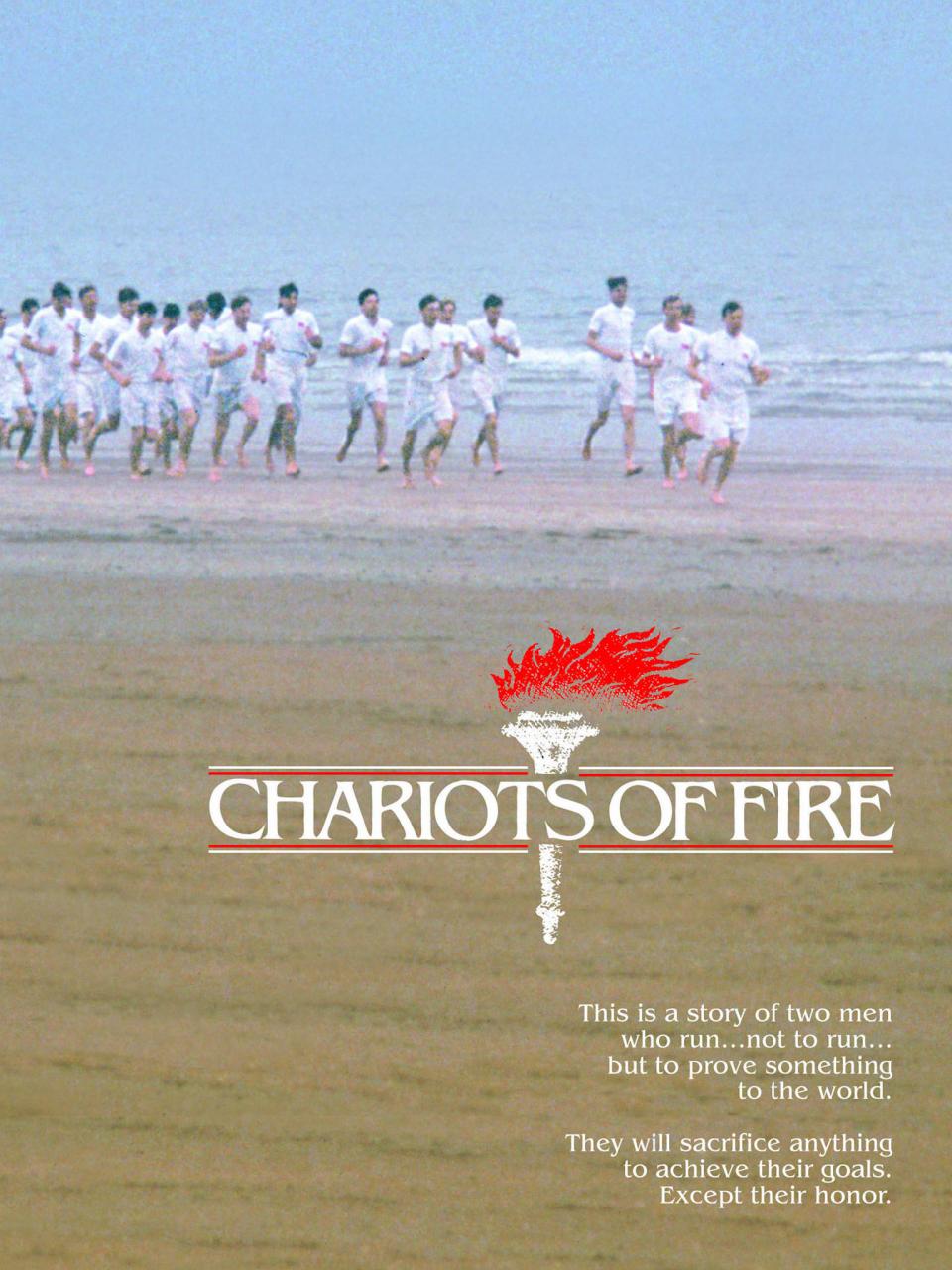
Chariots of Fire (1981)

ChariotsDirected by Hugh Hudson

This is another movie I grew up watching. My family must have an eclectic taste in movies, but I’ve never really realized that until now. Anyway, it’s always interesting to really pay attention to a movie you’ve seen a dozen times before. I noticed things and understood things differently than I ever had before. That might also have to do with the fact that I’m older and so see life a little bit differently than I did. But whatever the reason, watching Chariots of Fire again and trying to be impartial while doing so was a really good experience. And I think I will always be a little bit in love with Lord Lindsay.

So what’s the story? Harold Abrahams is an Englishman who goes to Cambridge and loves Gilbert and Sullivan. He’s also a Jew, which means that to some, he will never be entirely English. He runs to prove to everyone, not least himself, that he is as good as everyone else. Eric Liddell is a missionary who was born and grew up in China, but he also plays rugby for Scotland. He runs for the glory of God. These two men show their dedication in the 1924 Olympic games.

The Good: This movie has great acting. I’m honestly surprised that Ben Cross wasn’t nominated for a best actor Oscar for his portrayal of Harold Abrahams. Ian Charleston is just as good as Eric Liddell. The supporting actors are good as well. I noticed when I watched the famous running on the beach sequence that the four main runners (Harold, Eric, Aubrey Montague, Lord Lindsay) show their characters’ personalities in the few seconds that the camera is focused on them. It was all very well done.

This is the third movie that took place in a historical time this week, and this is the third one where the designer actually paid attention to what people were wearing at the time. Hooray for more correct historical costuming! Thank you, 1981!

I was impressed by the screenplay this time around. It’s based on a true story, but of course things are compressed or changed in time to make for a more streamlined story. All of the characters are distinct people with strong personalities. The story is inspiring, but it could have become overwhelmingly cheesy if the writers weren’t careful. The writers did an excellent job.

The Bad: I feel terrible saying this, but the music is bad. The themes are beautiful, and when the theme song is played on a piano or by an orchestra, I love it. However, the music in the movie is played on a synthesizer, and it just doesn’t work. It’s so very 1980s. It might have been fine if the movie took place in the 1980s, but it’s not okay in the 1920s. (And before anyone jumps down my throat for insulting the music, go and watch the movie. If you disagree with me after that…well, we will just have a difference of opinion. But it will be an informed difference of opinion.)

The Ugly: There is no ugly in this movie. It’s not perfect, but it’s really good.

Oscars Won: Best picture; best writing, screenplay written directly for the screen; best costume design; best music, original score.

Other Oscar Nominations: Best actor in a supporting role (Ian Holm); best director; best film editing.

Chicago (2002)

chicagoDirected by Rob Marshall

This is the one of the movies (the other is Guess Who’s Coming to Dinner) that inspired me to watch all of the movies nominated for best picture. When I saw Chicago for the first time, I was not impressed; it made me wonder how bad the other nominees were for this movie to have won best picture.

So what’s the story? In 1920s Chicago, vaudeville star Velma Kelly murders her husband and sister when she finds them sleeping together. Actress wannabe Roxie Hart kills her lover when he decides to break off their relationship and reveals that he never had the connections to make her a star. Both women are represented by Billy Flynn, a defense attorney who has never lost a case. Will his defense be enough to save them from the hangman’s rope?

The Good: Catherine Zeta-Jones. She is amazing as Velma Kelly. She not only sings and dances, but she acts while she’s doing it. In the scene where she’s trying to convince Roxie to be her partner in a new act (the song “I Can’t Do It Alone”), you can see the desperation written on her face. She’s a proud woman begging for help, and it hurts her, but she does what she has to do. She completely deserved her Oscar for best supporting actress.

The musical numbers were fantastic. I don’t automatically like movie musicals. If the songs don’t add something either to the plot or to the development of character, they feel like a waste of time to me. But I loved the songs in Chicago. “Cell Block Tango” is my favorite. I liked the symbolism of “We Both Reached for the Gun” and Richard Gere’s tap dance. All of the musical numbers added to the movie.

I did like the trope of having the musical numbers be inside Roxie’s head. That was a good way to make a musical believable, because people don’t normally break into song in a courtroom. That meant the editing had to be good, and it was. The movie cut beautifully between what was happening in the real world and what was being sung in Roxie’s mind. Having Taye Diggs as the announcer to tie it all together was a smart choice, too.

The Bad: Renèe Zellweger is not a dancer, nor does she have a voice of the same caliber of Catherine Zeta-Jones’s or Queen Latifah’s. She wasn’t horrible, but when you put someone great next to someone merely good, it makes you cringe. That last dance number is particularly bad. Catherine Zeta-Jones looked like dancing is as natural to her as walking, which makes Renèe Zellweger look stiff. It’s just not good.

The Ugly: This movie has no heart or soul. The theme of the movie is that you can get away with anything if you are famous enough. While that might be true, I don’t feel like it’s something to celebrate.

Oscars Won: Best picture; best actress in a supporting role (Catherine Zeta-Jones); best art direction – set direction; best costume design; best film editing; best sound.

Other Oscar Nominations: Best actress in a leading role (Renèe Zellweger); best actor in a supporting role (John C. Reilly); best actress in a supporting role (Queen Latifah); best director; best writing, adapted screenplay; best cinematography; best music, original song (“I Move On”).

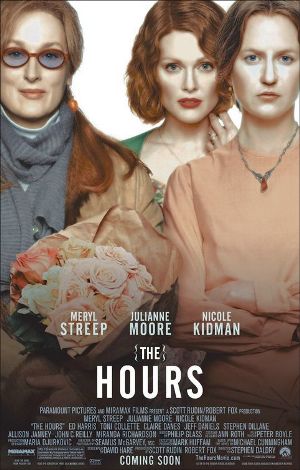
The Hours (2002)

The_Hours_posterDirected by Stephen Daldry

When I saw the poster for this movie, my first thought was, “Wait. It says Nicole Kidman is in this movie, but none of those three women are Nicole Kidman. Why isn’t she on the poster, and why doesn’t the third lady on the poster get higher billing?” So I looked it up on IMDb and realized that the makeup people did an amazing job; they managed to make Nicole Kidman look frumpy.

So what’s the story? Three different women from three different time periods have three parallel days that are all connected by parties, mental illness, and Virginia Woolf’s novel Mrs. Dalloway. I realize that doesn’t sound terribly exciting, but it’s a hard movie to sum up.

The Good: Like I said earlier, the makeup artists were amazing. They did a good job making Nicole Kidman look like Virginia Woolf, but they also did a fabulous job of aging Julianne Moore fifty years. Apparently, they weren’t eligible for an Oscar because a little bit CGI was used to make Nicole Kidman’s false nose look flawless, but still. Major kudos to them.

Major kudos also goes to the editors. The director is telling three different stories, but he jumps around from story to story often. The editing had to make that feel seamless and show the parallels in the different stories. It was very well done.

The soundtrack was beautiful, a lovely piano score. I thought it sounded very similar to the music from The Truman Show; sure enough, Philip Glass did the scores for both. But even though it wasn’t the most original, it was so lovely that it made me want to find some sheet music and learn it.

The acting was excellent. Nicole Kidman completely inhabited Virginia Woolf. Julianne Moore played a frustrated 1950s housewife, and Meryl Streep gave a moving performance as the woman of today (or 2001. But that was today when the movie was made.). John C. Reilly played Moore’s incredibly devoted husband, and Ed Harris was a poet dying of AIDS, a former lover of Meryl Streep’s character. Miranda Richardson felt completely natural as Virginia Woolf’s sister Vanessa.

The Bad: This movie is based on a book (which I haven’t read, so I can’t compare anything), and it shows. All three main character women spend a lot of time staring into space. I’m sure that in the novel, they are having deep thoughts, but those thoughts don’t always make it across on the screen. That got annoying.

I also felt like the three stories didn’t fit together as well as they should. Meryl Streep’s character had many parallels to Mrs. Dalloway, even down to the names, and her story dovetailed neatly with Julianne Moore’s, but the only connection that Julianne Moore had to Virginia Woolf was that she was reading Mrs. Dalloway, and I wanted it to be better than that.

The Ugly: Confession time: I struggle with depression. I have been suicidal in the past. I am a woman who doesn’t quite fit in her society. And even with all that, I never felt a deep connection with this movie. Maybe it was because we couldn’t get a deep look at these women’s inner thoughts, but it felt so shallow. The only woman I really felt like we got a good, sympathetic look at was Virginia Woolf; I would have happily watched an entire Virginia Woolf biopic starring Nicole Kidman and Stephen Dillane because they were the only very well-developed characters. That shouldn’t happen in a character-driven movie.

Oscars Won: Best actress in a leading role (Nicole Kidman).

Other Oscar Nominations: Best picture; best actor in a supporting role (Ed Harris); best actress in a supporting role (Julianne Moore); best director; best writing, adapted screenplay; best costume design; best film editing; best music, original score.