I'd like to spank the Academy

Posts tagged ‘1870s’

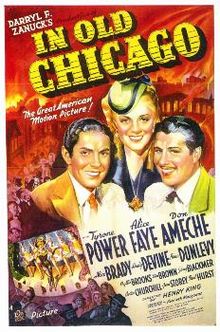
In Old Chicago (1937)

In old chicagoDirected by Henry King

Chicago politics. The Chicago Fire of 1871. Close brothers who become rivals. With all of these elements, what could go wrong? A lot, actually. While there were some exciting scenes, In Old Chicago left much to be desired.

So what’s the story? The O’Leary brothers are polar opposites. Straight-arrow Jack is an attorney who always fights for the underdog. Charmingly roguish Dion runs a saloon, but he has bigger plans. He will use anyone and anything to get what he wants. Jack and Dion’s ideals will be tested for once and all on the night of the Great Chicago Fire of 1871.

The Good: There was some good acting. Alice Brady stole the show as Mrs. O’Leary (yes, THAT Mrs. O’Leary). Don Ameche is strong as Jack, and Alice Faye makes a wonderful singer/saloon owner/woman in love with Dion. Dion’s character is a little inconsistent, but Tyrone Power does an excellent job with what he’s given.

The production design was impressive. There is a huge contrast in all the buildings, from the opulence of the saloons to the humble O’Leary home to the elegance of the Mayor’s office. It brought to life the different factions of Chicago society. Also, the streets were disgustingly muddy. Historical films don’t always remember to put in small details like that. I loved it.

I wasn’t going to be impressed with the actual fire scenes; it was 1937. How convincing could it be? That was a bad call on my part. The fire is amazing, possibly even better than the burning of Atlanta in Gone with the Wind two years later. It was just…wow.

The Bad: While I acknowledge that several scenes take place in saloons and that the producers were trying to showcase Alice Faye’s famous voice, there were too many musical numbers. They slowed down the conniving and the action, and they weren’t particularly entertaining.

While In Old Chicago has a good story with lots of potential drama, the movie felt really shallow. The screenplay left the characters feeling flat and uninteresting, except for Dion. He has the opposite problem. His character changes at the drop of a hat. One minute he’s a rogue with a twinkle in his eye, the next he’s completely evil. Then suddenly, he remembers how much he loves his brother and is perfectly good. It’s just not believable.

The Ugly: Rape isn’t a joke, although they play attempted rape as funny twice. Forcing a girl to kiss you and then threatening to rape her will not get you a business partner or a loving wife. Not cool, 1937.

Oscars Won: Best actress in a supporting role (Alice Brady); best assistant director.

Other Oscar Nominations: Best picture; best writing, original story; best sound, recording; best music, score.

High Noon (1952)

high noonDirected by Fred Zinneman

I love westerns. It’s probably because I watched so many of them growing up that now they make me feel like a little kid again. Whatever the reason, I’m always glad when they show up on the list of best picture nominees. However, High Noon isn’t exactly a western. It’s a thriller that just happens to take place in the Old West. It’s about relationships and small towns and above all, people. I’ve seen it before, but it’s always exciting to watch.

So what’s the story? Will Kane has just married his Quaker sweetheart and given up his marshal’s badge when he gets a telegram that Frank Miller, a murderer that he arrested, has been let out of prison. He’s set to arrive on the noon train and hell-bent on getting revenge on the man who sent him to prison. Miller’s old gang is already waiting for him at the platform. Realizing that a true man faces his problems, Will refuses to run, but can he get the help he needs from the townspeople he’s protected in the past?

The Good: High Noon happens in real time. It’s about 10:40 when Marshal Kane gets his telegram, and an hour and twenty minutes later in real life, the train comes in. This adds to the tension in a way that very few things could have. I’m not sure if High Noon was the first movie to use this tactic, but it’s very effective.

The editing is fantastic. I love really good editing, but sometimes I feel like good editing can be hard to spot. Every once in a while, though, I’m blown away by it. That’s what happened in High Noon. After all the tension has built up and the train is finally coming into town, there are shots of all the different groups waiting for the train to stop. The editing makes that part of the movie so stressful. It’s awesome.

Once again, the acting is superb (can a movie be nominated for best picture without having at least some good acting?). Gary Cooper plays Will Kane, a man committed to his path even though it may cost him the woman he loves. Grace Kelly plays his bride, Amy, who is understandably frightened at the prospect of losing her new husband. Bitter deputy marshal Harvey is played wonderfully by Lloyd Bridges. Even Henry Morgan (aka Colonel Potter in M*A*S*H) has a small role. But the standout actress in High Noon is Katy Jurado as Helen Ramirez. She is ridiculously good in her rather complicated role.

Helen Ramirez is actually another wonderful thing about this movie. Minorities in westerns generally only have tiny roles, and they are usually horrifically stereotypical. However, while Helen is a scarlet woman, she is smart, strong, passionate, and fair. She isn’t scared of anything and she doesn’t take anything from anyone. I love her. She’s a great character.

The cinematography is great. It manages to highlight Will’s forced solitude and the attitudes of the people surrounding him. It does what good cinematography should do.

The Bad: There is nothing bad about High Noon. Everything about this movie is either on fabulous or horrifically bad. I suppose I could say that it’s not fun to watch Thomas Mitchell, one of my favorite character actors, not be awesome. That’s just how the story goes, though.

The Ugly: The title song is awful. I think I could have rationalized it as a 1950s cowboy song if it weren’t for the fact of these two lines:

He made a vow while in state prison
Vowed it would be my life or his’n.

I think it should be a crime against the arts (is that a thing? Can we make it one?) to use “his’n” as a rhyme for “prison”. Bad, bad, bad. Even then, I might have been able to make my peace with it if bits of the song (including that line) didn’t keep playing throughout the movie and reminding me of its existence. The musical score by Dimitri Tiomkin itself is very good, but this song… So bad.

Oscars Won: Best actor in a leading role (Gary Cooper); best film editing; best music, original song (“High Noon [Do Not Forsake Me, Oh My Darlin’]”); best music, scoring of a dramatic or comedy picture.

Other Oscar Nominations: Best picture; best director; best writing, screenplay.

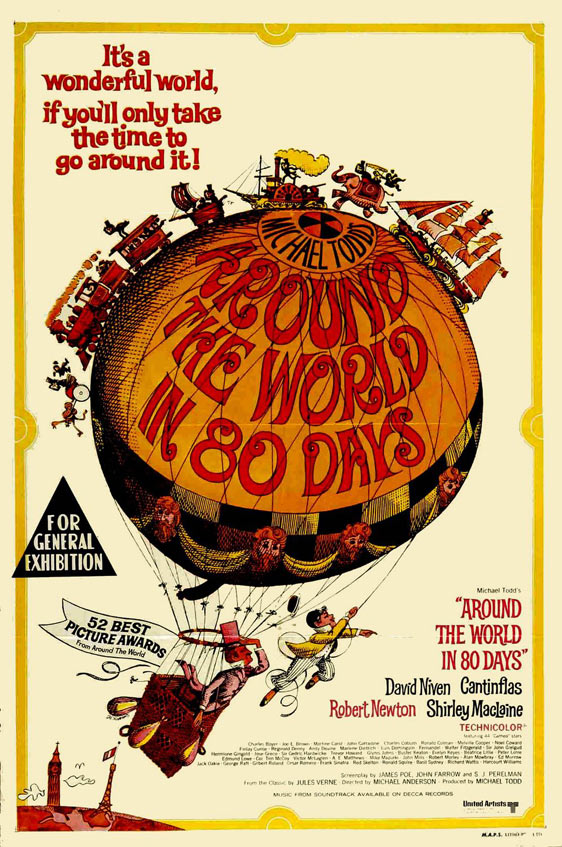
Around the World in Eighty Days (1956)

around_world_80_daysDirected by Michael Anderson

I had a patron come into the library where I work one day and ask for Cantinflas movies. I had no clue what he was talking about. He wrote the name down for me because I couldn’t spell it well enough to look it up in the catalogue, and I found some Spanish-language movies for him. The patron was honestly surprised that I had never heard of Cantinflas. I was surprised, but very pleased, to find Cantinflas in Around the World in Eighty Days. I’ve read the book, but I hadn’t seen the film before this week. The entire movie was a delightful surprise.

So what’s the story? Phileas Fogg, a wealthy, eccentric Englishman, bets the men in his club that he can travel all the way around the world in just eighty days. With nothing more than his newly hired manservant Passepartout and a carpetbag full of money, Fogg sets out on an amazing adventure.

The Good: This is another epic with thousands and thousands of people in it. It seriously boggles the mind that movies like this can come together. Coordinating all the details must have been ridiculous, but the work paid off. There are very many good things in this movie.

The cinematography is gorgeous. Many scenes were filmed on location, which takes extra work, but was absolutely worth it. Besides the beautiful scenery they were able to capture, it means that there were no places where you could tell that the actors were standing in front of a screen with a movie projected behind them. (I’m sure there’s a technical term for that, but I have no idea what it is. If anyone knows, please enlighten me!)

The music, by Victor Young, is also fabulous. At times it is sweeping and beautiful; other times, it is cheerful and jaunty. It fits the movie very well.

The cast was fun. Cantinflas, a Mexican comedic actor, is really good as Passepartout. He has a wide range of skills that fit the role and brought some good comedy to the movie. David Niven is good as a very English Englishman. But what is really fun about this movie is the cameos. So many famous people are in this movie, from Noel Coward to Marlene Dietrich to Frank Sinatra. My personal favorite was Buster Keaton, who talks! I’ve seen lots of his movies, but I’ve never heard him talk before. And he was a train conductor like in The General, which may be literally the funniest movie I have ever seen. Anyway, if you like classic movies, then you will enjoy spotting the stars.

The Bad: Shirley MacLaine was cast as an Indian (eastern, not American) princess. It was an odd choice. She didn’t do a horrible job, but she never convinced me that she was Indian, either.

The Ugly:  This movie needed some more editing. Some scenes are fine for a while, but then they don’t end. The bullfighting scene was the worst offender here. It just went on and on.  Around the World in Eighty Days didn’t need to be a three-hour movie. It would have been just fine at two and a half hours. As it is, there are some boring times.

Again, there is some ugly racial stereotyping because not only was this movie made in the 1950s, it is based on a book written in 1872. It’s not surprising, but it’s not good, either.

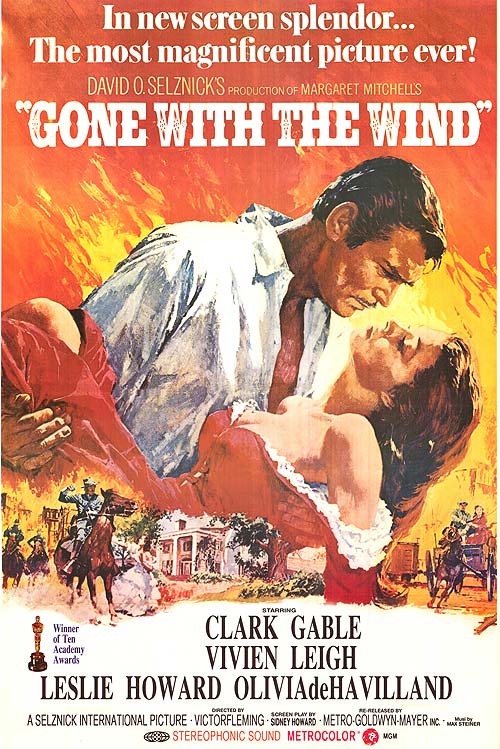
Gone with the Wind (1939)

gone with the windDirected by Victor Fleming

As I’ve been doing this project, I’ve noticed something that a lot of nominees have in common: they are freaking long. I have felt every minute of some of those three-hour movies (I’m looking at you, Thin Red Line!), while others have kept me captivated. Gone with the Wind is almost four hours long, but I didn’t feel it. I had seen bits and pieces growing up, but I watched the whole movie in one sitting when I was eleven. I’ve seen it several times since, including once in the theater when it was re-released for an anniversary event. And every single time I’ve watched it, I’ve been glued to the screen. It doesn’t matter that I know how it ends. The world of Gone with the Wind was so skillfully built that I can’t tear myself out of it. The characters are so real that they almost feel like friends; their triumphs and miseries become ours. That, my friends, is how you make a three-hour-plus movie fly by.

So what’s the story? Spoiled Southern belle Scarlett O’Hara’s world comes crashing down around her when the American Civil War begins. Her life of parties and flirting is over. As she tries to adjust to the harsh realities of her new life, she learns that she will do anything to keep what she loves. (That summary makes it sound boring. Trust me, it’s not.)

The Good: There are so many good things in Gone with the Wind that it’s hard to know where to start. I think I will change it up and start with cinematography. Gone with the Wind is a beautiful movie, full of glowing sunsets and billowing ball gowns. It’s not always pretty, though; the scene at the depot where the soldiers are lying dead in rows is tragic. The birth of Melanie’s son, where everything is shown in silhouette, is exquisitely done. These are just the highlights, though; there are lots of scenes where the camera work more quietly underscores the action or the emotion of the scene.

The costume design is also good. This movie is why I can complain about other movies’ lack of good historical costume. In Gone with the Wind, the fashions change with the times, like fashion does in real life. Not only that, but the clothes are fairly accurate (as far as I know. I am not a fashion historian; I have only picked up tidbits here and there.). I do know that the shape of the hoops change correctly for the times, which may only be a small detail, but it shows that the designer cared enough to do actual research.

The score is sweeping and beautiful and just a little bit over the top, which fits the epicness of this movie. Everything about Scarlett is dramatic, and it’s appropriate that the music in her movie is, too.

It is very easy to forget in this day and age that in 1939, everything in a movie was real. If you wanted a huge crowd of people, you had to hire actual people. If you wanted a fire, you had to burn something. There are some crazy special effects in this movie. I seriously wonder how they managed to film some of the scenes. Special effects took a certain kind of creativity back in the day, and have to give kudos to the special effects people for this movie.

Whoever adapted the giant book Gone with the Wind into a single (albeit long) movie was amazing. He found the most important things, the things that would make a compelling movie and took those out. He knew what to leave out; it was all good stuff – Ellen’s backstory, Scarlett’s other children, Will Benteen – but wasn’t necessary to the movie. Those extra things that fleshed out the novel would have bogged down the movie. It’s an excellent adaptation.

The entire cast of Gone with the Wind is stellar. After I had watched Dark Victory, I was thinking that maybe Bette Davis should have gotten the best actress Oscar, but when I saw Vivien Leigh’s performance again, I had to admit that Vivien Leigh deserved it. Clark Gable as gave an awesome performance as Rhett Butler. He is so good as the strong, manly lover hiding his love behind pride and lust. The flash of hurt on his face when Scarlett admits that she’s marrying him for his money…so sad. And that kind of thing happens more than once. It’s very subtle and very good. Olivia de Havilland plays Melanie Wilkes so beautifully. She manages to be an angelic, self-sacrificing person and yet not make you hate her. And she was only 23 when the movie came out. That was some serious acting for such a young woman. There is some controversy over Hattie McDaniel’s role as Mammy, Scarlett’s nurse/surrogate mother, but she plays the role well and allows us to see the main characters in a different light as she isn’t shy about expressing her opinions.

The Bad: This is an extremely frustrating movie to watch. Rhett loves Scarlett, but is too proud to admit that he’s actually fallen in love. Scarlett is too caught up with her make-believe love for Ashley to notice. When Rhett makes her notice, he is so ashamed of what he’s done that he doesn’t see the opening Scarlett is giving him. When he rejects her at that point, Scarlett is too proud to say anything. Grrrrr. These are two very strong, proud people who are so scared of showing weakness that they can’t allow happiness in. It makes me want to shake them both.

The Ugly: The movie laments the passing of a “beautiful, genteel” culture, but glosses over the evils that that culture is built upon. Slavery made that lifestyle possible, and so it’s hard to feel too sorry for the O’Hara family when they have to pick their own cotton and for Ashley Wilkes when he is splitting rails. Yes, it’s hard, and it’s not what they were brought up to do, but they were brought up to live off of the misery of others. Ashley briefly acknowledges this, but only briefly. Frankly, it was a culture that deserved to die. I can still enjoy the movie, but it doesn’t make me mourn the passing of the Old South.

Oscars Won: Best picture; best actress in a leading role (Vivien Leigh); best actress in a supporting role (Hattie McDaniel); best director; best writing, screenplay; best cinematography, color; best art direction; best film editing.

Other Oscar Nominations: Best actor in a leading role (Clark Gable); best actress in a supporting role (Olivia de Havilland); best sound, recording; best effects, special effects; best music, original score.

Other Oscars Won: Honorary award to William Cameron Menzies “for outstanding achievement in the use of color for the enhancement of dramatic mood in the production of Gone with the Wind”.

Technical Achievement Award to R.D. Musgrave “for pioneering in the use of coordinated equipment in the production Gone with the Wind”.