I'd like to spank the Academy

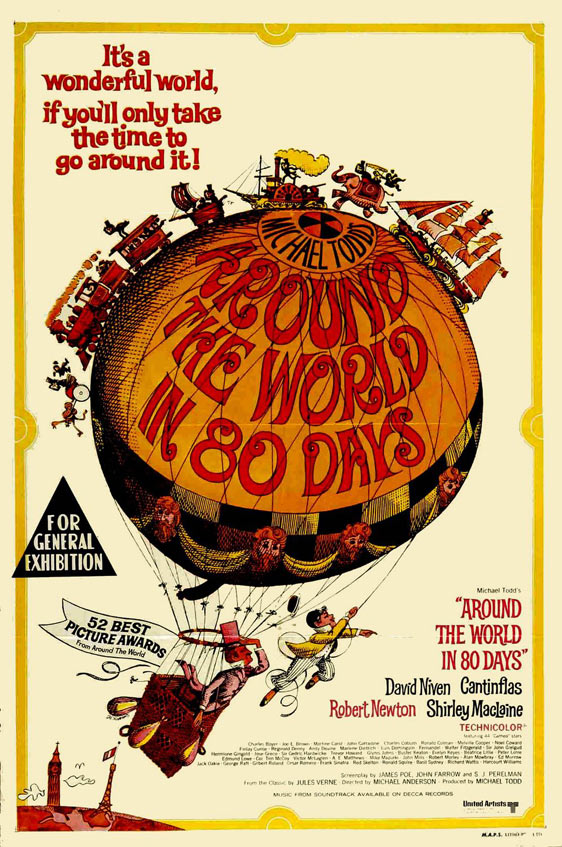
around_world_80_daysDirected by Michael Anderson

I had a patron come into the library where I work one day and ask for Cantinflas movies. I had no clue what he was talking about. He wrote the name down for me because I couldn’t spell it well enough to look it up in the catalogue, and I found some Spanish-language movies for him. The patron was honestly surprised that I had never heard of Cantinflas. I was surprised, but very pleased, to find Cantinflas in Around the World in Eighty Days. I’ve read the book, but I hadn’t seen the film before this week. The entire movie was a delightful surprise.

So what’s the story? Phileas Fogg, a wealthy, eccentric Englishman, bets the men in his club that he can travel all the way around the world in just eighty days. With nothing more than his newly hired manservant Passepartout and a carpetbag full of money, Fogg sets out on an amazing adventure.

The Good: This is another epic with thousands and thousands of people in it. It seriously boggles the mind that movies like this can come together. Coordinating all the details must have been ridiculous, but the work paid off. There are very many good things in this movie.

The cinematography is gorgeous. Many scenes were filmed on location, which takes extra work, but was absolutely worth it. Besides the beautiful scenery they were able to capture, it means that there were no places where you could tell that the actors were standing in front of a screen with a movie projected behind them. (I’m sure there’s a technical term for that, but I have no idea what it is. If anyone knows, please enlighten me!)

The music, by Victor Young, is also fabulous. At times it is sweeping and beautiful; other times, it is cheerful and jaunty. It fits the movie very well.

The cast was fun. Cantinflas, a Mexican comedic actor, is really good as Passepartout. He has a wide range of skills that fit the role and brought some good comedy to the movie. David Niven is good as a very English Englishman. But what is really fun about this movie is the cameos. So many famous people are in this movie, from Noel Coward to Marlene Dietrich to Frank Sinatra. My personal favorite was Buster Keaton, who talks! I’ve seen lots of his movies, but I’ve never heard him talk before. And he was a train conductor like in The General, which may be literally the funniest movie I have ever seen. Anyway, if you like classic movies, then you will enjoy spotting the stars.

The Bad: Shirley MacLaine was cast as an Indian (eastern, not American) princess. It was an odd choice. She didn’t do a horrible job, but she never convinced me that she was Indian, either.

The Ugly:  This movie needed some more editing. Some scenes are fine for a while, but then they don’t end. The bullfighting scene was the worst offender here. It just went on and on.  Around the World in Eighty Days didn’t need to be a three-hour movie. It would have been just fine at two and a half hours. As it is, there are some boring times.

Again, there is some ugly racial stereotyping because not only was this movie made in the 1950s, it is based on a book written in 1872. It’s not surprising, but it’s not good, either.

ten_commandments_ver2Directed by Cecil B. DeMille

I was brought up in a religious family, and when I was growing up, TV and movies were not allowed on Sunday. The only exception was religious movies. I am from a family that loves movies, so I have seen The Ten Commandments a ridiculous amount of times. (Well, I’ve seen the first couple hours many times; I was usually sent to bed before the very end, so I’ve only seen the end probably five times.) My sisters and I can do entire scenes from memory, and we each have our favorite lines (“To me you’re a lily, and I want water!”). So the only way I could watch The Ten Commandments this time was in my parents’ basement with my family. We had two big bowls of popcorn and a solemn oath that we wouldn’t quote the lines before they happened because my brother-in-law had never seen it before. That was a hard promise to keep. Man, I love this movie.

So what’s the story? This epic (and epically long) movie tells the story of Moses from his birth to his death. It tells of his young manhood in Pharaoh’s palace, his banishment to the desert, his marriage to a shepherd girl and subsequent return to Egypt to free the Hebrew slaves. And yes, in the end he receives the Ten Commandments.

The Good: I think I will always marvel that epic movies with casts of thousands were made at all. For a movie this scale to work, so many people have to be involved. And The Ten Commandments takes this a step further. I felt like Cecil B. DeMille wanted everything to be as authentic as possible, so many things were meticulously researched. As I watched the opening credits, I was impressed not just by the number of experts that were consulted, but also their caliber. DeMille didn’t just make stuff up or go for a vaguely Egyptian feel. He found people who knew what they were talking about so that things would be authentic. This leads to amazing production design and great costumes.

Elmer Berstein’s score is amazing. It is at times melodramatic (Nefretiri’s theme, anyone?), but that is the nature of the film. The score manages to be dramatic and sweeping, but also reverent when it deals with religious things. That’s an impressive thing to do. Also, I have apparently seen this movie so many times that I can listen to the soundtrack and know what lines are being said. But that means that although the music has themes, Bernstein doesn’t repeat himself too much.

The acting is good all around. Charlton Heston does a good job playing a man trying to figure out who he is and what his place is in the world. Yul Brynner plays another man in authority, but Rameses is a totally different king than the one in The King and I, even though both men think Moses is a fool. I think that displays how good an actor Brynner really was. Anne Baxter schemes most convincingly, playing woman who is not necessarily bad, but willing to do whatever it takes to get what she wants (did she get this role because she was typecast after All About Eve?). Yvonne de Carlo as Sephora, Moses’s wife, Nina Foch as Bithiah, Cedric Hardwicke as Sethi –everyone is so good in this movie. I would name everyone, but again, there is a huge cast.

The special effects were amazing for their time. Some haven’t held up, of course, because The Ten Commandments was made almost sixty years ago. But some have held up surprisingly well. The hail that turns to fire still looks believable. That’s incredible to me.

The Bad: As much as I love this movie, I will be the first to admit that the screenplay is not the best. There are many, many cheesy lines.  These lines make the movie really fun to watch, but they are not an example of fabulous writing.

The Ugly: I didn’t find anything ugly in this movie. I enjoyed watching it as much this last time as I did when I was a kid. That’s not always the case for me.

Oscar Won: Best effects, special effects.

Other Oscar Nominations: Best picture; best cinematography, color; best art direction-set direction, color; best costume design, color; best sound, recording; best film editing.

The King and I (1956)

king and iDirected by Walter Lang

This is the second movie I’ve watched this week that I’ve seen more times than I can count, but it’s the first movie this week that was based on a play which was based on a book which was based on a true story. I loved musicals when I was young(which I think is funny considering how little patience I have with them now), and this was one of my favorite musicals. I can still sing along with all of the songs, and I think it will always have a special place in my heart.

So what’s the story? Anna Leonowens, a widowed Englishwoman, comes to Siam (now Thailand) to be the governess to the children of the king.

The Good: I love the music in this movie. I don’t love all of the songs, because I think there are one or two that slow the movie down, but most of them are enjoyable. And the score is amazing. All I have to do is see the cover of this movie and I have “The March of the Siamese Children” in my head. Not only that, but I am happy to have that song in my head. That never happens.

I like the lead actors in this movie. Yul Brynner plays a man who is trying to hold on to tradition and effect change at the same time. His inner struggle is plain on his face as he tries to make hard decisions. Deborah Kerr makes an excellent Anna. She is smart and determined and compassionate and courageous.

The costumes are gorgeous. Because of this movie, I have had a lifelong dream of polkaing in a dress with a giant hoopskirt. But Anna’s dresses are not the only beautiful ones in The King and I. The women of the court also wear lovely things. Even the king’s clothes are very sumptuous. It’s all very fun.

As impatient as I am with musical numbers that don’t help advance the plot or at least help with characterization, I love the Uncle Tom’s Cabin ballet. It’s different and beautiful and mesmerizing. I’m glad it’s in the movie.

The Bad: It bothers me a little bit that many of the “Asian” people in The King and I were played by Latinos. I can see the reasoning behind hiring Rita Moreno, because she’s amazing, and who wouldn’t pick Rita Moreno if she were a choice? But were the producers really unable to find enough children to play the king’s children who were, if not Thai, at least Asian? There weren’t ten to fifteen Asian kids living in California in 1956?

The Ugly: I have seen this movie many times, and it never bothered me before, so maybe I’m being ultra picky, but the attitude of the movie toward Siam in general and the king in particular is very condescending. There is very much an air of “everything in European culture is good because the Europeans are so enlightened, but there is nothing good about Siamese culture.” The king is only admired because he is trying to westernize his country. He makes silly mistakes (like wanting to send only male elephants to America) that are then corrected by the superior Englishwoman. At one point, Anna tells her young son, Louis, that in many ways, the king was no older than Louis. Really? This is a grown man who had ruled a country and managed to keep it independent in a time of colonization. He is very different from an eight-year-old. I think this might not bother me so much if these characters weren’t based on real people, but since they are, I feel like the characterization of the king and the attitude toward Siam in general is very disrespectful. And yes, I understand that The King and I is from a different era, which is why I can still enjoy this movie. But I can also understand why it’s banned in Thailand. Not that I advocate banning, but I can sympathize with the feelings behind the banning in this particular case.

Oscars Won: Best actor in a leading role (Yul Brynner); best art direction-set direction, color; best costume design, color; best sound, recording; best music, scoring of a musical picture.

Other Oscar Nominations: Best picture; best actress in a leading role (Deborah Kerr); best director; best cinematography, color.

Giant (1956)

giantDirected by George Stevens

I had seen Giant before I watched it for my blog, but only once. I was probably seventeen, and while I was seriously underwhemed with the way the stars were aged, I liked the movie overall. But now that I’m older and more analytical (and possibly more cynical), I’m not as impressed with it as I once was.

So what’s the story? Texas rancher Jordan “Bick” Benedict, Jr. has come to Maryland to buy a stallion to improve his breeding stock. There he meets Leslie, a lovely and spirited society girl. After talking to each other for less than ten minutes, they are deeply in love. They marry and go back to Reata, Jordan’s ranch in dry, dusty Texas. They spend the next 25 years adjusting not only to each other, but to the changing world around them.

The Good: Perhaps because of his early death, James Dean still haunts pop culture. Before I actually saw him in anything, I thought people were overreacting a bit when they talked about how a great young actor was lost. But he really was that good. He brings a pathos to Jett Rink, a low-class ranch hand who strikes oil. Without James Dean, Jett would have been a slightly ridiculous character, but James Dean allows us to see his motivations, his dreams and desires. He makes him human. James Dean died before the filming of Giant was completed, but he left his mark on the film and on film history.

Three supporting actors really stood out. Mercedes McCambridge is Luz Benedict, Jordan’s crusty older sister. She loves Reata more than anything and can do anything a man can do on the ranch. (SPOILER ALERT)Her death, which happens so conveniently soon after Leslie comes to Texas, is really quite touching. Chill Wills plays Uncle Bawley, a kindly older gentleman who helps Leslie understand Texas and the Benedict children understand life. Jordan Benedict III is played by Dennis Hopper in what must have been one of his first big movie roles. Jordy is a rather quiet young man, but he is deeply passionate below the surface. It’s a very fine performance.

The Bad: I really enjoyed the first half of Giant. Up until the point where Jett finds his oil, it’s tight and focused. After that, it feels looser and more meandering. It doesn’t feel like it has a central focus. Jordan and Leslie and their relationship aren’t as important as they were, but nothing steps up to fill that vacuum. I don’t know if that’s how it is in the novel that Giant is based on, but it made the second half feel less meaningful and somewhat disconnected from the first half.

Giant must begin sometime in the 1920s since the movie spans 25 or 30 years, but you can’t really tell from the costume design. Elizabeth Taylor’s clothes are waaaay too 1950s-fashionable for the 1920s. The other costumes are not as bad. I guess it was decided that it wouldn’t do to have Elizabeth Taylor wearing thirty-year-old fashions. But I want Luz II’s white formal. It’s gorgeous.

The Ugly: The makeup in this movie is so bad that I have been using it as my standard of bad makeup for fifteen years. Elizabeth Taylor, Rock Hudson, and James Dean are “aged” thirty years by wearing grey wigs. That’s about it. That makes it hard to believe that Elizabeth Taylor and Rock Hudson are parents with grown children, let alone grandparents. It’s a little bit silly.

The thing I hated most about this movie is Leslie. She doesn’t grow or change at all in the course of the movie, even though she’s supposed to be about eighteen when she marries Jordan. She swoops in from Maryland and teaches all the ignorant, backward Texans what is acceptable in life. Yes, the Texans do have some deplorable attitudes, but the fact that Leslie is the only enlightened one is very grating. How exactly did a rich doctor’s daughter have so much life experience at eighteen that she has so much wisdom? It’s hard to watch a three-hour movie with a paragon as the main character. It makes it hard to suspend your disbelief.

Oscars Won: Best director.

Other Oscar Nominations: Best picture; best actor in a leading role (James Dean); best actor in a leading role (Rock Hudson); best actress in a supporting role (Mercedes McCambridge); best writing, best screenplay – adapted; best art direction-set direction, color; best costume design, color; best film editing; best music, scoring of a dramatic or comedy picture.

friendly-persuasion-movie-poster-1956-1020505962Directed by William Wyler

I had a bad day the day I watched this movie. I hadn’t felt well all day at work, but I didn’t feel bad enough to take time off. About five minutes after I got home from work, I was violently ill. It lasted about half an hour. I was feeling sick and weak when I put Friendly Persuasion in the DVD player.  But the moment the opening notes of the theme song started, I felt much better. Watching this movie is like being wrapped in a giant puffy quilt or getting a hug from someone you love. That may be because I was raised on this movie, but I like to think that the sweetness of this movie could make anyone’s day better.

So what’s the story? Jess and Eliza Birdwell are Quakers living in southern Indiana during the Civil War. Their older son, Joshua, is old enough to fight in the war, but the family’s pacifist beliefs keep him from joining up. Their daughter, Martha, is in love with their Methodist neighbor, who is a soldier. And their younger son, Little Jess, is in constant battle with Samantha the Goose. The family tries to simply go about their lives, but the war is about to come to them, forcing them all to make decisions of faith and love and conscience.

The Good: The cast is perfect. Jess is played by Gary Cooper, who makes Jess a slightly mischievous man who believes in his religion, but sometimes struggles to live up to the standards it sets for him. Dorothy McGuire plays Eliza, the Quaker minister who sometimes has to fight to keep her family on the straight and narrow. Anthony Perkins (yes, the same Anthony Perkins who is in Psycho) plays Josh, whose conscience tells him that fighting is a sin, but that his family is worth fighting for. Phyllis Love plays the lovesick Mattie almost uncomfortably perfectly. Robert Middleton plays family friend Sam Jordan with humor and love. Everyone is just good.

Okay, this is a weird thing, but I was struck as I watched  Friendly Persuasion this time by the goose. Or possibly geese? I’m not sure how one goes about training a goose. I can’t imagine that it’s easy. But that goose does all sorts of things. Even if it’s many geese all doing one trick, it would have taken lots of work. So hats off to the animal trainers for this movie!

I love the music for this movie. Pat Boone sings the theme song, and it’s beautiful. It reflects the mood of the movie: slow, yet loving. Dimitri Tiomkin’s score is also good, reinforcing the love and joy found in the Birdwells’ home life.

And speaking of the home life, I love that this family is a family. The children sometimes tease each other. They sometimes fight. The father defers to his wife, but he sometimes teases her and sometimes gangs up with his kids to get her to relax. The writers made the characters real people with faults and virtues. I love that.

The Bad: The plot isn’t perfectly linear. It meanders a bit. There are some scenes that add to the characterization of the people, but don’t necessarily add to the overarching Civil War plot. I’m okay with this in this movie because all these scenes are so delightful, but that also might be because I’ve loved Friendly Persuasion for a long time. Other people might not be so forgiving.

As Quakers, the Birdwells use speech that is a little bit different. They use “thee” and “thy” instead of “you” and “yours”. But to my German-speaking ear, they don’t use them quite correctly. This is apparently accurate for the Quakers, but it bothered me a little bit. It took me about a quarter of the movie to be okay with it.

The Ugly: I don’t think there is anything ugly about Friendly Persuasion, unless you object to a feel-good movie about a family trying to live according to their consciences.

Oscars Won: None

Oscar Nominations: Best picture; best actor in a supporting role (Anthony Perkins); best director; best writing, best screenplay – adapted; best sound, recording; best music, original song (“Friendly Persuasion (Thee I Love)”).

220px-54th_Academy_AwardsSome of the best picture nominees for 1981 were very typical. Inspirational dramas and historical epics often get nominated for best picture. But action/adventure movies and dark comedies are rarely ever nominated. I truly wonder why that is. If a movie makes us laugh, does that mean it doesn’t teach us about life? If there is more action than dialogue in a movie, does that automatically mean that it can’t make people think? And what does a “good” movie consist of? Raiders of the Lost Ark has entertainment value beyond measure, but it’s not about a serious subject. Reds is about the Russian Revolution, which is very serious. And Reds is rather dull. So which movie is better? Since both have good production values, I’m going with Raiders of the Lost Ark. Yes, art should show us something about life or ourselves. It should make us think about good and evil or if the life we’re living measures up to what we want it to be, but a movie can do that and be fun at the same time. I feel like the Academy may not value fun enough. That’s a huge lesson I took from the 1981 nominees (and from the fact that Guardians of the Galaxy wasn’t nominated for this last year).

The advantage to 1939 having so many nominees is that I saw almost all of the Oscar-nominated performances; that made it easy to judge whether or not I agreed with the decisions. But in 1981, things were spread out a little bit more. While it would be awesome to watch every movie ever nominated for every Academy Award, I have a job and a semblance of a life and simply don’t have the time to do that. So while I can’t say that Katharine Hepburn’s performance in On Golden Pond was the best performance of the year, I can say it was the best of those that I saw. I know that many people think she and Henry Fonda won only because of sentiment. Here are two actors from the golden age of Hollywood playing elderly people! Look how sweet! But I honestly thought Katharine Hepburn deserved her award. Henry Fonda, on the other, was also good, but not as good as Burt Lancaster in Atlantic City. Burt Lancaster made me care about an old criminal; he made Lou believable as a lover and a fighter. It was a much more difficult role than that of Norman Thayer, Jr., cranky yet lovable retired college professor. And Burt Lancaster is a Hollywood legend, too. If the Academy felt the need to give the award to an older actor, it should have been him.

Even though I love Raiders of the Lost Ark, I still think that the best movies need to be entertaining and meaningful. Chariots of Fire managed to do both. It’s the story of two men standing up for their principles through the medium of athletics. That’s not a typical story, and it is so well-written with such alive characters that you have to keep watching to find out if they will triumph. Raiders of the Lost Ark is gripping, too, but that’s because the action is non-stop. Practically every scene ends with a cliffhanger. You keep watching to make sure that everyone lives. It’s easier to keep people’s attention that way. It’s harder to keep people interested in characters who aren’t doing anything but running. That’s why I have to give the edge to Chariots of Fire. I think Raiders of the Lost Ark is a classic that will endure because people enjoy it, and I’m glad. But while I think it might be harder to convince someone to watch Chariots of Fire, the person who does will be more richly rewarded.

How do I rank the nominees?

5. Reds
4. On Golden Pond
3. Atlantic City
2. Raiders of the Lost Ark
1. Chariots of Fire

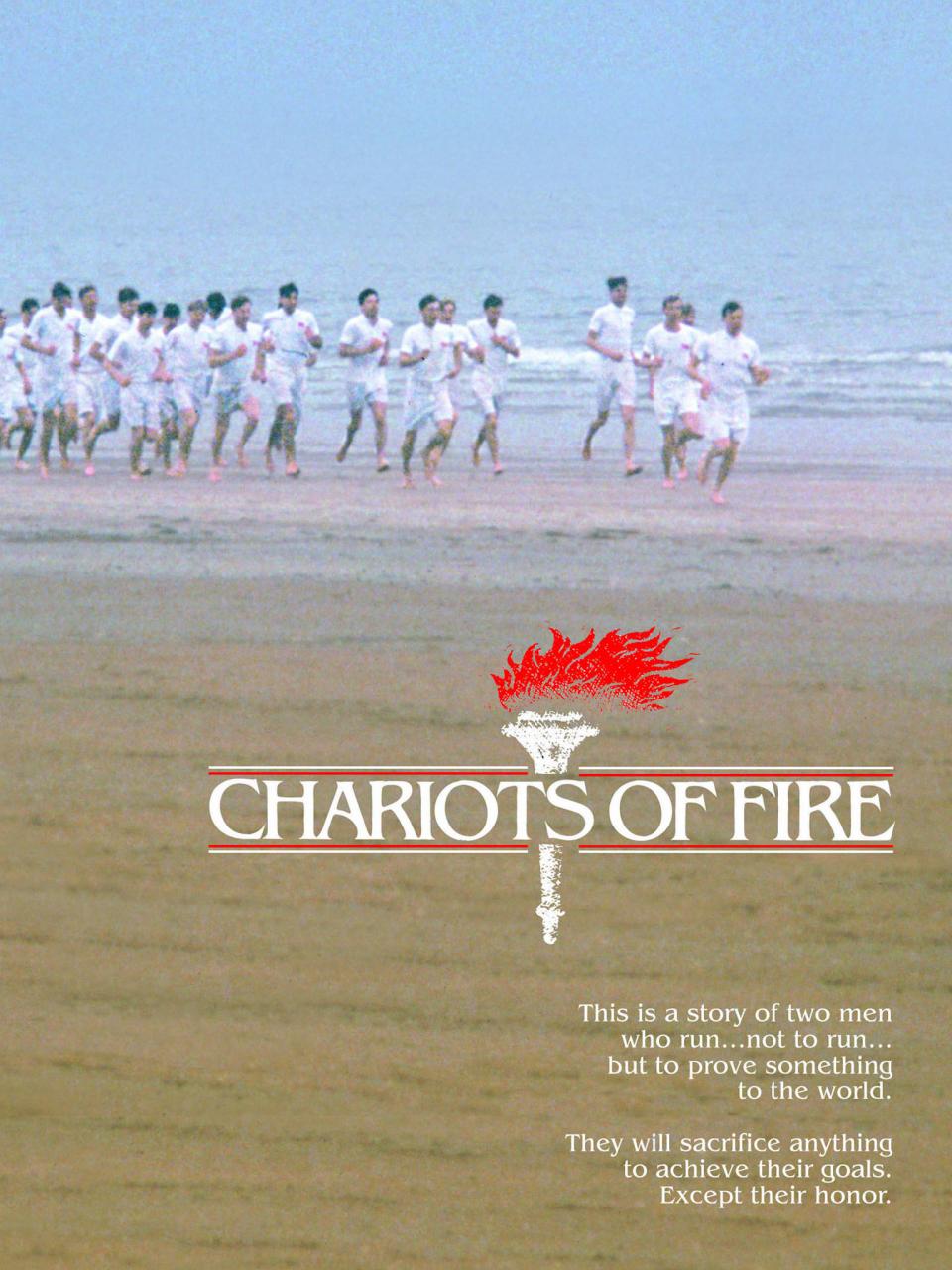
Chariots of Fire (1981)

ChariotsDirected by Hugh Hudson

This is another movie I grew up watching. My family must have an eclectic taste in movies, but I’ve never really realized that until now. Anyway, it’s always interesting to really pay attention to a movie you’ve seen a dozen times before. I noticed things and understood things differently than I ever had before. That might also have to do with the fact that I’m older and so see life a little bit differently than I did. But whatever the reason, watching Chariots of Fire again and trying to be impartial while doing so was a really good experience. And I think I will always be a little bit in love with Lord Lindsay.

So what’s the story? Harold Abrahams is an Englishman who goes to Cambridge and loves Gilbert and Sullivan. He’s also a Jew, which means that to some, he will never be entirely English. He runs to prove to everyone, not least himself, that he is as good as everyone else. Eric Liddell is a missionary who was born and grew up in China, but he also plays rugby for Scotland. He runs for the glory of God. These two men show their dedication in the 1924 Olympic games.

The Good: This movie has great acting. I’m honestly surprised that Ben Cross wasn’t nominated for a best actor Oscar for his portrayal of Harold Abrahams. Ian Charleston is just as good as Eric Liddell. The supporting actors are good as well. I noticed when I watched the famous running on the beach sequence that the four main runners (Harold, Eric, Aubrey Montague, Lord Lindsay) show their characters’ personalities in the few seconds that the camera is focused on them. It was all very well done.

This is the third movie that took place in a historical time this week, and this is the third one where the designer actually paid attention to what people were wearing at the time. Hooray for more correct historical costuming! Thank you, 1981!

I was impressed by the screenplay this time around. It’s based on a true story, but of course things are compressed or changed in time to make for a more streamlined story. All of the characters are distinct people with strong personalities. The story is inspiring, but it could have become overwhelmingly cheesy if the writers weren’t careful. The writers did an excellent job.

The Bad: I feel terrible saying this, but the music is bad. The themes are beautiful, and when the theme song is played on a piano or by an orchestra, I love it. However, the music in the movie is played on a synthesizer, and it just doesn’t work. It’s so very 1980s. It might have been fine if the movie took place in the 1980s, but it’s not okay in the 1920s. (And before anyone jumps down my throat for insulting the music, go and watch the movie. If you disagree with me after that…well, we will just have a difference of opinion. But it will be an informed difference of opinion.)

The Ugly: There is no ugly in this movie. It’s not perfect, but it’s really good.

Oscars Won: Best picture; best writing, screenplay written directly for the screen; best costume design; best music, original score.

Other Oscar Nominations: Best actor in a supporting role (Ian Holm); best director; best film editing.

220px-RedsposterDirected by Warren Beatty

I didn’t go into this movie with a very good attitude. I’m not a big Warren Beatty fan. I’m not sure why; he’s not a terrible actor. He just rubs me the wrong way, I guess. Maybe it has something to do with “You’re So Vain”. So I was already not looking forward to watching Reds because of Warren Beatty, and then I saw what the tagline was: “Not since Gone with the Wind has there been a great romantic epic like it!” That lowered my opinion of the movie even more. If a critic had compared it to Gone with the Wind, that would be one thing, but for people to say that about their own movie is silly. It makes filmmakers sound full of themselves, and it really lowered my expectations. But maybe the lowered expectations helped. Maybe I was able to enjoy Reds as much as I did only because it was better than I was expecting it to be.

So what’s the story? Louise Bryant is an outwardly respectable married woman living in Portland. She dreams of being a writer. She meets Jack Reed, a progressive journalist from the East and abandons her husband to go to New York with Jack. She meets his crowd of socialists and anarchists and is drawn in to their society as Jack travels the country agitating for socialism. Eventually the two travel to Russia and become involved in the Revolution.

The Good: Costume design! Yay! After watching many movies that couldn’t figure out how to do historical costuming, this was a nice change.

The supporting cast was very good. The standouts were Maureen Stapleton as activist and anarchist Emma Goldman and Jack Nicholson (whom I didn’t recognize behind the hair and the mustache) as playwright Eugene O’Neill. Each of them basically stole every scene they were in, and I wish they had both had a bigger part in the movie.

The Bad: I didn’t care for either Diane Keaton or Warren Beatty, which is bad since they play the main characters. Louise Bryant was supposedly this fascinating woman who attracted all kinds of men, but honestly, she was kind of bland. Yes, she got mad that her work wasn’t as good as Jack’s, but until that point and for a long while afterwards, she didn’t show much emotion. In fact, exasperation and anger with Jack were her two dominant emotions in the movie. Also, tiny annoyance, but her eye makeup was distractingly bad. Warren Beatty had a couple of good moments (the scene where Emma and Jack are arguing about the direction of the Revolution was fabulous), but there were not enough good moments to carry the movie.

This movie features elderly men and women who reminisce about Jack Reed and Louise Bryant and the times that Reds covers. While it was interesting to hear what they had to say, it really broke up the movie. The story would stop while the old people (“The Witnesses”) talked to the camera. The movie became half talking heads documentary, half biopic. While it was different and creative and probably why Warren Beatty won best director, it was distracting. Once or twice the words that The Witnesses were saying contradicted the story that was being told, which was jarring. And since there was a screenplay, it made me wonder whether what The Witnesses was saying was scripted. I felt like Beatty should have either made a documentary about Reed or just made Reds without The Witnesses. I really didn’t like it.

The Ugly: When your leads aren’t good and your story could be compelling but is too choppy due to interruptions from old people, a three hour movie doesn’t work. I got so very bored. I didn’t really care what happened to Jack and Louise. I thought that Louise was selfish and angry because she wasn’t as talented as Jack, and Jack was selfish and distracted because he was so talented, but I didn’t care about them. Gone with the Wind is forty-five minutes longer than Reds, but it flies by because the characters are so alive and compelling. You have to know what happens to them. Reds didn’t do that for me. I would have enjoyed a good documentary about Jack and Louise and their crazy New York group much more than this odd, indecisive, way-too-long movie.

Oscars Won: Best actress in a supporting role (Maureen Stapleton); best director; best cinematography.

Other Oscar Nominations: Best picture; best actress in a leading role (Diane Keaton); best actor in a leading role (Warren Beatty); best actor in a supporting role (Jack Nicholson); best writing, screenplay written directly for the screen; best art direction-set direction; best costume design; best sound; best film editing.

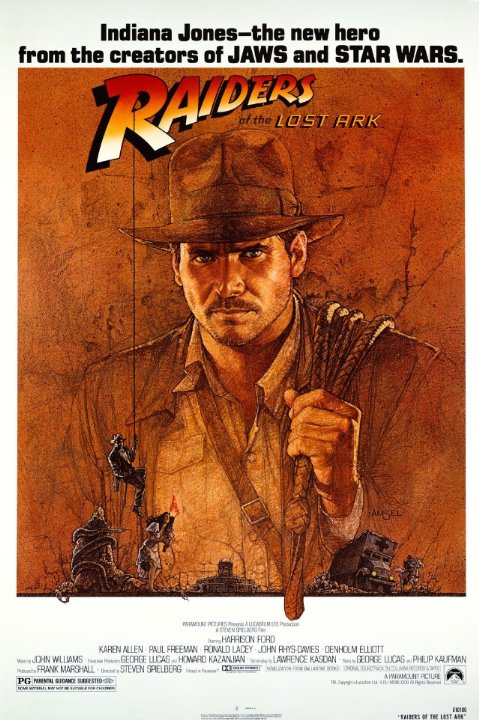
raidersDirected by Steven Spielberg

When I was little, I was seriously confused by this movie’s title. For a long time, I thought it was Raiders of the Lost Dark, and I could never figure out how the dark got lost. When I finally figured out it was Raiders of the Lost Ark, I was still confused. There was not a single reference to Noah in the entire movie. That didn’t keep me from liking the movie; I just ignored the confusing title and went along for the ride. And what a ride it is. Raiders of the Lost Ark remains one of the most purely fun movies I have ever seen, even though now it appears to have a new title: Indiana Jones and the Raiders of the Lost Ark.

So what’s the story? Dr. Indiana Jones, a professor of archaeology, is approached by two United States government officials. It seems that the Nazis are looking for the Ark of the Covenant because they believe it has mystical powers. Jones’s old mentor, Abner Ravenwood, is the world’s foremost expert on the Ark, but no one can locate him. Jones is tasked with finding first Ravenwood and then the Ark so that the Ark will be kept out of Nazi hands.

The Good: The thing that really sticks out for me in this movie is the pacing, which is kind of an odd thing to notice first off. But there is never a dull moment. It jumps from action scene to action scene. Even when there is a break from actual action, the scenes aren’t dull. The screenplay is fun enough and light enough to make even the longest talking scenes entertaining. It also means you can’t look away; you’ll miss something important if you do.

The characters in Raiders of the Lost Ark are very well-written, well-rounded characters. Marion Ravenwood is one of the best action movie heroines ever, I think. She never stands around and waits to be rescued. If there is danger, she always jumps in and gives as good as she gets. Yes, sometimes she does end up having to be rescued, but she only gets rescued after she’s done everything she possibly can to get out of the situation herself. She’s kind of an anomaly, not just for action movies, but for movies in general. Karen Allen played her perfectly. Indiana Jones is also a good character. He may be a terrible archaeologist since he is willing to destroy ancient temples to get the artifacts that he wants, but he’s still a good character. He can use a whip and shoot a gun and ride a horse and all those other things that good action heroes can do, but he’s also smart and not invincible. He gets hurt more than once. He would have completely lost that fight against the bald muscular German mechanic if not for the airplane propeller. I like that. What can I say? I’m a fan of imperfect main characters. Harrison Ford was a fabulous choice for the part.

I found myself admiring the production design that had been done for this movie. The designers not only had to make the audience believe that the action was taking place in the 1930s, but in various countries in the 1930s. It was really well done. Everything from the cars to the clothes to the buildings added up to a convincing 1930s.

John Williams wrote an amazing score for Raiders of the Lost Ark. It’s kind of dramatic, but so is the movie. The music underscores the action at the right moments and helps convey emotion. It’s very good, and it’s held up well. It’s as much fun to listen to now as it was thirty years ago.

The Bad: The action moves quickly, which prevents the viewer from asking too many questions. But something has always bothered me: how does Indiana Jones survive on the outside of a submarine that submerges? I know he’s pretty awesome, but I don’t think he can hold his breath that long. There might be other plot holes, too, but the awesomeness of the movie prevents me from thinking too hard about them.

The Ugly: If you don’t like spiders or snakes, beware. Raiders of the Lost Ark has plenty of both. It also has some graphic violence and special effects which hold up amazingly well. When I was a little girl, my parents would always tell me to close my eyes at certain parts so I wouldn’t get scared. As I grew up, I would close my eyes at those points out of habit. I don’t think I had seen the whole movie until I watched it this week. Sure enough, it is not much fun to watch faces melt and heads explode. (Honestly, though, it’s not the most violent or the worst violence I’ve seen in a movie; it’s not even the worst I’ve seen in the Oscar nominees. But I had to find something to put in The Ugly.)

Oscars Won: Best art direction-set direction; best sound; best film editing; best effects, visual effects.

Other Oscar Nominations: Best picture; best director; best cinematography; best music, original score.

Other Oscar Won: Special achievement award to Ben Burtt and Richard L. Anderson for sound effects editing.

On Golden Pond (1981)

On_golden_pondDirected by Mark Rydell

I’ve always liked the image evoked by the title of this movie. Golden Pond always sounded like such a lovely and peaceful place. But although I love Katharine Hepburn, I had never seen this movie. It was one of those that I always vaguely felt in the back of my mind that I should watch, but I had never made the effort. It turns out that it was a little bit hard to watch. My father is aging faster than I would like, and although I’ve always had a good relationship with him, this movie poked a sad spot in my heart. If actors like Katharine Hepburn and Henry Fonda can get old, what’s to stop the rest of humanity? It’s not comfortable to be confronted with mortality.

So what’s the story? Norman and Ethel are opening their summer house on the lake when they get a letter from their semi-estranged daughter, Chelsea. She wants to come for Norman’s 80th birthday and bring her boyfriend Bill to meet them. With Bill and Chelsea comes Billy, Bill’s thirteen-year-old son. Chelsea asks if they can leave Billy with Norman and Ethel while Chelsea and Bill go to Europe for a month. Norman, Ethel and Billy learn lessons about growing up and growing old during their summer together on Golden Pond.

The Good: Katharine Hepburn is good as always, although it is a little strange to see the normally elegant Hepburn flipping someone off and calling Henry Fonda “Old Poop.” But she sparkles with happiness at being in her beloved place and just generally glows. Henry Fonda also does a fine job as Norman, who is getting old and unsteady and losing his memory a bit. But it’s Doug McKeon as Billy who was the real surprise. He manages to hold his own while playing opposite two screen legends. He puts on a show of bravado, but underneath he’s a kid who is feeling abandoned and unwanted. His friendship with the irascible Norman is a lovely thing to see.

The filming location is lovely. I’m not sure where it was filmed, but the natural beauty of the land led to some nice cinematography.

The Bad: While I’m pretty sure the point of this movie was the reconciliation between Chelsea and Norman, I didn’t much care for the parts with Jane Fonda at all. She made Chelsea come off as a spoiled brat, even though Chelsea is a grown woman. The reasons for Chelsea’s problems with Norman were never made very clear, either. Yes, he’s a grumpy person and tends to snipe at people, but he does that to everyone. If the estrangement was about something other than that, it’s never said. That isn’t Jane Fonda’s fault; that’s just slightly sloppy storytelling. But it made Chelsea look oversensitive and whiny.

The movie is a bit over-scored for my taste. The music is good music, but there’s just too much of it for such a quiet movie. And during the scene in Purgatory Cove, the music sounded downright jaunty, even though the scene was not. It didn’t work for me.

The Ugly: I always hate admitting this because it makes me feel whiny and immature, but I got bored. There were scenes that I loved, but some parts just dragged on. I liked it a lot better once Chelsea and Bill left and it was just Ethel, Norman, and Billy. I could have watched more of that odd fellowship. Why did Chelsea have to be in it and ruin it with her whining? (And yes, I realize that I’m whining about whining.)

Oscars Won: Best actor in a leading role (Henry Fonda); best actress in a leading role (Katharine Hepburn); best writing, screenplay based on material from another medium.

Other Oscar Nominations: Best picture; best actress in a supporting role (Jane Fonda); best director; best cinematography; best sound; best film editing; best music, original score.