I'd like to spank the Academy

Archive for the ‘War’ Category

Born on the Fourth of July (1989)

Born_On_The_4th_Of_JulyDirected by Oliver Stone

Happy Independence Day! I thought that there could be no better day to review Born on the Fourth of July than actually on July 4. I remember when this movie came out. I was pretty sure it was about someone whose birthday was July 4, and I thought there could be no better thing. Fireworks on your birthday! How fun is that?* What I didn’t know was that even though Ron Kovic was actually born on the Fourth of July, the movie is not about someone’s amazing birthdays year after year.

So what’s the story? All-American kid Ron Kovic decides that it’s his duty to join the Marines and fight in Vietnam to stop the spread of Communism. He is injured and sent back home to a VA hospital, where he learns that he will never walk again. As he slowly becomes disillusioned by the way the government treats the veterans, he realizes that it’s possible to love America without blindly following the leaders. Ron begins to make his anger known, eventually becoming an anti-war activist.

The Good: I’ve never thought of Tom Cruise as a serious actor. He does action movies, and he does a good job in action movies, but I would not have guessed that Cruise could pull off a role like Ron Kovic. He does a really good job of being a man with a message, not just a man with a pretty face. The rest of the cast is also good, but the true standout is Willem Dafoe. He plays Charlie, another Vietnam vet who is also paralyzed. He’s not in the movie for very long; I’d say ten minutes at the most. But what he does in those minutes is amazing. His scene with Cruise is the best in the movie, the moment that made me connect with Ron more than at any other time. Although he was not nominated for best supporting actor, Dafoe’s performance is Oscar-worthy.

I was struck by the cinematography. When I hear the word “cinematography,” I often think of sweeping panoramic views. Born on the Fourth of July does have those, but Robert Richardson, the cinematographer, also uses extreme close-ups: the character’s faces fill the whole screen. This helps to highlight the inner struggles that the characters are feeling, as their world shrinks to nothing but what’s going on inside their heads. The editors worked with these shots, interchanging the shots of the characters as they argued to show that the characters were so wrapped up in themselves or their point of view that they couldn’t see anything else.

John William’s score is beautiful. Much of the orchestration uses a solo trumpet, which is reminiscent of soldiers fighting in wars, but which also represents Ron Kovic’s lonely fight, first against his own disillusionment, and then against the United States Government.

The Bad: The soundtrack is not great. Pop songs of the era are sprinkled throughout the movie. While some of the songs used fit naturally into the movie’s action, other songs seem to be placed completely randomly. There were way too many songs used, and “American Pie” was used twice. It almost felt like someone decided that they were going to put every single one of their favorite songs from the 1970s into the movie. It was so distracting.

I will get this out of the way before I criticize the storytelling of Born on the Fourth of July: Yes, I understand that this movie is based on a true story/an autobiography, and as such, had less leeway with how the story goes. However, what really bothers me about this movie was that they tried to show Kovic’s entire life. It starts with his idyllic childhood, showing him playing war and baseball with his friends, watching television with his family, and having his first kiss. Then it jumps to his high school days, with wrestling and the prom. Then Ron is on his second tour of duty for about 15 minutes, and then in the hospital, etc. Biopics do not usually try to show an entire life. There might be a flashback to childhood, or people may discuss their past with each other, but cramming in an entire life doesn’t really work. I suppose it’s the way it is because the real Ron Kovic wrote the screenplay with Oliver Stone; he probably felt like every bit of his life was important. But because Stone and Kovic tried to shove everything in, I had a harder time connecting to this movie. The characters were there and gone in a flash. I know that people can have an impact on you in just a few minutes in real life, but it didn’t allow for any relationships to come off as meaningful. Even Kyra Sedgwick’s character, Donna, who it seems is supposed to be Ron’s girlfriend, barely interacts with him. I had a hard time feeling Ron’s trauma from the war because only one quick incident from the war was shown. I feel like Stone and Kovic should have picked more impactful moments and perhaps taken a bit of liberty with the storyline to give it more focus. The meandering way that Kovic wanders through his story works well for books, but it’s not nearly as effective in movies. I usually like it when an author does the screenplay based on his work, but I think that’s not as good an idea for an autobiography.

I hate to compare movies; it’s just not fair. However, since The Deer Hunter, Coming Home, and Born on the Fourth of July are all stories about the Vietnam War and how it affected the people caught up in it, my subconscious comparison is more understandable. Both The Deer Hunter and Coming Home worked better as movies because they didn’t try to tell the backstories of every relationship. The backstories of the relationships come out more naturally in those movies because we see what their relationships are now. In The Deer Hunter, we don’t have to be told that Michael’s group of friends have been friends forever; it’s obvious in the way they interact with each other. We don’t have to be told that the whole town is devastated by the loss of their sons; it’s evident in the reactions of the people in the town to the tragedies of war. Born on the Fourth of July doesn’t get this quite right.

The Ugly: Again, I understand that it’s a true story, but it was incredibly selfish of Kovic to go tell Wilson’s family that Kovic himself had accidentally killed Wilson. It was self-indulgent, and while it may have been cathartic for him, it just added to the pain that the Wilson family was feeling. That scene left a bad taste in my mouth.

Oscars Won: Best director; best film editing.

Other Oscar Nominations: Best picture; best actor in a leading role (Tom Cruise); best writing, screenplay based on material from another medium; best cinematography; best sound; best music, original score.

*I could have a holiday celebrated with fireworks on my birthday, too, but I live in the wrong country.


The Deer Hunter (1978)

the-deer-hunterThe Deer Hunter
Directed by Michael Cimino

I knew The Deer Hunter was about Vietnam; I didn’t know that it was going to hurt my heart so badly.

So what’s the story? Mike, Steve, Nick, John, Stan, and Axel are a group of regular guys. They celebrate together, drink together, hang out together, hunt together. But then Mike, Nick, and Steve sign up to go fight in Vietnam. Their decision will change everyone’s lives forever.

The Good: In order to hurt the audience so much, the screenplay and actors first had to make us care about this group of very normal friends from a small town in Pennsylvania. Steve’s wedding is the setting to showcase the personalities of this diverse group. Mike (Robert De Niro) is slightly more mature than his friends. He takes things that he cares about very seriously. Nick (Christopher Walken) cares deeply about his friends and his girlfriend, Linda (Meryl Streep). Steven (John Savage) is so in love and so excited to marry Angela (Rutanya Alda) that he is willing to ignore the opinions that his Russian mother has about his fiance. Stan (John Cazale) is a ladies man who can’t understand anyone else’s point of view. John (George Dzundza) sings in the church choir, runs his bar, and is generally content with his life. He takes it upon himself to be the general peacemaker in the group and feels bad that his bad knees prevent him from going to Vietnam with his friends. Axel (Chuck Aspegren) is a good-hearted goofball who only seems to know one phrase. This extended setup not only makes us care, but it makes it hurt so much more when Mike, Steve, and Nick change so much, which the actors portray so heart-breakingly well. There is more that I want to say about the acting and the screenplay, but I’m trying so hard not to spoil anything for anyone. I will say this: some of the changes that people go through are more subtle than others; Christopher Walken does a ridiculously incredible job as Nick; I was glad that The Deer Hunter only showed some of the Vietnam War, because then you were able to feel the atrocities of war without being overwhelmed by them; and if you watch closely, the story mirrors itself, allowing the viewers to see people’s different reactions to the same or similar events. (If you’ve seen it and want to discuss it with me in the comments, be sure to label it if you put in spoilers.)

The music is beautiful and unobtrusive. The soundtrack is more classical than other soundtracks from 1978; no wailing saxophones here. The use of classical and popular music is managed very well. The chosen songs fit the moment they are in exactly. Stanley Meyers’s original theme, “Cavatina (Theme from The Deer Hunter)”, is fabulous, played quietly by guitarist John Williams (no, not THAT John Williams). It is iconic, one of those pieces that will always be associated with this movie. When I write these reviews, I usually like to listen to the soundtrack of the film I’m reviewing, but listening to “Cavatina” breaks my heart all over again, so I had to listen to other instrumental music so that I wasn’t too sad to write.

The editing was brutally disorienting at times. One moment the gang is all happy at home, and the next, Mike is fighting for his life in Vietnam. These cuts happen throughout the movie, and they can be disconcerting because we have no idea how we got there or what happened between the scenes. But life feels that way sometimes when we suddenly look around and realize where we are in life and then wonder how we got there. It’s also how we tell stories to people. No one ever says, “The ground starting shaking, and so I got in my car and drove down Main and then I turned right onto Elm and left onto High Street, went straight for two miles, and then I saw a monster rising out of the ground!” We leave out things that are not pertinent to the story. That’s why this editing works for this movie; it’s a story about everyday people, and the editing reflects that.

The Bad: Mike was a little too mature and heroic to be believable as a person. He’s too close to perfection for my liking.

The Ugly: Scenes of war will always be ugly and brutal and sad, which is why I’m glad The Deer Hunter acknowledges that no one is unaffected by war, and why I am also glad that the filmmakers were somewhat restrained in how much actual brutality they put into this movie.

Oscars Won: Best picture; best actor in a supporting role (Christopher Walken); best director; best sound; best film editing.

Other Oscar Nominations: Best actor in a leading role (Robert De Niro); best actress in a supporting role (Meryl Streep); best writing, screenplay written directly for the screen; best cinematography.

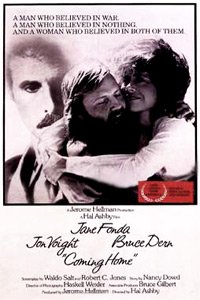
Coming Home (1978)

cominghome1Coming Home
Directed by Hal Ashby

 1978 is kind of a black hole in my movie world. This is another best picture nominated movie that I didn’t know anything about. When I picked it up from the library and saw that it was a movie about Vietnam starring Jane Fonda, I wasn’t thrilled. I’ve never been a fan of hers. But then I reminded myself that I loved watching Jane Fonda (and the rest of the cast) in Grace and Frankie, so I tried to put my prejudices aside and just lose myself in the movie, which turned out to be easy to do.

So what’s the story? Sally’s husband, Bob, is excited to be going to Vietnam to actually start doing his part in the Vietnam War. While he’s gone, Sally starts volunteering at the nearby VA hospital, where she reconnects with Luke, whom she knew in high school. Luke was injured in the war and is now a paraplegic. He is angry about the war, so naïve Sally tries to pull him out of his bitter shell. As they both wrestle with the tragic effects of war on so many different people, they find themselves falling in love.

The Good: Against my own expectations, I found myself very impressed with Jane Fonda’s performance as Sally. Sally grows slowly over the course of the film, and Fonda was able to show Sally’s progression from the little wife to a strong, brave woman. It’s a beautiful, heartbreaking piece of acting.

John Voight was equally good as Luke. I have prejudices against him, too (the Jim Phelps I know would never, ever betray the IM force), but since the long hair and beard helped disguise his face, I was able to appreciate his acting and feel the sadness, bitterness, and anger of a man returned from war, as well as his excitement when he started to feel that his life might get better.

The supporting actors were just as good as the leads. Penelope Milford played Vi, Sally’s free-spirited friend who worked at the hospital to be near her brother Bill, who came back from Vietnam with severe PTSD. Keith Carradine, who played Bill, and Bruce Dern, who played Sally’s husband, Bob, both portray men who can’t handle what happened in Vietnam, although they deal with it in different ways. Everyone in the movie is touched by the war somehow, and they were all able to show the different facets of living with something that can destroy men’s souls.

Both the music and cinematography in Coming Home were unusual in a good way. There was no original score, only songs that were from the time of the Vietnam War. When a song wasn’t playing in the background, there was no music at all, which added to the realism of the movie and forced the viewer to focus more intently on what is happening in the scene. The cinematography had a similar effect. There were a lot of shots of people’s hands as they were talking, underscoring what they were saying. This really stood out to me in the first scene, where actual veterans are having an unscripted conversation about the war, but it happened at other times, too.

The costuming and hair styles also underscored the changes people were making. As Sally found herself, she dressed in more comfortable, practical clothes instead of the dresses, heels, and pearls favored by the other officers’ wives. She let her hair be natural instead of straightening it. But when she went to Hong Kong to see Bob, she once again assumed the dress and appearance of a proper officer’s wife. It was a nice touch.

The Bad: Once again, I am so glad that I live now. The bad things in this movie are not problems with the movie, per se, but with the times. The attitudes towards women are terrible. Yes, I realize that people with the “men know best” attitudes still exist, but they aren’t as prevalent as they were. I’m also glad that PTSD is better understood and treated than it was in the past. I know treatment isn’t perfect, but it’s come a long way since the 1970s.

The Ugly: Coming Home isn’t a perfect movie, but there’s certainly nothing “ugly” about it.

Oscars Won: Best actor in a leading role (John Voight); best actress in a leading role (Jane Fonda); best writing, screenplay written directly for the screen.

Other Oscar Nominations: Best picture; best actor in a supporting role (Bruce Dern); best actress in a supporting role (Penelope Milford); best director; best film editing.

Zero Dark Thirty (2012)

PrintDirected by Kathryn Bigelow

When I’m deciding which year of movies I want to watch next, sometimes I let a random number generator pick. But when I chose the movies of 2012, I had a very specific reason in mind: I was in the mood to watch an action movie. There haven’t been a lot of action movies nominated for best picture, but I was certain that 2012 had two: Zero Dark Thirty and Argo. I hadn’t seen either one, but I knew that Zero Dark Thirty was about the assassination of Osama Bin Laden, which was exciting, so it had to be an action movie, right? Guess what. I was wrong. Don’t get me wrong; it’s a fantastic movie. It’s definitely not an action movie, though.

So what’s the story? Maya is a young CIA operative sent to Pakistan to protect the US from future terrorist attacks. It takes her ten long years of ferreting out information from the thinnest threads, but she is finally certain that she knows where Osama Bin Laden is hiding. Now she just has to convince the rest of the CIA.

The Good: Jessica Chastain is fabulous as Maya, the woman who believes in what she’s doing and refuses to budge on what she believes is correct. She’s tenacious and single-minded and tough. She doesn’t care about what other people think and she’s not ever going to give up. The part itself may seem a little cold, but Jessica Chastain does an excellent job. Her acting makes the ending perfect.

The supporting cast is solid. I love it when a movie has even the smallest role perfectly cast, and Zero Dark Thirty is one of those movies. If I made a list of everyone who does an amazing job in this movie, it would be really long, so I will just mention a couple. Jason Clarke and Jennifer Ehle both make fantastic CIA operatives. Kyle Chandler is good as Joseph Bradley, Maya’s boss who doesn’t really believe in her lead, but who knows that ignoring her is a bad idea. Joel Edgerton and Chris Pratt make excellent Seal Team Six members. But again, everyone is so spot on that it’s hard to pick out the best people.

I’ve watched other movies based on historical events that play fast and loose with dates and places (cough, Elizabeth, cough). I appreciated how places and dates were so specific. I even like the “chapters” that helped keep the story moving and showed how time passed, because frankly, spy work seems to move very slowly sometimes, and it would have been boring if every single step that Maya made to draw the lines and make the connections had been shown.

I loved the beginning. The lack of any images made the voices of September 11th so compelling that it drew me in and made me remember my September 11th experience. I don’t think that could have been done nearly so well if scenes from that day had been splashed on the screen.

The soundtrack is amazing. Music is used sparingly, so that when it happens, it really makes an impact. Most of the action happens to natural noises, which makes it more realistic, and the occasional music unobtrusively underscores the emotion. That was an excellent choice.

The screenplay manages not only to tell the story of what happened, but to make the characters feel real and believable. They have backstories and lives outside of what’s going on thanks to the screenplay, which I understand was rewritten after Osama Bin Laden was killed. I think it would be fascinating to know what the ending was going to be before that happened.

The Bad: Even though we all know how the story ends, the tension during the Seal Team Six scene is almost unbearable. That’s probably a good thing from a storytelling point of view, but for me, it’s as uncomfortable as watching a horror movie, especially since there are innocents involved.

The Ugly: The first twenty minutes or so of the movie are mostly scenes of torture, and there are other scenes of torture throughout. Bigelow doesn’t pull any punches or soften these scenes, and they are hard to watch. I know a lot of people believe that torture is sometimes necessary; I don’t want to get involved in any discussion about that. I’m just saying that it’s not an easy thing to see, especially knowing that torture happens in real life.

Oscar Won: Best achievement in sound editing (tied with Skyfall).

Other Oscar Nominations: Best motion picture of the year; best performance by an actress in a leading role (Jessica Chastain); best writing, original screenplay; best achievement in film editing.

Lincoln (2012)

Lincoln_2012_Teaser_PosterDirected by Steven Spielberg

This is yet another post that I had already written, but lost when I lost my flashdrive. On the bright side, that means I get to celebrate President’s Day by posting about Lincoln, which is a happy coincidence. It’s a great movie about a great man. I feel like I’m gushing, and I’m sorry, but it really is an amazing movie.

So what’s the story? In the last days of the American Civil War, Abraham Lincoln wheels and deals and does everything he can in order to pass the 13th Amendment to the Constitution, which will abolish slavery in the United States forever. He has a deadline, however; if the South rejoins the Union before the amendment passes, they will defeat the amendment and keep slavery legal.

The Good: Daniel Day-Lewis does it again. The man is a chameleon. I could pass him on the street and not have a clue who he is because he always becomes his character. I felt like I was watching real footage of Abraham Lincoln. Before I started watching these Oscar-nominated movies, I thought Daniel Day-Lewis was overrated. I will never think that again. I cannot believe how amazing he is in this part.

I am rarely struck by makeup and hairstyling, but there are so many actors in Lincoln that I am familiar with – and I didn’t recognize any of them except for Tommy Lee Jones. Even Sally Field is practically unrecognizable. Everyone looks period-correct, and it is impressive. The costuming adds to this, of course. You can see the different classes and stations in society through the clothes, and I love it.

Speaking of actors, the supporting cast is fantastic. Sally Field makes a wonderful Mary Todd Lincoln. She shows all the complexities of the woman, including her awareness of how her illness made Lincoln’s life more difficult. Tommy Lee Jones always plays crusty men well, but he is also tender in his portrayal of Thaddeus Stevens. I don’t usually like James Spader, because he always makes me feel slimy, but since his character is slimy, he works so perfectly. I didn’t feel that anyone did a poor job. This is another perfectly-cast movie.

The production design and the sets were another aspect that made the movie historically believable. The rooms were low-ceilinged and dim, even during the day. Everything is slightly dingy, as if covered by the ash of the fires. There is mud and dirt and grime and that’s how life was then.

John William’s score is surprisingly subtle for him. It’s beautiful and stirring and simple and just right for a movie about a brave, simple man.

The Bad: There is nothing bad about this movie. Nothing bothered me about it at all, except perhaps Tommy Lee Jones’ wig, but Thaddeus Stevens had a bad wig in real life, so there wasn’t much choice there.

The Ugly: There are some short ugly war scenes and reminders of the cost of keeping the war going so that the amendment could pass, but that’s realism, not bad filmmaking.

Oscars Won: Best performance by an actor in a leading role (Daniel Day-Lewis); best achievement in production design.

Other Oscar Nominations: Best motion picture of the year; best performance by an actor in a supporting role (Tommy Lee Jones); best performance by an actress in a supporting role (Sally Field); best achievement in directing; best writing, adapted screenplay; best achievement in cinematography; best achievement in film editing; best achievement in costume design; best achievement in music written for motion pictures, original score; best achievement in sound mixing.

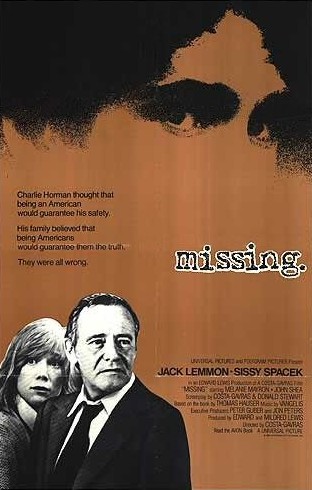
Missing (1982)

Missing_1982_filmDirected by Costa-Gravas

As I’ve been watching these Oscar-nominated movies, there have been many, especially from the 1970s and 1980s, that I haven’t really known anything about. Some of them have been less than stellar, and I can understand why they have fallen by the wayside, even for someone like me who likes watching good movies, no matter how old they are or what language they are in. Missing is not one of those movies. Missing is so awesome I want to show it to everyone I know, and I’ve been telling random people how sad I am that no one seems to have seen it. Missing makes me want to be a high school history or civics teacher so that I could show it to my class to teach them not to be too trusting of government. It makes me so mad that Missing is not a classic; it completely deserves to be one.

So what’s the story? Charlie and Beth Harmon are an idealistic young married couple who have been living in Chile for a couple of years when a right-wing coupe happens. They are going to leave the country soon, so Beth goes to say good-bye to a couple of friends. She gets stuck overnight because of the curfew. When she finally makes it home, Charlie is gone. About two weeks after his disappearance, Charlie’s conservative businessman father, Ed Horman, comes to help Beth navigate the waters of diplomacy and bureaucracy. What they find out together will change their lives forever.

The Good: I’m tired of starting with acting, so I’m going to start with music today. Vangelis’s score is beautiful and haunting. It’s more orchestral than the music in Chariots of Fire, and where he does use the synthesizer, it fits the time much better. The other thing that is great about the music is that it is not constant. Lots of the movie has no music, so that where there is music, it has a much greater impact.

The acting is wonderful. Sissy Spacek is wonderful as Beth, who changes from a vibrant, loving young woman to a frantic wife to a jaded and accepting woman in the course of just a few weeks. It’s a marvelous performance. Jack Lemmon is fantastic as Ed, who starts out so convinced that he’ll be able to fix everything with connections, but slowly comes to realize the truth. I’ve only ever seen Jack Lemmon in comedies, so this was a revelation. John Shea plays idealistic, happy-go-lucky Charlie. He’s not in the movie much, but he leaves an impact when his character is gone. Government agent Captain Ray Tower is played rather chillingly by Charles Cioffi. He’s so scary in part because he’s so friendly, but you can tell he’s hiding the truth.

This is going to sound silly, but the set decoration was so clever at one point. Beth and Ed are at the US Embassy, trying to get answers about what happened to Charlie. The US Ambassador is telling them that he’s probably in hiding and that they shouldn’t worry about him. While he is talking to them, he is standing directly under a picture of Richard Nixon. This movie takes place in 1973, so Nixon was the president then, but by the time Missing was made in 1982, everyone knew that Nixon was a liar. To see a man appointed by that president standing underneath him subtly, yet effectively, underscored the fact that the ambassador was also a liar.

The screenplay was very good. It made the characters come alive. It also made the movie completely gripping. I was so angry that I had to stop watching to go to work. I wanted to know what happened, and I wanted to know NOW! It was fantastic.

I have no concrete examples of why I felt this way, but I though the directing was very good. It’s hard to define good directing, because it’s hard for me to know how much of a hand the director had in various aspects of the movie, but I really felt good directing at play here.

The Bad: The only complaint I have is that Beth and Charlie’s friend Terry has 1980s poufy hair. As a free-spirited 1970s woman, Terry’s hair should have been longer and straighter. I know, tiny quibble. But it bothered me.

The Ugly: War is always ugly, and there are some shocking images and situations in this movie. It’s not the easiest movie to watch because of this, and also because this is a true story. Art that is great tends to bring up issues that might make people uncomfortable, but that doesn’t mean that these issues should be ignored. I think it’s better for people to know what is wrong in their world than to believe that everything is perfect when corruption is hiding underneath.

Oscar Won: Best writing, screenplay based on material from another medium.

Other Oscar Nominations: Best picture; best actor in a leading role (Jack Lemmon); best actress in a leading role (Sissy Spacek).

Friendly Persuasion (1956)

friendly-persuasion-movie-poster-1956-1020505962Directed by William Wyler

I had a bad day the day I watched this movie. I hadn’t felt well all day at work, but I didn’t feel bad enough to take time off. About five minutes after I got home from work, I was violently ill. It lasted about half an hour. I was feeling sick and weak when I put Friendly Persuasion in the DVD player.  But the moment the opening notes of the theme song started, I felt much better. Watching this movie is like being wrapped in a giant puffy quilt or getting a hug from someone you love. That may be because I was raised on this movie, but I like to think that the sweetness of this movie could make anyone’s day better.

So what’s the story? Jess and Eliza Birdwell are Quakers living in southern Indiana during the Civil War. Their older son, Joshua, is old enough to fight in the war, but the family’s pacifist beliefs keep him from joining up. Their daughter, Martha, is in love with their Methodist neighbor, who is a soldier. And their younger son, Little Jess, is in constant battle with Samantha the Goose. The family tries to simply go about their lives, but the war is about to come to them, forcing them all to make decisions of faith and love and conscience.

The Good: The cast is perfect. Jess is played by Gary Cooper, who makes Jess a slightly mischievous man who believes in his religion, but sometimes struggles to live up to the standards it sets for him. Dorothy McGuire plays Eliza, the Quaker minister who sometimes has to fight to keep her family on the straight and narrow. Anthony Perkins (yes, the same Anthony Perkins who is in Psycho) plays Josh, whose conscience tells him that fighting is a sin, but that his family is worth fighting for. Phyllis Love plays the lovesick Mattie almost uncomfortably perfectly. Robert Middleton plays family friend Sam Jordan with humor and love. Everyone is just good.

Okay, this is a weird thing, but I was struck as I watched  Friendly Persuasion this time by the goose. Or possibly geese? I’m not sure how one goes about training a goose. I can’t imagine that it’s easy. But that goose does all sorts of things. Even if it’s many geese all doing one trick, it would have taken lots of work. So hats off to the animal trainers for this movie!

I love the music for this movie. Pat Boone sings the theme song, and it’s beautiful. It reflects the mood of the movie: slow, yet loving. Dimitri Tiomkin’s score is also good, reinforcing the love and joy found in the Birdwells’ home life.

And speaking of the home life, I love that this family is a family. The children sometimes tease each other. They sometimes fight. The father defers to his wife, but he sometimes teases her and sometimes gangs up with his kids to get her to relax. The writers made the characters real people with faults and virtues. I love that.

The Bad: The plot isn’t perfectly linear. It meanders a bit. There are some scenes that add to the characterization of the people, but don’t necessarily add to the overarching Civil War plot. I’m okay with this in this movie because all these scenes are so delightful, but that also might be because I’ve loved Friendly Persuasion for a long time. Other people might not be so forgiving.

As Quakers, the Birdwells use speech that is a little bit different. They use “thee” and “thy” instead of “you” and “yours”. But to my German-speaking ear, they don’t use them quite correctly. This is apparently accurate for the Quakers, but it bothered me a little bit. It took me about a quarter of the movie to be okay with it.

The Ugly: I don’t think there is anything ugly about Friendly Persuasion, unless you object to a feel-good movie about a family trying to live according to their consciences.

Oscars Won: None

Oscar Nominations: Best picture; best actor in a supporting role (Anthony Perkins); best director; best writing, best screenplay – adapted; best sound, recording; best music, original song (“Friendly Persuasion (Thee I Love)”).

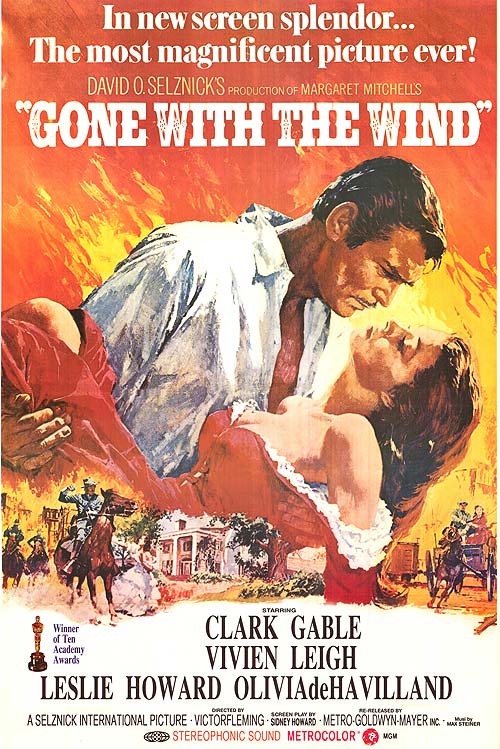
Gone with the Wind (1939)

gone with the windDirected by Victor Fleming

As I’ve been doing this project, I’ve noticed something that a lot of nominees have in common: they are freaking long. I have felt every minute of some of those three-hour movies (I’m looking at you, Thin Red Line!), while others have kept me captivated. Gone with the Wind is almost four hours long, but I didn’t feel it. I had seen bits and pieces growing up, but I watched the whole movie in one sitting when I was eleven. I’ve seen it several times since, including once in the theater when it was re-released for an anniversary event. And every single time I’ve watched it, I’ve been glued to the screen. It doesn’t matter that I know how it ends. The world of Gone with the Wind was so skillfully built that I can’t tear myself out of it. The characters are so real that they almost feel like friends; their triumphs and miseries become ours. That, my friends, is how you make a three-hour-plus movie fly by.

So what’s the story? Spoiled Southern belle Scarlett O’Hara’s world comes crashing down around her when the American Civil War begins. Her life of parties and flirting is over. As she tries to adjust to the harsh realities of her new life, she learns that she will do anything to keep what she loves. (That summary makes it sound boring. Trust me, it’s not.)

The Good: There are so many good things in Gone with the Wind that it’s hard to know where to start. I think I will change it up and start with cinematography. Gone with the Wind is a beautiful movie, full of glowing sunsets and billowing ball gowns. It’s not always pretty, though; the scene at the depot where the soldiers are lying dead in rows is tragic. The birth of Melanie’s son, where everything is shown in silhouette, is exquisitely done. These are just the highlights, though; there are lots of scenes where the camera work more quietly underscores the action or the emotion of the scene.

The costume design is also good. This movie is why I can complain about other movies’ lack of good historical costume. In Gone with the Wind, the fashions change with the times, like fashion does in real life. Not only that, but the clothes are fairly accurate (as far as I know. I am not a fashion historian; I have only picked up tidbits here and there.). I do know that the shape of the hoops change correctly for the times, which may only be a small detail, but it shows that the designer cared enough to do actual research.

The score is sweeping and beautiful and just a little bit over the top, which fits the epicness of this movie. Everything about Scarlett is dramatic, and it’s appropriate that the music in her movie is, too.

It is very easy to forget in this day and age that in 1939, everything in a movie was real. If you wanted a huge crowd of people, you had to hire actual people. If you wanted a fire, you had to burn something. There are some crazy special effects in this movie. I seriously wonder how they managed to film some of the scenes. Special effects took a certain kind of creativity back in the day, and have to give kudos to the special effects people for this movie.

Whoever adapted the giant book Gone with the Wind into a single (albeit long) movie was amazing. He found the most important things, the things that would make a compelling movie and took those out. He knew what to leave out; it was all good stuff – Ellen’s backstory, Scarlett’s other children, Will Benteen – but wasn’t necessary to the movie. Those extra things that fleshed out the novel would have bogged down the movie. It’s an excellent adaptation.

The entire cast of Gone with the Wind is stellar. After I had watched Dark Victory, I was thinking that maybe Bette Davis should have gotten the best actress Oscar, but when I saw Vivien Leigh’s performance again, I had to admit that Vivien Leigh deserved it. Clark Gable as gave an awesome performance as Rhett Butler. He is so good as the strong, manly lover hiding his love behind pride and lust. The flash of hurt on his face when Scarlett admits that she’s marrying him for his money…so sad. And that kind of thing happens more than once. It’s very subtle and very good. Olivia de Havilland plays Melanie Wilkes so beautifully. She manages to be an angelic, self-sacrificing person and yet not make you hate her. And she was only 23 when the movie came out. That was some serious acting for such a young woman. There is some controversy over Hattie McDaniel’s role as Mammy, Scarlett’s nurse/surrogate mother, but she plays the role well and allows us to see the main characters in a different light as she isn’t shy about expressing her opinions.

The Bad: This is an extremely frustrating movie to watch. Rhett loves Scarlett, but is too proud to admit that he’s actually fallen in love. Scarlett is too caught up with her make-believe love for Ashley to notice. When Rhett makes her notice, he is so ashamed of what he’s done that he doesn’t see the opening Scarlett is giving him. When he rejects her at that point, Scarlett is too proud to say anything. Grrrrr. These are two very strong, proud people who are so scared of showing weakness that they can’t allow happiness in. It makes me want to shake them both.

The Ugly: The movie laments the passing of a “beautiful, genteel” culture, but glosses over the evils that that culture is built upon. Slavery made that lifestyle possible, and so it’s hard to feel too sorry for the O’Hara family when they have to pick their own cotton and for Ashley Wilkes when he is splitting rails. Yes, it’s hard, and it’s not what they were brought up to do, but they were brought up to live off of the misery of others. Ashley briefly acknowledges this, but only briefly. Frankly, it was a culture that deserved to die. I can still enjoy the movie, but it doesn’t make me mourn the passing of the Old South.

Oscars Won: Best picture; best actress in a leading role (Vivien Leigh); best actress in a supporting role (Hattie McDaniel); best director; best writing, screenplay; best cinematography, color; best art direction; best film editing.

Other Oscar Nominations: Best actor in a leading role (Clark Gable); best actress in a supporting role (Olivia de Havilland); best sound, recording; best effects, special effects; best music, original score.

Other Oscars Won: Honorary award to William Cameron Menzies “for outstanding achievement in the use of color for the enhancement of dramatic mood in the production of Gone with the Wind”.

Technical Achievement Award to R.D. Musgrave “for pioneering in the use of coordinated equipment in the production Gone with the Wind”.

Goodbye, Mr. Chips (1939)

Goodbye,_Mr._Chips_(1939_film)_posterDirected by Sam Wood

I remember watching this movie when I was a young teenager. I liked it then. It’s a sweet movie. But watching it now was a totally different experience. Now I understand Mr. Chips so much better. We are actually very much alike; we are both slightly shy, rather reserved people who work with young people, but have a very hard time actually connecting to them. Because of this, I could empathize with his experiences, and I spent most of the last half of the movie in tears. It’s not an excessively tragic movie, but life itself is very sad sometimes.

So what’s the story? Mr. Chipping arrives at Brookfield School, a boarding school for English boys, in 1870. Over the next fifty-odd years, he experiences love and joy, heartache and heartbreak, all while teaching classics and other life lessons to the future leaders of England.

The Good: Often in movies that span a lot of time, two actors will play a single part, with one person playing the young man and the other playing the old man. That’s not the case in this movie. Robert Donat plays Chips from his twenties through his eighties — and he does a fantastic job. He walks differently as he gets older, he holds himself differently, he even moves his mouth differently. It’s very impressive. And that’s not all he does. Mr. Chipping changes dramatically personality-wise through the movie. It’s a struggle at first, but eventually being open and loving and caring towards the boys becomes second nature. Robert Donat shows us all of that through his portrayal of Mr. Chips. It’s an excellent performance.

The makeup artists did a very good job, too. They had to, or it would have been silly to pretend that a man in his mid-thirties was really in his eighties. They didn’t just put Donat in a grey wig and call it good(I’m looking at you, Giant!), but they gave him wrinkles and old man eyebrows and everything he needed to convincingly play an old man.

I also like how they showed the passage of time with the boys coming to the school in different uniforms and talking about current events. That was a nice way to handle a lot of years without something conventional like a fluttering calendar and without simply putting the date on the screen.

The Bad: When you are making a sentimental movie, it’s hard not to cross the line into cheesiness. Most of the time, this movie stayed on the right side of that, but the ending was a little much. Superimposing the face of Colley, who represents four generations of students, onto the screen was cringe-worthy. I know, I know, it was the 1930s, and people were less cynical then I think, but it was still a bit much.

This movie also has a slight costuming problem. I was trying to figure out about how old Chipping would have been when he met Katherine, but her clothes and hairstyle don’t quite match any era. Lots of movies throughout the history of movies have had the same problem; the actors are just put into clothes that feel old-timey without being from any specific time period. It can get ugly. Goodbye, Mr. Chips isn’t the worst I’ve seen, but it could have been better.

The Ugly: There wasn’t anything ugly about this movie unless you don’t like sweet sentimental movies about the difference one person can make to many. If that’s the case, don’t even bother with this one.

Oscars Won: Best actor in a leading role (Robert Donat).

Other Oscar Nominations: Best picture; best actress in a leading role (Greer Garson); best director; best writing, screenplay; best sound, recording; best film editing.

The Pianist (2002)

the-pianistDirected by Roman Polanski

When I was ten or so, I got interested in Holocaust literature. I think it’s because my teacher read us Daniel’s Story in class. Anyway, from that time on, I read lots of books written for children and teenagers about the Holocaust. I even read some written for adults. But that all stopped when I was sixteen. That year, my history teacher showed us footage of the liberation of the concentration camps. Reading all those books hadn’t prepared me for what the Holocaust really was. I hadn’t understood what it really meant, what it looked like when people were slowly being starved to death and being killed indiscriminately. But now I do, and now Holocaust movies are hard for me to watch. I don’t want to believe that people could treat other people that way. At the same time, even though they can be so terrible, movies about the Holocaust can also be testaments to human goodness and resilience.

So what’s the story? Wladyslaw Szpilman is a young pianist living and working in Warsaw in 1939. After Germany invades the country, Szpilman, who is Jewish, lives through the horrors of the Warsaw ghetto.

The Good: Adrien Brody. His performance is heartbreaking. His transformation from a carefree young musician to a starving, terrified shadow of a man is amazing. I cried as I watched him trying to open his can of food. Incredible.

I loved the costume design. It helped to tell the story in way I haven’t often seen. Wladyslaw starts out wearing fashionable suits, but as his life gets harder and harder, his clothes change, too. The contrasting clothing of the people in the ghetto also highlights the differences of the people. Some were dressed poorly; others had furs. Each of those people in the ghetto had a different story before they were forced together, and their clothes remind us of that. They aren’t just faceless people or numbers, but people with various pasts who faced a tragic future together.

The production design made me sad not just for the Jewish people, but for the Poles, also. Their capital was destroyed; many people died. I’m not sure how they were able to show such widespread destruction, but it was devastating to see a city in rubble.

The Bad: I know I’m not supposed to say this, especially about a Holocaust movie, but there are a couple of boring stretches in this movie. From the time Wladyslaw is separated from his family until he stops living in empty apartments, it’s not the most exciting movie. I suppose it really must have been boring trying to live silently in an apartment that is supposed to be empty, but it doesn’t make for thrilling cinema.

The Ugly: Roman Polanski was a Holocaust survivor who escaped from the Krakow ghetto, and he witnessed some horrific things. He doesn’t pull his punches in this movie, and so there is some very graphic and shocking violence. I don’t feel like it’s gratuitous in any way; it’s what happened. But that means there are some parts that are very difficult to watch.

Oscars Won: Best actor in a leading role (Adrien Brody); best director; best writing, adapted screenplay.

Other Oscar Nominations: Best picture; best cinematography; best costume design; best film editing.