I'd like to spank the Academy

Archive for the ‘Thriller’ Category

Crossfire (1947)

Directed by Edward Dmytryk
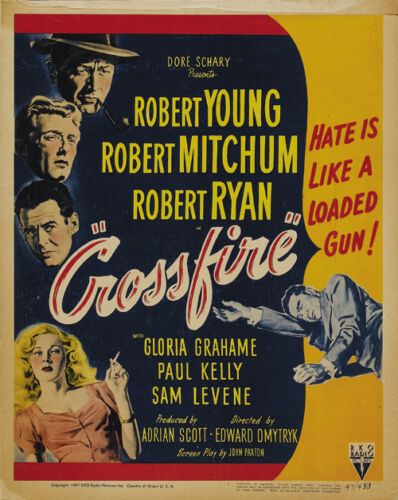
I didn’t know very much about this movie before I watched it. The DVD case made it appear to be a thrilling film noir with Gloria Grahame as the femme fatale. I’d been burned before, though (see: Dead End https://theoscargrouch.wordpress.com/2017/05/18/dead-end-1937/), so I didn’t let myself get my hopes up.

So what’s the story? Crossfire starts with the murder of a man, followed by the murderer running away. There’s confusion with the light and shadows, and we don’t know who the murderer is, but soon an off-duty soldier shows up to the apartment looking for his buddy who had been there earlier. The police zero in on the buddy, but did he really do it?

The Good: This movie may be the noiriest noir I have ever seen. There are so many shadows obscuring everything, figuratively and literally. Sometimes the shadows seem almost overwhelming. Light is used sparingly and very well. 

The music is used very much like the light: sparingly and well. Almost the only music in the movie at all is the music from the activity going on around the soldiers: music in a dance hall, music heard on the street while they pass bars, music in a movie that they watch. The filmmakers did not rely on music to tell you how to feel. 

The acting is great. Apparently, if you were a man who wanted a part in this movie, you had to be named Robert. Robert Ryan is Montgomery, the soldier who points civilian detective Robert Young in the direction of his buddy. Robert Mitchum is a soldier who doesn’t believe Montgomery’s accusation and goes looking for the truth on his own. To be fair, though, the Roberts were not the only good actors, although they were all superb. Sam Levene’s role as Samuels, the murdered man, is small, but he makes the character come alive in a way that his death hits pretty hard. Gloria Grahame plays a very sympathetic femme fatale; she’s less femme fatale and more “hooker with a heart of gold.” 

I rarely comment on the theme or message of a movie, but I feel like it’s important in the current political climate in the United States. Crossfire is about the dangers of vilifying “the other,” about feeling that you or your group is more important than or just straight-up better than another group. It warns about the danger of falling into that trap and says that even if you yourself feel safe, you need to stand up for others in the persecuted group. It’s a good message in a movie that isn’t a feel-good movie.

The Bad: It did drag at times. Not often, but there were a few scenes that could be trimmed just a little bit to make the movie tighter.  

The Ugly: I really did not understand who The Man was or what he was doing in the movie. His character just added unnecessary confusion. 

Oscars Won: None.

Oscar Nominations: Best picture; best actor in a supporting role (Robert Ryan); best actress in a supporting role (Gloria Grahame); best director (Edward Dmytryk); best writing, screenplay. 

Fun Bonus Fact: Although Crossfire deals with antisemitism, the novel that it is based on, The Brick Foxhole, is about homophobia, which is incredibly progressive for a book published in 1945.
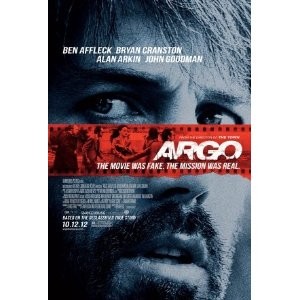
Argo (2012)

Directed by Ben Affleck

Okay, so argoit’s been awhile again. Apparently, because I wrote about my depression and how it was doing so much better in my Silver Linings Playbook post, my depression decided to remind me how powerful it actually can be. So yeah. Sorry if you’ve been waiting and hoping and wishing for my Argo review and my wrap-up of 2012; I’ve been trying not to slit my wrists. But at least I’ve been successful!
As I said in my Zero Dark Thirty review, I was excited for the 2012 movies because I got to watch two action movies that had been nominated for best picture. But just like Zero Dark Thirty, Argo is also not an action movie. It’s exciting, and it’s fun, and it has wonderfully tense moments, but it’s not an action movie. I think I might have watched the only action movie ever nominated when I watched Raiders of the Lost Ark. Argo is a fantastic movie, and I truly enjoyed it, but it’s not an action movie. It was also weird watching it on the heels of Zero Dark Thirty because they are so similar. Both movies are more spy film than action flick, both are based on true stories, both take place in the Middle East, both even have Kyle Chandler. So while I recommend seeing both films, don’t watch them back to back.

So what’s the story? During the takeover of the American embassy in Iran in 1979, six Americans manage to escape to the home of the Canadian ambassador. As the occupation of the embassy drags on, the U.S. government tries frantically to come up with an idea to get the six out before the Iranians realize that they aren’t in the embassy with the other civil servants they have taken hostage. Tony Mendez, a CIA officer whose job is extracting people from bad situations, finally comes up with “the best bad idea”—produce a fake movie, complete with screenplay, casting, and movie posters. He will then fly to Iran to “scout locations” and fly back with the six Americans as members of the production company. It’s a risky plan; can they pull it off?

The Good: I don’t know the term for what I’m about to admire, but I love that Argo looks like a movie from the late seventies or early eighties. The film quality is grainier, less sharp than current movies. No high definition here! I liked that the old Warner Brothers logo was used at the beginning of the film, too. It was a small thing, but helped set the tone for the movie.

Argo was a well-cast film. Everyone from Ben Affleck as Tony Mendez to John Goodman as legendary make-up artist John Chambers to Bryan Cranston as Mendez’s boss, Jack O’Donnell was fantastic. I was especially glad to see Victor Garber playing a sympathetic character (the Canadian ambassador) for once. He seems like the nicest man, but in the movies I’ve seen him in, his characters are always jerks (Mayor Shinn in The Music Man, the lecherous professor in Legally Blond, the money-grubbing lawyer in Eli Stone). Alan Arkin is a delight as the “producer” of Mendez’s movie, and the people playing the six non-hostages were also good. I didn’t feel like there was a false note in the casting.

The pacing of the movie was great. The director managed to keep the feeling of a lot of time going by balanced with the tension of having to get the people out. It would have been very easy to err in either direction – either with the movie dragging as the hostages stayed inside for months, or with the action happening too quickly to be believable.

Even though I feel like I know more about history than the average American, I didn’t know much about the Iran Hostage Crisis. We didn’t tend to get to more recent things in any of my history classes just because there was so much to cover in a year, and I wasn’t alive when it actually happened, so I appreciated the overview of the modern history of Iran at the beginning. Some of the movie wouldn’t have made sense without that background.

Alexandre Desplat’s score was a haunting, beautiful mix of Middle Eastern and Western music. It was subtle enough to underscore the drama of the situation without being overwhelming.

The Bad: While the casting was all good, I had a hard time keeping the six escapees straight. They didn’t get enough screen time for the viewers to understand their characters, so they all kind of blended together. I would have liked to have seen more of John Goodman and Alan Arkin and the Hollywood end of things, also. I feel like a lot of that was glossed over to give Ben Affleck more screen time and make Mendez seem more heroic.

Because I put off writing this review, I had to watch Argo twice in order to feel like I could give it an honest, helpful review. The first time, I loved it. It was one of those moments when you want to tell everyone you know that they should see it. A few weeks later, when I saw it for the second time, I just couldn’t get into it. I already knew what was going to happen, so there was no tension for me. This seems to be a flaw in the movie, but I can’t put my finger on why I didn’t care so much the second time around. It might be because I felt no connection to the characters; I’m not sure. But I feel like a movie that is named the best picture of the year should be able to be enjoyed more than once.

The Ugly: I didn’t find anything bad enough about Argo to be in this category. It’s flaws were minor.

Oscars Won: Best motion picture of the year; best writing, adapted screenplay; best achievement in film editing.

Other Oscar Nominations: Best performance by an actor in a supporting role (Alan Arkin); best achievement in music written for motion pictures, original score; best achievement in sound mixing; best achievement in sound editing.

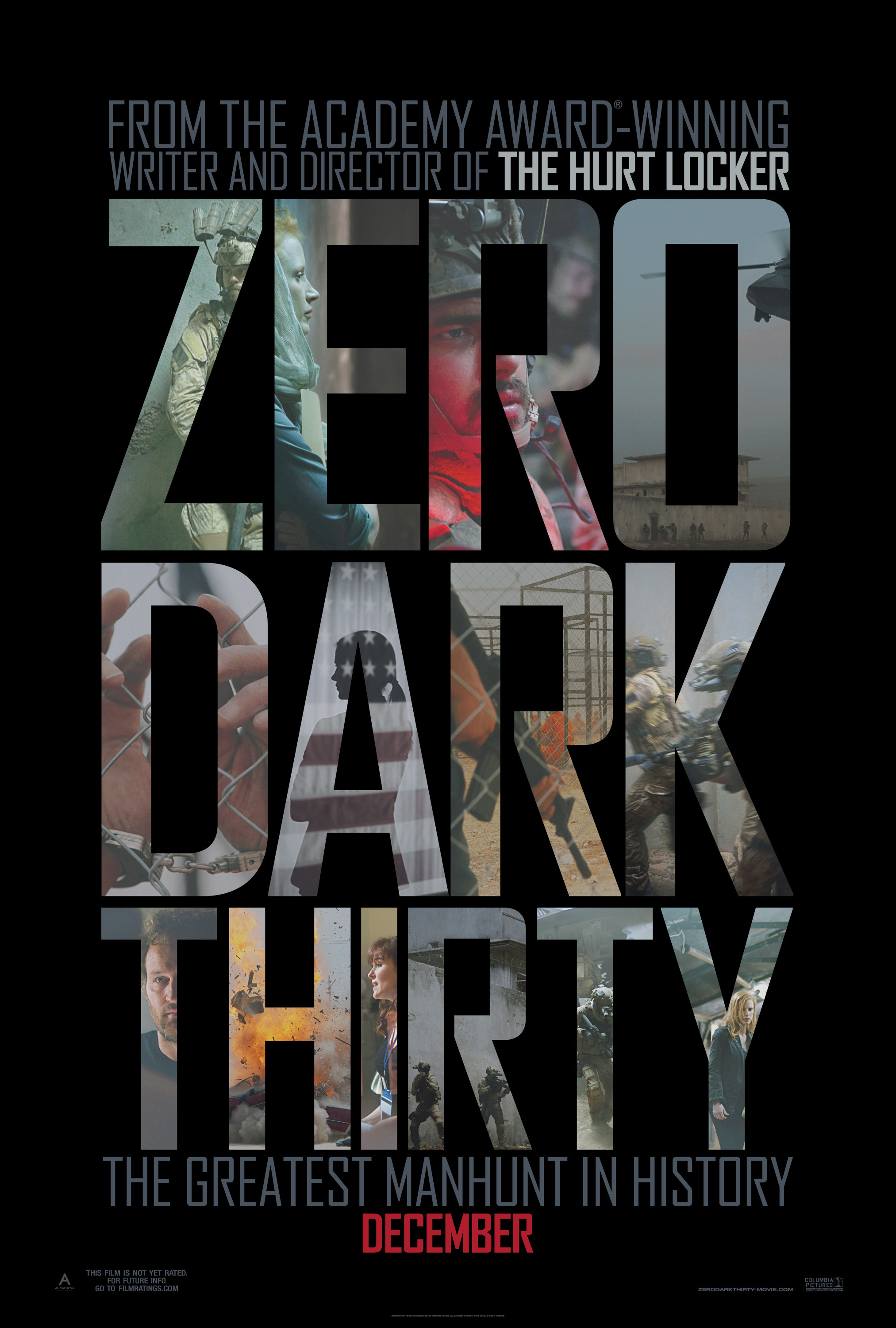
Zero Dark Thirty (2012)

PrintDirected by Kathryn Bigelow

When I’m deciding which year of movies I want to watch next, sometimes I let a random number generator pick. But when I chose the movies of 2012, I had a very specific reason in mind: I was in the mood to watch an action movie. There haven’t been a lot of action movies nominated for best picture, but I was certain that 2012 had two: Zero Dark Thirty and Argo. I hadn’t seen either one, but I knew that Zero Dark Thirty was about the assassination of Osama Bin Laden, which was exciting, so it had to be an action movie, right? Guess what. I was wrong. Don’t get me wrong; it’s a fantastic movie. It’s definitely not an action movie, though.

So what’s the story? Maya is a young CIA operative sent to Pakistan to protect the US from future terrorist attacks. It takes her ten long years of ferreting out information from the thinnest threads, but she is finally certain that she knows where Osama Bin Laden is hiding. Now she just has to convince the rest of the CIA.

The Good: Jessica Chastain is fabulous as Maya, the woman who believes in what she’s doing and refuses to budge on what she believes is correct. She’s tenacious and single-minded and tough. She doesn’t care about what other people think and she’s not ever going to give up. The part itself may seem a little cold, but Jessica Chastain does an excellent job. Her acting makes the ending perfect.

The supporting cast is solid. I love it when a movie has even the smallest role perfectly cast, and Zero Dark Thirty is one of those movies. If I made a list of everyone who does an amazing job in this movie, it would be really long, so I will just mention a couple. Jason Clarke and Jennifer Ehle both make fantastic CIA operatives. Kyle Chandler is good as Joseph Bradley, Maya’s boss who doesn’t really believe in her lead, but who knows that ignoring her is a bad idea. Joel Edgerton and Chris Pratt make excellent Seal Team Six members. But again, everyone is so spot on that it’s hard to pick out the best people.

I’ve watched other movies based on historical events that play fast and loose with dates and places (cough, Elizabeth, cough). I appreciated how places and dates were so specific. I even like the “chapters” that helped keep the story moving and showed how time passed, because frankly, spy work seems to move very slowly sometimes, and it would have been boring if every single step that Maya made to draw the lines and make the connections had been shown.

I loved the beginning. The lack of any images made the voices of September 11th so compelling that it drew me in and made me remember my September 11th experience. I don’t think that could have been done nearly so well if scenes from that day had been splashed on the screen.

The soundtrack is amazing. Music is used sparingly, so that when it happens, it really makes an impact. Most of the action happens to natural noises, which makes it more realistic, and the occasional music unobtrusively underscores the emotion. That was an excellent choice.

The screenplay manages not only to tell the story of what happened, but to make the characters feel real and believable. They have backstories and lives outside of what’s going on thanks to the screenplay, which I understand was rewritten after Osama Bin Laden was killed. I think it would be fascinating to know what the ending was going to be before that happened.

The Bad: Even though we all know how the story ends, the tension during the Seal Team Six scene is almost unbearable. That’s probably a good thing from a storytelling point of view, but for me, it’s as uncomfortable as watching a horror movie, especially since there are innocents involved.

The Ugly: The first twenty minutes or so of the movie are mostly scenes of torture, and there are other scenes of torture throughout. Bigelow doesn’t pull any punches or soften these scenes, and they are hard to watch. I know a lot of people believe that torture is sometimes necessary; I don’t want to get involved in any discussion about that. I’m just saying that it’s not an easy thing to see, especially knowing that torture happens in real life.

Oscar Won: Best achievement in sound editing (tied with Skyfall).

Other Oscar Nominations: Best motion picture of the year; best performance by an actress in a leading role (Jessica Chastain); best writing, original screenplay; best achievement in film editing.

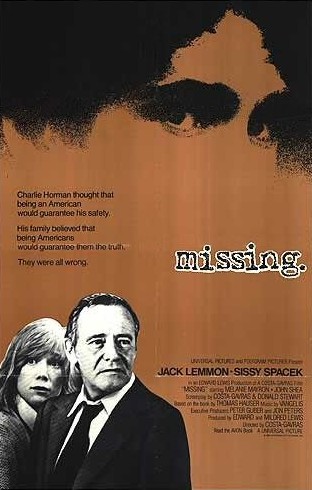
Missing (1982)

Missing_1982_filmDirected by Costa-Gravas

As I’ve been watching these Oscar-nominated movies, there have been many, especially from the 1970s and 1980s, that I haven’t really known anything about. Some of them have been less than stellar, and I can understand why they have fallen by the wayside, even for someone like me who likes watching good movies, no matter how old they are or what language they are in. Missing is not one of those movies. Missing is so awesome I want to show it to everyone I know, and I’ve been telling random people how sad I am that no one seems to have seen it. Missing makes me want to be a high school history or civics teacher so that I could show it to my class to teach them not to be too trusting of government. It makes me so mad that Missing is not a classic; it completely deserves to be one.

So what’s the story? Charlie and Beth Harmon are an idealistic young married couple who have been living in Chile for a couple of years when a right-wing coupe happens. They are going to leave the country soon, so Beth goes to say good-bye to a couple of friends. She gets stuck overnight because of the curfew. When she finally makes it home, Charlie is gone. About two weeks after his disappearance, Charlie’s conservative businessman father, Ed Horman, comes to help Beth navigate the waters of diplomacy and bureaucracy. What they find out together will change their lives forever.

The Good: I’m tired of starting with acting, so I’m going to start with music today. Vangelis’s score is beautiful and haunting. It’s more orchestral than the music in Chariots of Fire, and where he does use the synthesizer, it fits the time much better. The other thing that is great about the music is that it is not constant. Lots of the movie has no music, so that where there is music, it has a much greater impact.

The acting is wonderful. Sissy Spacek is wonderful as Beth, who changes from a vibrant, loving young woman to a frantic wife to a jaded and accepting woman in the course of just a few weeks. It’s a marvelous performance. Jack Lemmon is fantastic as Ed, who starts out so convinced that he’ll be able to fix everything with connections, but slowly comes to realize the truth. I’ve only ever seen Jack Lemmon in comedies, so this was a revelation. John Shea plays idealistic, happy-go-lucky Charlie. He’s not in the movie much, but he leaves an impact when his character is gone. Government agent Captain Ray Tower is played rather chillingly by Charles Cioffi. He’s so scary in part because he’s so friendly, but you can tell he’s hiding the truth.

This is going to sound silly, but the set decoration was so clever at one point. Beth and Ed are at the US Embassy, trying to get answers about what happened to Charlie. The US Ambassador is telling them that he’s probably in hiding and that they shouldn’t worry about him. While he is talking to them, he is standing directly under a picture of Richard Nixon. This movie takes place in 1973, so Nixon was the president then, but by the time Missing was made in 1982, everyone knew that Nixon was a liar. To see a man appointed by that president standing underneath him subtly, yet effectively, underscored the fact that the ambassador was also a liar.

The screenplay was very good. It made the characters come alive. It also made the movie completely gripping. I was so angry that I had to stop watching to go to work. I wanted to know what happened, and I wanted to know NOW! It was fantastic.

I have no concrete examples of why I felt this way, but I though the directing was very good. It’s hard to define good directing, because it’s hard for me to know how much of a hand the director had in various aspects of the movie, but I really felt good directing at play here.

The Bad: The only complaint I have is that Beth and Charlie’s friend Terry has 1980s poufy hair. As a free-spirited 1970s woman, Terry’s hair should have been longer and straighter. I know, tiny quibble. But it bothered me.

The Ugly: War is always ugly, and there are some shocking images and situations in this movie. It’s not the easiest movie to watch because of this, and also because this is a true story. Art that is great tends to bring up issues that might make people uncomfortable, but that doesn’t mean that these issues should be ignored. I think it’s better for people to know what is wrong in their world than to believe that everything is perfect when corruption is hiding underneath.

Oscar Won: Best writing, screenplay based on material from another medium.

Other Oscar Nominations: Best picture; best actor in a leading role (Jack Lemmon); best actress in a leading role (Sissy Spacek).

High Noon (1952)

high noonDirected by Fred Zinneman

I love westerns. It’s probably because I watched so many of them growing up that now they make me feel like a little kid again. Whatever the reason, I’m always glad when they show up on the list of best picture nominees. However, High Noon isn’t exactly a western. It’s a thriller that just happens to take place in the Old West. It’s about relationships and small towns and above all, people. I’ve seen it before, but it’s always exciting to watch.

So what’s the story? Will Kane has just married his Quaker sweetheart and given up his marshal’s badge when he gets a telegram that Frank Miller, a murderer that he arrested, has been let out of prison. He’s set to arrive on the noon train and hell-bent on getting revenge on the man who sent him to prison. Miller’s old gang is already waiting for him at the platform. Realizing that a true man faces his problems, Will refuses to run, but can he get the help he needs from the townspeople he’s protected in the past?

The Good: High Noon happens in real time. It’s about 10:40 when Marshal Kane gets his telegram, and an hour and twenty minutes later in real life, the train comes in. This adds to the tension in a way that very few things could have. I’m not sure if High Noon was the first movie to use this tactic, but it’s very effective.

The editing is fantastic. I love really good editing, but sometimes I feel like good editing can be hard to spot. Every once in a while, though, I’m blown away by it. That’s what happened in High Noon. After all the tension has built up and the train is finally coming into town, there are shots of all the different groups waiting for the train to stop. The editing makes that part of the movie so stressful. It’s awesome.

Once again, the acting is superb (can a movie be nominated for best picture without having at least some good acting?). Gary Cooper plays Will Kane, a man committed to his path even though it may cost him the woman he loves. Grace Kelly plays his bride, Amy, who is understandably frightened at the prospect of losing her new husband. Bitter deputy marshal Harvey is played wonderfully by Lloyd Bridges. Even Henry Morgan (aka Colonel Potter in M*A*S*H) has a small role. But the standout actress in High Noon is Katy Jurado as Helen Ramirez. She is ridiculously good in her rather complicated role.

Helen Ramirez is actually another wonderful thing about this movie. Minorities in westerns generally only have tiny roles, and they are usually horrifically stereotypical. However, while Helen is a scarlet woman, she is smart, strong, passionate, and fair. She isn’t scared of anything and she doesn’t take anything from anyone. I love her. She’s a great character.

The cinematography is great. It manages to highlight Will’s forced solitude and the attitudes of the people surrounding him. It does what good cinematography should do.

The Bad: There is nothing bad about High Noon. Everything about this movie is either on fabulous or horrifically bad. I suppose I could say that it’s not fun to watch Thomas Mitchell, one of my favorite character actors, not be awesome. That’s just how the story goes, though.

The Ugly: The title song is awful. I think I could have rationalized it as a 1950s cowboy song if it weren’t for the fact of these two lines:

He made a vow while in state prison
Vowed it would be my life or his’n.

I think it should be a crime against the arts (is that a thing? Can we make it one?) to use “his’n” as a rhyme for “prison”. Bad, bad, bad. Even then, I might have been able to make my peace with it if bits of the song (including that line) didn’t keep playing throughout the movie and reminding me of its existence. The musical score by Dimitri Tiomkin itself is very good, but this song… So bad.

Oscars Won: Best actor in a leading role (Gary Cooper); best film editing; best music, original song (“High Noon [Do Not Forsake Me, Oh My Darlin’]”); best music, scoring of a dramatic or comedy picture.

Other Oscar Nominations: Best picture; best director; best writing, screenplay.

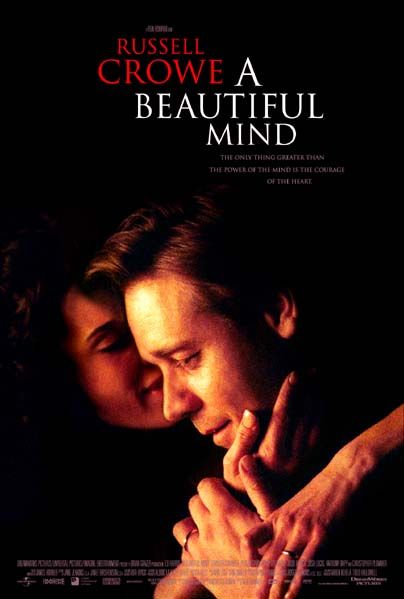
A Beautiful Mind (2001)

beautiful mindDirected by Ron Howard

It was late the night I put this movie in the DVD player, and I wasn’t going to watch the whole thing. But even though it’s not the most action-packed movie ever made, A Beautiful Mind is an extremely gripping movie. As it got later and later (or earlier and earlier in the morning), I kept thinking, “I should really turn this off and go to bed,” but I just couldn’t. I needed to know what happened to John Nash.

So what’s the story? John Nash is a genius mathematician from West Virginia. He doesn’t fit in with all the other Princeton graduate students, mostly because he is completely asocial. He makes a great mathematic breakthrough and gets a job at MIT with the Department of Defense. He meets and marries Alicia, but the top-secret decryption project he’s working on suddenly takes a dark turn.

The Good: The acting was superb. I haven’t seen a lot of Russell Crowe’s movies, and I wasn’t expecting much from him in A Beautiful Mind, mostly because what I’ve seen him in lately is clips from Les Miserables (no, I haven’t seen the whole thing yet, because I don’t want to watch it). Anyway, Russell Crowe became John Nash. I’m always impressed when actors can play a person with a mental disability without overacting. I loved his performance. The supporting cast was great, too. Paul Bettany as Charles, John’s crazy-fun roommate; Jennifer Connelly as John’s wife, Alicia; Ed Harris as John’s government contact; Adam Goldberg, Josh Lucas, and Anthony Rapp as John’s mathematician colleagues; and Christopher Plummer as Dr. Rosen, John’s psychiatrist are all wonderful. I don’t think any of the roles could have been easy to play, but all of the actors did very well.

The costume design was well done, especially since the year in which something happened was rarely given. The clothes were a clue to how many years had passed, and I was very thankful for that. The makeup was good, too. The stars were aged well. I didn’t much care for John Nash’s old look, but that’s because he looked uncomfortably like someone I know, and I couldn’t get past that. But everyone looked definitely, believably older (unlike the people in Giant, which is still my baseline of terribleness when it comes to aging in movies).

The screenplay was good. John Nash’s story could not have been an easy one to tell without giving too much away, but the writers did an excellent job.

The Bad: The music was beautiful, but there were some moments when James Horner copied his own music. At the very beginning of the movie, the music sounded exactly like the music from Sneakers, which I wasn’t even aware James Horner had scored. I had to look it up to be sure. Later on, there are bits from Titanic, which has a brilliant score. It makes me sad that someone who is as obviously talented as James Horner reuses his own stuff.

The Ugly: There wasn’t anything ugly in A Beautiful Mind. It’s a well-made movie that takes a hard topic and treats it sensitivity and tact. Ron Howard deserves major kudos for this movie.

Oscars Won: Best picture; best actress in a supporting role (Jennifer Connelly); best director; best screenplay, screenplay based on material previously produced or published.

Other Oscar Nominations: Best actor in a leading role (Russell Crowe); best film editing; best makeup; best music, original score.

In the Bedroom (2001)

in the bedroomDirected by Todd Field

Even when I recognize the titles of the movies that I’m watching, I don’t always know anything else about them. Sometimes, though, the title gives me a very good idea of what the movie is about. Other times, I am completely wrong. I had never really wanted to see In the Bedroom because I was convinced it was a raunchy sex comedy. That couldn’t be farther from the truth. I was surprised to find that it is instead a slow-moving drama about how a family deals with tragedy. I think I will have to stop judging movies based on their titles.

So what’s the story? Frank Fowler is a college student home for the summer. To his mother’s dismay, he starts dating Natalie, an older woman with two little boys. Natalie also has an ex-husband with a temper. As the summer heats up, tensions mount, and tragedy soon follows.

The Good: In Ian McEwan’s (rather dull) novel Saturday, two people are discussing Tolstoy, and one says, “The genius is in the details.” I feel that way about In the Bedroom. Everyone is believable, partly because the screenplay allows for details. When she’s depressed, Ruth Fowler sits on her couch, watching pointless TV and smoking. Matt Fowler likes to meet his son, Frank, for lunch. Natalie makes awkward conversation with her boyfriend’s college-educated parents, trying to get them to like and accept them. These little scenes, while not action-packed, reveal character and make the people real. The realism makes the sadness later much more real.

Because the screenplay moves so slowly, the acting had to be incredible. Tom Wilkinson and Sissy Spacek are Matt and Ruth Fowler, who are trying to understand and be supportive of their son’s choices, while at the same time not being happy about them. Marisa Tomei is Natalie, a woman who enjoys dating a younger man, but can also see his naiveté. Frank is played by Nick Stahl. He makes Frank a very sweet young man who is enthusiastic about life, but doesn’t really understand that choices have consequences. They are all a joy to watch.

The cinematography was interesting. It would have been very easy to film this movie about a normal family with straightforward camera angles, but instead the filmmakers took the opportunity to use the camera to show that people have inner lives and thoughts. I liked that a lot.

The Bad: Because this movie allows for the details, for the normal conversations between ordinary people, it gets a little boring sometimes. But guess what? Life is boring sometimes. I’m still trying to figure out how I feel about the ending, though. It might have been too exciting to be believable.

The Ugly: I spent a lot of time being annoyed that Natalie and Frank spent so much time with her boys when both Frank and Natalie kept insisting it was only a summer fling. It seemed like such an irresponsible thing to do, to let kids get attached to a boyfriend you’re only planning on dating for a few months. It made me grumpy.

Oscars Won: None.

Oscar Nominations: Best picture; best actor in a leading role (Tom Wilkinson); best actress in a leading role (Sissy Spacek); best actress in a supporting role (Marisa Tomei); best writing, screenplay based on material previously produced or published.

The Treasure of the Sierra Madre (1948)

the-treasure-of-the-sierra-madre-poster-11Directed by John Huston

The Treasure of the Sierra Madre was one of the few movies I had already seen but had no desire to see again. I checked it out from the library a while ago, probably because I had been told it was an adventure movie, which I tend to love, starring Humphrey Bogart, who is awesome. It was so boring that I didn’t even make it halfway through before giving up. So I was really surprised this time around at how much I liked this movie. It’s amazing. Now I’m wondering what was wrong with me the day I watched it the first time.

So what’s the story? Dobbs and Curtain are two American men down on their luck in Mexico. Both of them just want to make enough money to make it back to America, but they can’t find work. They meet Howard, an old prospector, who is willing to help them find gold, but he warns them that gold always carries a curse.

The Good: Like I said before, Humphrey Bogart is awesome, but I’ve never seen him quite like this before. He often plays crusty people on the fringes of society, but he always seems to have a heart of gold underneath. Not here. He’s a little frightening, really. I’m not sure why he wasn’t nominated for a best actor Oscar. Tim Holt plays Curtain, who is just an all-around nice guy with dreams of a bigger life. Howard is played by Walter Huston, director John Huston’s father. Normally I’m not a fan of nepotism, but I think this was a case where the perfect person for the role just happened to be related to the director. Huston did such a good job. He was patient with the greenhorns, yet you could see him waiting for the other shoe to drop. He had enough experience and wisdom to know how things were going to go. Huston managed to show all of that without getting annoying, which can be tricky in situations like that.

The cinematography is gorgeous. It was shot on location in Mexico, and the cinematographer took advantage of that. But there are also lots of intriguing camera angles and good moody lighting which help contribute to the movie.

The excellent score was masterfully written by Max Steiner. I’ve decided he could score pretty much anything and it would be amazing. He could score a movie of someone silently reading a phone book and it would become interesting.

The Bad: The Treasure of the Sierra Madre has the usual first half of the 20th century problem with racism, but it’s not the worst I’ve seen. It also moves a little bit slowly at times.

The Ugly: This movie has the single worst fistfight I have seen in any movie ever. The camera angles are all wrong, and you can see that the punches aren’t actually connecting, even though the foley artist is making the correct sounds. It’s sooooo bad. I was cringing all the way through.

Oscars Won: Best actor in a supporting role (Walter Huston); best director; best writing, screenplay.

Other Oscar Nominations: Best picture.

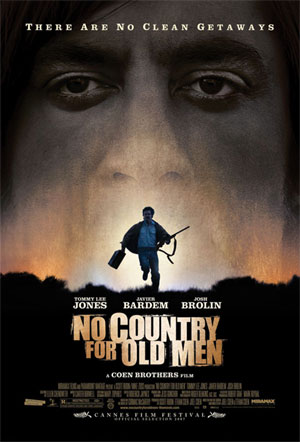
No Country for Old Men (2007)

No_Country_for_Old_Men_posterDirected by Ethan Coen and Joel Coen

I know it’s been a little while since I’ve posted, and I feel very bad about that. I know I left all my adoring fans hanging in 2007 (hahaha! Look at me, pretending I have fans!), but writing when you have a fever rarely produces anything that makes any sense, let alone anything readable. So in the future, I will attempt to not get sick until I’ve posted an entire week’s worth of reviews so that you, my loyal readers, will not be left without my wisdom.

I knew two things about this movie before I watched it: 1) It was based on a book by Cormac McCarthy and 2) It was a Coen brothers film. And this time, I was right on both counts! This movie makes a lot more sense for the Coen brothers. Although it’s a drama, it still has enough quirky characters and funny lines to bring that Coen brothers feel to it. Of course, that makes me extremely curious about the book that it’s based on. Does it have that same quirky feeling to it? Maybe one day when I have time in my life, I will find out.

So what’s the story? One day while he is out hunting (or poaching, maybe?) in the desert, Llewelyn Moss stumbles across the bloody aftermath of a drug deal gone wrong. He finds a case containing two million dollars, and instead of reporting it to the police, he decides to keep the money and run. Because he leaves his truck at the scene, he is soon being pursued by both the county sheriff and a psychopathic killer who works for the drug lord.

The Good: It’s extremely well-acted. Josh Brolin is Llewelyn Moss, a Vietnam veteran who wants more in his life. Tommy Lee Jones plays Ed Tom, the county sheriff who just can’t understand the mindless violence that has entered his life. And Javier Bardem won an Oscar for his portrayal of Anton Chigurh, the incredibly scary psychopathic killer. Side note: I realized while I was watching this movie that although Javier Bardem is an attractive man, I’ve only seen him in movies where he plays a really bad guy, so I’m a little bit scared of him. I’m sure he’s a perfectly nice man in real life, but I would need to see him being nice in real life to overcome the scary people I’ve seen him play. Kelly MacDonald is Moss’s innocent young wife with a backbone of steel. Her scene at the end was so well-played, I had to watch it twice.

I don’t know whether it was the acting or the screenplay or the direction, but No Country for Old Men is a gripping movie. I couldn’t stop watching. I got a phone call in the middle of the movie from someone I love, and getting pulled out of the movie made me really frustrated. I was so annoyed that I had to pause it; I was so into it and so absorbed in the world of the movie that coming out for a phone call was almost painful. And that was to talk to someone I care about. If it had been a telemarketer, I’m not sure what I would have done.

The Bad: Although I love Kelly MacDonald and think she’s a great actress, she looked so young that when I first saw her, I thought she was Josh Brolin’s teenaged daughter, which made it really creepy when he told her that if she didn’t stop talking, he was going to take her to the bedroom. It honestly took me a bit to realize she was supposed to be his wife. I think that’s more the fault of the makeup and costume people than anything. Everything else makeup and costumey worked, even Chigurh’s creepy haircut, but something needed to be done to make Kelly MacDonald not look like a sixteen-year-old.

I also felt like there was a lot of backstory to everyone which we as viewers never really get told about. Backstory is a good thing; it adds a lot of richness to a movie. But it left me with the feeling that there were things going on that I didn’t understand, and that frustrated me a bit. The questions didn’t all get answered, either. WHAT HAPPENED TO THE MONEY?

The Ugly: After watching No Country for Old Men, I feel kind of silly saying that There Will Be Blood was violent. No Country for Old Men is so much worse. People get shot left and right for no discernable purpose. I am also now afraid of oxygen tanks, although I recognize that Chigurh’s was a special cattle tool. Still. They are scary. And because there were so many deaths, I was left feeling empty at the end. I thought, “Wait. That’s it? That’s all there is to this story? What? How? Who? No, there has to be another ten minutes or so.” I didn’t have a feeling of closure; the movie just…ended. I didn’t like that at all. I felt like if that’s how it was going to end, then there wasn’t much point to the two hours that led up to the ending.

Oscars Won: Best motion picture of the year; best performance by an actor in a supporting role (Javier Bardem); best achievement in directing; best writing, adapted screenplay.

Other Oscar Nominations: Best achievement in cinematography; best achievement in film editing; best achievement in sound mixing; best achievement in sound editing.