I'd like to spank the Academy

Archive for the ‘Romance’ Category

A Star is Born (1937)
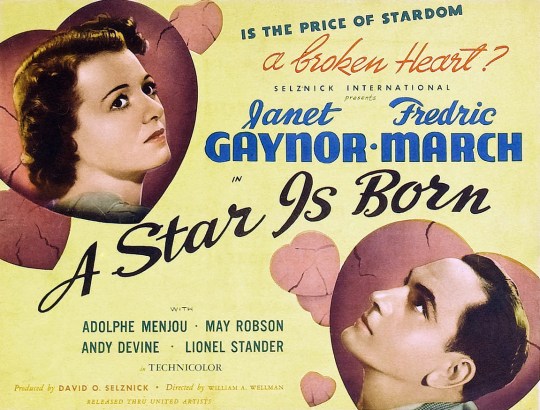
Poster - A Star is Born (1937)_02Directed by William A. Wellman

Surprise! There are extra posts this week! I miscounted the movies, and since I had a specific movie in mind for next week, I needed to finish 1937. So for your reading pleasure, I present The Rest of 1937.

I had a hard time getting hold of this movie, even though there are several copies of it in my library system. I had put it on hold, but it didn’t come in, so I called the customer service line to see what was going on. The lady on the other end said, “Oh, let me place that on hold for you again; it should spark the hold then. So you want A Star is Born? Oh, here it is. I just love Judy Garland in that movie. Wait. You don’t want the one with Judy Garland? You want Janet Gaynor? Are you sure that’s the one you want? It’s rather old.” She still sounded skeptical after I assured her that, yes, I was looking for the version with Janet Gaynor. I ended up having to call a coworker to grab a copy off the shelf at the library I work at so that I could get it. Yes, young people like old movies and just because something has been remade (and remade three times) doesn’t mean that the first one is obsolete.

So what’s the story? Young Esther Blodgett runs away to Hollywood with stars in her eyes, convinced that she will become a famous actress as soon as she gets there. Esther finds that it’s harder than she thought, but soon she catches the eye of the famous actor Norman Maine and finds herself shooting to stardom, even as Norman’s career begins to fail due to alcoholism.

The Good: I had only seen Janet Gaynor in silent movies before I watched A Star is Born. I had to check to make sure it was the same actress; she made such a good crossover to talkies that I felt a little unsure. Gaynor captures the spirit of Esther Blodgett as she goes from starry-eyed girl to mature woman. She also makes sure that the film doesn’t descend into melodrama.  Norman Maine, a man of humor and despair, is played to perfection by Fredric March. In his third role in an Oscar nominated movie in 1937, Adolphe Menjou plays Oliver Niles, Norman and Esther’s sympathetic agent. There was no type-casting for him, by the way. The three (large) roles he played in One Hundred Men and a Girl, Stage Door, and A Star is Born were all completely different. He did an excellent job in each.  I’m always glad to see Andy Devine, and he does a good job (as always) as Esther’s brotherly neighbor Danny (and he looks so young!). May Robson gives a sassy performance as Esther’s strong-willed grandmother Lettie.

The screenplay was co-written by one of my personal heroes: Dorothy Parker. Her trademark wit is scattered throughout. Again, although the story is a good one, A Star is Born could easily have become a melodrama. Thanks to Parker and her colleagues Alan Campbell and Robert Carson, the screenplay was able to help avoid that.

A Star is Born is a study in contrasts. The costuming, art direction, and music all work together to highlight Esther’s rise to stardom. Esther starts out as a girl from the sticks; her family lives in a small, plain house in the freezing mountains. She wears simple, practical clothes. The music that underscores these homely scenes includes familiar melodies, such as “Auld Lang Syne.” When she moves to Hollywood, her simple clothes stay the same, but her poverty is evident through her boardinghouse, which is old, cramped, and falling apart. Her neighbor Danny’s suits are of poor quality and always rumpled. The music here is rather sweet and innocent. The night that Esther goes to waitress at a party for Hollywood’s elite, everything changes. The suits and dresses of the wealthy are of a much better quality and cut, and of course of the highest fashion. The homes of the wealthy are also beautiful and fashionable, clean and open. They even have more modern telephones – and Oliver’s is even gold plated. The music is jazzy and fun, because these wealthy people seem not to have a care in the world. As Esther becomes a star, her clothes become more and more fantastic. At first they are of better quality, but still conservative. They get more fashionable the wealthier she gets. Esther and Norman’s house that they buy together is amazing, too. It has spacious rooms, beautiful gardens, and even a swimming pool. The music becomes much more sweeping and dramatic as Esther’s life fills not only with luxuries, but also difficulties. However, no matter how much life changes for Esther, she is still the simple farm girl inside. She’s obviously sending money home, because when Grandmother Lettie comes to remind Esther that Esther is strong and can get through anything, Grandmother Lettie is wearing fashionable old lady clothes instead of the old-fashioned country clothes she wore before Esther left. As her house empties out around her, the gentle music is a reminder that life can get better. Although not always the flashiest elements, the costuming, art direction, and music subtly add an extra dimension to the movie.

The Bad: The story on its own is a tad melodramatic. The theme of a country girl making it big and marrying the man of her dreams is not unfamiliar, but the story of Norman’s alcoholism could be a story written by a teetotaler in the 1880s. The title would be something like “The Evils of Drinking,” and it would detail the story of a wealthy man who ended up dying broken and alone because of his inability to give up alcohol. The original ending would have ruined the movie. Luckily, due to the screenplay and the excellent acting, A Star is Born avoids becoming a heavy-handed tale; it is instead a sensitive portrayal of an all-too-common issue.

The Ugly: There’s nothing truly horrible about A Star is Born; I had to reach to even find anything bad.

Oscars Won: Best writing, original story.

Honorary Oscar Won: W. Howard Greene, for the color photography.

Other Oscar Nominations: Best picture; best actor in a leading role (Fredric March); best actress in a leading role (Janet Gaynor); best director; best writing, screenplay; best assistant director.

Fun Fact: A Star is Born was the first all-color best picture nominee.


Lost Horizon (1937)

LostHorizon1937_previewDirected by Frank Capra

I read the book Lost Horizon a few years after I read The Good Earth, but it was still a very long time ago. I don’t remember every bit of the plot, but I did like it quite a bit; the adventure appealed to me, as did the idea of a beautiful place of peace. Being a fan of the book and a fan of Frank Capra, I thought the movie would be wonderful. The adventure and the philosophy that I loved in the book were in the movie, but I had a hard time remembering to watch through 1937 glasses. Shangri-La is not a utopia if you watch through 2017 glasses.

So what’s the story? Robert Conway, a British diplomat, is on the last plane out of a war-torn Chinese town with four other people: his brother, George; Lovett, a paleontologist; Barnard, a crook; and Gloria, a prostitute. Instead of heading to Shanghai as expected, the pilot flies the plane deeper into Asia. The plane crash-lands high in the freezing Tibetan mountains, but the group is rescued by a group of people who lead them to the monastery Shangri-La, where everyone is happy and all is well. But all is not as it seems…

The Good: The acting is good for the most part. It’s really quite fun to watch the change in Barnard (Thomas Mitchell), Lovett (Edward Everett Horton, who usually scares me), and Gloria (Isabel Jewell) as they go from frightened, selfish people to people who care about making their world better. Ronald Coleman makes a fine Robert Conway, although I would have liked to see a little more contrast in his character as Shangri-La changes him. That’s the screenwriter’s fault, though. John Howard is miscast as George Conway. He doesn’t even try to do a British accent, even though he is supposed to be the brother of the very British Coleman. That said, Howard did bring a lot of energy to the screen, with his growing impatience a contrast to the others’ peacefulness as everyone else settles in. Sam Jaffe makes a wonderful wise High Lama, even though he was only 46, so the makeup artists did a fantastic job, too.

The production design is great. The designers had to bring the east and west together for Shangri-La, which is in “Tibet” but built by a man from Belgium, with treasures from all over the world inside. The valley needed its own look, too. The end result is beautiful and believably peaceful.

Dmitri Tiomkin wrote a beautiful orchestral score for the film that underscores not only the beauty and peace of the valley but also the mystery and uncertainty that everyone finds there.

The Bad: Jane Wyatt is wooden in her performance as Sondra. She is school-girl giggly when she’s around Conway and sad when she thinks Conway is going. That’s all she’s got. It was a little painful to watch.

Chang is played stiffly by H.B. Warner. It may have been the way he was directed, but almost every time he talks, there’s a pause, almost as if he’s trying to remember his lines. He was nominated for best supporting actor, so some people saw something there. I will freely admit that I am not a professional acting judge, so I could be wrong and the performance could be brilliant, but it annoyed me.

The Ugly: There was nothing really ugly about the movie, except that about seven minutes of the movie are still shots instead of motion picture. The movie was edited from when it was first shown, and the original footage was lost. Film restorers looked in vaults all over the world for the missing minutes. They did find a full sound track and some of the missing moving footage, so they used stills from the filming to fill in the film that was lost. Some of the footage they found, though, was not of the best quality, so the movie is uneven in quality, too. It makes me so sad when movies aren’t taken care of. I hate it when art is lost.

Oscars Won: Best art direction; best film editing

Other Oscar Nominations: Best picture; best actor in a supporting role (H.B. Warner); best sound, recording; best assistant director; best music, score.

Why I would not want to live in the Shangri-La of 1937:

     Women have no rights and get very little respect from men.

  1. Conway asks the High Lama what happens if two men both want the same woman. The Lama replies that their manners are so good, that the man who had the woman first would give her to the second man. No one bothers to ask the woman which man she would rather be with.
  2. Sondra is teaching a class of children English when a child asks to be taken to the bathroom. As soon as she leaves to help the child, Conway simply dismisses the class without asking Sondra if she is done for the day. He assumes that she would be happy to spend her time with him instead of teaching.
  3. When Sondra tries to start a philosophical conversation about why people outside of Shangri-La are the way they are, Conway tells Sondra to stop asking why, saying that it is the most annoying question in the English language. He had a chance to actually think about his culture and discuss it with someone who is generally curious, and instead he shuts it down because he is more interested in Sondra physically than he in in honestly answering her questions.
  4. Barnard takes a shine to Gloria when she stops wearing her makeup, telling her she looks wholesome without and ordering her to never wear it again. When George asks if they would like to leave, Barnard says he isn’t going, and then Gloria says “I’m going to stay, too. Is that right, Barney?” (That’s paraphrased a bit.)

   The people of the monastery have no respect for the native people. 

  1. None of the people living in the monastery of Shangri-La are acolytes of the High Lama. Apparently only Europeans and Chang (who is played by a white man) are allowed to study in the monastery and do whatever they so desire, whether it’s playing the piano or riding horses or reading. The only native people living there are the servants. No one thinks to ask if that’s what they want to be doing.
  2. The people in the valley are basically patted on the heads and told what good people they are. They are not taught what is in the books that are brought into the valley. They farm and mine for the monastery because that’s what they have been taught to do. They are more or less slaves, even though they don’t know it. The High Lama even admits that those who live in the monastery rule those who live in the valley.
  3. Shangri-La was founded by a Christian missionary whose goal is to have the “Christian ideal” win all over the world. No, he doesn’t teach Christianity, but he also doesn’t draw on any tenants of other religions, including whatever the natives believed before he got there. While not stated, I’m pretty sure that he doesn’t allow the native religion to be followed in the valley.

Okay, rant over. I know that Lost Horizon came out 80 years ago, and I freely acknowledge that values have changed a bit over the years. That’s why it’s so important to try to understand where and when the filmmakers were coming from. You can’t judge art from the past with the values of today.

The Awful Truth (1937)

awful-truth

This is not the picture that steered me away from the movie. This one is much more fun!

The Awful Truth
Directed by Leo McCarey

I love old movies. I love Cary Grant. I love light-hearted comedies. Even though The Awful Truth fits all of those criteria, I had never wanted to see it. Why? The cover of the DVD that we have at my local library looks like it’s a musical. I couldn’t fathom Cary Grant in a musical; it made me uncomfortable. If it hadn’t been nominated for best picture, I never would have watched it. I would have missed out on a great movie.

So what’s the story? Married couple Lucy and Jerry Warriner have a silly misunderstanding and decided to get divorced. The divorce is granted, but they must wait three months for the divorce to be final. During these three months, both Lucy and Jerry date new people, but they both do everything they can to disrupt the other’s new relationships.

The Good: ASTA!!!! He may have been a dog, but Asta was a minor Hollywood star in the 1930s and 1940s, appearing with such stars as William Powell, Myrna Loy, and Katharine Hepburn. Not only is he adorable, he’s very well-trained. He’s also charming, which I didn’t realize a dog could be, but Asta is.

Asta’s human costars are wonderful, too, even if they aren’t as cute as he is. Although he plays Jerry Warriner with his characteristic suavity, Cary Grant also imbues his character with an inner delight in life. Irene Dunne’s Lucy is full of (justifiably) wounded pride; Dunne draw on this pride to explain both her rebound “love” and her fiendish delight in ruining Jerry’s new relationship. Of course, it’s expected that Dunne and Grant will be good; they weren’t famous just for their good looks. The totally unexpected performance came from Cecil Cunningham, who plays Lucy’s sardonic aunt, Patsy (or Patty; both were used in the movie). I had never heard of her before, but she is hilarious in this movie. She brings good, solid common sense into a screwball situation, letting both main characters know that they are being completely ridiculous.

The costumes and sets are gorgeous. The dresses are beautiful, and it was impossible for me to not admire the furs, even though I am anti-fur. Combined with the sparkling wit of the screenplay, The Awful Truth makes me wish that I were a wealthy person in the 1930s. It’s an impossible wish, I suppose, but it would be fun.

Leo McCarey’s direction was excellent. I don’t write often about whether or not I think the director did a good job, but that’s because I don’t know enough about directing to know how much of a part the director actually plays. I read a little bit about this movie, however, and apparently McCarey would tell people to not follow the script, to just say what they thought their character would say. He looked at things happening around him and encouraged the actors to do things on the set in character when they thought they weren’t being filmed, then used those almost candid scenes in the movie. It worked perfectly in a screwball comedy and added to the realism of the characters.

The Bad: The ending, which uses a cuckoo clock as a symbol, is ridiculous. I’m guessing that the director used it because of the Hays Code, which forbade any “indecency” in motion pictures, but I think this ending went too far in its pursuit to avoid being censored and just ended up being stupid.

The Ugly: There’s a little tiny bit of racial stereotyping, which was unfortunately common in movies from this time.

Oscars Won: Best director.

Other Oscar Nominations: Best picture; best actress in a leading role (Irene Dunne); best actor in a supporting role (Ralph Bellamy); best writing, screenplay; best film editing.

Heaven Can Wait (1978)

heaven_can_waitHeaven Can Wait
Directed by Warren Beatty and Buck Henry

Heaven Can Wait is the only movie from 1978 that I was familiar with before this project of mine, and by “familiar with,” I mean I have it practically memorized. This is another movie that I grew up, one that my dad would play over and over again while he was working at home. It’s both easier and harder to analyze a movie that you’re familiar with. On one hand, because you know the plot so well, you can concentrate more on the film elements. On the other hand, it’s sad when you find flaws in a movie you know so well. When I do find things that are less than perfect, I just have to remind myself that I can still enjoy an imperfect movie.

So what’s the story? Los Angeles Rams quarterback Joe Pendleton has been working hard to get back in the game after a bad knee injury. Just as he is getting back in shape, Joe is killed in a bike accident. When he shows up in the afterlife, however, he finds that he wasn’t supposed to die for another fifty years. Mr. Jordan, the angelic supervisor, offers to put Joe back into his body, but unfortunately, Joe’s body has already been cremated. Joe and Mr. Jordan look at several new bodies, Joe insisting that the new body be in good enough shape to play for the Rams. When Joe spots beautiful Betty Logan, he decides to accept the body of ruthless business mogul Mr. Farnsworth so that he can help Miss Logan out. Will Joe ever make it back to the Rams? Will Betty be able to look past Mr. Farnsworth’s terrible reputation to see Joe inside? Will Mr. Farnsworth’s scheming wife and his private secretary murder him before Joe has a chance to find happiness?

The Good: The screenplay is fun and funny. Joe gets himself into funny situations, which are often met with dry humor or great one-liners from the other characters. The people in Mr. Farnsworth’s life aren’t used to working with a young quarterback, and their reactions to some of Joe’s requests are priceless.

The sets are excellent. Joe ends up in three very different places: his little house where he lives as a football player, the waystation to his final destination, and Leo Farnsworth’s mansion. Each one is very different, and each reflects the person who lives there. It’s a subtle thing that helps to develop the characters.

Heaven Can Wait is a movie in which the supporting actors do a better job than the leads. Jack Warden shows a great range of emotions as Joe’s friend and trainer, Max; he’s happy when Joe overcomes his injury, devastated when Joe dies, disbelieving when Mr. Farnsworth tells Max that he (Mr. Farnsworth) is really Joe. Warden does all that and more perfectly. Mr. Farnsworth’s scheming, hysterical, alcoholic wife, Julia is played to perfection by Dyan Cannon. Charles Grodin is her perfect counterpart as the scheming, yet calm, personal secretary Tony Abbott. Joseph Maher is hilarious as Sisk, the very proper butler who deals with his employer’s new personality with complete aplomb. I’ve always loved the nameless angel who takes Joe out of his body too soon and then throws a fit when Joe won’t believe he’s dead. It turns out that the angel is played by Buck Henry, who is also the co-director of the movie. Too fun! And the calm, stately Mr. Jordan, the angelic supervisor, the played by the great James Mason. The casting of the supporting cast was perfectly done.

The costuming was also very good. The ugly jackets that Max wears, Julia’s over-the-top designer dresses, and Leo Farnsworth’s ridiculous sailing outfits that he wears even though he doesn’t sail all add another dimension to the character’s personalities.

If there were a category for best use of classical music in a movie, I would give the Oscar to Heaven Can Wait. The scene where Joe and Max try to get Farnsworth’s body into pro football shape using the servants as players is great by itself, but the musical accompaniment of Handel’s Sonata #3 makes the scene brilliant. It might be my favorite part of the whole movie.

The Bad: While the original musical score isn’t bad, the instrumentation is dated. Just like in An Unmarried Woman, there is too much saxophone. While it could be a subtle reference to Joe and his badly-played soprano sax, it didn’t age well.

The Ugly: When I was little, I always thought Julie Christie’s hair style was ugly. When I watched it this time, I decided I would be open-minded about her hair. Apparently, it’s ugly no matter how old you are.

Because they are souls without bodies, Mr. Jordan and Joe can walk through walls. The editing for the wall-walking is terrible. My nine-year-old niece literally does better editing on her dad’s smartphone. Yes, technology has changed over time, but there is no excuse for the bad effects.

The copy of Heaven Can Wait that my family had when I was young was copied from TV onto a video that wasn’t long enough, so I haven’t seen the ending as often as I’ve seen the rest of the movie. I’m okay with that, though, because I’m not fond of the ending. It goes on too long, and Joe doesn’t get a very good deal at the end. (Because I don’t do spoilers, I won’t say what bothers me specifically, but if you want to argue that the ending is perfect, we can do so in the comments.)

As I watched the movie this time around, I realized that there is a major plot hole. If the angels know the exact date that someone is going to die, why would they send an angel out to collect his soul at the wrong time? Don’t get me wrong; I still love the plot, but it’s hard to ignore the fact that the premise is logically wrong.

The worst thing about Heaven Can Wait is that it is a very obvious vanity project for Warren Beatty. Near the beginning, Joe (who is played by Warren Beatty) says something about how he’s old in the football business, but in any other field, he would just be getting started. At that point, I realized how old Beatty looks in the movie. I checked his age, and he would have been 41 when he made the film. There aren’t very many forty-one-year-old NFL players, and most of them are kickers. Starting quarterbacks that old are few and far between. If the character was supposed to be 41, he wouldn’t be young in another field. Even setting aside the age issue, Joe is just too good to be true. He’s a not-too-bright football player, but he is able to spontaneously come up with brilliant, profitable business ideas that none of the experienced businessmen in Farnsworth’s firm have ever thought of before. Women fall in love with him quickly and with flimsy reasons. In addition to that, he’s a great quarterback. His only fault seems to be his inability to play the soprano sax. This is why I feel that Warren Beatty’s acting is not the best; he’s basically playing himself.

Oscar Won: Best art direction-set decoration.

Other Oscar Nominations: Best picture; best actor in a leading role (Warren Beatty); best actor in a supporting role (Jack Warden); best actress in a supporting role (Dyan Cannon); best director; best writing, screenplay based on material from another medium; best cinematography; best music, original score.

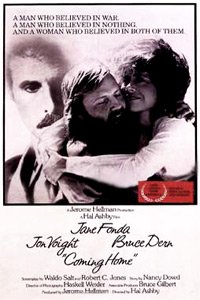
Coming Home (1978)

cominghome1Coming Home
Directed by Hal Ashby

 1978 is kind of a black hole in my movie world. This is another best picture nominated movie that I didn’t know anything about. When I picked it up from the library and saw that it was a movie about Vietnam starring Jane Fonda, I wasn’t thrilled. I’ve never been a fan of hers. But then I reminded myself that I loved watching Jane Fonda (and the rest of the cast) in Grace and Frankie, so I tried to put my prejudices aside and just lose myself in the movie, which turned out to be easy to do.

So what’s the story? Sally’s husband, Bob, is excited to be going to Vietnam to actually start doing his part in the Vietnam War. While he’s gone, Sally starts volunteering at the nearby VA hospital, where she reconnects with Luke, whom she knew in high school. Luke was injured in the war and is now a paraplegic. He is angry about the war, so naïve Sally tries to pull him out of his bitter shell. As they both wrestle with the tragic effects of war on so many different people, they find themselves falling in love.

The Good: Against my own expectations, I found myself very impressed with Jane Fonda’s performance as Sally. Sally grows slowly over the course of the film, and Fonda was able to show Sally’s progression from the little wife to a strong, brave woman. It’s a beautiful, heartbreaking piece of acting.

John Voight was equally good as Luke. I have prejudices against him, too (the Jim Phelps I know would never, ever betray the IM force), but since the long hair and beard helped disguise his face, I was able to appreciate his acting and feel the sadness, bitterness, and anger of a man returned from war, as well as his excitement when he started to feel that his life might get better.

The supporting actors were just as good as the leads. Penelope Milford played Vi, Sally’s free-spirited friend who worked at the hospital to be near her brother Bill, who came back from Vietnam with severe PTSD. Keith Carradine, who played Bill, and Bruce Dern, who played Sally’s husband, Bob, both portray men who can’t handle what happened in Vietnam, although they deal with it in different ways. Everyone in the movie is touched by the war somehow, and they were all able to show the different facets of living with something that can destroy men’s souls.

Both the music and cinematography in Coming Home were unusual in a good way. There was no original score, only songs that were from the time of the Vietnam War. When a song wasn’t playing in the background, there was no music at all, which added to the realism of the movie and forced the viewer to focus more intently on what is happening in the scene. The cinematography had a similar effect. There were a lot of shots of people’s hands as they were talking, underscoring what they were saying. This really stood out to me in the first scene, where actual veterans are having an unscripted conversation about the war, but it happened at other times, too.

The costuming and hair styles also underscored the changes people were making. As Sally found herself, she dressed in more comfortable, practical clothes instead of the dresses, heels, and pearls favored by the other officers’ wives. She let her hair be natural instead of straightening it. But when she went to Hong Kong to see Bob, she once again assumed the dress and appearance of a proper officer’s wife. It was a nice touch.

The Bad: Once again, I am so glad that I live now. The bad things in this movie are not problems with the movie, per se, but with the times. The attitudes towards women are terrible. Yes, I realize that people with the “men know best” attitudes still exist, but they aren’t as prevalent as they were. I’m also glad that PTSD is better understood and treated than it was in the past. I know treatment isn’t perfect, but it’s come a long way since the 1970s.

The Ugly: Coming Home isn’t a perfect movie, but there’s certainly nothing “ugly” about it.

Oscars Won: Best actor in a leading role (John Voight); best actress in a leading role (Jane Fonda); best writing, screenplay written directly for the screen.

Other Oscar Nominations: Best picture; best actor in a supporting role (Bruce Dern); best actress in a supporting role (Penelope Milford); best director; best film editing.

Amour (2012)

amourDirected by Michael Haneke

I wasn’t planning on taking this last week off. I had watched several of the movies and was reviewing my notes to write my posts when I got hit by a migraine that didn’t wear off for a few days. This meant that I got ahead in the audiobooks I’m currently listening to (Pinocchio: bizarre and pedantic; and Two Years Eight Months and Twenty-Eight Nights: bizarre and amazing, in case you were curious), but it was not helpful for blogging. But it’s gone and I’m glad to be back writing again.

I’m not hugely familiar with French cinema, but I like to think that I’ve seen more French movies than the average American. The French movies I have seen tend to be move a little more slowly, be a little more introspective, and end much more depressingly than American movies, so I wasn’t expecting a happy love story about an elderly French couple when I watched this movie, no matter what the cover looked like. But Amour was so much sadder than I would have been able to anticipate, mostly because it was so heartbreakingly real.

So what’s the story? Anne and Georges are a happily married couple. They are elderly retired music teachers, but they still live in their beautiful apartment by themselves. They read books and go to concerts and see their friends and play Chopin on their beloved piano. All that changes when Anne has a stroke and the realities of old age intrude upon their lives.

The Good: The acting is superb. Emmanuelle Riva was so perfect as Anne that I forgot that she was an actress playing a stroke victim; I thought that I was truly watching a woman whose body and mind had failed her. Jean-Louis Trintignant was amazing as Georges, a man watching his beloved wife slip away, but stubbornly doing his best to fight for her and care for her.

The soundtrack for the movie was also perfect. The only music in the movie was music that the couple played themselves on the piano or that they  were actually listening to. It added to the realism of the film. Any musical score that had played in the background to underscore the emotions or tell the viewer what they were supposed to be feeling would have detracted from the emotion that the movie brings just from the subject matter and acting.

The Bad: Because the movie is so realistic and captures so perfectly the burden of caring for a disabled loved one, it drags sometimes. Taking care of sick people isn’t fun or glamorous, and sometimes it’s downright dull. Amour needed to be that way, but watching people do dull things isn’t a completely fascinating way to spend two hours. I will admit to nodding off a couple of times. (And no, I do not wish to hear any comments along of the lines of “if you think this is boring, go watch Transformers!” Life is boring sometimes, and watching someone else’s life is boring. This truth doesn’t detract from my intelligence or from the beauty of the movie.)

The Ugly: There is nothing lovely about physical and mental decline. It is a horrible thing to see. Just like life can be boring, life can be horrible. This movie is very hard to watch because of that. Amour is a stark reminder of reality and not for the faint of heart, for those who only wish to see movies about the young and happy. It’s a beautiful portrayal of a terrible subject. Although I’m glad that I saw it, I don’t think I will ever be able to watch it again.

Oscar Won: Best foreign language film of the year.

Other Oscar Nominations: Best motion picture of the year; best performance by an actress in a leading role (Emmanuelle Riva); best achievement in directing; best writing, original screenplay.

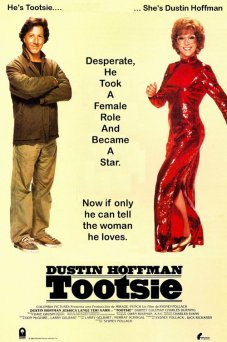
Tootsie (1982)

tootsieDirected by Sydney Pollack

I had seen Tootsie before, when I was probably ten or eleven. At that time in my life, I just thought it was weird. Why in the world would a man dress as a woman? Why could nobody see that Dorothy was a man? I didn’t understand the gender politics at play, either, so I was just left with an impression of oddness. This is why eleven-year-olds shouldn’t review movies made for adults. Tootsie is fabulous and hilarious and still relevant today, which is honestly kind of sad. There should have been more progress made in equality in the workplace in the last thirty-three years.

So what’s the story? Michael Dorsey is an actor who can’t get work. Even though he’s good, he has a reputation of being difficult to work with. Desperately in need of money, Michael decides to become Dorothy Michaels in order to try out for a role on a soap opera that a female friend didn’t get.  Michael soon finds out that when he puts on his dress and his makeup, he also puts on a different personality as Dorothy, inadvertently becoming a crusader for women’s rights. He also finds himself falling for his female coworker, but he can’t tell her who he really is. Will Michael be able to pull off his deception? Does love really conquer all? And will Michael ever lend his dresses to Julie?

The Good: The screenplay is brilliant. Both funny and meaningful, it manages to show Michael’s growth as a person without ever being preachy or obvious. It’s a tough balancing act, and the screenwriters pulled it off. After I watching Tootsie, I’ve been thinking about why more comedies aren’t nominated for best picture; watching lots of heavy dramas isn’t always the most fun. I’ve decided that it’s because the best movies introduce you to a new idea or make you think, and it is much easier to do that with a dramatic story than with a comedic one. The writers for Tootsie managed that, partly by letting the characters in the movie be real people, who sometimes get off killer zingers and who sometimes have no idea what to say. I love it. (Incidentally, this is one of the few times that I have recognized the name of a screenwriter as it flashed on the screen during the opening scenes: Larry Gelbart is one of the writers and producers of the television show M*A*S*H*, which is grew up watching with my parents and then grew to appreciate when I watched reruns on the Hallmark Channel in college. M*A*S*H* balances comedy with hard topics in the same way.)

The acting is fabulous all around. Dustin Hoffman plays Michael Dorsey and Michael Dorsey playing Dorothy Michaels so well that it’s indescribable. It’s a performance that needs to be seen, not just talked about. Teri Garr is wonderful as Sandy, the friend whose role Michael steals. She’s frustrated as an actress and as a woman, but she has hope that maybe things will get better. I love the role, and I love Teri Garr in it. Charles Durning plays Les, a man who falls in love with Dorothy. His reactions later on in the movie are priceless. Bill Murray is Jeff, Michael’s sarcastic playwright roommate. George Gaynes plays John Van Horn, the star of the soap opera who believes that he has the right to kiss all of his female coworkers. Michael’s bewildered agent is played by Sydney Pollack, who also directed the movie. Even the small roles are incredibly well-played. It’s one of those casts that melds together well and plays perfectly off each other. I love it.

The makeup is very good. Dustin Hoffman is listed twice in the credits, both as Michael Dorsey and as Dorothy Michaels. I think that decision was made because Dustin Hoffman is basically unrecognizable when he’s made up as Dorothy. It’s quite the feat.

The Bad: For being a movie about women being powerful, Julie and Sandy are both kind of stereotypical and weak. Sandy gets weepy and hysterical often at the drop of a hat, and Julie doesn’t have much personality. She’s brave to have a baby on her own in the 1980s, and she’s a sweet girl, but she doesn’t go very deep. It’s kind of disappointing that the only woman who is very strong and who bucks female stereotypes is a man.

The Ugly: The soundtrack is everything that is bad about ‘80s music. I’m not sure how it sounded originally, but it hasn’t aged well. The theme song (“It Might Be You”) is over-synthesized, which makes it super-cheesy. It might be a beautiful song if it was a bit more simplified, but it nothing about the 80s was simple or subtle, and the music in Tootsie suffers because of that.

Oscar Won: Best supporting actress (Jessica Lange).

Other Oscar Nominations: Best picture; best actor in a leading role (Dustin Hoffman); best actress is a supporting role (Teri Garr); best director; best writing, screenplay written directly for screen; best cinematography; best sound; best film editing; best music, original song (“It Might Be You”).

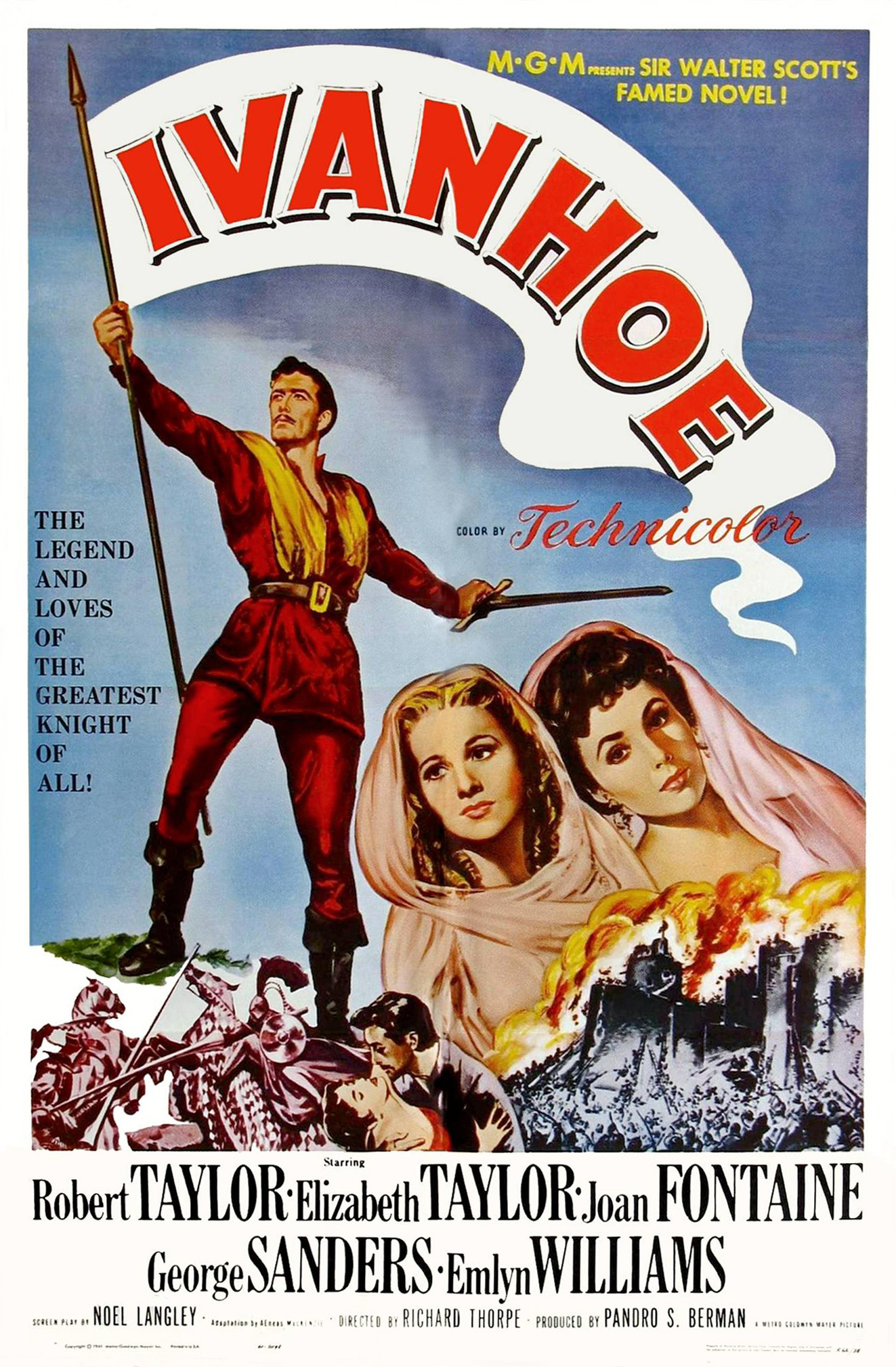
Ivanhoe (1952)

Ivanhoe (1952)_01

Directed by Richard Thorpe

I read Sir Walter Scott’s novel Ivanhoe when I was fourteen or fifteen, and I thought it was fabulous. It has all the necessary elements for an excellent swashbuckling story: adventure, romance, chivalry, and jousting. I had high hopes for the movie, too, but sadly, they were dashed. The elements were all still there, but something was missing. It didn’t feel alive somehow.

So what’s the story? Saxon knight Ivanhoe, who has been to fight in the Crusades, refuses to believe that King Richard is dead. As he makes his way back to England, he rides past every castle he can find, hoping that his English singing will attract the attention of a captive king. This long and slightly foolish plan works; King Richard throws him a letter explaining that he is being held for random. Prince John knows about the ransom, but refuses to pay it so that he can be king instead of his brother. When Ivanhoe reaches England, he not only has to raise the ransom, but right many wrongs and rescue damsels in distress.

The Good: The music is beautiful. It’s scored by Miklos Rozsa, who would go on to score Ben-Hur several years later. The music is very rich and full. The adjective I want to use is “orchestral,” but I’m not sure that would mean anything to anyone else. Hmm. How to put it? He uses the full orchestra to great effect. That makes it sound really boring, but it’s not. It’s really quite stirring.

The best actors in Ivanhoe were not the main characters. The person whose acting stood out to me the most was George Sanders as the villainous Norman knight De Bois-Guilbert. Even though his character was not the most chivalrous, his emotions rang true and he managed to take his flat character and make viewers pity him. It was impressive.

Other people with smaller parts were also able to make the most of their parts. Emlyn Williams as Ivanhoe’s slave-turned-page, Wamba, provided some welcome comic relief. Cedric, Ivanhoe’s bitter Saxon father, was played excellently by Finlay Currie. And Guy Rolfe was the vilest and scariest Prince John I have ever seen.

Although I read the book several years ago, I remember thinking that Rowena was terribly disappointing for a Saxon princess. She was just so blah. (That impression may have been wrong; like I said, it was a while ago.) But in this version, she has spirit and is a lot more awesome. Joan Fontaine did a very good job of showing her strength, her pride, and her jealousy, even if I thought she was a little old for the part. (Side note – this is the first time I’ve seen Joan Fontaine and thought, “Oh, yeah. She and Olivia de Havilland are totally sisters.” The resemblance really shines in this movie.)

The jousting scenes were pretty cool, even if some of the men’s colours were not manly looking. That was a seriously impressive sport, although I’m glad it’s not a big thing anymore because it also looks incredibly dangerous.

 The Bad: Robert Taylor is terribly miscast as Ivanhoe. He doesn’t even bother to try an English accent, which is a little jarring when everyone around him has one. He’s too old to convincingly be a young, dashing knight, and he’s much too solemn.

There is a scene where Ivanhoe has been taken captive, along with Rowena, Rebecca, Cedric, and Wamba. Robin of Locksley (yes, THAT Robin of Locksley) comes with his men to free them. There’s a huge battle with falling rocks and longbows and battering rams and swordfights, and it should be awesome. But it’s not. Watching people fire arrows at each other gets really boring after a while, and the swordplay is not well-choreographed. It may be the most disappointing medieval battle scene in a movie ever.

The Ugly: Elizabeth Taylor is so wooden as the Jewess Rebecca. She is extremely beautiful, but a damsel in distress should show some actual distress once in a while, instead of just looking pretty and putting her hand to her mouth. When she spoke, she sounded like she was reading lines, not speaking from her heart.

The worst thing about this movie was that it was so stiff. There was no sense of fun. There was no swash to the buckle, so to speak. Everything was taken so seriously. I wanted to say, “Hey! People! You’re in a castle! You’re fighting baddies! You’ve got awesome clothes! Smile once in a while. Look like you’re having fun!” No one ever did. Most of the separate elements were fine, but it just didn’t meld in a good way. A movie like this, set in the same time period and with so many of the same elements as The Adventures of Robin Hood (1938), is going to get compared to that movie. It needed to distinguish itself in some way, and sadly, it didn’t.

Oscars Won: None.

Oscar Nominations: Best picture; best cinematography, color; best music, scoring of a dramatic or comedy picture.

The Quiet Man (1952)

the-quiet-man-movie-poster-1952-1010203160Directed by John Ford

 As a librarian, I spend a lot of time using the alphabet, so yes, I realize that I by reviewing The Quiet Man today, I am doing things out of order. But Maureen O’Hara died on Saturday, and I’ve been thinking about her and her movies a lot the last couple of days. Because of Miracle on 34th Street and The Parent Trap (the originals of both, NOT the inferior remakes), I grew up admiring Maureen O’Hara as a strong, beautiful woman, completely unafraid to be herself, no matter what society thought. After reading obituaries and tributes to her the last couple of days, I get the feeling that she truly was that way. Since Maureen O’Hara plays another beautiful, strong woman in The Quiet Man, I’m posting my review of it today as my little tribute to a wonderful actress.

I grew up watching John Wayne movies, so I’m not sure how I missed this one. No, it’s not a Western, but I’d seen lots of other non-Western John Wayne movies. But even though I had never actually seen The Quiet Man, I had seen E.T. the Extraterrestrial, so I was really excited to finally know which movie included the dramatic kissing scene that E.T. watches on TV. It was a gap in my movie trivia knowledge, and I was ecstatic to have it filled in. Beyond that bit of trivia, I was glad to finally see The Quiet Man for another reason: it’s a dang good movie!

So what’s the story? Sean Thornton left Ireland for America with his parents when he was three years old, but his mother always talked of Ireland as if it were paradise, so he decides to move back and buy the cottage where he was born. He sees fiery-spirited redhead Mary Kate Danaher as soon as he steps foot in the village of Innesfree and decides that she is the girl for him. Unfortunately, Sean offends Mary Kate’s brother almost as soon. Although Mary Kate makes no secret about her reciprocation of Sean’s feelings, will her brother and her Irish customs keep them apart?

The Good: I’m going to mention cinematography first, because this movie is so beautiful that it literally made me cry. During the race, when the horses are pounding across the beach with the green mountains in the background…oh, it’s amazing. I can’t even begin to describe the beauty of it all. I know that Ireland is beautiful, but photographers still have to have an eye to capture the beauty, and the cinematographer did a fabulous job.

This movie is perfectly cast. I can’t think of another actress who could have done a better job at playing Mary Kate than Maureen O’Hara. She’s strong and proud and just plain wonderful. John Wayne is good as always as the man who is trying to live his dream, but who just doesn’t understand the culture of the woman he loves. He’s confused and frustrated, but so wholly in love. John Wayne and Maureen O’Hara were good friends in real life, and they have excellent on-screen chemistry.

The supporting cast is also so good. Ward Bond makes a surprisingly convincing Irish priest. Victor McLagen, although perhaps a little old to look like Maureen O’Hara’s brother, is full of bluster and silly pride as Will Danaher. Barry Fitzgerald brings a fabulous sense of humor to the role of Michaleen Oge Flynn, and his real-life brother Arthur Shields is excellent as the Protestant Reverend Cyril Playfair. Mrs. Playfair, played by Eileen Crowe, is mischievous and fun. I love them all!

The musical score is gorgeous. Victor Young used a lot of old Irish melodies, but also wrote some beautiful themes of his own. The music complements the movie perfectly.

The story and screenplay are fabulous. I’m not a huge fan of romantic comedies in general, because they’re just so fake. But The Quiet Man is so real. Two proud, stubborn people fall in love, but have a hard time adjusting to each other. Even though they love each other, they don’t completely understand one another. Movies don’t usually show that. Romantic comedies also tend to end with the wedding as the happy ending, but The Quiet Man is not like that. I wish more moviemakers would be brave enough to tell a real story like this one.

The Bad: Because I am a modern woman, I was incredibly uncomfortable with the scene where Sean drags Mary Kate off the train and pulls her across the fields and through the village. Yes, she was asking something of him that he didn’t want to do, but he wasn’t trying to understand her culture, either. Also, I’m not sure how accurate the Irish culture was portrayed. It felt very stereotypical to me, but maybe the stereotype happened because of reality. I don’t know. I just had to turn off the cultural sensitivity part of my brain, and then I was okay.

The Ugly: Nothing, unless you are even more sensitive than I am about the dragging through the fields scene.

Oscars Won: Best director; best cinematography, color.

Other Oscar Nominations: Best picture; best actor in a supporting role (Victor McLaglen); best writing, screenplay; best art direction-set direction, color; best sound, recording.

Random Fact: Even though The Quiet Man won an Oscar for best color cinematography, I once had a library patron who refused to check out the copy we have because it wasn’t in black and white, which, according to her, was the original. I did some research and apparently, ABC only had a black and white print, so that’s what was shown on broadcast TV for a while. The patron never did believe me that The Quiet Man was originally in color. Sigh.