I'd like to spank the Academy

Archive for the ‘Historical’ Category

The Godfather (1972)

godfatherDirected by Francis Ford Coppola

Even though I’m a library person, and librarians have a reputation for having Views about reading being the only worthwhile activity, I’m not like that. I like reading, but I also really like movies. However, when it comes to books based on movies, I almost always like the book better. Books can just get into characters’ heads in a way that movies can’t. I can list dozens of books that I like better than the movies that are based on them. The Godfather is not on that list. I read Mario Puzo’s novel five or six years ago, and I was not impressed. Before I read the book, I had really wanted to see the movie, but after I read the novel, I was a little bit worried. I wondered if a movie based on such a mediocre book could really be all it is hyped up to be. After I watched The Godfather, I found that yes, it can.

So what’s the story? Michael Corleone, son of Mafia Don Vito Corleone, resists joining the family business until an attempt on his father’s life leaves Michael in charge.

The Good: I’m gonna mix things up today and go with cinematography first. The cinematography was awesome. Whatever the cinematographer did, he made me feel like I was peering over someone’s shoulder and peeking into the lives of the Corleones. The scene that this stood out to me most was in the hospital when Michael realizes that there’s about to be another assassination attempt. It was so good.

The acting! What can I say about the acting that hasn’t been said before? Not much, I think, but I’m still going to talk about it. Watching Al Pacino take Michael Corleone from a straight-arrow war hero to a cold, calculating Mafia Don was amazing. He was just fantastic. James Caan as hot-headed brother Sonny Corleone was excellent, as was Robert Duvall as adopted brother Tom Hagen. Richard S. Castellano did a fantastic job as the high-up mob man Clemenza, and Lenny Montana made his short role as Luca Brasi very memorable. It was all great. I love it when a movie has not only great leads, but also a great supporting cast.

The music is beautiful. It captures the moods and the culture and the action very well. It wasn’t eligible for an Oscar because it was basically reworked from another movie’s soundtrack, but it is lovely and poignant and memorable.

The Bad: I had a hard time with Marlon Brando. I don’t necessarily think he did a bad job, but I was really distracted by whatever the makeup artists put in his cheeks to make them puffy at the bottom. It doesn’t look real, and so every time there was a close up on Brando’s face, that was all I could think about.

Diane Keaton also did not do a bad job, but after watching Reds, I realized I don’t really care for her as an actress. I was kind of bummed when I realized she was in The Godfather. And yes, I realize I will have to watch three more movies with her before I’m done. Oh, well. Life is like that sometimes.

The Ugly: It’s a movie about the Mafia, so it’s violent. It’s somehow not as shockingly violent to me as No Country for Old Men, but it’s still got some strong violence. It never felt gratuitous, though, except possibly for the amount of blood in the infamous horse head scene (which, by the way, is much more dramatic to see on the screen than to read in a book).

Oscars Won: Best picture; best actor in a leading role (Marlon Brando); best writing, screenplay based on material from another medium.

Other Oscar Nominations: Best actor in a supporting role (James Caan); best actor in a supporting role (Robert Duvall); best actor in a supporting role (Al Pacino); best director; best costume design; best sound; best film editing.The Godfather
Utvandrarna – The Emigrants (1971)

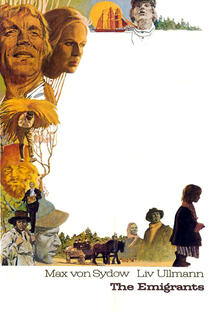
emgrants posterDirected by Jan Troell

I knew when I started this project that I would have trouble finding some of the movies, but I thought that the ones that would be hard to find would be some of the more obscure ones from the 1930s and 40s, not from the 70s. And I wouldn’t even say that Utvandrarna is obscure; some of my library coworkers remembered seeing it when it came out. Not only that, the Academy thought this movie was so awesome that it was nominated for Best Foreign Language Film the year it came out in Sweden, and then for Best Picture when it was released in America the following year. Despite all this awesomeness, none of the three library systems that I have cards for had it. I had to order it from a university library in Minnesota. The fact that it’s so hard to get makes me really sad, because it’s a fabulous movie.

So what’s the story? Life in Sweden is hard in the 19th century. Abusive employers, failed crops, and a strict religion give different members of a family different reasons to leave Sweden for America. Utvandrarna chronicles this family’s journey from Sweden to Minnesota.

The Good: The acting is amazing. Liv Ullman is Kristina, who grows from a young newlywed to a mother of many children. She has some heartbreaking moments as she portrays the struggles of daily life in Sweden and the trials of moving a large family to an utterly foreign country. Kristina’s husband is Karl Oskar. He yearns for a better life for his family, but is unsure of how to reach that goal. Max von Sydow does an excellent job at showing Karl Oskar’s torment. The other standout in my mind was Monica Zetterlund as Ulrika, a reformed prostitute. She’s an outcast because of her past, but she both wants and disdains acceptance. She’s a fascinating character and Zetterlund’s performance was fantastic. The other actors were all just as good. No one seemed out of place or bad at acting.

I loved the set design. I’m kind of obsessed with ships, and I’ve always thought it would be kind of cool to sail across the Atlantic in a reenactment of what some of my immigrant ancestors did, but after seeing Utvandrarna, I’m not sure I could do it. I really got a sense of the tininess of the ship and the cramped quarters. The scenes on the ship were almost claustrophobic. The other sets were just as good at building the world of the 1840s. The costumes were good, too. I’m not an expert on Swedish farming clothes of the 1840s, but at they felt right for the time and place.

The Bad: While the set design and costume design seemed authentically 1840s, the hair screamed 1970s. The men’s haircuts were especially bad. They all had Luke Skywalker hair. (And yes, I realize Star Wars came later than this movie, but they still had Luke Skywalker hair.)

The Ugly: Utvandrarna was nominated for five Oscars over two separate years. It has a compelling story and great acting. And yet it is unavailable here in North America except for in an edited, DUBBED form. Dubbing is the worst. I thought this was what The Criterion Collection was for – to preserve fantastic movies that may not be the most popular at the moment. Come on, Criterion Collection people! If the movie is that impressive with dubbing, how amazing would it be in Swedish with English subtitles?

Oscars Won: None.

Oscar Nominations 1973: Best picture; best actress in a leading role (Liv Ullman); best director; best writing, screenplay based on material from another medium.

Oscar Nominations 1972: Best foreign language film.

Sounder (1972)

sounderDirected by Martin Ritt

I think my third grade teacher hated children. What is my evidence for this? She made us read not only The Red Pony by John Steinbeck, but also Sounder by William H. Armstrong. While both are good books (SPOILER ALERT), the beloved animal dies at the end of both books. It does not make for happy reading for eight and nine year old children. The only thing that could have made the year worse was if we had also read Where the Red Fern Grows by Wilson Rawls. (We read Summer of the Monkeys instead.) Because I remembered how depressing and sad that year was, I wasn’t particularly looking forward to watching Sounder. But the screenwriter was smart, and the movie ends much more happily than the book does.

So what’s the story? During the Depression, sharecroppers David Lee and his father Nathan spend their nights hunting with their dog, Sounder, hoping to get any kind of meat to put on the table. One day, in desperation, Nathan steals a ham from his work. He is arrested and sent to a work camp. The town sheriff won’t tell David Lee and his mother and younger siblings where Nathan has been sent, so David Lee and Sounder go off in search of Nathan.

The Good: There are some nice performances in this movie. Kevin Hooks did a great job of carrying the movie as David Lee, which is a hard job for a teenager. Cicely Tyson plays Rebecca, Nathan’s wife, who is determined to keep the farming going without her husband. She does a beautiful job as the tough, yet loving woman. Paul Winfield is Nathan, a man trying so hard to provide for his family in an impossible time. The major standout for me, though, was Janet MacLachlan, who plays Camille, a teacher who cares. She shone in every scene she was in.

I liked the plot. I like seeing movies about people who love each other and who try to help each other through bad times. Sounder managed to tell the story without being cheesy, which is a hard thing to do.

The Bad: Even though all the performances were lovely, and even though I liked the story of the family, I felt like the movie rambled some. There were some unnecessary scenes. Or maybe they were necessary, but they just didn’t feel like they tied in to the rest of the movie. It dragged a bit, and that made it hard for me to connect with the movie, even though I felt for the people and their plight.

The Ugly: This is a G-rated movie, and there’s not anything horribly offensive in it, but it’s sad. Black sharecroppers in the South during the Depression did not have an easy time of it. This is a so-called “family movie,” but I would suggest not letting small children watch it on their own. I think it’s a movie that parents should talk about with their children so that children can understand what the family was going through.

Oscars Won: None.

Oscar Nominations: Best picture; best actor in a leading role (Paul Winfield); best actress in a leading role (Cicely Tyson); best writing, screenplay based on material from another medium.

Cabaret (1972)

cabaretDirected by Bob Fosse

Okay, I’m back. I’m finally better enough that my writing once again makes sense. And I’m glad, because I’ve missed this. Now on to 1972!

I liked musicals when I was young. I’m not sure why. Maybe I liked believing in a place where people burst spontaneously into song and dancing with your enemy could solve problems. Maybe I didn’t notice that story and character development tend to suffer when the director has to make room for musical numbers. Maybe I liked the happy endings. But whatever it was that I liked as a child is gone now. Musicals make me very impatient. I still retain a nostalgic liking for the musicals I liked growing up, but I have a hard time with musicals that I am seeing for the first time. Since Cabaret has adult themes, it is not a musical I grew up with. Although I can see some of what people like about it, I didn’t particularly care for it.

So what’s the story? Young English author Brian Roberts moves to Germany in the 1930s. At his boardinghouse, he meets Sally Bowles, an effervescent American nightclub singer/aspiring actress. Together they experience the heady turmoil of pre-World War II Berlin.

The Good: I will give Cabaret props because even though it has musical numbers, all of the musical numbers take place in the nightclub. No one randomly breaks into song on the street or anywhere else. I did like that aspect of Cabaret as a musical. It made it realistic enough that I didn’t want to throw something at the TV.

The acting was good. Liza Minelli made a wonderful Sally, a woman who finds every experience in life worth trying, a woman who just loves life for life’s sake. I quite liked Michael York as Brian, the quiet Englishman who’s not quite sure of his sexuality or what he wants out of life. But the people who I really loved (and whose story I found more interesting than that of Sally and Brian’s) were Fritz Wepper and Marisa Berenson as a gold-digging man and a rich young woman, respectively. Both characters were extremely compelling, and being unsure if they will get a happy ending after all makes them semi-tragic.

The Bad: Even though the characters didn’t randomly burst into song, I didn’t feel like the songs added anything to the movie. The songs could have all been cut, and the only thing it would have done to the movie is make it shorter. There wasn’t even any fabulous dancing to make the musical numbers worth it. And I think some of the cabaret dancers were men in drag, but I couldn’t ever be sure, so I was distracted during the musical numbers trying to figure it out.

The Ugly: There wasn’t anything ugly about Cabaret per se, but I had a really hard time connecting to the movie at all. I can’t even blame being sick, because I was really into other movies I watched while I was sick. Anyway, I’m just going to have to risk the wrath of the internet and say I think Cabaret is overrated.

Oscars Won: Best actress in a leading role (Liza Minnelli); best actor in a supporting role (Joel Grey); best director; best cinematography; best art direction-set direction; best sound; best film editing; best music, scoring original song score and/or adaptation.

Other Oscar Nominations: Best picture; best writing, screenplay based on material from another medium.

No Country for Old Men (2007)

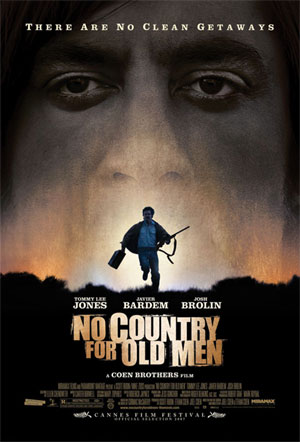
No_Country_for_Old_Men_posterDirected by Ethan Coen and Joel Coen

I know it’s been a little while since I’ve posted, and I feel very bad about that. I know I left all my adoring fans hanging in 2007 (hahaha! Look at me, pretending I have fans!), but writing when you have a fever rarely produces anything that makes any sense, let alone anything readable. So in the future, I will attempt to not get sick until I’ve posted an entire week’s worth of reviews so that you, my loyal readers, will not be left without my wisdom.

I knew two things about this movie before I watched it: 1) It was based on a book by Cormac McCarthy and 2) It was a Coen brothers film. And this time, I was right on both counts! This movie makes a lot more sense for the Coen brothers. Although it’s a drama, it still has enough quirky characters and funny lines to bring that Coen brothers feel to it. Of course, that makes me extremely curious about the book that it’s based on. Does it have that same quirky feeling to it? Maybe one day when I have time in my life, I will find out.

So what’s the story? One day while he is out hunting (or poaching, maybe?) in the desert, Llewelyn Moss stumbles across the bloody aftermath of a drug deal gone wrong. He finds a case containing two million dollars, and instead of reporting it to the police, he decides to keep the money and run. Because he leaves his truck at the scene, he is soon being pursued by both the county sheriff and a psychopathic killer who works for the drug lord.

The Good: It’s extremely well-acted. Josh Brolin is Llewelyn Moss, a Vietnam veteran who wants more in his life. Tommy Lee Jones plays Ed Tom, the county sheriff who just can’t understand the mindless violence that has entered his life. And Javier Bardem won an Oscar for his portrayal of Anton Chigurh, the incredibly scary psychopathic killer. Side note: I realized while I was watching this movie that although Javier Bardem is an attractive man, I’ve only seen him in movies where he plays a really bad guy, so I’m a little bit scared of him. I’m sure he’s a perfectly nice man in real life, but I would need to see him being nice in real life to overcome the scary people I’ve seen him play. Kelly MacDonald is Moss’s innocent young wife with a backbone of steel. Her scene at the end was so well-played, I had to watch it twice.

I don’t know whether it was the acting or the screenplay or the direction, but No Country for Old Men is a gripping movie. I couldn’t stop watching. I got a phone call in the middle of the movie from someone I love, and getting pulled out of the movie made me really frustrated. I was so annoyed that I had to pause it; I was so into it and so absorbed in the world of the movie that coming out for a phone call was almost painful. And that was to talk to someone I care about. If it had been a telemarketer, I’m not sure what I would have done.

The Bad: Although I love Kelly MacDonald and think she’s a great actress, she looked so young that when I first saw her, I thought she was Josh Brolin’s teenaged daughter, which made it really creepy when he told her that if she didn’t stop talking, he was going to take her to the bedroom. It honestly took me a bit to realize she was supposed to be his wife. I think that’s more the fault of the makeup and costume people than anything. Everything else makeup and costumey worked, even Chigurh’s creepy haircut, but something needed to be done to make Kelly MacDonald not look like a sixteen-year-old.

I also felt like there was a lot of backstory to everyone which we as viewers never really get told about. Backstory is a good thing; it adds a lot of richness to a movie. But it left me with the feeling that there were things going on that I didn’t understand, and that frustrated me a bit. The questions didn’t all get answered, either. WHAT HAPPENED TO THE MONEY?

The Ugly: After watching No Country for Old Men, I feel kind of silly saying that There Will Be Blood was violent. No Country for Old Men is so much worse. People get shot left and right for no discernable purpose. I am also now afraid of oxygen tanks, although I recognize that Chigurh’s was a special cattle tool. Still. They are scary. And because there were so many deaths, I was left feeling empty at the end. I thought, “Wait. That’s it? That’s all there is to this story? What? How? Who? No, there has to be another ten minutes or so.” I didn’t have a feeling of closure; the movie just…ended. I didn’t like that at all. I felt like if that’s how it was going to end, then there wasn’t much point to the two hours that led up to the ending.

Oscars Won: Best motion picture of the year; best performance by an actor in a supporting role (Javier Bardem); best achievement in directing; best writing, adapted screenplay.

Other Oscar Nominations: Best achievement in cinematography; best achievement in film editing; best achievement in sound mixing; best achievement in sound editing.

There Will Be Blood (2007)

600full-there-will-be-blood-poster-finalDirected by Paul Thomas Anderson

I knew two things about There Will Be Blood before I watched it: 1)it was based on a book by Upton Sinclair; 2)it was a Coen brothers film. As I watched it, I couldn’t help but think it was a very odd film for the Coen brothers. It was just so serious and everything was played completely straight. About midway through, I looked it up on IMDb and realized that I had only known one thing about There Will Be Blood: it was based on a book by Upton Sinclair.

So what’s the story? On a tip from a young man named Paul Sunday, prospector-turned-oilman Daniel Plainview travels with his son to the community of Little Boston to see if he can start some oil wells. The land is promising, but Paul’s creepy twin brother, Eli Sunday, has a strange hold over the people of Little Boston.

The Good: I’m not very familiar with Daniel Day-Lewis as an actor, but I didn’t think very much of his performance in Gangs of New York, so I wasn’t exactly jumping with excitement to see him in There Will Be Blood. But his performance as Daniel Plainview was excellent. It had to be; Daniel is in almost the entire movie and for some of the movie, he’s the only person onscreen. The movie wouldn’t have worked with a lesser actor.

I really liked the soundtrack. It wasn’t constant; at times there was no music at all. I like that. It makes it feel more real and less manipulative. I liked, too, that the music was usually played by a smaller group, not necessarily a full orchestra. It reflected the bare bones of the frontier places Plainview was.

The Bad: There were a couple questions I had that never really got answered. Why did HW stop talking? He had the capability to speak. Why did he not? And what happened to Paul Sunday? I suppose if I had a creepy brother like Eli, I might leave and never come back, but why does his family never mention him again? I kept waiting for him to show up again, but he never did. I felt like other people disappeared, too, like Ciaran Hinds’ character. What happened to all those people?

The Ugly: I’m not a big fan of violence, whether it’s intentional or accidental, and many distressingly violent things happen in this movie. My cat finally moved off my lap in disgust because I kept jumping and gasping at things that were happening. Mining and oil well-digging were very dangerous jobs back then, and I didn’t like seeing what could happen to people while they practiced those professions. I’m not mortally offended by it; I’m just not good at handling that kind of stuff.

Oscars Won: Best performance by an actor in a leading role (Daniel Day-Lewis); best achievement in cinematography.

Other Oscar Nominations: Best motion picture of the year; best achievement in directing; best writing, adapted screenplay; best achievement in film editing; best achievement in art direction; best achievement in sound editing.

Atonement (2007)

Atonement-movie-posterDirected by Joe Wright

It was five or six years ago when I read Ian McEwan’s novel Atonement, but it has stayed with me. Even though I liked the writing style and thought that the characters were very well drawn, it was a hard book for me to get through. As soon as Robbie handed Briony his note, I knew things were going to take a turn for the worse; I didn’t want that to happen, so I put the book down for a while. I couldn’t stay away, though; I had to find out exactly what happened to all of these great characters. I finished it and loved it, but never felt like I had to emotional strength to read it again. So it was with a feeling of trepidation that I watched Atonement. I didn’t want to see all the bad things happen to the people I cared about. I needn’t have worried. Although it’s a good film, I didn’t get as emotionally caught up with the characters as I did when I read the book. Maybe it’s because I already knew what was going to happen, so I subconsciously made the decision to stay detached.

So what’s the story? On a hot summer’s day in 1935 England, thirteen-year-old Briony witnesses some things that she doesn’t understand and so misinterprets as menacing. When her cousin is attacked, Briony makes an accusation based on what she’s seen earlier. This accusation has serious repercussions for Briony’s sister, Cecelia, and Cecelia’s lover, Robbie, that will echo throughout the rest of their lives.

The Good: The music struck me from the very beginning. I really liked the way that the typewriter was used almost as a percussion instrument. It was very clever and somehow added to the tension of the movie.

The acting was very good. I don’t usually like Keira Knightly, but she really fit her part here. James McAvoy made an excellent Robbie. Saoirse Ronan was nominated for best supporting actress for her role as thirteen-year-old Briony. She has very expressive eyes. Romola Garai plays eighteen-year-old Briony, a young woman haunted by what she did five years before. They are all excellent in their roles.

The cinematography was lovely. The very long tracking shot on the beach emphasized the hopelessness and chaos of the situation. The cinematographer also somehow made the scenes at the country house glow like a long-cherished memory. It’s a very pretty movie.

The screenplay was well-done, too. I was wondering how they were going to show what really happened and also what Briony saw and interpreted. They did an excellent job with that.

The Bad: I kept wondering about the scene between Cecelia and Robbie in the coffee shop/at the bus stop. (SPOILER ALERT): If everything we see in the movie up until the interview is Briony’s story that she’s rewritten for Robbie and Cecelia’s happy ending, how did Briony know about that meeting and the summer cottage? Because when we see Robbie dying, he has the photograph of the beach house. That kind of bugged me.

The Ugly: The movie itself didn’t have anything ugly about it, but the story is frustrating and sad. It’s probably not a good movie for the easily depressed to watch.

Oscar Won: Best achievement in music written for motion pictures, original score.

Other Oscar Nominations: Best motion picture of the year; best performance by an actress in a supporting role (Saoirse Ronan); best writing, adapted screenplay; best achievement in cinematography; best achievement in art direction; best achievement in costume design. (When did the names of the awards get so long?)

Around the World in Eighty Days (1956)

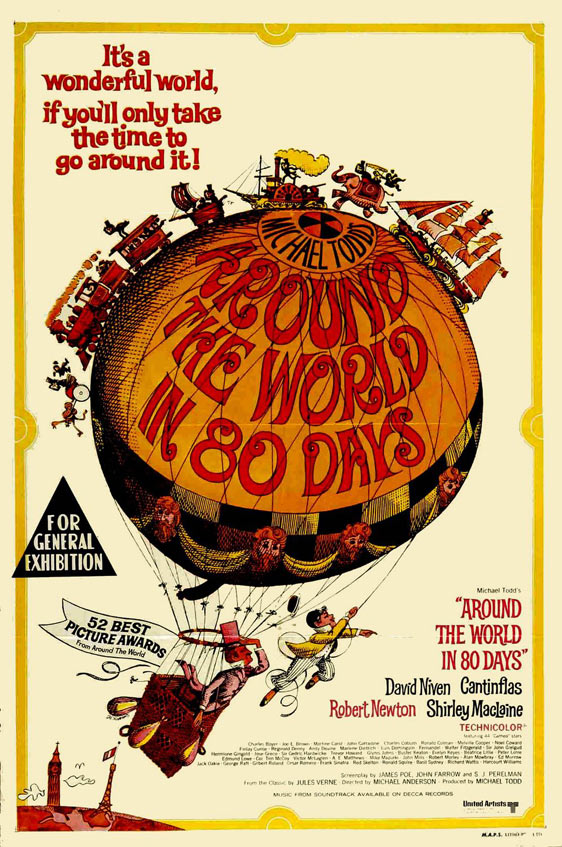
around_world_80_daysDirected by Michael Anderson

I had a patron come into the library where I work one day and ask for Cantinflas movies. I had no clue what he was talking about. He wrote the name down for me because I couldn’t spell it well enough to look it up in the catalogue, and I found some Spanish-language movies for him. The patron was honestly surprised that I had never heard of Cantinflas. I was surprised, but very pleased, to find Cantinflas in Around the World in Eighty Days. I’ve read the book, but I hadn’t seen the film before this week. The entire movie was a delightful surprise.

So what’s the story? Phileas Fogg, a wealthy, eccentric Englishman, bets the men in his club that he can travel all the way around the world in just eighty days. With nothing more than his newly hired manservant Passepartout and a carpetbag full of money, Fogg sets out on an amazing adventure.

The Good: This is another epic with thousands and thousands of people in it. It seriously boggles the mind that movies like this can come together. Coordinating all the details must have been ridiculous, but the work paid off. There are very many good things in this movie.

The cinematography is gorgeous. Many scenes were filmed on location, which takes extra work, but was absolutely worth it. Besides the beautiful scenery they were able to capture, it means that there were no places where you could tell that the actors were standing in front of a screen with a movie projected behind them. (I’m sure there’s a technical term for that, but I have no idea what it is. If anyone knows, please enlighten me!)

The music, by Victor Young, is also fabulous. At times it is sweeping and beautiful; other times, it is cheerful and jaunty. It fits the movie very well.

The cast was fun. Cantinflas, a Mexican comedic actor, is really good as Passepartout. He has a wide range of skills that fit the role and brought some good comedy to the movie. David Niven is good as a very English Englishman. But what is really fun about this movie is the cameos. So many famous people are in this movie, from Noel Coward to Marlene Dietrich to Frank Sinatra. My personal favorite was Buster Keaton, who talks! I’ve seen lots of his movies, but I’ve never heard him talk before. And he was a train conductor like in The General, which may be literally the funniest movie I have ever seen. Anyway, if you like classic movies, then you will enjoy spotting the stars.

The Bad: Shirley MacLaine was cast as an Indian (eastern, not American) princess. It was an odd choice. She didn’t do a horrible job, but she never convinced me that she was Indian, either.

The Ugly:  This movie needed some more editing. Some scenes are fine for a while, but then they don’t end. The bullfighting scene was the worst offender here. It just went on and on.  Around the World in Eighty Days didn’t need to be a three-hour movie. It would have been just fine at two and a half hours. As it is, there are some boring times.

Again, there is some ugly racial stereotyping because not only was this movie made in the 1950s, it is based on a book written in 1872. It’s not surprising, but it’s not good, either.

The Ten Commandments (1956)

ten_commandments_ver2Directed by Cecil B. DeMille

I was brought up in a religious family, and when I was growing up, TV and movies were not allowed on Sunday. The only exception was religious movies. I am from a family that loves movies, so I have seen The Ten Commandments a ridiculous amount of times. (Well, I’ve seen the first couple hours many times; I was usually sent to bed before the very end, so I’ve only seen the end probably five times.) My sisters and I can do entire scenes from memory, and we each have our favorite lines (“To me you’re a lily, and I want water!”). So the only way I could watch The Ten Commandments this time was in my parents’ basement with my family. We had two big bowls of popcorn and a solemn oath that we wouldn’t quote the lines before they happened because my brother-in-law had never seen it before. That was a hard promise to keep. Man, I love this movie.

So what’s the story? This epic (and epically long) movie tells the story of Moses from his birth to his death. It tells of his young manhood in Pharaoh’s palace, his banishment to the desert, his marriage to a shepherd girl and subsequent return to Egypt to free the Hebrew slaves. And yes, in the end he receives the Ten Commandments.

The Good: I think I will always marvel that epic movies with casts of thousands were made at all. For a movie this scale to work, so many people have to be involved. And The Ten Commandments takes this a step further. I felt like Cecil B. DeMille wanted everything to be as authentic as possible, so many things were meticulously researched. As I watched the opening credits, I was impressed not just by the number of experts that were consulted, but also their caliber. DeMille didn’t just make stuff up or go for a vaguely Egyptian feel. He found people who knew what they were talking about so that things would be authentic. This leads to amazing production design and great costumes.

Elmer Berstein’s score is amazing. It is at times melodramatic (Nefretiri’s theme, anyone?), but that is the nature of the film. The score manages to be dramatic and sweeping, but also reverent when it deals with religious things. That’s an impressive thing to do. Also, I have apparently seen this movie so many times that I can listen to the soundtrack and know what lines are being said. But that means that although the music has themes, Bernstein doesn’t repeat himself too much.

The acting is good all around. Charlton Heston does a good job playing a man trying to figure out who he is and what his place is in the world. Yul Brynner plays another man in authority, but Rameses is a totally different king than the one in The King and I, even though both men think Moses is a fool. I think that displays how good an actor Brynner really was. Anne Baxter schemes most convincingly, playing woman who is not necessarily bad, but willing to do whatever it takes to get what she wants (did she get this role because she was typecast after All About Eve?). Yvonne de Carlo as Sephora, Moses’s wife, Nina Foch as Bithiah, Cedric Hardwicke as Sethi –everyone is so good in this movie. I would name everyone, but again, there is a huge cast.

The special effects were amazing for their time. Some haven’t held up, of course, because The Ten Commandments was made almost sixty years ago. But some have held up surprisingly well. The hail that turns to fire still looks believable. That’s incredible to me.

The Bad: As much as I love this movie, I will be the first to admit that the screenplay is not the best. There are many, many cheesy lines.  These lines make the movie really fun to watch, but they are not an example of fabulous writing.

The Ugly: I didn’t find anything ugly in this movie. I enjoyed watching it as much this last time as I did when I was a kid. That’s not always the case for me.

Oscar Won: Best effects, special effects.

Other Oscar Nominations: Best picture; best cinematography, color; best art direction-set direction, color; best costume design, color; best sound, recording; best film editing.

The King and I (1956)

king and iDirected by Walter Lang

This is the second movie I’ve watched this week that I’ve seen more times than I can count, but it’s the first movie this week that was based on a play which was based on a book which was based on a true story. I loved musicals when I was young(which I think is funny considering how little patience I have with them now), and this was one of my favorite musicals. I can still sing along with all of the songs, and I think it will always have a special place in my heart.

So what’s the story? Anna Leonowens, a widowed Englishwoman, comes to Siam (now Thailand) to be the governess to the children of the king.

The Good: I love the music in this movie. I don’t love all of the songs, because I think there are one or two that slow the movie down, but most of them are enjoyable. And the score is amazing. All I have to do is see the cover of this movie and I have “The March of the Siamese Children” in my head. Not only that, but I am happy to have that song in my head. That never happens.

I like the lead actors in this movie. Yul Brynner plays a man who is trying to hold on to tradition and effect change at the same time. His inner struggle is plain on his face as he tries to make hard decisions. Deborah Kerr makes an excellent Anna. She is smart and determined and compassionate and courageous.

The costumes are gorgeous. Because of this movie, I have had a lifelong dream of polkaing in a dress with a giant hoopskirt. But Anna’s dresses are not the only beautiful ones in The King and I. The women of the court also wear lovely things. Even the king’s clothes are very sumptuous. It’s all very fun.

As impatient as I am with musical numbers that don’t help advance the plot or at least help with characterization, I love the Uncle Tom’s Cabin ballet. It’s different and beautiful and mesmerizing. I’m glad it’s in the movie.

The Bad: It bothers me a little bit that many of the “Asian” people in The King and I were played by Latinos. I can see the reasoning behind hiring Rita Moreno, because she’s amazing, and who wouldn’t pick Rita Moreno if she were a choice? But were the producers really unable to find enough children to play the king’s children who were, if not Thai, at least Asian? There weren’t ten to fifteen Asian kids living in California in 1956?

The Ugly: I have seen this movie many times, and it never bothered me before, so maybe I’m being ultra picky, but the attitude of the movie toward Siam in general and the king in particular is very condescending. There is very much an air of “everything in European culture is good because the Europeans are so enlightened, but there is nothing good about Siamese culture.” The king is only admired because he is trying to westernize his country. He makes silly mistakes (like wanting to send only male elephants to America) that are then corrected by the superior Englishwoman. At one point, Anna tells her young son, Louis, that in many ways, the king was no older than Louis. Really? This is a grown man who had ruled a country and managed to keep it independent in a time of colonization. He is very different from an eight-year-old. I think this might not bother me so much if these characters weren’t based on real people, but since they are, I feel like the characterization of the king and the attitude toward Siam in general is very disrespectful. And yes, I understand that The King and I is from a different era, which is why I can still enjoy this movie. But I can also understand why it’s banned in Thailand. Not that I advocate banning, but I can sympathize with the feelings behind the banning in this particular case.

Oscars Won: Best actor in a leading role (Yul Brynner); best art direction-set direction, color; best costume design, color; best sound, recording; best music, scoring of a musical picture.

Other Oscar Nominations: Best picture; best actress in a leading role (Deborah Kerr); best director; best cinematography, color.