I'd like to spank the Academy

Archive for the ‘Historical’ Category

Gandhi (1982)

gandhi-movie-poster-1982-1020195902Directed by Richard Attenborough

I always worry when I’m watching a movie about a culture that isn’t my own, especially when it’s made by someone also outside that culture. I worry that I will “learn” something inaccurate or get the wrong idea about that culture. I had seen Gandhi before, but I was probably fourteen or fifteen and impressionable, so I was worried about how Indians view the movie and whether I could watch it comfortably as an American. But the day I picked it up from the library, an Indian coworker of mine said, “Oh, you are going to watch that movie? It is such an excellent movie. So well done.” Later that night, a British friend of mine whose parents are from India and Pakistan asked me what I was doing. I told him I was watching Gandhi. His response? “I love that movie.” So while there might be historical inaccuracies or only part of the story told, I at least know that Indians do not find this movie offensive, which does make me glad.

So what’s the story? Mohandas Gandhi, a young Indian lawyer educated in London, experiences racial prejudice in South Africa and decides that it is unacceptable for anyone to be treated that way. He begins a protest of the way Indians in South Africa are treated. His activism doesn’t stop there, however. He goes back to India and becomes the leader of the long struggle against British rule.

The Good: Ben Kingsley makes an excellent Gandhi, both young and old. He takes us on the same journey that Gandhi made, from rash young man to wise old leader, full of patience and kindness. It is an excellent performance.

I’m not going to name all of the people who did a good job of acting, because in a three-hour movie with lots of small roles filled by famous or soon-to-be-famous people (including Daniel Day-Lewis!), there is lots of good acting. I will mention Rohini Hattangadi, though. She played Ba, Gandhi’s wife, going from a young woman unsure if her husband is doing the right thing or if he has gone crazy to a woman who believes fully in what he does and supports him completely. She was impressive.

I loved the cinematography. There are times when it shows the grandeur of India, the huge scale of that country, and other times when it is intimate, showing how one man was able to make such a difference in such a large, diverse country. If I hadn’t already wanted to visit India someday, the cinematography of this movie would have made me want to go.

The makeup people did an excellent job of making Gandhi and Ba look older as time passed. I might have thought that the old and young were played by different people, especially as Ben Kingsley looks less like himself and more like Gandhi as he “aged”.

The Bad: Those same makeup people who did such a good job on Gandhi did a less-than-stellar job on Gandhi’s associates Nehru, Jinnah, and Patel. They didn’t age at all until the very end, even though they had been working for independence for thirty years. If this was done on purpose to show how much more quickly people age when they are living a lifestyle of poverty, than I suppose it was okay. But even if you are wealthy, you age over time, not all at once.

What happened to Gandhi’s sons? They are shown at the beginning of the movie in South Africa, but then we never see them again. There was nothing about the sons to make them a huge plot point, but I really did have to wonder if they all died, since they don’t seem to be anywhere around Gandhi and his wife for the rest of his life. Leaving them out altogether would have been one thing, but to show them once and then never again is bad storytelling.

The Ugly: I’m not disputing that Gandhi was a great man. He truly was. It takes an amazing kind of person to struggle for independence without fighting and to inspire an entire nation to do the same. His story is an incredible one. But except for one scene where he is angry at his wife, he is shown as having no weaknesses. He is made out to be a saint. I’m not trying to insult anyone or tear Gandhi down, but no one is that perfect, which made me feel like the movie was only semi-factual. I may be wrong; I know very little about the Mahatma. He may have been perfect. But because I was feeling that throughout the movie, I couldn’t immerse myself completely in the experience, so I’m going to stand firm in my belief that it was a weakness for this movie.

Oscars Won: Best picture; best actor in a leading role (Ben Kingsley); best director; best writing, screenplay written directly for the screen; best cinematography; best art direction-set decoration; best costume design; best film editing.

Other Oscar Nominations: Best sound; best music, original score; best makeup.
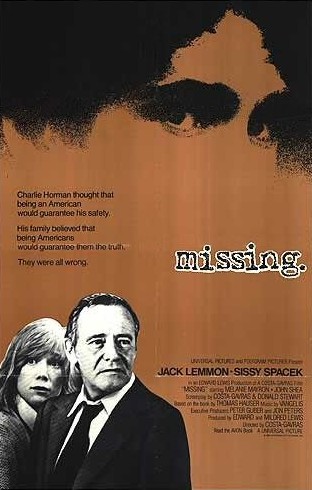
Missing (1982)

Missing_1982_filmDirected by Costa-Gravas

As I’ve been watching these Oscar-nominated movies, there have been many, especially from the 1970s and 1980s, that I haven’t really known anything about. Some of them have been less than stellar, and I can understand why they have fallen by the wayside, even for someone like me who likes watching good movies, no matter how old they are or what language they are in. Missing is not one of those movies. Missing is so awesome I want to show it to everyone I know, and I’ve been telling random people how sad I am that no one seems to have seen it. Missing makes me want to be a high school history or civics teacher so that I could show it to my class to teach them not to be too trusting of government. It makes me so mad that Missing is not a classic; it completely deserves to be one.

So what’s the story? Charlie and Beth Harmon are an idealistic young married couple who have been living in Chile for a couple of years when a right-wing coupe happens. They are going to leave the country soon, so Beth goes to say good-bye to a couple of friends. She gets stuck overnight because of the curfew. When she finally makes it home, Charlie is gone. About two weeks after his disappearance, Charlie’s conservative businessman father, Ed Horman, comes to help Beth navigate the waters of diplomacy and bureaucracy. What they find out together will change their lives forever.

The Good: I’m tired of starting with acting, so I’m going to start with music today. Vangelis’s score is beautiful and haunting. It’s more orchestral than the music in Chariots of Fire, and where he does use the synthesizer, it fits the time much better. The other thing that is great about the music is that it is not constant. Lots of the movie has no music, so that where there is music, it has a much greater impact.

The acting is wonderful. Sissy Spacek is wonderful as Beth, who changes from a vibrant, loving young woman to a frantic wife to a jaded and accepting woman in the course of just a few weeks. It’s a marvelous performance. Jack Lemmon is fantastic as Ed, who starts out so convinced that he’ll be able to fix everything with connections, but slowly comes to realize the truth. I’ve only ever seen Jack Lemmon in comedies, so this was a revelation. John Shea plays idealistic, happy-go-lucky Charlie. He’s not in the movie much, but he leaves an impact when his character is gone. Government agent Captain Ray Tower is played rather chillingly by Charles Cioffi. He’s so scary in part because he’s so friendly, but you can tell he’s hiding the truth.

This is going to sound silly, but the set decoration was so clever at one point. Beth and Ed are at the US Embassy, trying to get answers about what happened to Charlie. The US Ambassador is telling them that he’s probably in hiding and that they shouldn’t worry about him. While he is talking to them, he is standing directly under a picture of Richard Nixon. This movie takes place in 1973, so Nixon was the president then, but by the time Missing was made in 1982, everyone knew that Nixon was a liar. To see a man appointed by that president standing underneath him subtly, yet effectively, underscored the fact that the ambassador was also a liar.

The screenplay was very good. It made the characters come alive. It also made the movie completely gripping. I was so angry that I had to stop watching to go to work. I wanted to know what happened, and I wanted to know NOW! It was fantastic.

I have no concrete examples of why I felt this way, but I though the directing was very good. It’s hard to define good directing, because it’s hard for me to know how much of a hand the director had in various aspects of the movie, but I really felt good directing at play here.

The Bad: The only complaint I have is that Beth and Charlie’s friend Terry has 1980s poufy hair. As a free-spirited 1970s woman, Terry’s hair should have been longer and straighter. I know, tiny quibble. But it bothered me.

The Ugly: War is always ugly, and there are some shocking images and situations in this movie. It’s not the easiest movie to watch because of this, and also because this is a true story. Art that is great tends to bring up issues that might make people uncomfortable, but that doesn’t mean that these issues should be ignored. I think it’s better for people to know what is wrong in their world than to believe that everything is perfect when corruption is hiding underneath.

Oscar Won: Best writing, screenplay based on material from another medium.

Other Oscar Nominations: Best picture; best actor in a leading role (Jack Lemmon); best actress in a leading role (Sissy Spacek).

Moulin Rouge (1952)

Poster - Moulin Rouge (1952)_11Directed by John Huston

I will freely admit that part of the reason I’m doing 1952 right now is because after watching Moulin Rouge! (2001), I was curious about this movie. I wasn’t sure if the 2001 version was a drug-induced remake of the same story or a weird Baz Luhrmann fantasy that had nothing to do with John Huston’s movie. It turns out that except for the setting, they don’t really have much to do with each other. That made me glad, because I much prefer John Huston’s vision over Luhrmann’s, and I hate it when people are more familiar with subpar remakes than with the fantastic originals.

So what’s the story? Aristocrat Henri de Toulouse-Lautrec turns his back on his privileged upbringing to become an artist during the heady days of late 19th century France.

The Good: Josè Ferrer. Toulouse-Lautrec is a complicated character in this movie. He’s an angry drunk who is convinced that life won’t bring him anything good. Ferrer does an excellent job with that.

Henri has two different women in his life: Marie Chalet and Myriamme Hayam. Colette Marchand is Marie Chalet, a beautiful, yet poor, woman who doesn’t mind Henri’s deformities. Marie is a hateful, pettish gold-digger, and Marchand plays her perfectly. The more sympathetic, mature Myriamme is played heart-breakingly well by Suzanne Flon.

Another great thing about this movie is that it has Zsa Zsa Gabor. Even though she has top billing after Jose Ferrer, her role is rather small. But you can tell that she’s having so much fun basically playing herself that you just have to love her. I have to admit, I find the Gabor sisters fascinating; they were kind of like the Kardashians (famous for no good reason), but super classy. I think they would have interesting people to know. And I will stop crushing on Zsa Zsa now and move on.

There is some clever camera work in this movie. In real life, Toulouse-Lautrec was 5’1”. Josè Ferrer was much taller. He spent quite a bit of the movie walking on his knees to be closer to the right height. You can’t tell, and I love that you can’t tell. This movie would have been just silly if they had done a bad job with Henri’s height because it’s so central to the story.

The dancing in the movie is ridiculously amazing. I have never seen the cancan done in real life, but I had a vague idea that it involved high kicks while balancing on one foot. I would suggest that even if you don’t ever watch this movie, at least google the cancan scene from this movie. It takes serious skill and athleticism to do it. I was blown away. Oh, and in case you’re wondering (or worried), no, the dancers don’t wear split bloomers. The movie’s from the 1950s; that would have been too scandalous.

I love how 19th century Paris and Toulouse-Lautrec’s art were brought to life. The clothes and the colors and the costumes are all fantastic. There are rich people and poor people and you can differentiate between them (which isn’t always the case in the movies). The costume and makeup people paid close attention to the art and took some of the clothes, makeup, and hairstyles straight from his paintings. I loved it. I also loved the two interludes where the paintings themselves were flashed on the screen to music that matched them. It was a good way to show passage of time and also to highlight what Toulouse-Lautrec did and what lower-class Paris was like at the time. It was very cool.

Even though I minored in art history in college, I don’t know much about Toulouse-Lautrec’s life in general. Seeing as how this is a biopic based on a novel based on his life, it’s probably not completely accurate. But I liked the story. It didn’t make Henri out to be perfect, but it gave him more dignity than he had in Moulin Rouge! (2001), which was something that really bothered me about that movie.

The Bad: I can’t think of anything about this movie that’s bad. It’s mostly good, except for the ending, which flies past “bad” and lands in “ugly”.

The Ugly: The ending is so cheesily bad. It rivals Goodbye, Mr. Chips for cheesy badness.

Oscars Won: Best art direction-set decoration, color; best costume design, color.

Other Oscar Nominations: Best picture; best actor in a leading role (Josè Ferrer); best actress in a supporting role (Colette Marchand); best director; best film editing.

Random Fact: It is really hard to type “Moulin Rouge”. My fingers want to type “Moulin Rogue,” which works, too, but it sounds like a superhero who patrols the streets of Paris. (“Who was that masked man by the mill?” “Don’t you know? That was the Moulin Rogue!”)

Another Random Fact: Peter Cushing (AKA Grand Moff Tarkin) has a small role in this movie. Watch for him at the horse races!

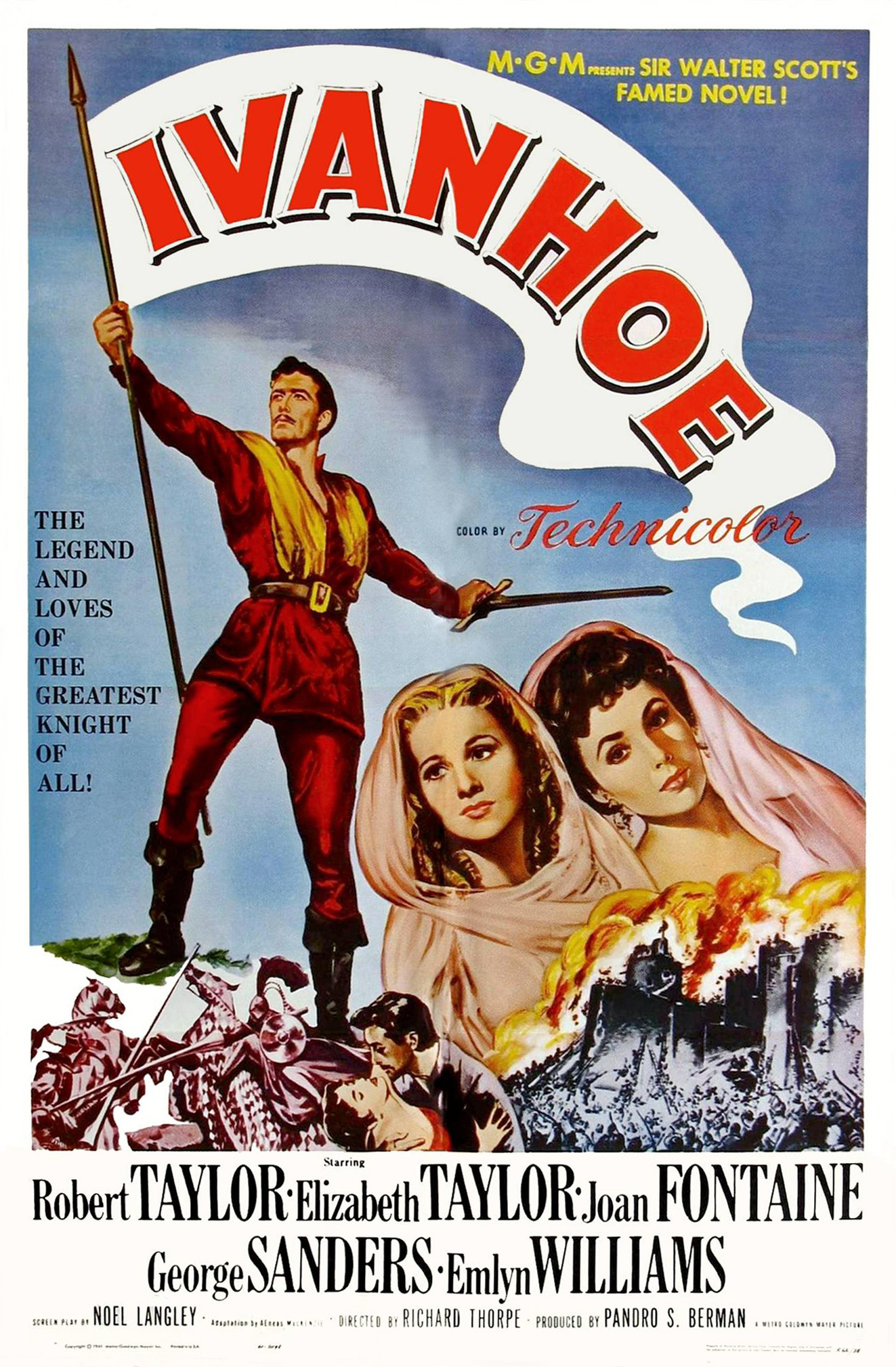
Ivanhoe (1952)

Ivanhoe (1952)_01

Directed by Richard Thorpe

I read Sir Walter Scott’s novel Ivanhoe when I was fourteen or fifteen, and I thought it was fabulous. It has all the necessary elements for an excellent swashbuckling story: adventure, romance, chivalry, and jousting. I had high hopes for the movie, too, but sadly, they were dashed. The elements were all still there, but something was missing. It didn’t feel alive somehow.

So what’s the story? Saxon knight Ivanhoe, who has been to fight in the Crusades, refuses to believe that King Richard is dead. As he makes his way back to England, he rides past every castle he can find, hoping that his English singing will attract the attention of a captive king. This long and slightly foolish plan works; King Richard throws him a letter explaining that he is being held for random. Prince John knows about the ransom, but refuses to pay it so that he can be king instead of his brother. When Ivanhoe reaches England, he not only has to raise the ransom, but right many wrongs and rescue damsels in distress.

The Good: The music is beautiful. It’s scored by Miklos Rozsa, who would go on to score Ben-Hur several years later. The music is very rich and full. The adjective I want to use is “orchestral,” but I’m not sure that would mean anything to anyone else. Hmm. How to put it? He uses the full orchestra to great effect. That makes it sound really boring, but it’s not. It’s really quite stirring.

The best actors in Ivanhoe were not the main characters. The person whose acting stood out to me the most was George Sanders as the villainous Norman knight De Bois-Guilbert. Even though his character was not the most chivalrous, his emotions rang true and he managed to take his flat character and make viewers pity him. It was impressive.

Other people with smaller parts were also able to make the most of their parts. Emlyn Williams as Ivanhoe’s slave-turned-page, Wamba, provided some welcome comic relief. Cedric, Ivanhoe’s bitter Saxon father, was played excellently by Finlay Currie. And Guy Rolfe was the vilest and scariest Prince John I have ever seen.

Although I read the book several years ago, I remember thinking that Rowena was terribly disappointing for a Saxon princess. She was just so blah. (That impression may have been wrong; like I said, it was a while ago.) But in this version, she has spirit and is a lot more awesome. Joan Fontaine did a very good job of showing her strength, her pride, and her jealousy, even if I thought she was a little old for the part. (Side note – this is the first time I’ve seen Joan Fontaine and thought, “Oh, yeah. She and Olivia de Havilland are totally sisters.” The resemblance really shines in this movie.)

The jousting scenes were pretty cool, even if some of the men’s colours were not manly looking. That was a seriously impressive sport, although I’m glad it’s not a big thing anymore because it also looks incredibly dangerous.

 The Bad: Robert Taylor is terribly miscast as Ivanhoe. He doesn’t even bother to try an English accent, which is a little jarring when everyone around him has one. He’s too old to convincingly be a young, dashing knight, and he’s much too solemn.

There is a scene where Ivanhoe has been taken captive, along with Rowena, Rebecca, Cedric, and Wamba. Robin of Locksley (yes, THAT Robin of Locksley) comes with his men to free them. There’s a huge battle with falling rocks and longbows and battering rams and swordfights, and it should be awesome. But it’s not. Watching people fire arrows at each other gets really boring after a while, and the swordplay is not well-choreographed. It may be the most disappointing medieval battle scene in a movie ever.

The Ugly: Elizabeth Taylor is so wooden as the Jewess Rebecca. She is extremely beautiful, but a damsel in distress should show some actual distress once in a while, instead of just looking pretty and putting her hand to her mouth. When she spoke, she sounded like she was reading lines, not speaking from her heart.

The worst thing about this movie was that it was so stiff. There was no sense of fun. There was no swash to the buckle, so to speak. Everything was taken so seriously. I wanted to say, “Hey! People! You’re in a castle! You’re fighting baddies! You’ve got awesome clothes! Smile once in a while. Look like you’re having fun!” No one ever did. Most of the separate elements were fine, but it just didn’t meld in a good way. A movie like this, set in the same time period and with so many of the same elements as The Adventures of Robin Hood (1938), is going to get compared to that movie. It needed to distinguish itself in some way, and sadly, it didn’t.

Oscars Won: None.

Oscar Nominations: Best picture; best cinematography, color; best music, scoring of a dramatic or comedy picture.

High Noon (1952)

high noonDirected by Fred Zinneman

I love westerns. It’s probably because I watched so many of them growing up that now they make me feel like a little kid again. Whatever the reason, I’m always glad when they show up on the list of best picture nominees. However, High Noon isn’t exactly a western. It’s a thriller that just happens to take place in the Old West. It’s about relationships and small towns and above all, people. I’ve seen it before, but it’s always exciting to watch.

So what’s the story? Will Kane has just married his Quaker sweetheart and given up his marshal’s badge when he gets a telegram that Frank Miller, a murderer that he arrested, has been let out of prison. He’s set to arrive on the noon train and hell-bent on getting revenge on the man who sent him to prison. Miller’s old gang is already waiting for him at the platform. Realizing that a true man faces his problems, Will refuses to run, but can he get the help he needs from the townspeople he’s protected in the past?

The Good: High Noon happens in real time. It’s about 10:40 when Marshal Kane gets his telegram, and an hour and twenty minutes later in real life, the train comes in. This adds to the tension in a way that very few things could have. I’m not sure if High Noon was the first movie to use this tactic, but it’s very effective.

The editing is fantastic. I love really good editing, but sometimes I feel like good editing can be hard to spot. Every once in a while, though, I’m blown away by it. That’s what happened in High Noon. After all the tension has built up and the train is finally coming into town, there are shots of all the different groups waiting for the train to stop. The editing makes that part of the movie so stressful. It’s awesome.

Once again, the acting is superb (can a movie be nominated for best picture without having at least some good acting?). Gary Cooper plays Will Kane, a man committed to his path even though it may cost him the woman he loves. Grace Kelly plays his bride, Amy, who is understandably frightened at the prospect of losing her new husband. Bitter deputy marshal Harvey is played wonderfully by Lloyd Bridges. Even Henry Morgan (aka Colonel Potter in M*A*S*H) has a small role. But the standout actress in High Noon is Katy Jurado as Helen Ramirez. She is ridiculously good in her rather complicated role.

Helen Ramirez is actually another wonderful thing about this movie. Minorities in westerns generally only have tiny roles, and they are usually horrifically stereotypical. However, while Helen is a scarlet woman, she is smart, strong, passionate, and fair. She isn’t scared of anything and she doesn’t take anything from anyone. I love her. She’s a great character.

The cinematography is great. It manages to highlight Will’s forced solitude and the attitudes of the people surrounding him. It does what good cinematography should do.

The Bad: There is nothing bad about High Noon. Everything about this movie is either on fabulous or horrifically bad. I suppose I could say that it’s not fun to watch Thomas Mitchell, one of my favorite character actors, not be awesome. That’s just how the story goes, though.

The Ugly: The title song is awful. I think I could have rationalized it as a 1950s cowboy song if it weren’t for the fact of these two lines:

He made a vow while in state prison
Vowed it would be my life or his’n.

I think it should be a crime against the arts (is that a thing? Can we make it one?) to use “his’n” as a rhyme for “prison”. Bad, bad, bad. Even then, I might have been able to make my peace with it if bits of the song (including that line) didn’t keep playing throughout the movie and reminding me of its existence. The musical score by Dimitri Tiomkin itself is very good, but this song… So bad.

Oscars Won: Best actor in a leading role (Gary Cooper); best film editing; best music, original song (“High Noon [Do Not Forsake Me, Oh My Darlin’]”); best music, scoring of a dramatic or comedy picture.

Other Oscar Nominations: Best picture; best director; best writing, screenplay.

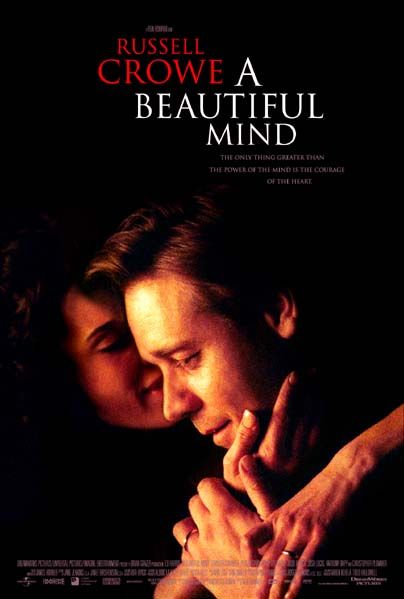
A Beautiful Mind (2001)

beautiful mindDirected by Ron Howard

It was late the night I put this movie in the DVD player, and I wasn’t going to watch the whole thing. But even though it’s not the most action-packed movie ever made, A Beautiful Mind is an extremely gripping movie. As it got later and later (or earlier and earlier in the morning), I kept thinking, “I should really turn this off and go to bed,” but I just couldn’t. I needed to know what happened to John Nash.

So what’s the story? John Nash is a genius mathematician from West Virginia. He doesn’t fit in with all the other Princeton graduate students, mostly because he is completely asocial. He makes a great mathematic breakthrough and gets a job at MIT with the Department of Defense. He meets and marries Alicia, but the top-secret decryption project he’s working on suddenly takes a dark turn.

The Good: The acting was superb. I haven’t seen a lot of Russell Crowe’s movies, and I wasn’t expecting much from him in A Beautiful Mind, mostly because what I’ve seen him in lately is clips from Les Miserables (no, I haven’t seen the whole thing yet, because I don’t want to watch it). Anyway, Russell Crowe became John Nash. I’m always impressed when actors can play a person with a mental disability without overacting. I loved his performance. The supporting cast was great, too. Paul Bettany as Charles, John’s crazy-fun roommate; Jennifer Connelly as John’s wife, Alicia; Ed Harris as John’s government contact; Adam Goldberg, Josh Lucas, and Anthony Rapp as John’s mathematician colleagues; and Christopher Plummer as Dr. Rosen, John’s psychiatrist are all wonderful. I don’t think any of the roles could have been easy to play, but all of the actors did very well.

The costume design was well done, especially since the year in which something happened was rarely given. The clothes were a clue to how many years had passed, and I was very thankful for that. The makeup was good, too. The stars were aged well. I didn’t much care for John Nash’s old look, but that’s because he looked uncomfortably like someone I know, and I couldn’t get past that. But everyone looked definitely, believably older (unlike the people in Giant, which is still my baseline of terribleness when it comes to aging in movies).

The screenplay was good. John Nash’s story could not have been an easy one to tell without giving too much away, but the writers did an excellent job.

The Bad: The music was beautiful, but there were some moments when James Horner copied his own music. At the very beginning of the movie, the music sounded exactly like the music from Sneakers, which I wasn’t even aware James Horner had scored. I had to look it up to be sure. Later on, there are bits from Titanic, which has a brilliant score. It makes me sad that someone who is as obviously talented as James Horner reuses his own stuff.

The Ugly: There wasn’t anything ugly in A Beautiful Mind. It’s a well-made movie that takes a hard topic and treats it sensitivity and tact. Ron Howard deserves major kudos for this movie.

Oscars Won: Best picture; best actress in a supporting role (Jennifer Connelly); best director; best screenplay, screenplay based on material previously produced or published.

Other Oscar Nominations: Best actor in a leading role (Russell Crowe); best film editing; best makeup; best music, original score.

Moulin Rouge! (2001)

moulin rouge!Directed by Baz Luhrmann

I was a freshman in college when Moulin Rouge! came out, and I had a friend who was obsessed with the soundtrack. Whenever we would go and hang out and play games at his apartment, that CD would be playing. It made watching the movie kind of surreal; the music had seeped into my subconscious without my knowledge. I knew all the music, but I had never seen the movie before (overprotective friends again), so I had a strange sense of déjà vu. I’m not sure that helped my general perception of the movie, which was of noise, color, and oddness.

So what’s the story? Young Christian comes to Paris from Great Britain so that he can write about the Bohemians ideals of truth, beauty, freedom, and love. At the famous nightclub Moulin Rouge, he meets and falls for Satine, a performer/prostitute who has dreams of being a real actress. Will they be able to find happiness in the noisy, colorful life that is Paris?

The Good: There was some good acting. Nicole Kidman did a nice job as Satine, even if I did think she was Amy Adams ninety percent of the time. Jim Broadbent was excellent as Zidler, the owner of the Moulin Rouge, who is sympathetic to Satine and Christian’s love, but who also wants his own dreams to come true. Ewan McGregor is a little bit nondescript as Christian at the beginning of the movie, but he does jealousy and heartbreak well towards the end. Toulouse-Lautrec is played by John Leguizamo, who does a good job of showing the yearning for a love that he will never have.

Before I talk about the cinematography, I want to make something clear. I don’t get carsick. I don’t airsick or seasick or rollercoaster sick. But I have known to get sick from certain visual stimuli. I can’t play first-person shooter games, for example, or any first-person games, really. I have run, not walked, out of IMAX movies because I was about to be sick. Moulin Rouge! did the same thing to me. The jerky, constantly moving cinematography did not make agree with my stomach. Or with my head. So I was watching Moulin Rouge through a haze of headache and stomachache. But just because I didn’t like the cinematography and it didn’t agree with my stomach doesn’t mean the cinematography is bad, per se; it’s creative and different and fits with the whirling gaiety of the nightclub. I just didn’t personally like it. I wish I had a section called “Things I didn’t personally like, but can respect for their artistry.” That would make writing reviews easier sometimes. But I since I didn’t feel it was bad, I’m going to leave cinematography in the good category.

The makeup and costumes and production design were over the top and crazy, but so were the lives of the denizens of the Moulin Rouge. Like the crazy cinematography, it worked for the film and what the filmmakers were trying to do accomplish. Again, I’m not sure I liked it that much, but it was admirable.

The Bad: The music rubbed me the wrong way. Yes, it is very clever to use modern music in a movie that takes place over a hundred years ago, but I feel like the filmmakers were a little too clever sometimes, like they were drawing attention to their own cleverness. I feel like they were saying, “Look how clever we are! We used ‘Smells Like Teen Spirit’ to show how immature all these men are who frequent nightclubs! Aren’t we smart?” It became more of a gimmick than something meaningful.

The Ugly: The story was terrible, unoriginal, and uninspired. It was kind of a cheap rip off of Cabaret combined with La bohème. (Possible spoilers ahead) Christian and Satine fell in love for no reason at all. The Duke was silly and not believable as a real person. Also, if you were coughing up blood in 19th century Paris, you knew you were dying of consumption. Tuberculosis wasn’t uncommon then. And while I’m no expert, I’m pretty sure that if you are about to die from tuberculosis, you don’t have the energy to appear in a musical theater production, especially not one based in India with lots of high-energy dancing. The ending is curiously flat. The movie as a whole feels more like an excuse to do crazy musical numbers with modern music than a movie that has anything meaningful to say.

Oscars Won: Best art direction-set decoration; best costume design.

Other Oscar Nominations: Best picture; best actress in a leading role (Nicole Kidman); best cinematography; best film editing; best makeup; best sound.

Gosford Park (2001)

gosford parkDirected by Robert Altman

I read my first Agatha Christie murder mystery when I was twelve. It was the start of a beautiful relationship. Every summer after that, I would check out stacks of Agatha Christie mysteries. The plots were always intricate and watertight, but I also loved the idea of rich British people in country houses dressing for dinner and going shooting and having weekend parties. Gosford Park is basically an Agatha Christie mystery with a twist—it not only shows how the family is affected by the murder, but also how the servants are affected. It could be called Murder at Downton Abbey.

So what’s the story? Sir William McCordle has invited friends and family to Gosford Park for a weekend shooting party. The guests come with their servants, and everyone, both upstairs and down, has a secret.

The Good: The cast reads like a Who’s Who of British actors. Maggie Smith, Helen Mirren, Michael Gambon, Kristin Scott Thomas, Derek Jacobi, Jeremy Northam, Clive Owen, Stephen Fry, and Kelly Macdonald are all in this movie, to name just a few. Everyone is excellent. There isn’t an actor in the movie who was miscast or who isn’t completely believable in their role. It’s a fantastic cast, and the movie is incredibly well-acted.

The screenplay is delightful. I had to laugh when I was watching the credits and realized why I felt it was similar to Downton Abbey. The screenplay was written by Julian Fellowes, the man behind Downton Abbey. The screenplay is fun and funny. Although there are many characters, the screenplay allows them all to show their personalities and problems. It’s very clever and well-written.

The costume design impressed me. The designer, Jenny Beavan, had to not only design clothes for the wealthy and their servants, but also had to show a range of incomes in those different classes. She did so very cleverly and period-appropriately.

I love the music. It’s buoyant and jolly when it needs to be and unobtrusive when more serious things are happening. The cheery piano music made me want to find the sheet music.

The art direction is also excellent. It drew me in to this country house of the 1930s. The cars, the bedrooms, the servants’ quarters, everything felt realistic to me.

The Bad: I got so mad watching this movie at the way people treated their servants. The servants weren’t treated so much like people as they were like useful machines. They are used and abused at their employers’ pleasure. I felt very frustrated. Based on things that I’ve read, I’m fairly sure the attitudes are accurate. Even in my beloved Agatha Christie novels, the servants are almost always discounted from being murder suspects because they couldn’t possibly have a motive; they don’t know the murdered person well enough. I love that this movie shows the relationships between the rich and their servants; the only one who cries at the news of the murder is a servant. But the treatment of the servants still makes me mad.

The Ugly: It was a little hard to keep track of who everyone was. The relationships of the upper-class people were especially hard to figure out. Everyone is introduced so quickly and shallowly at first that it doesn’t all sink in the first time around.

Oscar Won: Best writing, screenplay written directly for the screen.

Other Oscar Nominations: Best picture; best actress in a supporting role (Helen Mirren); best actress in a supporting role (Maggie Smith); best director; best art direction-set decoration; best costume design.

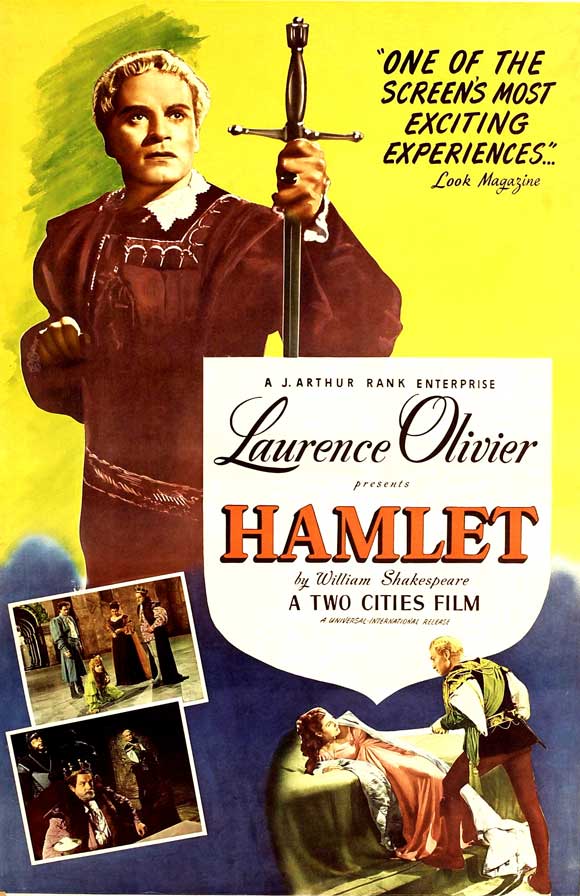
Hamlet (1948)

laurence_olivier_hamlet_movie_poster_b_2aDirected by Laurence Olivier

There are lots of versions of Hamlet. Kenneth Branagh starred in one; so did Ethan Hawke. David Tennant and Patrick Stewart did an excellent Hamlet onstage a few years ago that was made into a Masterpiece Theatre production. Even Mel Gibson has played Hamlet. And those were all made in the last twenty years or so. There are so many others. Why is Hamlet so popular? I’m guessing because it’s a great story. It’s so psychologically dramatic, and it has the potential to have some really great moments. I like Hamlet. I like Shakespeare in general. I think there’s a reason why his plays have been celebrated for the past 400 years. And yet, I found this production dull. It has all the ingredients for greatness, but it somehow misses the mark.

So what’s the story? Prince Hamlet is depressed and reeling. His father died not long ago, and his mother is already remarried—to Hamlet’s uncle, Claudius, his father’s brother. It only gets worse when the ghost of his father appears and tells Hamlet that he didn’t die of natural causes; Claudius murdered him. Hamlet’s father gives Hamlet a mission – avenge his death.

The Good: The acting is excellent. I’m guessing (because I haven’t done the research) that many of the actors and actresses were well-trained stage actors. They all do a wonderful job. Laurence Olivier has some good moments as Hamlet. Jean Simmons does crazy beautifully as Ophelia. Felix Aylmer is appropriately stuffy and self-important as Polonius. Eileen Herlie shows sorrow, remorse, and confusion as Queen Gertrude. Norman Wooland is a sensitive Horatio. Plus this movie has nerd cred. Patrick Troughton (aka the Second Doctor), Peter Cushing (Grand Moff Tarkin and Doctor Who),  and Christopher Lee (Saruman and Count Dukoo) all have small roles. It’s kind of fun to pick them out.

The costumes are beautifully sumptuous. It’s almost enough to make me want to be a noble in Denmark in the Middle Ages. (Or at least in Laurence Olivier’s Middle Ages. Because I’m not sure on the accuracy of the costumes. But they are gorgeous.)

The Bad: In all the other versions of Hamlet I have seen, the filmmakers take advantage of the fact that they although they are making a movie based on play, they don’t have the constraints of a play; they don’t have to shoot on a stage, but can move outside or shoot on location or do anything their imagination tells them to do. In this Hamlet, I felt like I was always looking at a stage set. It wasn’t particularly impressive.

I will probably never say this about a movie again, but it needed more music. I’m usually a fan of restraint in movie soundtracks, but I think more music would have helped it feel less stark and dull. Don’t get me wrong; the music itself isn’t bad. It’s quite good, in fact, but there should have been more to help the movie along.

While Laurence Olivier is a great actor, and he did a marvelous job in the role, I feel like he was too old to make a convincing Hamlet at that point in his life. It might have worked on stage where the audience doesn’t get any close-up views of him, but his age shows in the film. Also, he does not make a convincing blond.

The Ugly: It is so boring. I can’t put my finger on what makes it that way, but I had to rewind at least five times because I kept falling asleep. I wasn’t mentally captivated by this film. It was a fine film, but it didn’t stand out in a particularly memorable way.

Oscars Won: Best picture; best actor in a leading role (Laurence Olivier); best art direction-set decoration, black-and-white; best costume design, black-and-white.

Other Oscar Nominations: Best actress in a supporting role (Jean Simmons); best director; best music, scoring of a dramatic or comedy picture.

Fun fact: I didn’t plan it this way, but today is actually Laurence Olivier’s birthday. Happy 108th birthday, Mr. Olivier!

The Treasure of the Sierra Madre (1948)

the-treasure-of-the-sierra-madre-poster-11Directed by John Huston

The Treasure of the Sierra Madre was one of the few movies I had already seen but had no desire to see again. I checked it out from the library a while ago, probably because I had been told it was an adventure movie, which I tend to love, starring Humphrey Bogart, who is awesome. It was so boring that I didn’t even make it halfway through before giving up. So I was really surprised this time around at how much I liked this movie. It’s amazing. Now I’m wondering what was wrong with me the day I watched it the first time.

So what’s the story? Dobbs and Curtain are two American men down on their luck in Mexico. Both of them just want to make enough money to make it back to America, but they can’t find work. They meet Howard, an old prospector, who is willing to help them find gold, but he warns them that gold always carries a curse.

The Good: Like I said before, Humphrey Bogart is awesome, but I’ve never seen him quite like this before. He often plays crusty people on the fringes of society, but he always seems to have a heart of gold underneath. Not here. He’s a little frightening, really. I’m not sure why he wasn’t nominated for a best actor Oscar. Tim Holt plays Curtain, who is just an all-around nice guy with dreams of a bigger life. Howard is played by Walter Huston, director John Huston’s father. Normally I’m not a fan of nepotism, but I think this was a case where the perfect person for the role just happened to be related to the director. Huston did such a good job. He was patient with the greenhorns, yet you could see him waiting for the other shoe to drop. He had enough experience and wisdom to know how things were going to go. Huston managed to show all of that without getting annoying, which can be tricky in situations like that.

The cinematography is gorgeous. It was shot on location in Mexico, and the cinematographer took advantage of that. But there are also lots of intriguing camera angles and good moody lighting which help contribute to the movie.

The excellent score was masterfully written by Max Steiner. I’ve decided he could score pretty much anything and it would be amazing. He could score a movie of someone silently reading a phone book and it would become interesting.

The Bad: The Treasure of the Sierra Madre has the usual first half of the 20th century problem with racism, but it’s not the worst I’ve seen. It also moves a little bit slowly at times.

The Ugly: This movie has the single worst fistfight I have seen in any movie ever. The camera angles are all wrong, and you can see that the punches aren’t actually connecting, even though the foley artist is making the correct sounds. It’s sooooo bad. I was cringing all the way through.

Oscars Won: Best actor in a supporting role (Walter Huston); best director; best writing, screenplay.

Other Oscar Nominations: Best picture.