I'd like to spank the Academy

Archive for the ‘Drama’ Category

The Lord of the Rings: The Fellowship of the Ring (2001)

The_Fellowship_Of_The_RingDirected by Peter Jackson

Although I usually plan out which movies I’m going to watch a couple of weeks in advance, I don’t always. I found myself this week with a couple different years’ worth of movies out from the library; I had choices. I was kind of leaning toward 1997, but I realized on Saturday night that I really wanted to watch Gosford Park. I hesitated, though, because I also knew that that meant I would have to watch another Lord of the Rings movie. I had seen this one before (twice, even), but I had disliked Peter Jackson’s interpretation enough that I didn’t want to see the rest of the movies. My desire to watch Gosford Park overcame my negativity about Fellowship, so here I am trying to write unbiasedly about another movie that is apparently universally beloved, but I don’t quite get why.

So what’s the story? Frodo Baggins, an Hobbit living in the idyllic Shire, discovers that a family heirloom is actually a dangerous artifact belonging to an ancient evil sorcerer. Frodo sets out on a journey with his friends to destroy the ring and save the world.

The Good: The production design is fantastic. There are many different races in Middle Earth, and the design gives each race their own look for everything, from clothing to dwellings. It’s all done very well, very beautifully. I don’t necessarily agree with all their decisions, but I still admire the look of the film.

Howard Shore’s music is beautiful. It captures everything from the naiveté and joy of the Shire to the heroism of Aragorn to the eerie beauty of the Mines of Moria. I may not care much for the movie in general, but I do love the music.

Ian McKellen does some seriously good acting as Gandalf, the wizard who sets the events in motion. The moment where Frodo volunteers to take the ring and Gandalf’s face falls…just beautiful. Gandalf is many things – jolly firework-maker, stern counselor, frightened man betrayed by his master. Ian McKellen shows all of those facets very convincingly. Sean Astin is the other acting standout. He plays Samwise Gamgee, Frodo’s gardener and faithful friend. He isn’t glad to leave the Shire, but he refuses to abandon Frodo, no matter how dark the journey gets or how scared he is. It’s fabulous work.

The Bad: The Elves all talk like Jareth the Goblin King (aka David Bowie) from Labyrinth. I think they’re supposed to be showing how wise and calm they are, but because they also kind of look like Jareth, especially Elrond, it’s kind of distracting.

I wasn’t a big fan of how much time was spent on Aragorn and Arwen’s love story. I felt like there were other things that must have been cut to explore that at length. Boromir, for example, didn’t get much backstory, only a line or two about how his people are already fighting for survival. This lack of development made it hard to see him as anything but a bad guy, when he was really a proud, desperate Man who wanted to save his city and his people.

Some of the acting in Fellowship of the Ring is good; some is indifferent. But some is downright bad. Elijah Wood never showed much emotion as Frodo; he was just kind of….there. Orlando Bloom was just as wooden as Legolas. He looked nice, but luckily he didn’t have much to do beyond yelling out dangers (“Wargs!” “Orcs!”) in a noble voice.

The Ugly: There were a couple of glaring plot holes and inconsistencies. (Possible spoilers here, although I feel like everyone in the world has seen this movie, so…) For example, if the chain Frodo was wearing the ring on fell off his neck when he stumbled and fell on the mountain, how in the world did it stay on when the lake hydra-creature had him by the ankle and was waving him back and forth in the air? The ring should have been lost in the lake. And why did Pippin and Merry go to Bree and beyond with Frodo and Sam? They had no reason to. And why did Elrond let them go as part of the Fellowship? They had no training in any kind of weapons, no survival skills, nothing. They would really be more of a hindrance than an asset. And why did the Hobbits trust Strider in the first place? He gave them no sign, no reason for them to trust him. It really bugged me. How did Strider know to have four Hobbit-sized swords ready? Pippin and Merry were impulsive last-minute additions. Grrrr.

Oscars Won: Best cinematography; best makeup; best music, original score; best effects, visual effects.

Other Oscar Nominations: Best picture; best actor in a supporting role (Ian McKellen); best director; best writing, screenplay based on material previously produced or published; best art direction-set decoration; best costume design; best film editing; best music, original song (“May It Be”); best sound.

The part where I get to whine about how different the movie is from the book: Actually, The Fellowship of the Ring follows the book much more closely than The Two Towers does. Things are left out, and Glorfindel is sacrificed to give Arwen more screen time, but at least there is no Aragorn-goes-over-a-cliff-but-is-saved-by-his-horse moment. I wasn’t a big fan of changing Arwen so much, but the lack of female characters in the trilogy could be a concern for this day and age, so it’s kind of understandable. I also don’t like that Tom Bombadil was left out. He himself is perhaps not important to the story, but the Hobbits did need to stumble into the Barrow-Wights to find the swords that can break the spell on the Ringwraiths, and Tom saves them from the Wights. I haven’t seen The Return of the King, so I can’t say how Peter Jackson overcomes that important plot point, but it should have been set up in this movie.

In the Bedroom (2001)

in the bedroomDirected by Todd Field

Even when I recognize the titles of the movies that I’m watching, I don’t always know anything else about them. Sometimes, though, the title gives me a very good idea of what the movie is about. Other times, I am completely wrong. I had never really wanted to see In the Bedroom because I was convinced it was a raunchy sex comedy. That couldn’t be farther from the truth. I was surprised to find that it is instead a slow-moving drama about how a family deals with tragedy. I think I will have to stop judging movies based on their titles.

So what’s the story? Frank Fowler is a college student home for the summer. To his mother’s dismay, he starts dating Natalie, an older woman with two little boys. Natalie also has an ex-husband with a temper. As the summer heats up, tensions mount, and tragedy soon follows.

The Good: In Ian McEwan’s (rather dull) novel Saturday, two people are discussing Tolstoy, and one says, “The genius is in the details.” I feel that way about In the Bedroom. Everyone is believable, partly because the screenplay allows for details. When she’s depressed, Ruth Fowler sits on her couch, watching pointless TV and smoking. Matt Fowler likes to meet his son, Frank, for lunch. Natalie makes awkward conversation with her boyfriend’s college-educated parents, trying to get them to like and accept them. These little scenes, while not action-packed, reveal character and make the people real. The realism makes the sadness later much more real.

Because the screenplay moves so slowly, the acting had to be incredible. Tom Wilkinson and Sissy Spacek are Matt and Ruth Fowler, who are trying to understand and be supportive of their son’s choices, while at the same time not being happy about them. Marisa Tomei is Natalie, a woman who enjoys dating a younger man, but can also see his naiveté. Frank is played by Nick Stahl. He makes Frank a very sweet young man who is enthusiastic about life, but doesn’t really understand that choices have consequences. They are all a joy to watch.

The cinematography was interesting. It would have been very easy to film this movie about a normal family with straightforward camera angles, but instead the filmmakers took the opportunity to use the camera to show that people have inner lives and thoughts. I liked that a lot.

The Bad: Because this movie allows for the details, for the normal conversations between ordinary people, it gets a little boring sometimes. But guess what? Life is boring sometimes. I’m still trying to figure out how I feel about the ending, though. It might have been too exciting to be believable.

The Ugly: I spent a lot of time being annoyed that Natalie and Frank spent so much time with her boys when both Frank and Natalie kept insisting it was only a summer fling. It seemed like such an irresponsible thing to do, to let kids get attached to a boyfriend you’re only planning on dating for a few months. It made me grumpy.

Oscars Won: None.

Oscar Nominations: Best picture; best actor in a leading role (Tom Wilkinson); best actress in a leading role (Sissy Spacek); best actress in a supporting role (Marisa Tomei); best writing, screenplay based on material previously produced or published.

Gosford Park (2001)

gosford parkDirected by Robert Altman

I read my first Agatha Christie murder mystery when I was twelve. It was the start of a beautiful relationship. Every summer after that, I would check out stacks of Agatha Christie mysteries. The plots were always intricate and watertight, but I also loved the idea of rich British people in country houses dressing for dinner and going shooting and having weekend parties. Gosford Park is basically an Agatha Christie mystery with a twist—it not only shows how the family is affected by the murder, but also how the servants are affected. It could be called Murder at Downton Abbey.

So what’s the story? Sir William McCordle has invited friends and family to Gosford Park for a weekend shooting party. The guests come with their servants, and everyone, both upstairs and down, has a secret.

The Good: The cast reads like a Who’s Who of British actors. Maggie Smith, Helen Mirren, Michael Gambon, Kristin Scott Thomas, Derek Jacobi, Jeremy Northam, Clive Owen, Stephen Fry, and Kelly Macdonald are all in this movie, to name just a few. Everyone is excellent. There isn’t an actor in the movie who was miscast or who isn’t completely believable in their role. It’s a fantastic cast, and the movie is incredibly well-acted.

The screenplay is delightful. I had to laugh when I was watching the credits and realized why I felt it was similar to Downton Abbey. The screenplay was written by Julian Fellowes, the man behind Downton Abbey. The screenplay is fun and funny. Although there are many characters, the screenplay allows them all to show their personalities and problems. It’s very clever and well-written.

The costume design impressed me. The designer, Jenny Beavan, had to not only design clothes for the wealthy and their servants, but also had to show a range of incomes in those different classes. She did so very cleverly and period-appropriately.

I love the music. It’s buoyant and jolly when it needs to be and unobtrusive when more serious things are happening. The cheery piano music made me want to find the sheet music.

The art direction is also excellent. It drew me in to this country house of the 1930s. The cars, the bedrooms, the servants’ quarters, everything felt realistic to me.

The Bad: I got so mad watching this movie at the way people treated their servants. The servants weren’t treated so much like people as they were like useful machines. They are used and abused at their employers’ pleasure. I felt very frustrated. Based on things that I’ve read, I’m fairly sure the attitudes are accurate. Even in my beloved Agatha Christie novels, the servants are almost always discounted from being murder suspects because they couldn’t possibly have a motive; they don’t know the murdered person well enough. I love that this movie shows the relationships between the rich and their servants; the only one who cries at the news of the murder is a servant. But the treatment of the servants still makes me mad.

The Ugly: It was a little hard to keep track of who everyone was. The relationships of the upper-class people were especially hard to figure out. Everyone is introduced so quickly and shallowly at first that it doesn’t all sink in the first time around.

Oscar Won: Best writing, screenplay written directly for the screen.

Other Oscar Nominations: Best picture; best actress in a supporting role (Helen Mirren); best actress in a supporting role (Maggie Smith); best director; best art direction-set decoration; best costume design.

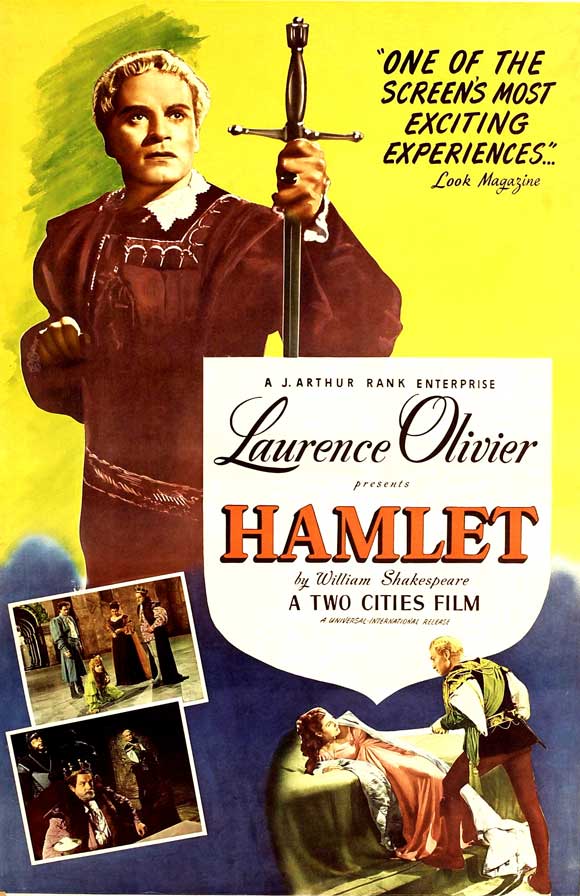
Hamlet (1948)

laurence_olivier_hamlet_movie_poster_b_2aDirected by Laurence Olivier

There are lots of versions of Hamlet. Kenneth Branagh starred in one; so did Ethan Hawke. David Tennant and Patrick Stewart did an excellent Hamlet onstage a few years ago that was made into a Masterpiece Theatre production. Even Mel Gibson has played Hamlet. And those were all made in the last twenty years or so. There are so many others. Why is Hamlet so popular? I’m guessing because it’s a great story. It’s so psychologically dramatic, and it has the potential to have some really great moments. I like Hamlet. I like Shakespeare in general. I think there’s a reason why his plays have been celebrated for the past 400 years. And yet, I found this production dull. It has all the ingredients for greatness, but it somehow misses the mark.

So what’s the story? Prince Hamlet is depressed and reeling. His father died not long ago, and his mother is already remarried—to Hamlet’s uncle, Claudius, his father’s brother. It only gets worse when the ghost of his father appears and tells Hamlet that he didn’t die of natural causes; Claudius murdered him. Hamlet’s father gives Hamlet a mission – avenge his death.

The Good: The acting is excellent. I’m guessing (because I haven’t done the research) that many of the actors and actresses were well-trained stage actors. They all do a wonderful job. Laurence Olivier has some good moments as Hamlet. Jean Simmons does crazy beautifully as Ophelia. Felix Aylmer is appropriately stuffy and self-important as Polonius. Eileen Herlie shows sorrow, remorse, and confusion as Queen Gertrude. Norman Wooland is a sensitive Horatio. Plus this movie has nerd cred. Patrick Troughton (aka the Second Doctor), Peter Cushing (Grand Moff Tarkin and Doctor Who),  and Christopher Lee (Saruman and Count Dukoo) all have small roles. It’s kind of fun to pick them out.

The costumes are beautifully sumptuous. It’s almost enough to make me want to be a noble in Denmark in the Middle Ages. (Or at least in Laurence Olivier’s Middle Ages. Because I’m not sure on the accuracy of the costumes. But they are gorgeous.)

The Bad: In all the other versions of Hamlet I have seen, the filmmakers take advantage of the fact that they although they are making a movie based on play, they don’t have the constraints of a play; they don’t have to shoot on a stage, but can move outside or shoot on location or do anything their imagination tells them to do. In this Hamlet, I felt like I was always looking at a stage set. It wasn’t particularly impressive.

I will probably never say this about a movie again, but it needed more music. I’m usually a fan of restraint in movie soundtracks, but I think more music would have helped it feel less stark and dull. Don’t get me wrong; the music itself isn’t bad. It’s quite good, in fact, but there should have been more to help the movie along.

While Laurence Olivier is a great actor, and he did a marvelous job in the role, I feel like he was too old to make a convincing Hamlet at that point in his life. It might have worked on stage where the audience doesn’t get any close-up views of him, but his age shows in the film. Also, he does not make a convincing blond.

The Ugly: It is so boring. I can’t put my finger on what makes it that way, but I had to rewind at least five times because I kept falling asleep. I wasn’t mentally captivated by this film. It was a fine film, but it didn’t stand out in a particularly memorable way.

Oscars Won: Best picture; best actor in a leading role (Laurence Olivier); best art direction-set decoration, black-and-white; best costume design, black-and-white.

Other Oscar Nominations: Best actress in a supporting role (Jean Simmons); best director; best music, scoring of a dramatic or comedy picture.

Fun fact: I didn’t plan it this way, but today is actually Laurence Olivier’s birthday. Happy 108th birthday, Mr. Olivier!

The Treasure of the Sierra Madre (1948)

the-treasure-of-the-sierra-madre-poster-11Directed by John Huston

The Treasure of the Sierra Madre was one of the few movies I had already seen but had no desire to see again. I checked it out from the library a while ago, probably because I had been told it was an adventure movie, which I tend to love, starring Humphrey Bogart, who is awesome. It was so boring that I didn’t even make it halfway through before giving up. So I was really surprised this time around at how much I liked this movie. It’s amazing. Now I’m wondering what was wrong with me the day I watched it the first time.

So what’s the story? Dobbs and Curtain are two American men down on their luck in Mexico. Both of them just want to make enough money to make it back to America, but they can’t find work. They meet Howard, an old prospector, who is willing to help them find gold, but he warns them that gold always carries a curse.

The Good: Like I said before, Humphrey Bogart is awesome, but I’ve never seen him quite like this before. He often plays crusty people on the fringes of society, but he always seems to have a heart of gold underneath. Not here. He’s a little frightening, really. I’m not sure why he wasn’t nominated for a best actor Oscar. Tim Holt plays Curtain, who is just an all-around nice guy with dreams of a bigger life. Howard is played by Walter Huston, director John Huston’s father. Normally I’m not a fan of nepotism, but I think this was a case where the perfect person for the role just happened to be related to the director. Huston did such a good job. He was patient with the greenhorns, yet you could see him waiting for the other shoe to drop. He had enough experience and wisdom to know how things were going to go. Huston managed to show all of that without getting annoying, which can be tricky in situations like that.

The cinematography is gorgeous. It was shot on location in Mexico, and the cinematographer took advantage of that. But there are also lots of intriguing camera angles and good moody lighting which help contribute to the movie.

The excellent score was masterfully written by Max Steiner. I’ve decided he could score pretty much anything and it would be amazing. He could score a movie of someone silently reading a phone book and it would become interesting.

The Bad: The Treasure of the Sierra Madre has the usual first half of the 20th century problem with racism, but it’s not the worst I’ve seen. It also moves a little bit slowly at times.

The Ugly: This movie has the single worst fistfight I have seen in any movie ever. The camera angles are all wrong, and you can see that the punches aren’t actually connecting, even though the foley artist is making the correct sounds. It’s sooooo bad. I was cringing all the way through.

Oscars Won: Best actor in a supporting role (Walter Huston); best director; best writing, screenplay.

Other Oscar Nominations: Best picture.

The Red Shoes (1948)

red-shoes-02Directed by Michael Powell and Emeric Pressburger

This was another movie I first saw on Turner Classic Movies (TCM) about ten years ago. I wonder now if they were spotlighting the movies from 1948, because it seems strange that I would have seen both The Snake Pit and The Red Shoes at the same time if they weren’t. Anyway, when I saw The Red Shoes then, I liked it so much that I when I was home from college on a break, I checked it out from the library and made my younger sisters watch it. I was kind of excited to see it again, but I didn’t like it nearly so much this time around. That made me wonder what has changed about me or my tastes. I’m not sure what it is, but whatever happened in the last ten years, I noticed some definite weaknesses that I hadn’t noticed before.

So what’s the story? Two young artists, composer Julian Craster and dancer Victoria Page, are taken under the wing of ballet master Boris Lermontov. With his guidance and support, both are able to soar to new heights in their respective arts. But when Julian and Victoria fall in love, they will have to live with the consequences of their choices.

The Good: The dancing is beautiful. Moira Shearer, who played Victoria, was a ballerina, not an actress. Her acting is competent, nothing special, but her dancing is glorious. Leonide Massine is Ljubov, the choreographer/featured performer (sorry, I don’t really know ballet terms) of Ballet Lermontov. He’s a fabulous dancer (and a very good actor).

Most of the acting isn’t anything special, but Anton Walbrook does an excellent job as Boris Lermontov, the man who cares about his ballet company more than anything in the world, who only values people for what they can contribute to his art.

I loved the music. The composer, Brian Easdale, had to not only write a score, but also music for ballets. It was all really very lovely.

The Bad: The Red Shoes ballet kind of annoyed me. There were a couple of special effects (like the red shoes suddenly appearing on Victoria’s feet, magicked on by the shoemaker) that wouldn’t have really worked in a real stage ballet. I hate it when a movie is supposed to be showing something real, but takes advantage of movie special effects. It’s cheating. And stupid.

The Ugly: When you take a creative writing class, one of the first things you learn is “Show, don’t tell.” That means that you shouldn’t say, “Victoria and Julian are madly in love;” you should actually show them talking together more than once. You should show meaningful looks and lingering hand holding. This rule should apply to movies, but the writers of The Red Shoes apparently had never heard of it. The love story was extremely weak, which made it hard to believe the rest of the movie. I’m not sure how I missed that the first time around, but I must not have been as discerning when it comes to love stories ten years ago as I am now.

Oscars Won: Best art direction-set decoration, color; best music, scoring of a dramatic or comedy picture.

Other Oscar Nominations: Best picture; best writing, motion picture story; best film editing.

The Snake Pit (1948)

snake pitDirected by Anatole Litvak

My family didn’t have cable TV when I was growing up. We didn’t watch much TV (although we watched lots of movies on the weekends), and my mom thought that cable didn’t have much to offer, so my first real experience with cable was in college, when most of my apartments offered free cable. That’s when I found out that my mother was right; cable didn’t have much to offer. But there is one awesome cable channel that I still miss: Turner Classic Movies. It’s a fabulous station that shows (surprise) classic movies. I couldn’t always convince my roommates that it was a fun station, but when I was home alone sick or just on a quiet night, that was my channel of choice. And that is where I first saw The Snake Pit. At that point, I missed the beginning, but I was still blown away by the honest look at the treatment of the mentally ill in the 1940s.

So what’s the story? Virginia Stuart Cunningham has had a mental breakdown and has been committed to a mental institution in upstate New York. She doesn’t know where she is or why she’s there at first, but with the help of a caring, patient doctor, she slowly discovers what brought upon her breakdown.

The Good: Olivia de Havilland is always good, but she is amazing in this movie. Her acting is never over the top; she makes Virginia a very sympathetic character. She puts a human face on mental illness. Leo Glenn as the understanding Dr. Kik also does a good job. The cruel Nurse Davis is played wonderfully well by Helen Craig.

The story and screenplay were wonderful. There is still a lot of prejudice and misunderstanding when it comes to mental illness, and based on the care Virginia received, I’m sure it was even worse in the 1940s. And yet this movie is very respectful and understanding toward the mentally ill. None of the patients were mocked or despised by the filmmakers themselves. In fact, the villain of the movie, Nurse Davis, is a nurse who openly despises her charges. Her treatment of Virginia and the other patients is shown as cruel and terrible. The sensitivity and kindness that the movie shows towards people with problems gives hope that things will get better.

The Bad: Some of the treatments used on the patients are not nice. Watching people get electroshock therapy or being put in a straightjacket is kind of scary, but it does make me glad that we have come so far in the treatment of mental illness.

The Ugly: There is nothing really ugly about this movie. It’s really very good.

Oscar Won: Best sound, recording.

Other Oscar Nominations: Best picture; best actress in a leading role (Olivia de Havilland); best director; best writing, screenplay; best music, scoring of a dramatic or comedy picture.

Johnny Belinda (1948)

johnny-belinda-movie-poster-1948-1020435490Directed by Jean Negulesco

When I was a little girl, my family always had a copy of Leonard Maltin’s Movie Guide on hand. This was in the days before IMDb, and we liked to look up people who looked familiar in movies to figure out what other movies they had been in. In the back of the books was a list of the Oscar winners for best picture, actor, actress, and director for every year. Johnny Belinda was on that list because of Jane Wyman’s win, but that was all I knew about the movie before I saw it. I had a vague idea it was about a boxer; I’m not sure why. It most definitely is not. It’s a beautiful and moving story about people in a small town.

So what’s the story? Dr. Robert Richardson is the new doctor in a small fishing village in Nova Scotia. He goes out to the mill to help the mill owner and his sister deliver a calf. There he meets Belinda, the owner’s daughter, who is a deaf-mute. Because she can’t communicate, everyone in town assumes she is mentally incapable, but the doctor recognizes her intelligence and teaches her lip-reading and sign language. Belinda begins to blossom under his tutelage, but when she is raped and becomes pregnant, the town turns on her and the doctor.

The Good: Johnny Belinda was deservedly nominated in all four acting categories. Jane Wyman plays Belinda with sensitivity and tact, never over-acting. It’s a fabulous performance. Lew Ayres is the outsider doctor who ties to a more modern society allow him to help a woman who would have been stuck in her own world for her entire life. Belinda’s father is played by Charles Bickford. He grows from an impatient, rather uncaring father to a man who is proud of his smart, beautiful daughter. Agnes Moorehead, perhaps best known for her role of Endora in Bewitched is Belinda’s aunt Aggie. Aggie isn’t impressed with Belinda’s progress and is unkind to Belinda until Belinda becomes pregnant. At that point, Aggie becomes protective and loving. It’s a quick turnaround, but it’s very realistic. All of those performances were fantastic. And they weren’t the only ones. Stephen McNally is nicely creepy as the cocky Locky McCormick (and yes, his name is Locky, not Lucky; it’s short for Laughlin, apparently), and Jan Sterling plays the vain, pettish Stella perfectly. The whole movie is very well-cast.

The screenplay was also excellent. The story is sad, yes, but there were moments of humor, because that’s life. I loved the part where Dr. Richardson takes Belinda into a bigger city to see a doctor about her deafness. She looks into the window of a store and sees a brassiere for the first time. She has no idea what it is, and asks Dr. Richardson to explain it to her. He has no words for her, and the look on his face is priceless. Moments like that keep the movie from being too depressing. The subject matter is not easy, but the screenplay treats it sensitively. It’s very well done.

The music underscores the movie well. It helps plot Belinda’s moods and her growth as she becomes more a part of her world. The cinematography helped with that, too. Both elements added a lot to the movie.

The Bad: I had a hard time figuring out what time period the movie was set in. The townspeople didn’t look particularly modern, but the doctor’s clothes were completely 1940s. But then I thought about my grandma. She grew up in a small cabin in backwoods Tennessee in the 40s. Her family didn’t have electricity until after World War II. I’m sure her family wasn’t wearing the latest fashions, either. So although it took me awhile, I don’t have a major beef with it. If you’re aware that it’s contemporary to the time that the movie was made, it shouldn’t bother you at all.

The narration at the beginning bothered me, but I can’t think of another way they could have established some of the background without a lot of conversation that would have seemed kind of stilted and pointless, so I guess I can’t really complain.

The Ugly: I have never seen a more obvious stunt dummy than in this movie. I know this movie was made in the 1940s, but still. Real bodies don’t move like that. It makes a high-tension moment a little less dramatic.

Oscar Won: Best actress in a leading role (Jane Wyman).

Other Oscar Nominations: Best picture; best actor in a leading role (Lew Ayres); best actor in a supporting role (Charles Bickford); best actress in a supporting role (Agnes Moorehead); best director; best writing, screenplay; best cinematography, black-and-white; best sound, recording; best film editing; best music, scoring of a dramatic or comedy picture.

The Godfather (1972)

godfatherDirected by Francis Ford Coppola

Even though I’m a library person, and librarians have a reputation for having Views about reading being the only worthwhile activity, I’m not like that. I like reading, but I also really like movies. However, when it comes to books based on movies, I almost always like the book better. Books can just get into characters’ heads in a way that movies can’t. I can list dozens of books that I like better than the movies that are based on them. The Godfather is not on that list. I read Mario Puzo’s novel five or six years ago, and I was not impressed. Before I read the book, I had really wanted to see the movie, but after I read the novel, I was a little bit worried. I wondered if a movie based on such a mediocre book could really be all it is hyped up to be. After I watched The Godfather, I found that yes, it can.

So what’s the story? Michael Corleone, son of Mafia Don Vito Corleone, resists joining the family business until an attempt on his father’s life leaves Michael in charge.

The Good: I’m gonna mix things up today and go with cinematography first. The cinematography was awesome. Whatever the cinematographer did, he made me feel like I was peering over someone’s shoulder and peeking into the lives of the Corleones. The scene that this stood out to me most was in the hospital when Michael realizes that there’s about to be another assassination attempt. It was so good.

The acting! What can I say about the acting that hasn’t been said before? Not much, I think, but I’m still going to talk about it. Watching Al Pacino take Michael Corleone from a straight-arrow war hero to a cold, calculating Mafia Don was amazing. He was just fantastic. James Caan as hot-headed brother Sonny Corleone was excellent, as was Robert Duvall as adopted brother Tom Hagen. Richard S. Castellano did a fantastic job as the high-up mob man Clemenza, and Lenny Montana made his short role as Luca Brasi very memorable. It was all great. I love it when a movie has not only great leads, but also a great supporting cast.

The music is beautiful. It captures the moods and the culture and the action very well. It wasn’t eligible for an Oscar because it was basically reworked from another movie’s soundtrack, but it is lovely and poignant and memorable.

The Bad: I had a hard time with Marlon Brando. I don’t necessarily think he did a bad job, but I was really distracted by whatever the makeup artists put in his cheeks to make them puffy at the bottom. It doesn’t look real, and so every time there was a close up on Brando’s face, that was all I could think about.

Diane Keaton also did not do a bad job, but after watching Reds, I realized I don’t really care for her as an actress. I was kind of bummed when I realized she was in The Godfather. And yes, I realize I will have to watch three more movies with her before I’m done. Oh, well. Life is like that sometimes.

The Ugly: It’s a movie about the Mafia, so it’s violent. It’s somehow not as shockingly violent to me as No Country for Old Men, but it’s still got some strong violence. It never felt gratuitous, though, except possibly for the amount of blood in the infamous horse head scene (which, by the way, is much more dramatic to see on the screen than to read in a book).

Oscars Won: Best picture; best actor in a leading role (Marlon Brando); best writing, screenplay based on material from another medium.

Other Oscar Nominations: Best actor in a supporting role (James Caan); best actor in a supporting role (Robert Duvall); best actor in a supporting role (Al Pacino); best director; best costume design; best sound; best film editing.The Godfather

Utvandrarna – The Emigrants (1971)

emgrants posterDirected by Jan Troell

I knew when I started this project that I would have trouble finding some of the movies, but I thought that the ones that would be hard to find would be some of the more obscure ones from the 1930s and 40s, not from the 70s. And I wouldn’t even say that Utvandrarna is obscure; some of my library coworkers remembered seeing it when it came out. Not only that, the Academy thought this movie was so awesome that it was nominated for Best Foreign Language Film the year it came out in Sweden, and then for Best Picture when it was released in America the following year. Despite all this awesomeness, none of the three library systems that I have cards for had it. I had to order it from a university library in Minnesota. The fact that it’s so hard to get makes me really sad, because it’s a fabulous movie.

So what’s the story? Life in Sweden is hard in the 19th century. Abusive employers, failed crops, and a strict religion give different members of a family different reasons to leave Sweden for America. Utvandrarna chronicles this family’s journey from Sweden to Minnesota.

The Good: The acting is amazing. Liv Ullman is Kristina, who grows from a young newlywed to a mother of many children. She has some heartbreaking moments as she portrays the struggles of daily life in Sweden and the trials of moving a large family to an utterly foreign country. Kristina’s husband is Karl Oskar. He yearns for a better life for his family, but is unsure of how to reach that goal. Max von Sydow does an excellent job at showing Karl Oskar’s torment. The other standout in my mind was Monica Zetterlund as Ulrika, a reformed prostitute. She’s an outcast because of her past, but she both wants and disdains acceptance. She’s a fascinating character and Zetterlund’s performance was fantastic. The other actors were all just as good. No one seemed out of place or bad at acting.

I loved the set design. I’m kind of obsessed with ships, and I’ve always thought it would be kind of cool to sail across the Atlantic in a reenactment of what some of my immigrant ancestors did, but after seeing Utvandrarna, I’m not sure I could do it. I really got a sense of the tininess of the ship and the cramped quarters. The scenes on the ship were almost claustrophobic. The other sets were just as good at building the world of the 1840s. The costumes were good, too. I’m not an expert on Swedish farming clothes of the 1840s, but at they felt right for the time and place.

The Bad: While the set design and costume design seemed authentically 1840s, the hair screamed 1970s. The men’s haircuts were especially bad. They all had Luke Skywalker hair. (And yes, I realize Star Wars came later than this movie, but they still had Luke Skywalker hair.)

The Ugly: Utvandrarna was nominated for five Oscars over two separate years. It has a compelling story and great acting. And yet it is unavailable here in North America except for in an edited, DUBBED form. Dubbing is the worst. I thought this was what The Criterion Collection was for – to preserve fantastic movies that may not be the most popular at the moment. Come on, Criterion Collection people! If the movie is that impressive with dubbing, how amazing would it be in Swedish with English subtitles?

Oscars Won: None.

Oscar Nominations 1973: Best picture; best actress in a leading role (Liv Ullman); best director; best writing, screenplay based on material from another medium.

Oscar Nominations 1972: Best foreign language film.