I'd like to spank the Academy

Archive for the ‘Drama’ Category

A Star is Born (1937)
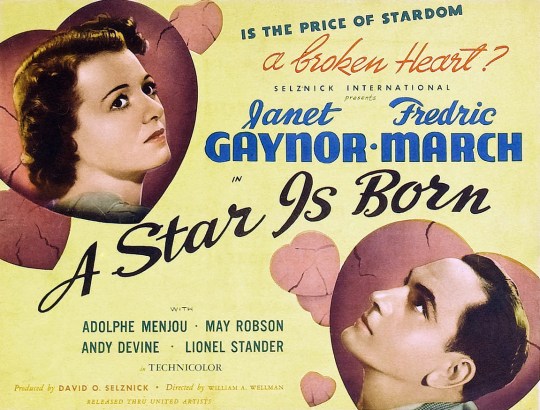
Poster - A Star is Born (1937)_02Directed by William A. Wellman

Surprise! There are extra posts this week! I miscounted the movies, and since I had a specific movie in mind for next week, I needed to finish 1937. So for your reading pleasure, I present The Rest of 1937.

I had a hard time getting hold of this movie, even though there are several copies of it in my library system. I had put it on hold, but it didn’t come in, so I called the customer service line to see what was going on. The lady on the other end said, “Oh, let me place that on hold for you again; it should spark the hold then. So you want A Star is Born? Oh, here it is. I just love Judy Garland in that movie. Wait. You don’t want the one with Judy Garland? You want Janet Gaynor? Are you sure that’s the one you want? It’s rather old.” She still sounded skeptical after I assured her that, yes, I was looking for the version with Janet Gaynor. I ended up having to call a coworker to grab a copy off the shelf at the library I work at so that I could get it. Yes, young people like old movies and just because something has been remade (and remade three times) doesn’t mean that the first one is obsolete.

So what’s the story? Young Esther Blodgett runs away to Hollywood with stars in her eyes, convinced that she will become a famous actress as soon as she gets there. Esther finds that it’s harder than she thought, but soon she catches the eye of the famous actor Norman Maine and finds herself shooting to stardom, even as Norman’s career begins to fail due to alcoholism.

The Good: I had only seen Janet Gaynor in silent movies before I watched A Star is Born. I had to check to make sure it was the same actress; she made such a good crossover to talkies that I felt a little unsure. Gaynor captures the spirit of Esther Blodgett as she goes from starry-eyed girl to mature woman. She also makes sure that the film doesn’t descend into melodrama.  Norman Maine, a man of humor and despair, is played to perfection by Fredric March. In his third role in an Oscar nominated movie in 1937, Adolphe Menjou plays Oliver Niles, Norman and Esther’s sympathetic agent. There was no type-casting for him, by the way. The three (large) roles he played in One Hundred Men and a Girl, Stage Door, and A Star is Born were all completely different. He did an excellent job in each.  I’m always glad to see Andy Devine, and he does a good job (as always) as Esther’s brotherly neighbor Danny (and he looks so young!). May Robson gives a sassy performance as Esther’s strong-willed grandmother Lettie.

The screenplay was co-written by one of my personal heroes: Dorothy Parker. Her trademark wit is scattered throughout. Again, although the story is a good one, A Star is Born could easily have become a melodrama. Thanks to Parker and her colleagues Alan Campbell and Robert Carson, the screenplay was able to help avoid that.

A Star is Born is a study in contrasts. The costuming, art direction, and music all work together to highlight Esther’s rise to stardom. Esther starts out as a girl from the sticks; her family lives in a small, plain house in the freezing mountains. She wears simple, practical clothes. The music that underscores these homely scenes includes familiar melodies, such as “Auld Lang Syne.” When she moves to Hollywood, her simple clothes stay the same, but her poverty is evident through her boardinghouse, which is old, cramped, and falling apart. Her neighbor Danny’s suits are of poor quality and always rumpled. The music here is rather sweet and innocent. The night that Esther goes to waitress at a party for Hollywood’s elite, everything changes. The suits and dresses of the wealthy are of a much better quality and cut, and of course of the highest fashion. The homes of the wealthy are also beautiful and fashionable, clean and open. They even have more modern telephones – and Oliver’s is even gold plated. The music is jazzy and fun, because these wealthy people seem not to have a care in the world. As Esther becomes a star, her clothes become more and more fantastic. At first they are of better quality, but still conservative. They get more fashionable the wealthier she gets. Esther and Norman’s house that they buy together is amazing, too. It has spacious rooms, beautiful gardens, and even a swimming pool. The music becomes much more sweeping and dramatic as Esther’s life fills not only with luxuries, but also difficulties. However, no matter how much life changes for Esther, she is still the simple farm girl inside. She’s obviously sending money home, because when Grandmother Lettie comes to remind Esther that Esther is strong and can get through anything, Grandmother Lettie is wearing fashionable old lady clothes instead of the old-fashioned country clothes she wore before Esther left. As her house empties out around her, the gentle music is a reminder that life can get better. Although not always the flashiest elements, the costuming, art direction, and music subtly add an extra dimension to the movie.

The Bad: The story on its own is a tad melodramatic. The theme of a country girl making it big and marrying the man of her dreams is not unfamiliar, but the story of Norman’s alcoholism could be a story written by a teetotaler in the 1880s. The title would be something like “The Evils of Drinking,” and it would detail the story of a wealthy man who ended up dying broken and alone because of his inability to give up alcohol. The original ending would have ruined the movie. Luckily, due to the screenplay and the excellent acting, A Star is Born avoids becoming a heavy-handed tale; it is instead a sensitive portrayal of an all-too-common issue.

The Ugly: There’s nothing truly horrible about A Star is Born; I had to reach to even find anything bad.

Oscars Won: Best writing, original story.

Honorary Oscar Won: W. Howard Greene, for the color photography.

Other Oscar Nominations: Best picture; best actor in a leading role (Fredric March); best actress in a leading role (Janet Gaynor); best director; best writing, screenplay; best assistant director.

Fun Fact: A Star is Born was the first all-color best picture nominee.


Stage Door (1937)

ORIGINAL-STAGE-DOOR-MOVIE-POSTERDirected by Gregory LaCava

I feel like the films from 1937 are trying to deceive me. We had a musical that wasn’t a musical (The Awful Truth), a film noir that wasn’t a film noir (Dead End), a historical movie that ended up being set in the present (Captains Courageous). Now with Stage Door, we get a movie that was promoted as a comedy (“The gaiety…glamour…foolishness and fun of showbusiness!”), but which has a too-serious ending.

So What’s the Story? The young women living at the Footlights boarding house all have the same ambition: stardom on the stage. Some are actresses, some dancers, some singers, but they’re all just waiting for that big break. Into this madhouse of laughter and rivalry comes the mysterious Terry Randall, who just doesn’t fit in. She’s too wealthy and too educated to understand these smart-mouthed girls. As she beings to settle in, she begins to see that much more is required for stage work than talent and pluck.

The Good: I have never seen Katharine Hepburn not a good job in a movie, but she is brilliant as Terry Randall. Standoffish and snobby at first, she learns to appreciate what her housemates are going through the longer she’s there. She loves them and sticks up for them. With a lesser actress, Stage Door would not have been the strong movie it is.

Many of the girls living in the boarding house would become famous actresses in later years. Ginger Rogers was already well known, of course. She is fabulous as Jean, Terry’s slightly bitter wise-cracking roommate. Gail Patrick was also famous at the time. She plays Linda, a woman who has decided that accepting advances from a man is better than struggling as an actress. Ann Miller is Annie, an optimistic girl who is Jean’s dance partner in a tap routine. Eve Arden plays Eve, a jaded young woman who wears her cat around her neck like a stole (yes, it sounds silly, but seriously, how did they train that cat?). The name that is perhaps more familiar to people now is that of Lucille Ball. She plays Judy, a girl from Seattle who is more interested in boys than auditions. All of these actresses are so funny; they deliver their quips at a whip-crack pace that somehow manages to seem natural. Each displays a distinct personality even though they all want the same thing.

There is one girl in the boardinghouse who doesn’t join in the fun, but is still sweet and kind. Kay is recognized as a great actress, but she has lost confidence in her abilities because she hasn’t had a part for over a year. Andrea Leeds plays the part with great sensitivity, showing Kay’s determination and desperation as she tries to get the part she was born to play.

Adolphe Menjou is in Stage Door, as well as being One Hundred Men and a Girl. 1937 must have been a busy year for him. However, he is not the sweet father that he played in One Hundred Men and a Girl, but a slimy stage producer who takes advantage of desperate girls who want to be stars. He is really, really good at being gross, unlikable, and debonair. It’s hard to see the kindly father in this smug, wealthy jerk.

The screenplay is quite good. It brings out the personalities and contrasts between each of the characters in a humorous way, but it’s also able to make tragedy personal and realistic. It’s not just a sunny comedic romp through a bustling girls’ boarding house; the screenplay shows the downsides and sadness of show business just as well as it does the humor. There isn’t exactly a happy ending, which makes the movie deeper and truer.

The Bad: With the quips flying quickly from every direction as the girls talk over each other, sometimes the lines get garbled. Everything is so funny that I want to hear everything they say, so it’s a little bit sad that they don’t all come out clearly.

Both Ginger Rogers and Ann Miller are in this movie, and there is no fantastic dance number to show off their skills. It might have been out of place. It may have slowed the movie down. But still. Two great dancers that don’t get a chance to show off their skills? It is a sad waste of talent.

The Ugly: Nope. Stage Door is really a well-done picture.

The Apology: I’m sorry that I kept referring to all the young women as girls. They are (mostly) all adults. I will use the excuse that they are always called “girls” in the movie, and so that’s what is in my head.

Oscars Won: None.

Oscar Nominations: Best picture; best actress in a supporting role (Andrea Leeds); best director; best writing, screenplay.

Lost Horizon (1937)

LostHorizon1937_previewDirected by Frank Capra

I read the book Lost Horizon a few years after I read The Good Earth, but it was still a very long time ago. I don’t remember every bit of the plot, but I did like it quite a bit; the adventure appealed to me, as did the idea of a beautiful place of peace. Being a fan of the book and a fan of Frank Capra, I thought the movie would be wonderful. The adventure and the philosophy that I loved in the book were in the movie, but I had a hard time remembering to watch through 1937 glasses. Shangri-La is not a utopia if you watch through 2017 glasses.

So what’s the story? Robert Conway, a British diplomat, is on the last plane out of a war-torn Chinese town with four other people: his brother, George; Lovett, a paleontologist; Barnard, a crook; and Gloria, a prostitute. Instead of heading to Shanghai as expected, the pilot flies the plane deeper into Asia. The plane crash-lands high in the freezing Tibetan mountains, but the group is rescued by a group of people who lead them to the monastery Shangri-La, where everyone is happy and all is well. But all is not as it seems…

The Good: The acting is good for the most part. It’s really quite fun to watch the change in Barnard (Thomas Mitchell), Lovett (Edward Everett Horton, who usually scares me), and Gloria (Isabel Jewell) as they go from frightened, selfish people to people who care about making their world better. Ronald Coleman makes a fine Robert Conway, although I would have liked to see a little more contrast in his character as Shangri-La changes him. That’s the screenwriter’s fault, though. John Howard is miscast as George Conway. He doesn’t even try to do a British accent, even though he is supposed to be the brother of the very British Coleman. That said, Howard did bring a lot of energy to the screen, with his growing impatience a contrast to the others’ peacefulness as everyone else settles in. Sam Jaffe makes a wonderful wise High Lama, even though he was only 46, so the makeup artists did a fantastic job, too.

The production design is great. The designers had to bring the east and west together for Shangri-La, which is in “Tibet” but built by a man from Belgium, with treasures from all over the world inside. The valley needed its own look, too. The end result is beautiful and believably peaceful.

Dmitri Tiomkin wrote a beautiful orchestral score for the film that underscores not only the beauty and peace of the valley but also the mystery and uncertainty that everyone finds there.

The Bad: Jane Wyatt is wooden in her performance as Sondra. She is school-girl giggly when she’s around Conway and sad when she thinks Conway is going. That’s all she’s got. It was a little painful to watch.

Chang is played stiffly by H.B. Warner. It may have been the way he was directed, but almost every time he talks, there’s a pause, almost as if he’s trying to remember his lines. He was nominated for best supporting actor, so some people saw something there. I will freely admit that I am not a professional acting judge, so I could be wrong and the performance could be brilliant, but it annoyed me.

The Ugly: There was nothing really ugly about the movie, except that about seven minutes of the movie are still shots instead of motion picture. The movie was edited from when it was first shown, and the original footage was lost. Film restorers looked in vaults all over the world for the missing minutes. They did find a full sound track and some of the missing moving footage, so they used stills from the filming to fill in the film that was lost. Some of the footage they found, though, was not of the best quality, so the movie is uneven in quality, too. It makes me so sad when movies aren’t taken care of. I hate it when art is lost.

Oscars Won: Best art direction; best film editing

Other Oscar Nominations: Best picture; best actor in a supporting role (H.B. Warner); best sound, recording; best assistant director; best music, score.

Why I would not want to live in the Shangri-La of 1937:

     Women have no rights and get very little respect from men.

  1. Conway asks the High Lama what happens if two men both want the same woman. The Lama replies that their manners are so good, that the man who had the woman first would give her to the second man. No one bothers to ask the woman which man she would rather be with.
  2. Sondra is teaching a class of children English when a child asks to be taken to the bathroom. As soon as she leaves to help the child, Conway simply dismisses the class without asking Sondra if she is done for the day. He assumes that she would be happy to spend her time with him instead of teaching.
  3. When Sondra tries to start a philosophical conversation about why people outside of Shangri-La are the way they are, Conway tells Sondra to stop asking why, saying that it is the most annoying question in the English language. He had a chance to actually think about his culture and discuss it with someone who is generally curious, and instead he shuts it down because he is more interested in Sondra physically than he in in honestly answering her questions.
  4. Barnard takes a shine to Gloria when she stops wearing her makeup, telling her she looks wholesome without and ordering her to never wear it again. When George asks if they would like to leave, Barnard says he isn’t going, and then Gloria says “I’m going to stay, too. Is that right, Barney?” (That’s paraphrased a bit.)

   The people of the monastery have no respect for the native people. 

  1. None of the people living in the monastery of Shangri-La are acolytes of the High Lama. Apparently only Europeans and Chang (who is played by a white man) are allowed to study in the monastery and do whatever they so desire, whether it’s playing the piano or riding horses or reading. The only native people living there are the servants. No one thinks to ask if that’s what they want to be doing.
  2. The people in the valley are basically patted on the heads and told what good people they are. They are not taught what is in the books that are brought into the valley. They farm and mine for the monastery because that’s what they have been taught to do. They are more or less slaves, even though they don’t know it. The High Lama even admits that those who live in the monastery rule those who live in the valley.
  3. Shangri-La was founded by a Christian missionary whose goal is to have the “Christian ideal” win all over the world. No, he doesn’t teach Christianity, but he also doesn’t draw on any tenants of other religions, including whatever the natives believed before he got there. While not stated, I’m pretty sure that he doesn’t allow the native religion to be followed in the valley.

Okay, rant over. I know that Lost Horizon came out 80 years ago, and I freely acknowledge that values have changed a bit over the years. That’s why it’s so important to try to understand where and when the filmmakers were coming from. You can’t judge art from the past with the values of today.

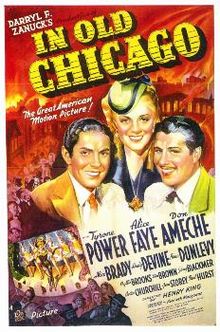
In Old Chicago (1937)

In old chicagoDirected by Henry King

Chicago politics. The Chicago Fire of 1871. Close brothers who become rivals. With all of these elements, what could go wrong? A lot, actually. While there were some exciting scenes, In Old Chicago left much to be desired.

So what’s the story? The O’Leary brothers are polar opposites. Straight-arrow Jack is an attorney who always fights for the underdog. Charmingly roguish Dion runs a saloon, but he has bigger plans. He will use anyone and anything to get what he wants. Jack and Dion’s ideals will be tested for once and all on the night of the Great Chicago Fire of 1871.

The Good: There was some good acting. Alice Brady stole the show as Mrs. O’Leary (yes, THAT Mrs. O’Leary). Don Ameche is strong as Jack, and Alice Faye makes a wonderful singer/saloon owner/woman in love with Dion. Dion’s character is a little inconsistent, but Tyrone Power does an excellent job with what he’s given.

The production design was impressive. There is a huge contrast in all the buildings, from the opulence of the saloons to the humble O’Leary home to the elegance of the Mayor’s office. It brought to life the different factions of Chicago society. Also, the streets were disgustingly muddy. Historical films don’t always remember to put in small details like that. I loved it.

I wasn’t going to be impressed with the actual fire scenes; it was 1937. How convincing could it be? That was a bad call on my part. The fire is amazing, possibly even better than the burning of Atlanta in Gone with the Wind two years later. It was just…wow.

The Bad: While I acknowledge that several scenes take place in saloons and that the producers were trying to showcase Alice Faye’s famous voice, there were too many musical numbers. They slowed down the conniving and the action, and they weren’t particularly entertaining.

While In Old Chicago has a good story with lots of potential drama, the movie felt really shallow. The screenplay left the characters feeling flat and uninteresting, except for Dion. He has the opposite problem. His character changes at the drop of a hat. One minute he’s a rogue with a twinkle in his eye, the next he’s completely evil. Then suddenly, he remembers how much he loves his brother and is perfectly good. It’s just not believable.

The Ugly: Rape isn’t a joke, although they play attempted rape as funny twice. Forcing a girl to kiss you and then threatening to rape her will not get you a business partner or a loving wife. Not cool, 1937.

Oscars Won: Best actress in a supporting role (Alice Brady); best assistant director.

Other Oscar Nominations: Best picture; best writing, original story; best sound, recording; best music, score.

The Good Earth (1937)

good earthDirected by Sidney Franklin

I read the novel The Good Earth for the first time when I was fourteen, which is longer ago than I’d like to admit. Even though I was so young, I felt the love and respect that Pearl S. Buck had for the people and culture of China, along with some of her criticism (which is fair, because no culture is perfect). I was nervous about watching this movie, because I wasn’t sure what Hollywood would do to such a sensitive book about such a different place. Although the filmmakers did make some horrifying decisions (more on that later), The Good Earth is both an excellent movie on its own and an excellent adaptation of the book, which is an incredibly difficult thing to do.

So what’s the story? Poor farmer Wang Lung marries O-lan, a mistreated slave from a wealthy household. For many years, they work side by side on his small farm, buying more land whenever they can scrape the money together to do so. They stick together through storms, famine, and locusts. When Wang forgets what is truly important in life, O-lan is there to remind him. (This is basically the storyline, but the movie is much more exciting and subtle than this summary makes it sound.)

The Good: Luise Rainer makes an excellent O-lan. O-lan is a very quiet, shy character; she never has much to say. Rainer finds O-lan’s soul and brings out her inner strength for the world to see. Her expressions and body language are incredible; they let the viewer get a glimpse of O-lan’s inner workings.

Paul Muni shows boyish delight as Wang. He takes pride in the beautiful things that are his – his farm, his wife, his children. He loves the land and all it gives him. When the land betrays Wang and later, when he becomes wealthy, Muni is able to show the despair and hubris Wang experiences. Yes, Wang has more to say than O-lan, but he, too, has his inner struggles.

The cinematography is exceptional. Karl Freund, the cinematographer, makes excellent use of light and shadow. The scene where O-lan is having her baby during a thunderstorm with lightning as the only light is incredible. Freund also does wonderful work with wide-angle lenses. The panoramic views of people travelling during the famine adds to the feeling of despair, while the views of the locusts make it seem like the entire world is about to end. It’s amazing.

I know I’m not supposed to compare movies to books, but there are so few good adaptations that I have to mention it when I see it. Yes, some things get left out, but that’s because no one wants to sit through a five hour long movie. The story that is left is rich and full and draws the viewer in. So maybe I’ll excuse my indulgence by saying The Good Earth has an excellent screenplay.

There was no Oscar for special effects in 1937, but if there had been, The Good Earth would have deserved it for the locust scene alone. It was frightening on the 19 inch screen I watched in on in 2017. It must have been terrifying on a big screen in 1937, when people weren’t jaded by the CGI monsters that are so common now.

 The Bad:  Most of the music is very stereotypically Chinese; it uses the “Oriental” chords to evoke the strangeness of China. However, I did like music during the scene where O-lan kills the bull. The sweeping chords and building melody were how heroism was often underscored in the 1930s, and it echoes the O-lan’s heroism in the face of starvation.

The makeup was sketchy. While the makeup artists did a fabulous job using makeup to age the characters, they did not do a great job of making Paul Muni and Luise Rainer look Asian, which leads us to…

The Ugly: Let’s talk about the whitewashing. Yes, Paul Muni and Luise Rainer were wonderful in their parts. I’m not going to blame them for starring in the movie. But I do have a problem with the fact that the prominent roles of Wang, O-lan, Wang’s father, Wang’s uncle, and Wang’s second wife, along with a few less-prominent characters, were not played by people of Chinese descent, or even people from other Asian countries. They were all white. I recognize that the Hollywood of the day would not have even auditioned actual Asians to star in a story about China even though there were plenty of Asians living in California, but it still bothers me. It still happens today in Hollywood, which doesn’t make a lot of sense, because there are lots of very good Asian-American actors to choose from. I would have like to have been able to see The Good Earth with actors of the proper race. Since I can’t, I hope Hollywood will get over itself and let Asians play Asians.

Oscars Won: Best actress in a leading role (Luise Rainer); best cinematography.

Other Oscar Nominations: Best picture; best director; best film editing.

Fun Fact: With her Oscar for this role, Luise Rainer became the first person to win Oscars for a leading role back-to-back.

Dead End (1937)

dead endDirected by William Wyler

“There was blood on his hands…and a price on his head!” I knew absolutely nothing about Dead End before I watched it, but this tagline made me pretty sure it was film noir. I was so excited; I love film noir. Turns out Dead End is not film noir, but something better: a look at the life of poverty-stricken people in New York’s Lower East Side.

So what’s the story? Drina is single and poor, struggling to raise her younger brother, Tommy. She has always been in love with Dave, a man who worked hard to put himself through college so he could escape the slums, but who can’t get a job now. Dave is falling for Kay, a young woman living in the fancy new apartment building that backs onto Drina and Dave’s block. Tommy is the leader of a street gang; he’s getting into more and more trouble lately. One day, a mysterious man comes to the block. On that one fateful day, the tensions between rich and poor, wealth and poverty, and law and crime all come to a head.

The Good: The lead actors (Sylvia Sydney as Drina and Joel McCrae as Dave) were amazing. Their performances were so good that I can’t figure out why I wasn’t familiar with their names. They both deserved to have much bigger careers than they did. Humphrey Bogart did a good job as always, as did some of the teens in Tommy’s gang.

The filmmakers used several elements to contrast the realities in the lives of the rich and poor. At the beginning, they use editing to show alternating scenes as both groups get ready for the day. The costumes also show class contrast. Drina has one dress on throughout the day, and although it’s clean and pressed, it’s not fashionable. We see Kay in a couple of dresses: a fashionably simple, blindingly white day dress, and a beautiful evening gown. The gang of teenage boys wear a variety of clothes, many of which are obviously hand-me-downs, while the teen boy who lives in the apartment house wears a tailored suit. Martin wears (and brags about) his expensive clothes, while Dave wears worn shirts and trousers. Those living in the poor neighborhood use more slang than the wealthy apartment dwellers; their grammar is also not always perfect. These things all come together to subtly remind viewers of the contrasting lives.

The musical score in Dead End is perfect for the movie; there isn’t one. Sure, there’s some music over the opening credits, and again at the “The End” placard, but the only other music in the movie is the naturally occurring music throughout the day: the player piano in the bar; the kazoo that one of the boys joyfully plays; the songs people sing; the jazz records of the wealthy. This adds to the realism of the movie.

More than anything else, though, the story and screenplay made me love this movie. Dead End speaks for people who don’t have voices, people who are doing their best but who can’t make it out of poverty. It shows why people get stuck in the poverty cycle. It explores that while all people have dreams, sometimes you can’t have all of your dreams. Fighting for your dreams is important, but that doesn’t mean that you’ll get what you’re fighting for. Doing your best isn’t always good enough. The wealthy are not only privileged in their money, but also with the law. They have connections that can get them what they want. On the other hand, just because they are wealthy doesn’t mean that they don’t deserve the protections of the law. All of this was packed into one movie that takes place in one day. That was extraordinarily well done.

The Bad: While Tommy’s gang has some good actors in their midst, some of them are not so great. Also, some of them have such thick New York accents that it’s hard for this person from “out West” to tell what they are saying sometimes.

There were a few parts that felt a little bit slow, but everything is important at some point, so don’t let your attention wander.

The Ugly: This is still happening. People are still living in poor, crime-ridden parts of town. They want to move to a nicer place, but they don’t have the money. Kids still get in over their heads in gangs. Some people decide that they would rather have the money that comes with a life of crime than live an honest life. Some people try to get out of the life, but society makes it hard for them. The justice system comes down harder on poverty-stricken people. I have never ever said that a movie should be remade, but I think this one should be. Not because it’s a bad movie, but because many people won’t watch a black-and-white movie to save their lives. I also think some of the parallels to today might be lost on some people. But this is partially what the humanities are for: to help people understand other people whose lives are so completely different than their own.

Oscars Won: None.

Oscar Nominations: Best picture; best actress in a supporting role (Clair Trevor); best cinematography; best art direction.

Captains Courageous

Directed by Victor Flemingcaptains courageous

Side note: I knew I hadn’t posted for a while, but I had no idea that it had been three months. I wouldn’t have guessed more than one. Where does the time go? I’ve decided to make another change, since two movie reviews a week are apparently more than I can handle. I’m just going to post once a week. on Thursdays, so anyone looking for a weekend movie has a new idea. And now back to our irregularly scheduled post:

I knew that I had seen Captains Courageous as a child because I remembered very clearly a scene where Mickey Rooney has an argument with the captain. It turns out that doesn’t actually happen in Captains Courageous, so I’m thinking that maybe a similar thing happens in Boys Town. But I’m still sure that I saw this movie, because my love of pea coats and fisherman’s sweaters is rooted so firmly in Captains Courageous that when I see the DVD at the library, I think, “Oh! The pea coat movie!”

So what’s the story? Spoiled, conniving, manipulative Harvey Cheyne, aged ten, is suspended from his elite boarding when the teachers find out he is blackmailing other boys and trying to bribe teachers to get what he wants. His formerly absent father decides to take Harvey with him on a business trip to Europe to try to teach him that you have to work for what you want. When Harvey tries to play a prank on the other boys on the ocean liner, he falls overboard. He is rescued by a group of fishermen, but nothing he can say will make them return to shore before their fishing season is over. Faced with spending three months on a fishing boat full of men who all have to do their part, Harvey is forced to learn that hard work at honest labor delivers more rewards than he could ever have imagined.

The Good: The screenwriters made an amazing choice for this movie. Rudyard Kipling’s novel upon which this movie is based was published in 1897. The writers decided to set the movie in 1937 instead. It would have been good if it had been set in 1897, but changing the setting made the movie much more timely. At one point, Harvey tries to manipulate one of his classmates by threatening to have his classmate’s father fired. This would have been a huge threat in the 1930s, when millions of people were out of work and starving because of the Great Depression. This setting connected people to the movie much more strongly than a historical fiction film would have.

The supporting cast was wonderful. Lionel Barrymore is excellent as Captain Disko, and Mickey Rooney does a good job is his smaller-than-I-was-expecting role of Dan, the captain’s son. I loved the other sailors (some of whom are played by rather prolific actors), who all had different personalities and came to be fond of Harvey in their own different ways. Melvyn Douglas plays Mr. Cheyne, a widower who thinks that he is giving Harvey everything he needs, only to realize that he doesn’t know his own son. It’s a small role, but Douglas’s ability makes it a tender one.

Now let’s talk about the most amazing thing in the movie: Freddie Bartholomew’s acting. I marveled throughout the entire movie as I watched a spoiled brat struggling as he turns into a young man. It’s ridiculous how good of an actor that child was. Everything in the movie hinges on the part of Harvey, and if a lesser actor had played him, the movie would have failed. I don’t have the words to describe his acting; Captains Courageous is a movie you will want to watch if you enjoy watching fine acting.

The Bad and The Ugly: Nothing exactly fits into these categories, so I had to make a new category for today:

The I Have No Idea How I Feel About This: People who have looked at the movie poster will say, “Wait a minute. Spencer Tracy’s name is on the movie poster. Why haven’t you talked about him?” It’s because I have very mixed feelings about this performance. The performance itself is not exactly bad, but Tracy’s accent is atrocious to the point that it becomes distracting. He does express various emotions well, but for me, he never quite becomes jolly Portuguese sailor Manuel; he’s just an actor doing a bad accent. It’s possible that the performance is good and the accent is ugly, but since they are so intertwined, it’s hard for me to make a judgment.

Oscar Wins: Best actor in a leading role (Spencer Tracy).

Other Oscar Nominations: Best picture; best writing, screenplay; best film editing.

The Deer Hunter (1978)

the-deer-hunterThe Deer Hunter
Directed by Michael Cimino

I knew The Deer Hunter was about Vietnam; I didn’t know that it was going to hurt my heart so badly.

So what’s the story? Mike, Steve, Nick, John, Stan, and Axel are a group of regular guys. They celebrate together, drink together, hang out together, hunt together. But then Mike, Nick, and Steve sign up to go fight in Vietnam. Their decision will change everyone’s lives forever.

The Good: In order to hurt the audience so much, the screenplay and actors first had to make us care about this group of very normal friends from a small town in Pennsylvania. Steve’s wedding is the setting to showcase the personalities of this diverse group. Mike (Robert De Niro) is slightly more mature than his friends. He takes things that he cares about very seriously. Nick (Christopher Walken) cares deeply about his friends and his girlfriend, Linda (Meryl Streep). Steven (John Savage) is so in love and so excited to marry Angela (Rutanya Alda) that he is willing to ignore the opinions that his Russian mother has about his fiance. Stan (John Cazale) is a ladies man who can’t understand anyone else’s point of view. John (George Dzundza) sings in the church choir, runs his bar, and is generally content with his life. He takes it upon himself to be the general peacemaker in the group and feels bad that his bad knees prevent him from going to Vietnam with his friends. Axel (Chuck Aspegren) is a good-hearted goofball who only seems to know one phrase. This extended setup not only makes us care, but it makes it hurt so much more when Mike, Steve, and Nick change so much, which the actors portray so heart-breakingly well. There is more that I want to say about the acting and the screenplay, but I’m trying so hard not to spoil anything for anyone. I will say this: some of the changes that people go through are more subtle than others; Christopher Walken does a ridiculously incredible job as Nick; I was glad that The Deer Hunter only showed some of the Vietnam War, because then you were able to feel the atrocities of war without being overwhelmed by them; and if you watch closely, the story mirrors itself, allowing the viewers to see people’s different reactions to the same or similar events. (If you’ve seen it and want to discuss it with me in the comments, be sure to label it if you put in spoilers.)

The music is beautiful and unobtrusive. The soundtrack is more classical than other soundtracks from 1978; no wailing saxophones here. The use of classical and popular music is managed very well. The chosen songs fit the moment they are in exactly. Stanley Meyers’s original theme, “Cavatina (Theme from The Deer Hunter)”, is fabulous, played quietly by guitarist John Williams (no, not THAT John Williams). It is iconic, one of those pieces that will always be associated with this movie. When I write these reviews, I usually like to listen to the soundtrack of the film I’m reviewing, but listening to “Cavatina” breaks my heart all over again, so I had to listen to other instrumental music so that I wasn’t too sad to write.

The editing was brutally disorienting at times. One moment the gang is all happy at home, and the next, Mike is fighting for his life in Vietnam. These cuts happen throughout the movie, and they can be disconcerting because we have no idea how we got there or what happened between the scenes. But life feels that way sometimes when we suddenly look around and realize where we are in life and then wonder how we got there. It’s also how we tell stories to people. No one ever says, “The ground starting shaking, and so I got in my car and drove down Main and then I turned right onto Elm and left onto High Street, went straight for two miles, and then I saw a monster rising out of the ground!” We leave out things that are not pertinent to the story. That’s why this editing works for this movie; it’s a story about everyday people, and the editing reflects that.

The Bad: Mike was a little too mature and heroic to be believable as a person. He’s too close to perfection for my liking.

The Ugly: Scenes of war will always be ugly and brutal and sad, which is why I’m glad The Deer Hunter acknowledges that no one is unaffected by war, and why I am also glad that the filmmakers were somewhat restrained in how much actual brutality they put into this movie.

Oscars Won: Best picture; best actor in a supporting role (Christopher Walken); best director; best sound; best film editing.

Other Oscar Nominations: Best actor in a leading role (Robert De Niro); best actress in a supporting role (Meryl Streep); best writing, screenplay written directly for the screen; best cinematography.

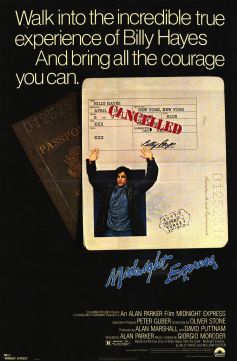
Midnight Express (1978)

midnight_express_ver2_xlgMidnight Express
Directed by Alan Parker

Like most of the other nominees from 1978, I knew nothing about Midnight Express before I watched it. Because it had “express” in the title, just like Murder on the Orient Express, Von Ryan’s Express, and Shanghai Express, I thought I was going to see an exciting train movie. I was disappointed and apprehensive to learn that it was not about trains, but about the horrifying conditions in a Turkish prison. I was fully expecting a movie as brutal as Deliverance, and I was relieved that it wasn’t nearly as bad.

So what’s the story? Young American Billy Hayes is caught trying to smuggle two kilos (or four and a half pounds) of hashish out of Turkey and sentenced to four years in prison there.

The Good: The acting is phenomenal. Brad Davis is truly amazing as Billy as he goes from terror to acceptance to insanity. Randy Quaid plays Jimmy, an inmate who is always coming up with escape plans that go awry.  Norbert Weisser shows subtle sympathy as Kurt the Swede. The sneaky prison snitch Rifki is played with quiet menace by Paolo Bonacelli. John Hurt gives a heartbreaking performance as Kurt, an English prisoner who has been there so long that he has very little hope left to hang on to.

The music is good, with the music in the chase scene being exceptional. It was a bit too synthesized in my opinion, but it’s still good.

I liked that the Turkish wasn’t translated, especially when Billy was first arrested at the airport. It was kind of disorienting, because I wasn’t sure exactly what was going on, and that echoed Billy’s experience.

The Bad: Go straight to ugly. Do not pass Go. Do not collect $200.

The Ugly: I couldn’t connect with Billy Hayes. He came off as an entitled spoiled brat. He was smuggling several pounds of hashish out of Turkey, but he seems to believe that he doesn’t deserve any sentence at all for that. Depending on the state he was in, he’d get about five years in prison for that in the US, especially since he admitted that he had the intent to sell. Smuggling carries an even greater penalty, so when he whined about having to stay four years, my opinion of him went down even more. Unfortunately, if you can’t connect with the main character in some way (or at least have some sympathy for him), a movie gets a little dull. You just want it to be over, because you just don’t care what happens.

I was upset when I found out that most of the movie was made up. If you are purporting to tell a true story,there should be more truth to your movie than the very basic plot. According to Billy Hayes, the conditions weren’t nearly as brutal as Alan Parker and Oliver Stone, who wrote the screenplay, depicted. I feel like you shouldn’t defame an entire country just for the drama.

I rarely do spoilers, but I am going to highlight the most brutal moments here so that you can make a more informed decision about watching it (SPOILERS BELOW):

  1. A cat is hung.
  2. One inmate bites off another’s tongue.
  3. A man’s head is squished on a peg and some grossness ensues.

Those are the three most brutal moments; everything else is basically as tame as the things that happen in the TV show Prison Break.

Oscars Won: Best writing, screenplay based on material from another medium; best music, original score.

Other Oscar Nominations: Best picture; best actor in a supporting role (John Hurt); best director; best film editing.

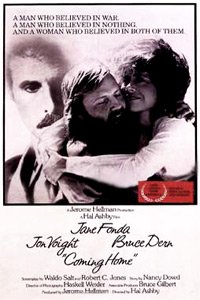
Coming Home (1978)

cominghome1Coming Home
Directed by Hal Ashby

 1978 is kind of a black hole in my movie world. This is another best picture nominated movie that I didn’t know anything about. When I picked it up from the library and saw that it was a movie about Vietnam starring Jane Fonda, I wasn’t thrilled. I’ve never been a fan of hers. But then I reminded myself that I loved watching Jane Fonda (and the rest of the cast) in Grace and Frankie, so I tried to put my prejudices aside and just lose myself in the movie, which turned out to be easy to do.

So what’s the story? Sally’s husband, Bob, is excited to be going to Vietnam to actually start doing his part in the Vietnam War. While he’s gone, Sally starts volunteering at the nearby VA hospital, where she reconnects with Luke, whom she knew in high school. Luke was injured in the war and is now a paraplegic. He is angry about the war, so naïve Sally tries to pull him out of his bitter shell. As they both wrestle with the tragic effects of war on so many different people, they find themselves falling in love.

The Good: Against my own expectations, I found myself very impressed with Jane Fonda’s performance as Sally. Sally grows slowly over the course of the film, and Fonda was able to show Sally’s progression from the little wife to a strong, brave woman. It’s a beautiful, heartbreaking piece of acting.

John Voight was equally good as Luke. I have prejudices against him, too (the Jim Phelps I know would never, ever betray the IM force), but since the long hair and beard helped disguise his face, I was able to appreciate his acting and feel the sadness, bitterness, and anger of a man returned from war, as well as his excitement when he started to feel that his life might get better.

The supporting actors were just as good as the leads. Penelope Milford played Vi, Sally’s free-spirited friend who worked at the hospital to be near her brother Bill, who came back from Vietnam with severe PTSD. Keith Carradine, who played Bill, and Bruce Dern, who played Sally’s husband, Bob, both portray men who can’t handle what happened in Vietnam, although they deal with it in different ways. Everyone in the movie is touched by the war somehow, and they were all able to show the different facets of living with something that can destroy men’s souls.

Both the music and cinematography in Coming Home were unusual in a good way. There was no original score, only songs that were from the time of the Vietnam War. When a song wasn’t playing in the background, there was no music at all, which added to the realism of the movie and forced the viewer to focus more intently on what is happening in the scene. The cinematography had a similar effect. There were a lot of shots of people’s hands as they were talking, underscoring what they were saying. This really stood out to me in the first scene, where actual veterans are having an unscripted conversation about the war, but it happened at other times, too.

The costuming and hair styles also underscored the changes people were making. As Sally found herself, she dressed in more comfortable, practical clothes instead of the dresses, heels, and pearls favored by the other officers’ wives. She let her hair be natural instead of straightening it. But when she went to Hong Kong to see Bob, she once again assumed the dress and appearance of a proper officer’s wife. It was a nice touch.

The Bad: Once again, I am so glad that I live now. The bad things in this movie are not problems with the movie, per se, but with the times. The attitudes towards women are terrible. Yes, I realize that people with the “men know best” attitudes still exist, but they aren’t as prevalent as they were. I’m also glad that PTSD is better understood and treated than it was in the past. I know treatment isn’t perfect, but it’s come a long way since the 1970s.

The Ugly: Coming Home isn’t a perfect movie, but there’s certainly nothing “ugly” about it.

Oscars Won: Best actor in a leading role (John Voight); best actress in a leading role (Jane Fonda); best writing, screenplay written directly for the screen.

Other Oscar Nominations: Best picture; best actor in a supporting role (Bruce Dern); best actress in a supporting role (Penelope Milford); best director; best film editing.