I'd like to spank the Academy

Archive for the ‘Comedy’ Category

Love Affair (1939)

Love_AffairDirected by Leo McCarey

This was the movie that was responsible for some of the difficulties last week. The first copy I checked out from the library was the worst quality DVD I had ever watched. The disc itself was fine; it didn’t have any scratches or divots. But the sound was so bad I couldn’t understand what anyone was saying half the time, and the picture looked like a bad transfer of a sub-par VHS. I didn’t feel like watching that DVD would give me a fair picture of Love Affair, so I had to dig up another copy from a different library. (It is available for streaming on Amazon, but Amazon was being extremely stubborn; while I could see that the movie was there, it wouldn’t let me stream it. Amazon kept trying to stream Downton Abbey, and wouldn’t believe me when I said I wanted anything else. True story.) Anyway, the second DVD I got wasn’t impressive, either, but at least I could understand what the characters were saying. The picture was clearer, too; it still looked like a VHS, but it was at least a higher quality one. It made me feel bad. This movie deserves better.

So what’s the story? Michel Marnay, a famous French playboy, is traveling by sea to New York to join his heiress fiancé. He meets Terry McKay, a down-to-earth American woman who is coming back from a business trip. She’s engaged to her boss. Michel and Terry fall in love, but decide to part for six months to give Michel a chance to prove to himself that he can be something more than just a playboy and that he’s worthy of Terry. They make plans to meet at the top of the Empire State Building after the six months. With so much determination between the two, what could possibly go wrong? If this story sounds suspiciously familiar, that’s probably because Leo McCarey remade his own movie in 1957 and called it An Affair to Remember.

The Good: I was a little bit nervous going in. I had only seen Charles Boyer in one movie before this one, and that was Gaslight. I don’t like Charles Boyer’s character in Gaslight, and I wasn’t sure he would be a good enough actor to erase that character from my mind. But Charles Boyer makes a very charming playboy turned good. Irene Dunne plays an independent woman who refuses to fall for silly pick-up lines equally well. They made a very good, very believable screen couple. I could understand why they would fall for each other, which is something that doesn’t always happen.

There is also another person who deserves mention in this movie for her acting. Maria Ouspenskaya plays Michel’s darling, elegant little grandmother. She’s not in the movie very long at all, but I couldn’t help falling in love with her. She is such a sweet, beautiful old lady.

The screenplay was very fun. Terry gets to say all sorts of things to remind Michel that as attractive and charming as he is, he’s still just a man. But Terry isn’t perfect, either, and she gets called out on her imperfections, too. I like the evenhanded treatment of both people.

The Bad: The one problem with the story is that I think it is inconsistent with Terry’s character that she doesn’t share her secret with Michel. I realize she is a proud and independent woman, but I feel like she would have trusted his love enough to at least give him a chance to react to it. But then I guess the story would have resolved too quickly.

The Ugly: Again, this isn’t the movie’s fault, but someone really needs to make a decent DVD of this movie. It’s inexplicable to me that no one has. I suppose it’s because this movie has been overshadowed by An Affair to Remember, but Love Affair is equally good and deserves a better DVD.

Oscars Won: None.

Oscar Nominations: Best picture; best actress in a leading role (Irene Dunne); best actress in a supporting role (Maria Ouspenskaya); best writing, original story; best art direction; best music, original song.

Mr. Smith Goes to Washington (1939)

Mr. Smith Goes to WashingtonDirected by Frank Capra

Mr. Smith Goes to Washington is one of the movies I had seen before I started this project and was happy to watch again because it’s so good. I was also happy in a really weird way that I couldn’t get it from the library I work at; there was a waiting list. For a movie from 1939. So I have hope for the future now, even though I had to get the movie from a different library.

So what’s the story? A senator from an unnamed state dies, and the governor needs to appoint a replacement. The corrupt political boss that got him elected tells him to pick one person, while the unions and other state leaders give him another name. His savvy kids (all eight of them!) tell him to appoint their local scout leader, Jefferson Smith. Not wanting to offend anyone, the governor appoints Jefferson Smith. Jeff is a naive patriot who loves his country and believes in the Constitution, but the rest of the elected officials from his state are corrupt and trying to push graft through. It’s up to him and his cynical assistant to stop the evil political machine from succeeding.

The Good: There is lots of good acting in the movie. Jimmy Stewart plays Jefferson Smith, and he’s always good. Jean Arthur is the cynical assistant Saunders who is slowly won over by Smith’s naivety. The corrupt senior senator is Claude Rains, who is one of my personal favorites, and I think it’s a shame that he never won an Oscar. He did get a best supporting actor nomination for this movie, though. So did Harry Carey , who is listed as President of the Senate, but if I remember my Constitution correctly, doesn’t that make him Vice President of the United States? Anyway, he has almost no lines in this movie, but his face is incredibly expressive.

I actually wrote a paper in college about the music in this movie for an American history class where they required us to watch Mr. Smith Goes to Washington; the music is very instrumental (hahaha) to the drama of the movie. Dimitri Tiomkin used lots of American folk songs and patriotic songs to underscore Smith’s fight against corruption.

I’m going to award kudos to the makeup people for this movie, too. I had always thought that Mr. Smith Goes to Washington was made in the late forties, many years after The Adventures of Robin Hood (1938) and Casablanca (1942). I assumed this because of Claude Rains, who looks so much older in this movie than in the other two. But since that is all down to the makeup department and not natural aging, I have to congratulate the makeup department for fooling me.

While I was watching this movie, I assumed that they had gotten permission to film on location at the Capitol Building. Nope! They just rebuilt the Senate Chamber in complete detail in a studio in California. It’s crazy good, and it says to me that Frank Capra cared a lot about this movie.

Another detail that I appreciated was that Capra never named the state that Smith is from or the which political party any of the politicians belong to. He made it so that no one could say, “Well, it didn’t happen in my state or my party, so I’m fine.” He didn’t allow anyone to be complacent about corruption in the government.

The Bad: As Jefferson Smith is trying to expose the corruption, his Boy Rangers back home try to spread the word about what he’s doing. The political machine shuts them down, and it’s very hard to watch. It’s not graphic, but if you’re sensitive to children in danger, be warned. Watch the movie anyway, but know that that’s coming.

The (Possibly) Ugly: Patriotism, idealism, and optimism aren’t always highly regarded now. People are more cynical, especially about the government. Some people might say that this movie is unbearably cheesy because of that. I don’t find it so; I kind of wish there were more people now who did believe that what they do can make a difference.

Oscar Won: Best writing, original story.

Other Oscar Nominations: Best picture; best actor in a leading role(James Stewart); best actor in a supporting role (Harry Carey); best actor in a supporting role (Claude Rains); best director; best writing, screenplay; best art direction; best sound, recording; best film editing; best music, scoring.

Ninotchka (1939)

ninotchkaDirected by Ernst Lubitsch

 When I looked at the list of nominees from 1939, I didn’t recognize the name Ninotchka at all. My first feelings when I saw that name on the list were feelings of frustration; I didn’t want to watch a depressing Russian love story with Greta Garbo, who would probably die at the end after a dramatic illness (yes, that’s what I assumed the story was after only seeing the title). I was so pleased to find out when I watched it that it is the complete opposite of those assumptions. I was also pleased to find out that it’s a freakin’ awesome movie.

So what’s the story? The Soviet experiment is failing, and the government has sent emissaries to capitalistic countries to sell some of the treasures that they confiscated from wealthy Russians. Three rather incompetent men are sent to Paris to sell some jewels that had belonged to Duchess Swana during the Revolution. Swana finds out they have her jewels, and her lover, Leon, volunteers to get them back. He manages to gum up the process enough that the government sends Ninotchka, a very stern woman, to Paris to fix the mess. Will Leon be able to change Ninotchka’s views of the world?

The Good: This movie is hilarious. The screenplay is very well done. There are lots of good zingers from Ninotchka about the uselessness of Parisian society that manage to make fun of both communism and capitalism at the same time. So funny.

The acting is very good. Greta Garbo makes Ninotchka’s transition from a committed, no-nonsense Communist Party member to a woman in love believable. My favorite moment is when she goes out dressed in fashionable clothes instead of her practical Soviet clothes. She’s so self-conscious and feels a little bit silly, while at the same time she knows she looks good. It’s a very woman thing, and Garbo plays it perfectly. The three original envoys sent to Paris are very funny, always making excuses about why they need to spend money for the good of the Party. Melvyn Douglas as Leon was a little bland, but not terrible.

Since it’s high Parisian society in the late 1930s, the clothes are lots of fun. That is all.

The Bad: Although I completely understood why Leon fell for Ninotchka, I could never quite understand why she fell for him. I always like to understand couples in a romantic movie, but I wasn’t able to do so in Ninotchka.

The Ugly: While all of the Russians have (more or less) Russian accents, all of the Frenchmen have American accents. It’s a tiny thing, but it really distracted me.

Oscars Won: None.

Oscar Nominations: Best picture; best actress in a leading role (Greta Garbo); best writing, original story; best writing, screenplay.

Guess Who’s Coming to Dinner (1967)

guess-who's-coming-to-dinner-posterDirected by Stanley Kramer

This is one of the two movies that made me want to start this blog. I had never seen it before last summer. It was one that I had always wanted to see; I had even checked out the DVD from the library a couple of times. I just somehow never got around to watching it. But late one night, I was packing to go on a trip and was looking for something to play in the background while I packed. This movie happened to be streaming on Netflix at the time (although it’s not right now), so I turned it on. My packing didn’t get done until the next morning. I couldn’t tear myself away from this movie. Even though this is a quiet movie about one day in the life of one family, the tension is so great as we wait to find out the parents’ opinions that I couldn’t stop watching.

So what’s the story? Joanna Drayton comes home unexpectedly from Hawaii with a surprise: her new fiancé, Dr. John Prentice, who happens to be black. She is excited for her parents to meet him, and because they are liberals from San Francisco, she is confident that they won’t be upset at the prospect of a black son-in-law. But Joanna doesn’t know something: John has told her parents that if they don’t one hundred percent approve of the marriage, he will respect their opinion and not marry their daughter. Since John is flying to New York and then Geneva soon after, Matt and Christina Drayton only have a few hours to come to terms with this shift in their world.

The Good: There are so many good things about this movie that it’s hard to know where to start. We can start with the acting, I guess. It was a pretty small cast, and everyone was spot on. Sydney Poitier and Katharine Houghton (Katharine Hepburn’s niece) are the engaged couple. Real-life lovers Spencer Tracy and Katharine Hepburn are her parents; Roy Glenn and Beah Richards are his. Isabel Sanford plays Tillie, the Draytons’ maid, who disapproves strongly of the relationship. Cecil Kellaway is the Draytons’ family friend Monsignor Ryan, who strongly supports the couple and quotes the Beatles. Everyone is very believable as people who are blindsided by an unexpected situation.

The music really worked for me, too. Background music was used sparingly throughout the movie, which made it feel more real. After all, who really has their own theme song?

The cinematography was fairly straightforward, but because of this, the one time that anything was different really stood out. When Tillie is berating John for thinking about marrying above himself, the camera is at an angle, reflecting her anger and his bewilderment. It was a small thing, but it made an impact.

The Bad: I don’t like the scene where Matt and Christina go for ice cream. It just didn’t seem to fit in the movie somehow.

Joanna’s attitude annoyed me throughout the whole movie. While she obviously realizes that John is black, she doesn’t seem to think about what that means on a daily basis. She seems to have no idea of the ugliness that is racism. She apparently thinks that their love will be enough to protect them from prejudice. I can understand that she’s a young girl in love, but I feel like she has no understanding of what is waiting for her and John in their life together.

Also, no one raised any objection to the fact that Joanna is 23 and John is 37 and that they are getting married after having known each other only ten days. John’s race is a huge deal, but so is that age difference. I would be seriously worried if my daughter brought home some guy fourteen years older than her that she had known for ten days and said it was true love, but the only thing anyone worried about was the race issue.

The Ugly: There isn’t really any ugly in this movie. It’s a well-done intimate look at what happens to people when they are called upon to live up to the ideals that they’ve preached all their lives.

Oscar Wins: Best actress in a leading role (Katharine Hepburn); best writing, story and screenplay – written directly for the screen.

Other Oscar Nominations: Best picture; best actor in a leading role (Spencer Tracy, posthumously); best actor in a supporting role (Cecil Kellaway); best actress in a supporting role (Beah Richards); best director; best art direction – set direction; best film editing; best music, scoring of music, adaptation, or treatment.

The Graduate (1967)

the-graduate-poster1Directed by Mike Nichols

When I was a sophomore in college, my roommate and I were talking about movies late one night. I don’t remember how it came up, but I admitted that I had never seen The Graduate. She was shocked. “But Melanie,” she said, “you’ve seen every other old movie out there. How have I seen an old movie that you haven’t seen?” I didn’t want to admit to my more sophisticated roommate that I hadn’t ever watched it because I was so uncomfortable with the subject matter; I had no interest in watching a forty-something-year-old woman and a man in his early twenties have sex. Now that I’ve seen it, though, I’ve learned that I was worried about the wrong thing. Nothing explicit is shown. No, what did make me uncomfortable was how very awkwardly that young man handled the affair.

So what’s the story? Benjamin Braddock has just graduated from college and come home to California. On the night of his welcome home party, his neighbor Mrs. Robinson asks him to drive her home. Once there, she tries to seduce Ben, but he gets spooked and leaves. He can’t stop thinking about it, though, and phones her one night to ask if the offer is still open. They begin to have an affair. It’s all going well until Elaine Robinson, Mrs. Robinson’s daughter and Benjamin’s contemporary, comes home from Berkeley. At the insistence of his parents and her father, who is unaware of the affair, Ben takes her out. But now he has a new problem: he’s starting to fall in love with Elaine.

The Good: Dennis Hoffman is ridiculously awkward as Ben, and it was fun to see William Daniels (without his Bostonian accent!) as Mr. Braddock. But Anne Bancroft and Katharine Ross were the standouts for me. I had only seen Anne Bancroft do comedy before, so it was a revelation to see her as an unhappy, alcoholic predator. And Katharine Ross did wonders with the part of Elaine, a girl in a seemingly impossible situation.

The soundtrack is fabulous. It features several Simon and Garfunkel songs, including “The Sounds of Silence”, “Scarborough Fair/Canticle”, and (of course) “Mrs. Robinson”. Good stuff.

I feel like the cinematography is a standout, too. There are lots of interestingly-composed shots that add to the emotions of moments in the film.

Like Bonnie and Clyde, this movie has an excellent ending. It’s not exactly happy, but it’s not sad, either. It fits the mood and the theme of the movie perfectly.

The Bad: I know that Mrs. Robinson is the villain of the piece, but I wished I had gotten a better sense of her motives. Why was she seducing Benjamin? I understand that she was unhappy, but that didn’t feel like enough of a reason to seduce the son of your husband’s business partner. I would have been better convinced by the movie if I had had more of an understanding of her character.

The Ugly: I get embarrassed for people very easily, and there is a lot to be embarrassed about in this movie. Ben is just so awkward, especially at the beginning of the affair. He is so far out of his depth that it can be hard to watch. I’m pretty sure that that’s what the director was going for, and he definitely succeeded. But man. Sometimes I just want to shake Benjamin and say, “Ben! Stop trying so hard! Also get away from that crazy lady!”

Oscar Won: Best director.

Other Oscar Nominations: Best picture; best actor in a leading role (Dustin Hoffman); best actress in a leading role (Anne Bancroft); best actress in a supporting role (Katharine Ross); best writing, screenplay based on material from another medium; best cinematography.

Doctor Dolittle (1967)

doctor dolittleDirected by Richard Fleischer

An actual conversation:

Me: Guess what I watched last night! Doctor Dolittle! The one with Rex Harrison.

My mother (in a horrified voice): WHY?

Me: For my blog. It was nominated for best picture.

My mother: Well, you really took one for the team on that one.

Contrary to the way this conversation makes it sound, Doctor Dolittle is not an evil movie. It is, however, a rather tedious movie in which forty-five minutes’ worth of plot is stretched to fill two and half hours.

So what’s the story? Dr. Dolittle is a kindly country doctor who learns to talk to animals with the help of his parrot, Polynesia. Because he can communicate with animals better than humans, he decides to be a vet instead of a doctor. For reasons not made clear in the movie, he wants to find the Great Pink Sea Snail and talk to it, so after he gets enough money and breaks out of the insane asylum, he goes on a voyage to find it.

The Good: As I watched this movie, I kept thinking what a nightmare it must have been to make. It was the 1960s, so the animals aren’t CGI or puppets, but real live animals. If you count the ducks and the goats and the pigs and the cows and the bears and the ridiculously cute lion cubs and all the other animals, there must be hundreds of animals.  I can’t even imagine trying to orchestrate such a thing. That alone is very impressive.

There was some fun humor. I even laughed out loud a couple of times. I enjoyed the song that Emma sang as she was storming away from meeting Dr. Dolittle for the first time.

I will also admit that Rex Harrison did a good job. Although on the surface the role of Dr. Dolittle is quite similar to that of Henry Higgins in My Fair Lady (a middle-aged linguist who doesn’t get on well with people), he didn’t play the roles the same way. Dr. Dolittle is much kinder and gentler, and it showed in Harrison’s face.

The Bad: There wasn’t much of a story. The movie kind of meandered around various vignettes. There’s the house scene, where we and Stubbins are introduced to the doctor and his many animal friends. There’s the ugly scene between Bellowes and the doctor. There’s the courtroom scene. There’s the breaking out of jail scene. There’s the voyaging scene and the island scene. I remember being amused by the book when I was a child, which makes me think that there was good source material, but the writers couldn’t seem to find a straightforward linear story from it.

Also, the love triangle was…odd. I could see no reason for Emma to fall for Dr. Dolittle, the middle-aged linguist, over Matthew, the charming young Irishman. I don’t care what My Fair Lady teaches us. Attractive young women do not fall in love with middle-aged linguists who don’t get on with people and can’t sing. I don’t buy it.

The Ugly: It was two and one-half hours long. With fourteen mediocre musical numbers. Enough said.

Oscars Won: Best effects, special effects; best music, original song (“Talk to the Animals”).

Other Oscar Nominations: Best picture; best cinematography; best film editing; best sound; best music, original music score; best music, scoring of music, adaptation or treatment; best art direction-set direction.

A Curiosity: Richard Attenborough is in this movie for about as long as Judi Dench is in Shakespeare in Love, but Richard Attenborough sings a song. He got a Golden Globe for best supporting actor for this. I didn’t know he could sing. And I’m not sure that what he did counted as being a supporting actor. I wish I knew how these things are judged.

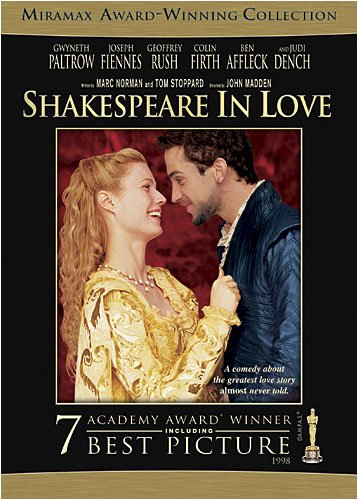
Shakespeare in Love (1998)

shakespeare in love posterDirected by John Madden

I hadn’t seen this movie when it first came out, so all I really knew about it was that according to everyone, it stole the best picture Oscar from Saving Private Ryan (which I also hadn’t seen). I think I was half expecting it to be terrible after all the outrage. And I know I am about to damn this movie with faint praise, but it was cute. There was nothing really wrong with it.

So what’s the story? Shakespeare, a young playwright with a good reputation, is struggling to write his next play. He finds a muse in Viola De Lesseps, a young woman so obsessed with the theater that she is willing to break the law and perform on stage disguised as a man. There are some misunderstandings and mishaps, but eventually Shakespeare writes his masterpiece Romeo and Juliet.

The Good: I loved the production design. I felt like it was a very full picture of Elizabethan England, from the formality of the court to the disgusting dirtiness of the streets. It felt very alive. It almost made me want to live in those times. Well, no. Really too dirty for my taste. But maybe visit!

The music! It was fun and upbeat and just…fit. Loved it.

The supporting cast was great. I’m not a huge fan of either Gwyneth Paltrow or Joseph Fiennes, but I loved everyone else. Imelda Staunton as the nurse was a huge favorite of mine, as was Geoffrey Rush in his role as a befuddled producer. Colin Firth was surprising as a slightly evil stuffed shirt nobleman, and I loved Mark Williams as the tailor who wanted to be an actor. Judi Dench was good in her expanded cameo as Queen Elizabeth, even though I don’t think that eight minutes of a movie is enough to count as a supporting role. I even liked Ben Affleck’s egotistical actor. The cast was really just stellar.

The Bad: The writers played around with history a little too much for my liking. Romeo and Juliet was written in the 1590s; no one was settling Virginia until the early 1600s. But since I feel like the filmmakers weren’t trying to make any kind of serious movie, but just present a fun alternative backstory to Romeo and Juliet, I suppose I can forgive them.

The Ugly: There’s nothing really ugly about this movie. It’s just cute and sweet. But I do have a little rant. Everyone thinks the ending of this movie is so sad. But guess what? It wouldn’t have lasted. And no one seems to understand that. Whatever the real Shakespeare was like, the character in this movie was a philanderer who fell in and out of love with ease, just like Romeo. Which has always bugged me about Romeo, incidentally. I guess I just have never felt that Romeo and Juliet was a particularly romantic play, so I carry those feelings over to this movie.

Oscars Won: Best picture; best actress in a leading role; best actress in a leading role; best writing, screenplay written directly for the screen; best art direction-set direction; best costume design; best music, original musical or comedy score.

Other Oscar Nominations: Best actor in a supporting role (Geoffrey Rush); best director; best cinematography; best sound; best film editing; best makeup.

La vita è bella-Life is Beautiful (1998)

life is beautiful posterDirected by Roberto Benigni

When I was a sophomore in high school, my history teacher broke precedent and offered us extra credit if we went to a certain movie that was playing at the arthouse cinema downtown. Getting extra credit for watching a movie was a no-brainer to me, so one cold, snowy Saturday night in January, I called up my best friend to see if she wanted to go see it with me. Her mom asked what the movie was about, and when Tiffany said that it was a comedy about the Holocaust, her mom flipped out and almost refused to let her go. The extra credit was too good to pass up, though, so my brother drove us down to the theater. When we got there, my jaw dropped. The line for tickets wound out the door, filled the sidewalk, and bumped up onto the street. We didn’t get in to the early showing and barely made it into the late one. But after I had seen Life is Beautiful, I understood. I knew why people were willing to stand on the sidewalk in the dark and the freezing cold to experience this movie.

So what’s the story? Guido is a young man who moves to the city hoping to open a bookshop but willing to work as a waiter until that dream comes true. He meets the beautiful Dora, his “pricipessa,” and wins her heart when he shares with her the joy he finds in life. Despite the disapproval of Dora’s mother, they marry and have a little boy, Giosuè. But it’s not safe to be a Jew in Italy during World War II, and Guido, his uncle, and Giosuè are taken to a labor camp. Dora insists on going, even though she is not Jewish. Giosuè is too young to understand what’s going on, and Guido is determined to keep Giosuè in the dark. He invents a story that the camp is game with challenges to be won. Life in the camp gets harder and darker, but Guido keeps up his spirits and humor so that his child won’t see the horrors of the concentration camp.

The Good: Roberto Benigni had to tread very carefully with this film. When you are making a comedy about such a serious topic, everything has to be perfect. If it’s too over the top, it will be disrespectful. If it’s too subtle, people are going to wonder if it was meant to be funny. I think Nicola Piovani managed to walk that line perfectly with his musical score. The music underscored the darker moments, but also brightened the happier ones.

The acting was also marvelous. Roberto Benigni showed so many facets of a complex man, a man willing to do anything and everything for love. Nicoletta Braschi, Benigni’s real-life wife, did an excellent job playing a woman who finds the courage to accept love and fight to keep it when she finds it. Giorgio Cantarini is adorable as Giosuè. The rest of the cast was excellent, as well.

The Bad: The only thing I don’t like about this movie is that Guido’s friend Ferruccio disappears. Once Dora and Guido leave the restaurant, he never shows up again. While I realize that friendships shift and change over time, I would have liked to have seen him again. But really, that’s a tiny quibble.

The Ugly: Never ever ever watch this movie dubbed. Only watch it in its original Italian with subtitles. I checked the movie out on VHS not long after it was released on video, and I was shocked that it wasn’t in Italian. The dubbing made me almost physically sick. It loses so much of its charm and life when its dubbed. Don’t do it!

Oscars Won: Best foreign language film; best actor in a leading role (Roberto Benigni); best music, original dramatic score

Other Oscar Nominations: Best picture; best director; best writing, screenplay written directly for the screen; best film editing