I'd like to spank the Academy

Archive for the ‘Comedy’ Category

Tootsie (1982)

tootsieDirected by Sydney Pollack

I had seen Tootsie before, when I was probably ten or eleven. At that time in my life, I just thought it was weird. Why in the world would a man dress as a woman? Why could nobody see that Dorothy was a man? I didn’t understand the gender politics at play, either, so I was just left with an impression of oddness. This is why eleven-year-olds shouldn’t review movies made for adults. Tootsie is fabulous and hilarious and still relevant today, which is honestly kind of sad. There should have been more progress made in equality in the workplace in the last thirty-three years.

So what’s the story? Michael Dorsey is an actor who can’t get work. Even though he’s good, he has a reputation of being difficult to work with. Desperately in need of money, Michael decides to become Dorothy Michaels in order to try out for a role on a soap opera that a female friend didn’t get.  Michael soon finds out that when he puts on his dress and his makeup, he also puts on a different personality as Dorothy, inadvertently becoming a crusader for women’s rights. He also finds himself falling for his female coworker, but he can’t tell her who he really is. Will Michael be able to pull off his deception? Does love really conquer all? And will Michael ever lend his dresses to Julie?

The Good: The screenplay is brilliant. Both funny and meaningful, it manages to show Michael’s growth as a person without ever being preachy or obvious. It’s a tough balancing act, and the screenwriters pulled it off. After I watching Tootsie, I’ve been thinking about why more comedies aren’t nominated for best picture; watching lots of heavy dramas isn’t always the most fun. I’ve decided that it’s because the best movies introduce you to a new idea or make you think, and it is much easier to do that with a dramatic story than with a comedic one. The writers for Tootsie managed that, partly by letting the characters in the movie be real people, who sometimes get off killer zingers and who sometimes have no idea what to say. I love it. (Incidentally, this is one of the few times that I have recognized the name of a screenwriter as it flashed on the screen during the opening scenes: Larry Gelbart is one of the writers and producers of the television show M*A*S*H*, which is grew up watching with my parents and then grew to appreciate when I watched reruns on the Hallmark Channel in college. M*A*S*H* balances comedy with hard topics in the same way.)

The acting is fabulous all around. Dustin Hoffman plays Michael Dorsey and Michael Dorsey playing Dorothy Michaels so well that it’s indescribable. It’s a performance that needs to be seen, not just talked about. Teri Garr is wonderful as Sandy, the friend whose role Michael steals. She’s frustrated as an actress and as a woman, but she has hope that maybe things will get better. I love the role, and I love Teri Garr in it. Charles Durning plays Les, a man who falls in love with Dorothy. His reactions later on in the movie are priceless. Bill Murray is Jeff, Michael’s sarcastic playwright roommate. George Gaynes plays John Van Horn, the star of the soap opera who believes that he has the right to kiss all of his female coworkers. Michael’s bewildered agent is played by Sydney Pollack, who also directed the movie. Even the small roles are incredibly well-played. It’s one of those casts that melds together well and plays perfectly off each other. I love it.

The makeup is very good. Dustin Hoffman is listed twice in the credits, both as Michael Dorsey and as Dorothy Michaels. I think that decision was made because Dustin Hoffman is basically unrecognizable when he’s made up as Dorothy. It’s quite the feat.

The Bad: For being a movie about women being powerful, Julie and Sandy are both kind of stereotypical and weak. Sandy gets weepy and hysterical often at the drop of a hat, and Julie doesn’t have much personality. She’s brave to have a baby on her own in the 1980s, and she’s a sweet girl, but she doesn’t go very deep. It’s kind of disappointing that the only woman who is very strong and who bucks female stereotypes is a man.

The Ugly: The soundtrack is everything that is bad about ‘80s music. I’m not sure how it sounded originally, but it hasn’t aged well. The theme song (“It Might Be You”) is over-synthesized, which makes it super-cheesy. It might be a beautiful song if it was a bit more simplified, but it nothing about the 80s was simple or subtle, and the music in Tootsie suffers because of that.

Oscar Won: Best supporting actress (Jessica Lange).

Other Oscar Nominations: Best picture; best actor in a leading role (Dustin Hoffman); best actress is a supporting role (Teri Garr); best director; best writing, screenplay written directly for screen; best cinematography; best sound; best film editing; best music, original song (“It Might Be You”).
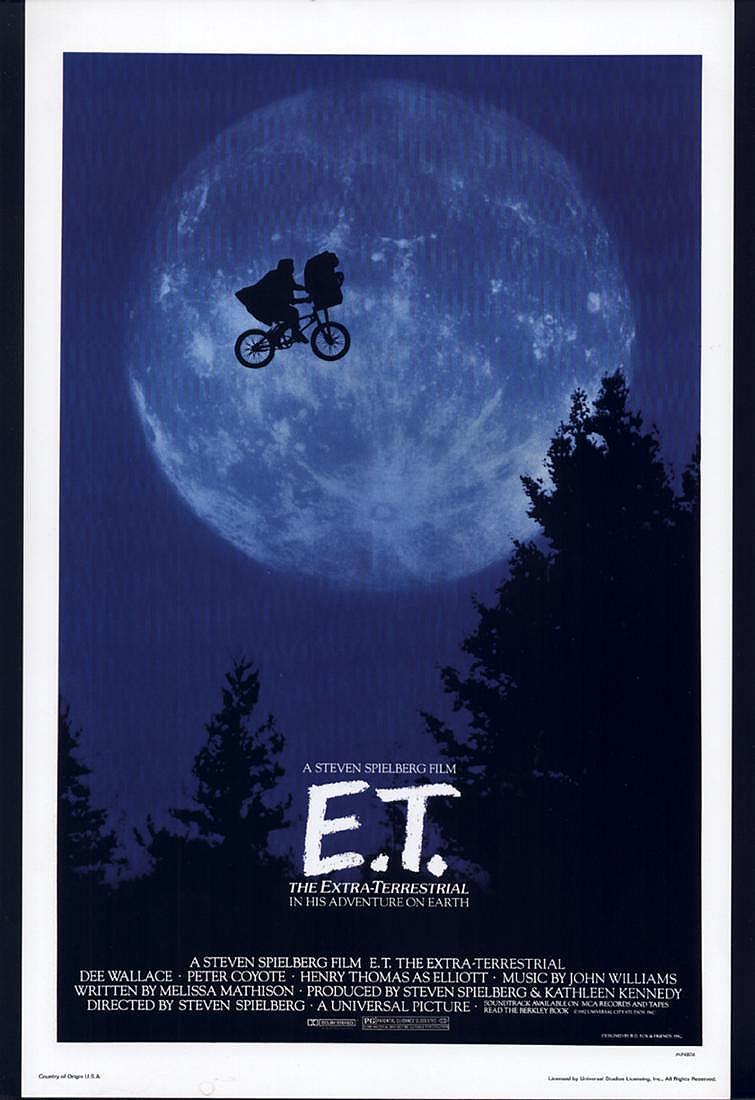
E.T. The Extra-Terrestrial (1982)

ETDirected by Steven Spielberg

Even though I am a child of the 1980s, I didn’t grow up with this movie. I’d seen it a few times, but not a lot. My mom didn’t approve of some of the language the kids used, which is fair. (For some reason, people in the ‘80s thought it was really funny for kids to use bad language. I’m so glad that phase of our society is mostly over.) It was interesting to go back and watch it as an adult with a different understanding. I felt like even though E.T. is about kids, that doesn’t necessarily mean that it’s only for kids.

So what’s the story? A bunch of aliens come to Earth to collect plants. They are interrupted by a group of alien-hunters, who cut one alien off from being able to return to the ship. He is left behind when the ship takes off. He makes his way to the suburbs, where he is found by Elliott, an unhappy young boy. Elliott and the alien, whom he christens E.T., form an unshakable bond as Elliott tries to keep E.T. a secret from adults and help E.T. return home.

The Good: It’s scary to make a movie about children. Child actors can make or break a movie. The children in E.T. were breathtakingly good. Henry Thomas is completely convincing as Elliott. Little sister Gertie is played by Drew Barrymore; this is the only role of hers that I think she does a good job in. Robert MacNaughton is big brother Mike. He has a couple of rough patches acting-wise, but nothing terrible. The three kids truly act like a family. They squabble, they call each other names, the little sister can’t be trusted with secrets, and they pull together when they need to. They know they can depend on each other when it’s important. That’s what a family is.

Of course, this isn’t only due to the acting; the screenwriter, Melissa Mathison, had a lot to do with that. Her screenplay is fantastic, even if she does occasionally have the kids say things that I don’t think they would say in real life. The story could have been bogged down in cheesiness, but the screenwriter managed to keep the movie balanced on the fine line between heartfelt and ridiculous. She also manages to give a sense of backstory without bogging down the movie, which can be another hard thing to balance.

John Williams’s musical score is glorious. I can’t get it out of my head, but I don’t mind too much because it’s so beautiful. Not only is it beautiful, it fits the movie perfectly. It doesn’t overwhelm the movie at all. Williams is a master at using the orchestra, too. The instruments he uses are always the right ones for his themes.

This movie is thirty-three years old, but the special effects hold up. My brother would say that that’s because they don’t use CGI, and I think that’s a good explanation. As CGI gets better and better, the older CGI things end up looking fake, where a well-done robot alien or the overlay of one shot over another to change the background will always look real. I was impressed.

The cinematography was exceptional, also. Part of the reason the adults are so threatening is that no adults (with the exception of Henry’s mother) have faces until close to the end of the movie. The first scene is especially effective because of this. It’s shown from E.T.’s point of view, and we see that he is an intelligent, but frightened, being trying to reunite with his people. It’s heartbreaking and scary all at the same time.

The Bad: Everything worked well, but it can be stressful to see these kids trying to keep E.T. a secret from the adult world. Kids in danger movies are hard for me sometimes, and in this case, while I completely understood the reasoning behind their actions, that didn’t stop me from wanting to step in and help them. I know that won’t bother everyone, though.

The aforementioned children-swearing thing did bug me. I was glad to know that Henry Thomas actually objected to some stronger language and pointed out that he would never say that, so his character shouldn’t, either. And it’s not so much the language I object to, although it’s not my favorite. I hear worse than that every day at work. It’s just that it makes everything feel less realistic for words like that to be coming out of a nine-year-old’s mouth.

The Ugly: I have to go with “nothing” for this one. E.T. is an incredibly well-made movie.

Oscars Won: Best sound; best effects, visual effects; best effects, sound effects editing; best music, original score.

Other Oscar Nominations: Best picture; best director; best writing, screenplay written directly for the screen; best cinematography; best film editing.

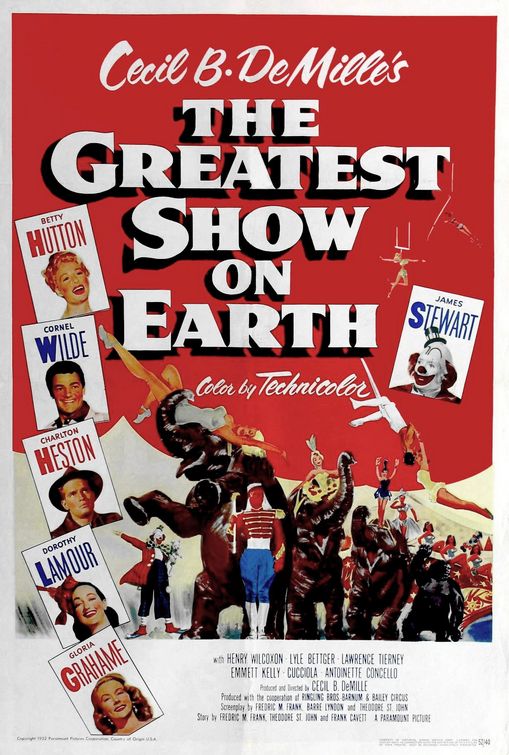
The Greatest Show on Earth (1952)

the_greatest_show_on_earth_posterDirected by Cecil B. DeMille

I have only been to the circus once. I was two, I think. The only thing I remember about the circus is the elephants coming in to the ring; that’s all. Because I have so little circus-watching experience, I wasn’t sure what to expect from this movie. I was glad I didn’t have high expectations, because I was able to enjoy it, even though it has its ups and downs.

So what’s the story? The Ringling Brothers-Barnum and Bailey Circus is not doing well. People just don’t want to come to the circus anymore. The backers don’t want to do a full season. Brad, the circus manager, gets them to promise that the circus will stay out as long as they stay in the black. To do this, he hires Sebastian, a famous trapeze artist. This makes unknown, but excellent, trapeze artist Holly angry, because she wanted to be in the center ring. She decides to prove to Brad and Sebastian that she is the best.

The Good: The circus is amazing. I kind of wish Cecil B. DeMille had just made a documentary about the circus and the real circus performers, because the story wasn’t all that interesting. I would have loved to know how people got involved in the circus, how they learned to do some of the incredible things they do, if they would ever consider leaving the circus. The circus was truly the best part of the movie.

The cinematography was well done. It had to be in order to capture the feeling of the circus, the size and the noise and the color and the bustle and the amount of work it is to put a circus on.

Gloria Grahame is fantastic as Angel, a “sadder but wiser” circus performer who loves Brad, but isn’t sure that he will love her back because of her past. Charlton Heston (whom I did not recognize in normal clothes and a hat) is very good as Brad, the manager who will do anything to keep the circus going. Cornel Wilde is charming as the playboy performer Sebastian. It’s always nice to see Jimmy Stewart, even though his role as the clown with a mysterious past isn’t very large. His little dog is adorable, too. Lyle Bettger was good as the Angel-obsessed Klaus. And it is fun to see famous circus people like John Ringling North and Emmett Kelly doing their thing.

The Bad: I did not like Betty Hutton, who played Holly. She was more annoying than anything. Apparently, she was a famous singer at the time, but her acting skills could have used some work.

Since I grew up watching The Ten Commandments, I’m used to Cecil B. DeMille narrating with great weight about serious subjects. It was really odd to hear him narrating about the circus. It wasn’t necessarily bad, per se, but it was really weird for me. It probably wouldn’t bother someone who isn’t familiar with DeMille’s voice.

The Ugly: The story is really weak and not particularly interesting. How the writers managed to win an Oscar for best story is beyond me. It must have been a weak year for that award.

The train wreck at the end was probably good for its day, but it doesn’t hold up well. Klaus is obviously sitting in front of screen when he’s supposedly on the tracks. I try not to let that kind of stuff get to me, but sometimes it does. This is one of those times.

Oscars Won: Best picture; best writing, motion picture story.

Other Oscar Nominations: Best director; best costume design, color; best film editing.

The Quiet Man (1952)

the-quiet-man-movie-poster-1952-1010203160Directed by John Ford

 As a librarian, I spend a lot of time using the alphabet, so yes, I realize that I by reviewing The Quiet Man today, I am doing things out of order. But Maureen O’Hara died on Saturday, and I’ve been thinking about her and her movies a lot the last couple of days. Because of Miracle on 34th Street and The Parent Trap (the originals of both, NOT the inferior remakes), I grew up admiring Maureen O’Hara as a strong, beautiful woman, completely unafraid to be herself, no matter what society thought. After reading obituaries and tributes to her the last couple of days, I get the feeling that she truly was that way. Since Maureen O’Hara plays another beautiful, strong woman in The Quiet Man, I’m posting my review of it today as my little tribute to a wonderful actress.

I grew up watching John Wayne movies, so I’m not sure how I missed this one. No, it’s not a Western, but I’d seen lots of other non-Western John Wayne movies. But even though I had never actually seen The Quiet Man, I had seen E.T. the Extraterrestrial, so I was really excited to finally know which movie included the dramatic kissing scene that E.T. watches on TV. It was a gap in my movie trivia knowledge, and I was ecstatic to have it filled in. Beyond that bit of trivia, I was glad to finally see The Quiet Man for another reason: it’s a dang good movie!

So what’s the story? Sean Thornton left Ireland for America with his parents when he was three years old, but his mother always talked of Ireland as if it were paradise, so he decides to move back and buy the cottage where he was born. He sees fiery-spirited redhead Mary Kate Danaher as soon as he steps foot in the village of Innesfree and decides that she is the girl for him. Unfortunately, Sean offends Mary Kate’s brother almost as soon. Although Mary Kate makes no secret about her reciprocation of Sean’s feelings, will her brother and her Irish customs keep them apart?

The Good: I’m going to mention cinematography first, because this movie is so beautiful that it literally made me cry. During the race, when the horses are pounding across the beach with the green mountains in the background…oh, it’s amazing. I can’t even begin to describe the beauty of it all. I know that Ireland is beautiful, but photographers still have to have an eye to capture the beauty, and the cinematographer did a fabulous job.

This movie is perfectly cast. I can’t think of another actress who could have done a better job at playing Mary Kate than Maureen O’Hara. She’s strong and proud and just plain wonderful. John Wayne is good as always as the man who is trying to live his dream, but who just doesn’t understand the culture of the woman he loves. He’s confused and frustrated, but so wholly in love. John Wayne and Maureen O’Hara were good friends in real life, and they have excellent on-screen chemistry.

The supporting cast is also so good. Ward Bond makes a surprisingly convincing Irish priest. Victor McLagen, although perhaps a little old to look like Maureen O’Hara’s brother, is full of bluster and silly pride as Will Danaher. Barry Fitzgerald brings a fabulous sense of humor to the role of Michaleen Oge Flynn, and his real-life brother Arthur Shields is excellent as the Protestant Reverend Cyril Playfair. Mrs. Playfair, played by Eileen Crowe, is mischievous and fun. I love them all!

The musical score is gorgeous. Victor Young used a lot of old Irish melodies, but also wrote some beautiful themes of his own. The music complements the movie perfectly.

The story and screenplay are fabulous. I’m not a huge fan of romantic comedies in general, because they’re just so fake. But The Quiet Man is so real. Two proud, stubborn people fall in love, but have a hard time adjusting to each other. Even though they love each other, they don’t completely understand one another. Movies don’t usually show that. Romantic comedies also tend to end with the wedding as the happy ending, but The Quiet Man is not like that. I wish more moviemakers would be brave enough to tell a real story like this one.

The Bad: Because I am a modern woman, I was incredibly uncomfortable with the scene where Sean drags Mary Kate off the train and pulls her across the fields and through the village. Yes, she was asking something of him that he didn’t want to do, but he wasn’t trying to understand her culture, either. Also, I’m not sure how accurate the Irish culture was portrayed. It felt very stereotypical to me, but maybe the stereotype happened because of reality. I don’t know. I just had to turn off the cultural sensitivity part of my brain, and then I was okay.

The Ugly: Nothing, unless you are even more sensitive than I am about the dragging through the fields scene.

Oscars Won: Best director; best cinematography, color.

Other Oscar Nominations: Best picture; best actor in a supporting role (Victor McLaglen); best writing, screenplay; best art direction-set direction, color; best sound, recording.

Random Fact: Even though The Quiet Man won an Oscar for best color cinematography, I once had a library patron who refused to check out the copy we have because it wasn’t in black and white, which, according to her, was the original. I did some research and apparently, ABC only had a black and white print, so that’s what was shown on broadcast TV for a while. The patron never did believe me that The Quiet Man was originally in color. Sigh.

Moulin Rouge! (2001)

moulin rouge!Directed by Baz Luhrmann

I was a freshman in college when Moulin Rouge! came out, and I had a friend who was obsessed with the soundtrack. Whenever we would go and hang out and play games at his apartment, that CD would be playing. It made watching the movie kind of surreal; the music had seeped into my subconscious without my knowledge. I knew all the music, but I had never seen the movie before (overprotective friends again), so I had a strange sense of déjà vu. I’m not sure that helped my general perception of the movie, which was of noise, color, and oddness.

So what’s the story? Young Christian comes to Paris from Great Britain so that he can write about the Bohemians ideals of truth, beauty, freedom, and love. At the famous nightclub Moulin Rouge, he meets and falls for Satine, a performer/prostitute who has dreams of being a real actress. Will they be able to find happiness in the noisy, colorful life that is Paris?

The Good: There was some good acting. Nicole Kidman did a nice job as Satine, even if I did think she was Amy Adams ninety percent of the time. Jim Broadbent was excellent as Zidler, the owner of the Moulin Rouge, who is sympathetic to Satine and Christian’s love, but who also wants his own dreams to come true. Ewan McGregor is a little bit nondescript as Christian at the beginning of the movie, but he does jealousy and heartbreak well towards the end. Toulouse-Lautrec is played by John Leguizamo, who does a good job of showing the yearning for a love that he will never have.

Before I talk about the cinematography, I want to make something clear. I don’t get carsick. I don’t airsick or seasick or rollercoaster sick. But I have known to get sick from certain visual stimuli. I can’t play first-person shooter games, for example, or any first-person games, really. I have run, not walked, out of IMAX movies because I was about to be sick. Moulin Rouge! did the same thing to me. The jerky, constantly moving cinematography did not make agree with my stomach. Or with my head. So I was watching Moulin Rouge through a haze of headache and stomachache. But just because I didn’t like the cinematography and it didn’t agree with my stomach doesn’t mean the cinematography is bad, per se; it’s creative and different and fits with the whirling gaiety of the nightclub. I just didn’t personally like it. I wish I had a section called “Things I didn’t personally like, but can respect for their artistry.” That would make writing reviews easier sometimes. But I since I didn’t feel it was bad, I’m going to leave cinematography in the good category.

The makeup and costumes and production design were over the top and crazy, but so were the lives of the denizens of the Moulin Rouge. Like the crazy cinematography, it worked for the film and what the filmmakers were trying to do accomplish. Again, I’m not sure I liked it that much, but it was admirable.

The Bad: The music rubbed me the wrong way. Yes, it is very clever to use modern music in a movie that takes place over a hundred years ago, but I feel like the filmmakers were a little too clever sometimes, like they were drawing attention to their own cleverness. I feel like they were saying, “Look how clever we are! We used ‘Smells Like Teen Spirit’ to show how immature all these men are who frequent nightclubs! Aren’t we smart?” It became more of a gimmick than something meaningful.

The Ugly: The story was terrible, unoriginal, and uninspired. It was kind of a cheap rip off of Cabaret combined with La bohème. (Possible spoilers ahead) Christian and Satine fell in love for no reason at all. The Duke was silly and not believable as a real person. Also, if you were coughing up blood in 19th century Paris, you knew you were dying of consumption. Tuberculosis wasn’t uncommon then. And while I’m no expert, I’m pretty sure that if you are about to die from tuberculosis, you don’t have the energy to appear in a musical theater production, especially not one based in India with lots of high-energy dancing. The ending is curiously flat. The movie as a whole feels more like an excuse to do crazy musical numbers with modern music than a movie that has anything meaningful to say.

Oscars Won: Best art direction-set decoration; best costume design.

Other Oscar Nominations: Best picture; best actress in a leading role (Nicole Kidman); best cinematography; best film editing; best makeup; best sound.

Gosford Park (2001)

gosford parkDirected by Robert Altman

I read my first Agatha Christie murder mystery when I was twelve. It was the start of a beautiful relationship. Every summer after that, I would check out stacks of Agatha Christie mysteries. The plots were always intricate and watertight, but I also loved the idea of rich British people in country houses dressing for dinner and going shooting and having weekend parties. Gosford Park is basically an Agatha Christie mystery with a twist—it not only shows how the family is affected by the murder, but also how the servants are affected. It could be called Murder at Downton Abbey.

So what’s the story? Sir William McCordle has invited friends and family to Gosford Park for a weekend shooting party. The guests come with their servants, and everyone, both upstairs and down, has a secret.

The Good: The cast reads like a Who’s Who of British actors. Maggie Smith, Helen Mirren, Michael Gambon, Kristin Scott Thomas, Derek Jacobi, Jeremy Northam, Clive Owen, Stephen Fry, and Kelly Macdonald are all in this movie, to name just a few. Everyone is excellent. There isn’t an actor in the movie who was miscast or who isn’t completely believable in their role. It’s a fantastic cast, and the movie is incredibly well-acted.

The screenplay is delightful. I had to laugh when I was watching the credits and realized why I felt it was similar to Downton Abbey. The screenplay was written by Julian Fellowes, the man behind Downton Abbey. The screenplay is fun and funny. Although there are many characters, the screenplay allows them all to show their personalities and problems. It’s very clever and well-written.

The costume design impressed me. The designer, Jenny Beavan, had to not only design clothes for the wealthy and their servants, but also had to show a range of incomes in those different classes. She did so very cleverly and period-appropriately.

I love the music. It’s buoyant and jolly when it needs to be and unobtrusive when more serious things are happening. The cheery piano music made me want to find the sheet music.

The art direction is also excellent. It drew me in to this country house of the 1930s. The cars, the bedrooms, the servants’ quarters, everything felt realistic to me.

The Bad: I got so mad watching this movie at the way people treated their servants. The servants weren’t treated so much like people as they were like useful machines. They are used and abused at their employers’ pleasure. I felt very frustrated. Based on things that I’ve read, I’m fairly sure the attitudes are accurate. Even in my beloved Agatha Christie novels, the servants are almost always discounted from being murder suspects because they couldn’t possibly have a motive; they don’t know the murdered person well enough. I love that this movie shows the relationships between the rich and their servants; the only one who cries at the news of the murder is a servant. But the treatment of the servants still makes me mad.

The Ugly: It was a little hard to keep track of who everyone was. The relationships of the upper-class people were especially hard to figure out. Everyone is introduced so quickly and shallowly at first that it doesn’t all sink in the first time around.

Oscar Won: Best writing, screenplay written directly for the screen.

Other Oscar Nominations: Best picture; best actress in a supporting role (Helen Mirren); best actress in a supporting role (Maggie Smith); best director; best art direction-set decoration; best costume design.

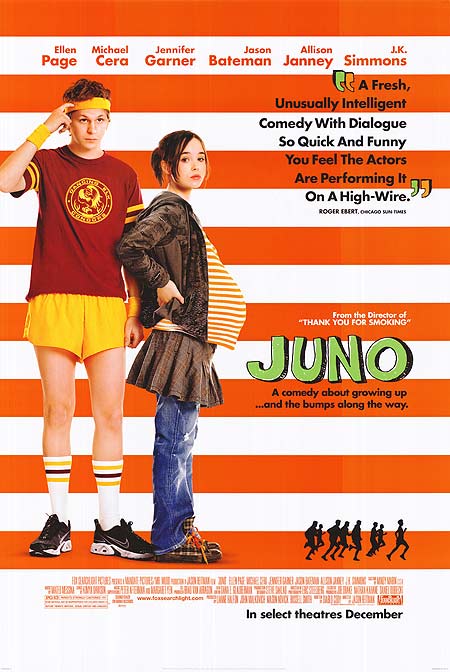
Juno (2007)

JunoDirected by Jason Reitman

When people rave about a quirky independent comedy, I always worry a little. Is the movie really that good, or are people afraid to say they don’t like it for fear of being seen as uncool or unsophisticated? Because let’s face it, not every independent movie is good. Some are downright boring. But because they aren’t made by the established Hollywood studios, independent movies are seen by a certain set of people as being automatically amazing. Then more and more people jump on the bandwagon and suddenly this independent movie is the best movie ever made, according to popular opinion. And then I watch it and I have no clue what everyone sees in it. (Sorry for the tirade. I just hate pretentious people.) Anyway, that wasn’t the case with Juno. It’s a fun, funny, enjoyable movie–and I’m not just saying that to please the hipsters.

So what’s the story? Sixteen-year-old Juno has sex for the first time with her best friend/unacknowledged crush Paulie Bleekman and ends up pregnant. She goes to get an abortion, but just can’t do it. She decides to put the baby up for adoption. She looks for potential adoptive parents in the Penny Saver ads and finds Vanessa and Mark, a seemingly perfect couple. Juno hits it off with Mark right away, but has a harder time connecting to the worried, perfectionist Vanessa. But there are many surprises in store for everyone during Juno’s pregnancy.

The Good: I like the cast. Ellen Page makes a very believable sixteen-year-old who’s trying to figure out life. Michael Cera is at his awkward best as Paulie Bleekman. Jennifer Garner is delightful as uptight Vanessa. Jason Bateman captures just the right attitude as Mark, the man who’s not ready to grow up. Allison Janney is Bren, Juno’s dog-obsessed stepmom who is still unsure of her relationship with Juno, but is willing to support her to the end. I decided I wanted to be friends with J.K. Simmons when he wore a fedora to the Oscars this year; Juno makes me want to be his friend even more. As Juno’s dad, he’s a little rough around the edges, but he loves his daughter and will do anything for her. So yeah. The cast was awesome.

I liked the music, too. I like happy acoustic guitar music. Does that make me a hipster? Ugh! I am having so many mixed feelings about liking anything about this movie.

The screenplay was excellent. Diablo Cody managed to make the viewer like Mark and hate Vanessa at first and then slowly reverse position. That was very clever. There were a lot of good, funny lines, too. Very well done all around.

The Bad: Leah didn’t fit in the movie. She was funny, and the actress was good, but the friendship didn’t feel real. In my experience, cheerleaders aren’t BFFs with quirky, semi-loner musicians.

The Ugly: I didn’t find any in Juno. There were some awkward moments, but awkwardness is a part of adolescence. Juno herself was a little more clever and self-confident than most high school juniors I’ve met, but it’s a movie.

Oscar Won: Best writing, original screenplay.

Other Oscar Nominations: Best motion picture of the year; best performance by an actress in a leading role (Ellen Page); best achievement in directing.

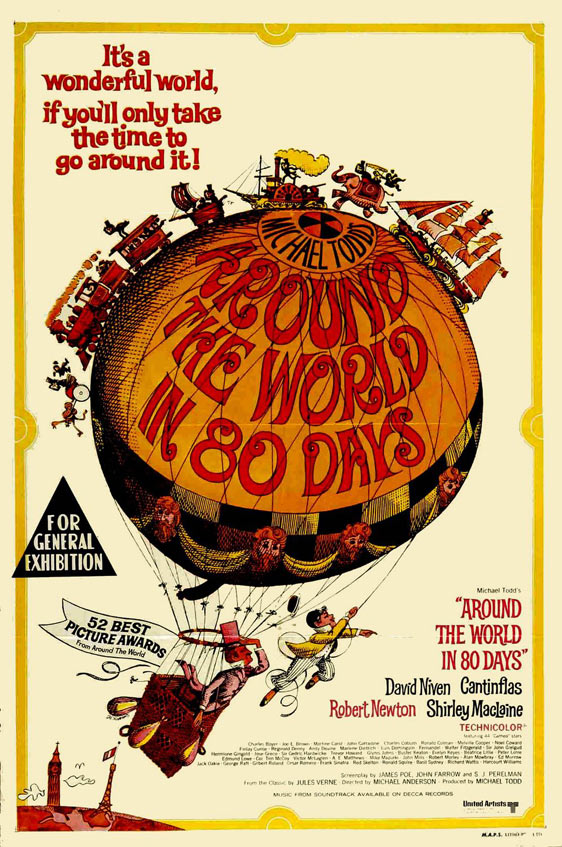
Around the World in Eighty Days (1956)

around_world_80_daysDirected by Michael Anderson

I had a patron come into the library where I work one day and ask for Cantinflas movies. I had no clue what he was talking about. He wrote the name down for me because I couldn’t spell it well enough to look it up in the catalogue, and I found some Spanish-language movies for him. The patron was honestly surprised that I had never heard of Cantinflas. I was surprised, but very pleased, to find Cantinflas in Around the World in Eighty Days. I’ve read the book, but I hadn’t seen the film before this week. The entire movie was a delightful surprise.

So what’s the story? Phileas Fogg, a wealthy, eccentric Englishman, bets the men in his club that he can travel all the way around the world in just eighty days. With nothing more than his newly hired manservant Passepartout and a carpetbag full of money, Fogg sets out on an amazing adventure.

The Good: This is another epic with thousands and thousands of people in it. It seriously boggles the mind that movies like this can come together. Coordinating all the details must have been ridiculous, but the work paid off. There are very many good things in this movie.

The cinematography is gorgeous. Many scenes were filmed on location, which takes extra work, but was absolutely worth it. Besides the beautiful scenery they were able to capture, it means that there were no places where you could tell that the actors were standing in front of a screen with a movie projected behind them. (I’m sure there’s a technical term for that, but I have no idea what it is. If anyone knows, please enlighten me!)

The music, by Victor Young, is also fabulous. At times it is sweeping and beautiful; other times, it is cheerful and jaunty. It fits the movie very well.

The cast was fun. Cantinflas, a Mexican comedic actor, is really good as Passepartout. He has a wide range of skills that fit the role and brought some good comedy to the movie. David Niven is good as a very English Englishman. But what is really fun about this movie is the cameos. So many famous people are in this movie, from Noel Coward to Marlene Dietrich to Frank Sinatra. My personal favorite was Buster Keaton, who talks! I’ve seen lots of his movies, but I’ve never heard him talk before. And he was a train conductor like in The General, which may be literally the funniest movie I have ever seen. Anyway, if you like classic movies, then you will enjoy spotting the stars.

The Bad: Shirley MacLaine was cast as an Indian (eastern, not American) princess. It was an odd choice. She didn’t do a horrible job, but she never convinced me that she was Indian, either.

The Ugly:  This movie needed some more editing. Some scenes are fine for a while, but then they don’t end. The bullfighting scene was the worst offender here. It just went on and on.  Around the World in Eighty Days didn’t need to be a three-hour movie. It would have been just fine at two and a half hours. As it is, there are some boring times.

Again, there is some ugly racial stereotyping because not only was this movie made in the 1950s, it is based on a book written in 1872. It’s not surprising, but it’s not good, either.

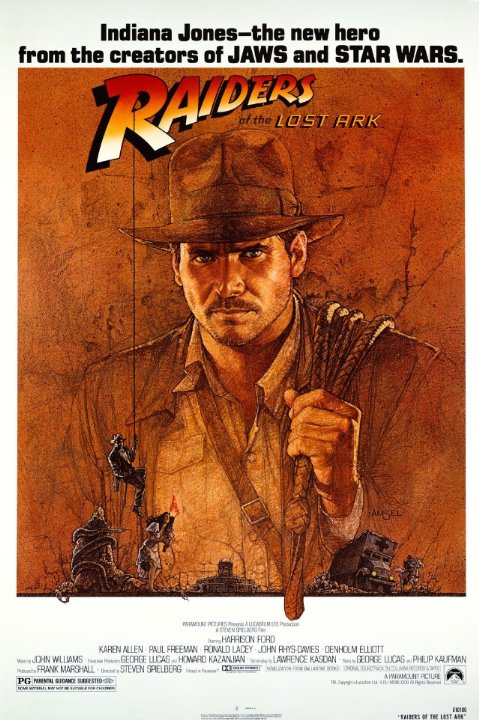
Raiders of the Lost Ark (1981)

raidersDirected by Steven Spielberg

When I was little, I was seriously confused by this movie’s title. For a long time, I thought it was Raiders of the Lost Dark, and I could never figure out how the dark got lost. When I finally figured out it was Raiders of the Lost Ark, I was still confused. There was not a single reference to Noah in the entire movie. That didn’t keep me from liking the movie; I just ignored the confusing title and went along for the ride. And what a ride it is. Raiders of the Lost Ark remains one of the most purely fun movies I have ever seen, even though now it appears to have a new title: Indiana Jones and the Raiders of the Lost Ark.

So what’s the story? Dr. Indiana Jones, a professor of archaeology, is approached by two United States government officials. It seems that the Nazis are looking for the Ark of the Covenant because they believe it has mystical powers. Jones’s old mentor, Abner Ravenwood, is the world’s foremost expert on the Ark, but no one can locate him. Jones is tasked with finding first Ravenwood and then the Ark so that the Ark will be kept out of Nazi hands.

The Good: The thing that really sticks out for me in this movie is the pacing, which is kind of an odd thing to notice first off. But there is never a dull moment. It jumps from action scene to action scene. Even when there is a break from actual action, the scenes aren’t dull. The screenplay is fun enough and light enough to make even the longest talking scenes entertaining. It also means you can’t look away; you’ll miss something important if you do.

The characters in Raiders of the Lost Ark are very well-written, well-rounded characters. Marion Ravenwood is one of the best action movie heroines ever, I think. She never stands around and waits to be rescued. If there is danger, she always jumps in and gives as good as she gets. Yes, sometimes she does end up having to be rescued, but she only gets rescued after she’s done everything she possibly can to get out of the situation herself. She’s kind of an anomaly, not just for action movies, but for movies in general. Karen Allen played her perfectly. Indiana Jones is also a good character. He may be a terrible archaeologist since he is willing to destroy ancient temples to get the artifacts that he wants, but he’s still a good character. He can use a whip and shoot a gun and ride a horse and all those other things that good action heroes can do, but he’s also smart and not invincible. He gets hurt more than once. He would have completely lost that fight against the bald muscular German mechanic if not for the airplane propeller. I like that. What can I say? I’m a fan of imperfect main characters. Harrison Ford was a fabulous choice for the part.

I found myself admiring the production design that had been done for this movie. The designers not only had to make the audience believe that the action was taking place in the 1930s, but in various countries in the 1930s. It was really well done. Everything from the cars to the clothes to the buildings added up to a convincing 1930s.

John Williams wrote an amazing score for Raiders of the Lost Ark. It’s kind of dramatic, but so is the movie. The music underscores the action at the right moments and helps convey emotion. It’s very good, and it’s held up well. It’s as much fun to listen to now as it was thirty years ago.

The Bad: The action moves quickly, which prevents the viewer from asking too many questions. But something has always bothered me: how does Indiana Jones survive on the outside of a submarine that submerges? I know he’s pretty awesome, but I don’t think he can hold his breath that long. There might be other plot holes, too, but the awesomeness of the movie prevents me from thinking too hard about them.

The Ugly: If you don’t like spiders or snakes, beware. Raiders of the Lost Ark has plenty of both. It also has some graphic violence and special effects which hold up amazingly well. When I was a little girl, my parents would always tell me to close my eyes at certain parts so I wouldn’t get scared. As I grew up, I would close my eyes at those points out of habit. I don’t think I had seen the whole movie until I watched it this week. Sure enough, it is not much fun to watch faces melt and heads explode. (Honestly, though, it’s not the most violent or the worst violence I’ve seen in a movie; it’s not even the worst I’ve seen in the Oscar nominees. But I had to find something to put in The Ugly.)

Oscars Won: Best art direction-set direction; best sound; best film editing; best effects, visual effects.

Other Oscar Nominations: Best picture; best director; best cinematography; best music, original score.

Other Oscar Won: Special achievement award to Ben Burtt and Richard L. Anderson for sound effects editing.

On Golden Pond (1981)

On_golden_pondDirected by Mark Rydell

I’ve always liked the image evoked by the title of this movie. Golden Pond always sounded like such a lovely and peaceful place. But although I love Katharine Hepburn, I had never seen this movie. It was one of those that I always vaguely felt in the back of my mind that I should watch, but I had never made the effort. It turns out that it was a little bit hard to watch. My father is aging faster than I would like, and although I’ve always had a good relationship with him, this movie poked a sad spot in my heart. If actors like Katharine Hepburn and Henry Fonda can get old, what’s to stop the rest of humanity? It’s not comfortable to be confronted with mortality.

So what’s the story? Norman and Ethel are opening their summer house on the lake when they get a letter from their semi-estranged daughter, Chelsea. She wants to come for Norman’s 80th birthday and bring her boyfriend Bill to meet them. With Bill and Chelsea comes Billy, Bill’s thirteen-year-old son. Chelsea asks if they can leave Billy with Norman and Ethel while Chelsea and Bill go to Europe for a month. Norman, Ethel and Billy learn lessons about growing up and growing old during their summer together on Golden Pond.

The Good: Katharine Hepburn is good as always, although it is a little strange to see the normally elegant Hepburn flipping someone off and calling Henry Fonda “Old Poop.” But she sparkles with happiness at being in her beloved place and just generally glows. Henry Fonda also does a fine job as Norman, who is getting old and unsteady and losing his memory a bit. But it’s Doug McKeon as Billy who was the real surprise. He manages to hold his own while playing opposite two screen legends. He puts on a show of bravado, but underneath he’s a kid who is feeling abandoned and unwanted. His friendship with the irascible Norman is a lovely thing to see.

The filming location is lovely. I’m not sure where it was filmed, but the natural beauty of the land led to some nice cinematography.

The Bad: While I’m pretty sure the point of this movie was the reconciliation between Chelsea and Norman, I didn’t much care for the parts with Jane Fonda at all. She made Chelsea come off as a spoiled brat, even though Chelsea is a grown woman. The reasons for Chelsea’s problems with Norman were never made very clear, either. Yes, he’s a grumpy person and tends to snipe at people, but he does that to everyone. If the estrangement was about something other than that, it’s never said. That isn’t Jane Fonda’s fault; that’s just slightly sloppy storytelling. But it made Chelsea look oversensitive and whiny.

The movie is a bit over-scored for my taste. The music is good music, but there’s just too much of it for such a quiet movie. And during the scene in Purgatory Cove, the music sounded downright jaunty, even though the scene was not. It didn’t work for me.

The Ugly: I always hate admitting this because it makes me feel whiny and immature, but I got bored. There were scenes that I loved, but some parts just dragged on. I liked it a lot better once Chelsea and Bill left and it was just Ethel, Norman, and Billy. I could have watched more of that odd fellowship. Why did Chelsea have to be in it and ruin it with her whining? (And yes, I realize that I’m whining about whining.)

Oscars Won: Best actor in a leading role (Henry Fonda); best actress in a leading role (Katharine Hepburn); best writing, screenplay based on material from another medium.

Other Oscar Nominations: Best picture; best actress in a supporting role (Jane Fonda); best director; best cinematography; best sound; best film editing; best music, original score.