Gentleman’s Agreement (1947)
Directed by Elia Kazan
Gentleman’s Agreement wasn’t a new movie to me. It wasn’t one I grew up watching, but I’d seen it once or twice before I watched it this time around. I’ve always thought it was a good movie, but it hits so much harder after the Black Lives Matter protests spread across the globe last year in response to George Floyd’s killing. Now, I wish I could make it required viewing for everyone.
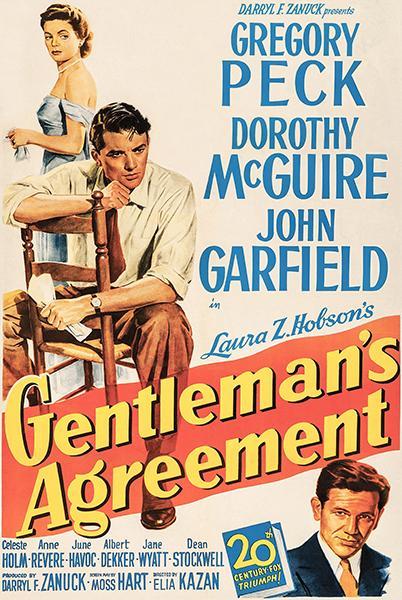
So what’s the story? Widowed writer Phil Green has just moved from California to New York with his son and mother for a new job at a magazine. His boss wants him to write an article about anti-Semitism, but Green can’t figure out what he can say that hasn’t been said before, until suddenly he hits on the idea to tell everyone in his new job, neighborhood, etc, that he is Jewish. Although his new girlfriend knows that he isn’t Jewish, his project puts serious strain on their relationship.
The Good: It’s hard to call the acting in Gentleman’s Agreement good, because it isn’t just good; it’s fantastic. There is not a weak actor in the whole movie. Gregory Peck is always reliably good, but he brings the passionate, stubborn, slightly inflexible Phil Green to life. It’s fun to see Dorothy Parker as a wealthy, sophisticated New York divorcee instead of as the nineteenth century mother she plays in Old Yeller and Friendly Persuasion. Anne Revere is excellent as Phil’s mother, Mrs. Green. She’s supportive and strong, despite her health issues, and she’s never afraid to share her opinions with Phil. You can tell she doesn’t suffer fools gladly. I loved John Garfield as Phil’s Jewish boyhood friend and June Havoc as Phil’s secretary. And now we get to talk about the two best actors in the entire film: Celeste Holm and Dean Stockwell. Celeste Holm plays Anne Dettry, the fashion editor at the magazine Phil works for. The moment that she finds out that Phil has a girlfriend is one of the best pieces of acting I have ever seen in my life. Her smile slips just a bit, her eyes sparkle a bit less; you can see her disappointment, but she doesn’t let Phil see it. It’s amazing and heartbreaking. And Dean Stockwell? He plays Tommy Green, Phil’s ten-year-old son. He casually asks his father what “Jewish” means while he’s slicing a banana onto his cornflakes. He cries with all the heartbreak of a child when the other kids won’t play with him because they think he’s Jewish. He is completely natural all the way through the movie. He isn’t stiff or awkward and doesn’t seem to be aware of the camera. I was blown away, especially because Dean Stockwell isn’t an actor that I was unfamiliar with; he was Al in the TV show Quantum Leap in the 1990s and Cavil in Battlestar Galactica in the 2000s. To find out that he had been acting (and acting well!) for almost his entire life made me happy for reasons I can’t explain.
Of course, all of the amazing acting would have been for naught if Moss Hart’s screenplay hadn’t been wonderful as well. The movie is not quite two hours long, but somehow all of the characters have depth. It feels like all of the characters have a backstory. We may not know anything about those backstories, but they are there. They’ve all had lives before this experience, and they will continue to have lives after the movie is over. The message against anti-Semitism could have been preachy or obvious, and while there are some statements against it, a lot of it is more subtle. It’s fantastic writing.
The Bad: Phil’s pretending to be Jewish so that he could write about it didn’t sit well with me. It was kind of white savior-ish. Were there no Jewish writers who could have written about the day-to-day prejudices they faced? I suppose the argument could be made that since Phil was experiencing all of the prejudices, big and small, for the first time, it was a more poignant experience, but it still felt weird.
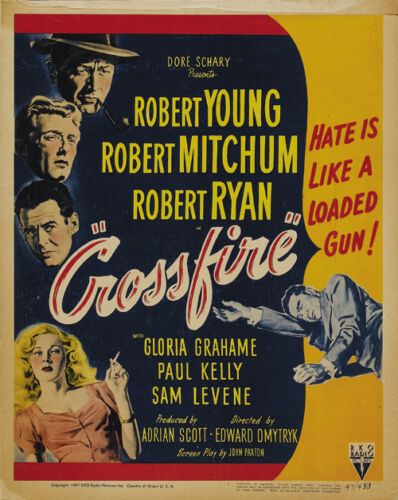
The Ugly: Anti-Semitism is ugly. The anti-Semitism in Gentleman’s Agreement is not as obvious as the anti-Semitism in Crossfire, but it’s almost worse. It’s worse than the type of prejudice where people say, “Well, I’m not a Nazi, so I don’t really have any prejudice toward Jews. I just don’t really like them.” It’s the same thing that lets people say, “Well, I don’t want black people in my neighborhood, but it’s not like I’m in the KKK or anything.” And it even goes a step beyond that. Gentleman’s Agreement points out the much more subtle ugliness in people who say they’re colorblind, who read newspaper articles about shootings and shake their heads and say, “That’s terrible,” but then don’t stand up against racism or oppression when they see it around them in small, everyday ways. There’s a lot of ugliness in the world; Gentleman’s Agreement tries to help people see that the ugliness comes in many forms.
Ironically, Elia Kazan, the director of this movie, was someone who didn’t stand up against oppression. When Hollywood was being investigated by the House Un-American Activities Committee, he named names of people who he thought had ties to the Communist Party. I can sympathize with not wanting to be blacklisted in your industry, but for someone who seemed to be invested in standing up for persecuted people, his actions were disappointing.
A Rebuttal to an Opinion I Read that Has Been Bothering Me for a Long Time: I once read a review about Gentleman’s Agreement that said it was a bad movie because it didn’t talk about the Holocaust when the Holocaust had so recently happened. But this movie isn’t a history of Jewish oppression; it’s a movie about what was happening in America in 1947, not what had happened in Europe two years ago. It’s purpose is partly to say that even though the Holocaust is over, even though it didn’t happen in America, people in America still allow themselves to act on prejudices. Gentleman’s Agreement is for the people who think racism is a thing of the past in America because Barack Obama was elected president.
Oscars Won: Best picture; best director; best actress in a supporting role (Celeste Holm).
Other Oscar Nominations: Best actor in a leading role (Gregory Peck); best actress in a leading role (Dorothy McGuire); best actress in a supporting role (Anne Revere); best writing, screenplay; best film editing.
 Oh, Academy members of 1989, what were you thinking? I shake my head at you. You got so much right, and yet you got the most basic thing – Best Picture nominees – wrong.
 Glory is a movie based on the true story of the 54th Massachusetts Voluntary Infantry Regiment, an all-black regiment fighting for the Union during the American Civil War. So we’re starting off with an amazing historical story, but let’s look at the cast. In perhaps his only serious role ever (I exaggerate, but not much), Matthew Broderick plays Colonel Robert Shaw, the man chosen to train and lead this new regiment. Denzel Washington gives an Oscar-winning performance as Private Silas Trip, a former runaway slave who is choosing to risk everything to fight against slavery. Add Cary Elwes, Morgan Freeman, and Andre Braugher, and you’ve got some serious acting ability in this movie in addition to the great story. The production design and costuming is spot-on, the cinematography is beautiful, and James Horner’s score is so great that he plagiarized himself twenty years later when he “wrote” the “original score” of Avatar (2009). It’s even still watched in middle school American history classrooms across the country as a way to help students understand the Civil War and race relations. It’s so good that my mother, who literally only let me see one movie that was rated PG-13 before I was 13 (Jurassic Park, for those who are wondering), had no problem with my dad’s watching Glory over and over, as long as he fast-forwarded the Battle of Antietam and muted the racist’s sergeant’s serious profanities. I have been watching this movie since I was seven years old, and I find that I still see new things every time I watch it. To me, that is the definition of any great work of art: something that is meaningful on different levels as you age and view it through new eyes.
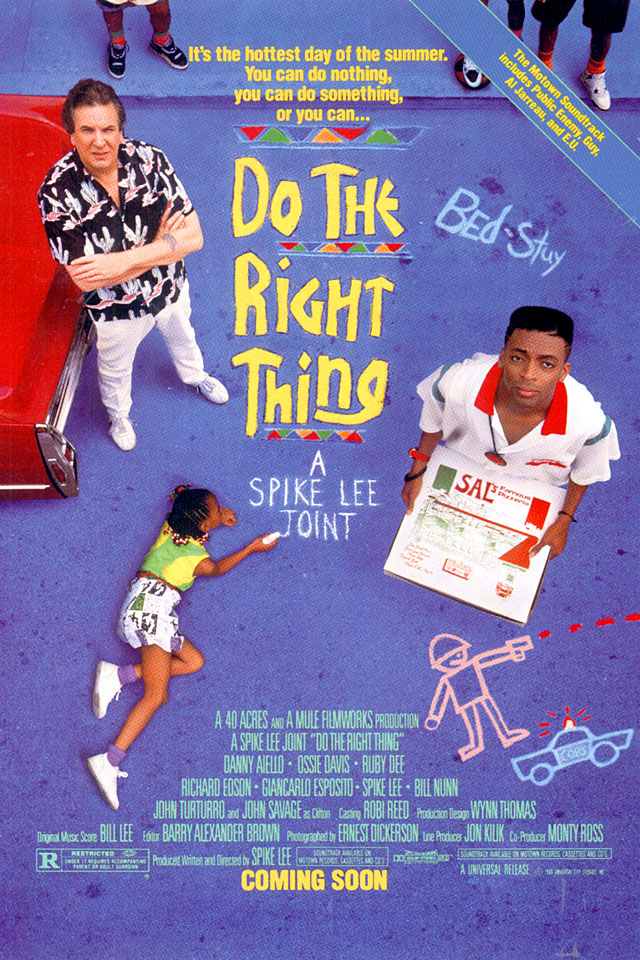 Do the Right Thing is also about race relations in America, but of the three race relations movies on my list, Do the Right Thing is the only one written and directed by an African-American and told from the perspective of an African-American. The story that writer/director Spike Lee is telling is a contemporary one, not one from history. It’s a simple premise: on a hot day in a neighborhood in Brooklyn, underlying tensions between community members surface and then explode, causing a riot with tragic circumstances. But it’s a comedy. And it works. Everything about it is different. The movie is filmed from all different angles, giving an off-kilter feeling at times. Sometimes the characters directly address the camera as if it were a documentary. Think The Office, but in this case, it’s groundbreaking. There are conversations that are edited in a way that make you feel that you are both of the characters at once. There isn’t a beautiful, sweeping score; the soundtrack is the music around the characters. (And since it’s the late 1980s, yes, there is a boom box.) So many little scraps of characters’ stories are told that you are able to see how the neighborhood keeps its balance until it suddenly doesn’t. The clothes are, again, 80s clothes, so they are bright and colorful, belying the dark tensions running underneath. I know I’m not doing very well at describing what makes this movie so great, but please watch it anyway. It blew my mind; nobody talks about stories like these (definitely not in 1989, and not very much more now), and nobody tells a story this way.
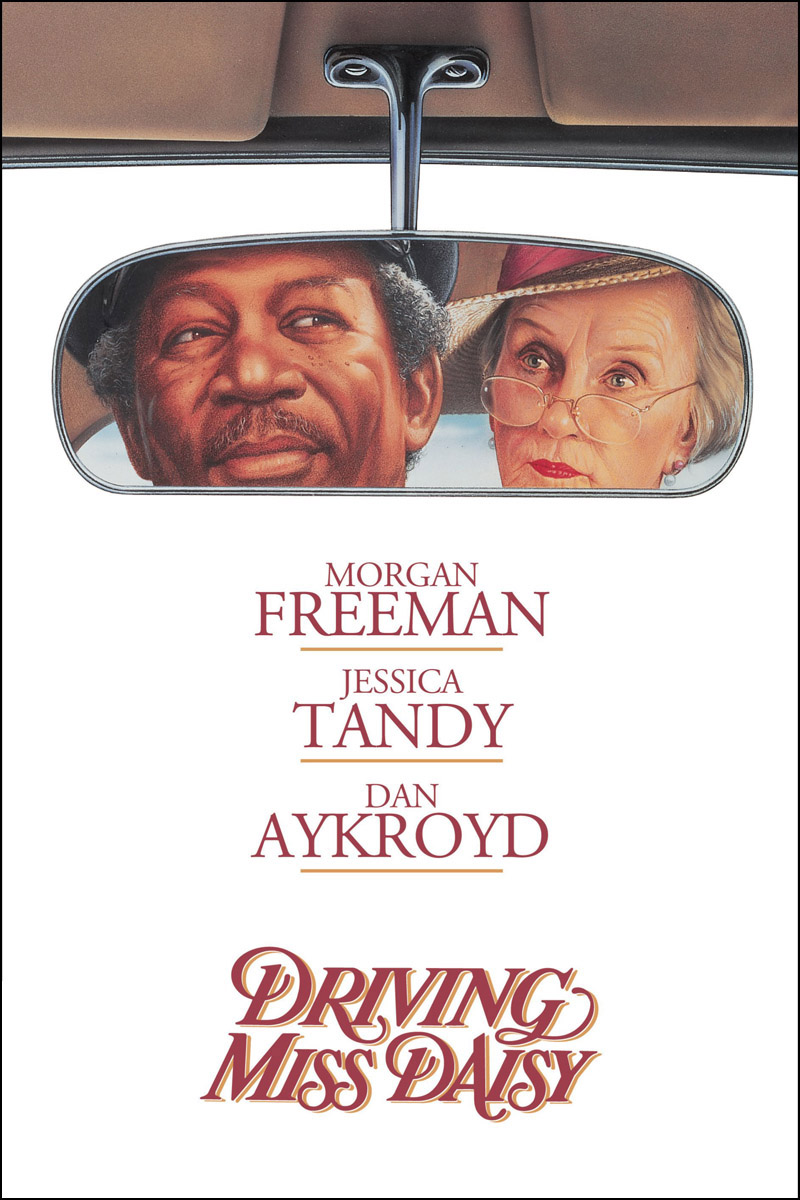 Directed by Bruce Beresford
 Directed by William Dieterle
 The Deer Hunter
 Before I start in on my very decided opinions about the 85th Academy Awards, I would like to draw your attention to the poster for that year. Designed by artist Olly Moss, it shows 85 Oscar statuettes, each one made to represent a best picture winner. My personal favorite? 2001. An empty pedestal for A Beautiful Mind. I highly encourage you to Google “Olly Moss Oscar Poster” to find a version that is not too pixelated when you make it big enough to admire each individual statuette. See how many best picture winners you can name based simply on the statuette. It’s amazingly fun. I love this poster so much that I tracked one down, had it sent from England, and got it custom framed—and I have no regrets about any of that, even though it’s probably the most money I’ve ever spent on anything outside of my car.
 it’s been awhile again. Apparently, because I wrote about my depression and how it was doing so much better in my Silver Linings Playbook post, my depression decided to remind me how powerful it actually can be. So yeah. Sorry if you’ve been waiting and hoping and wishing for my Argo review and my wrap-up of 2012; I’ve been trying not to slit my wrists. But at least I’ve been successful!
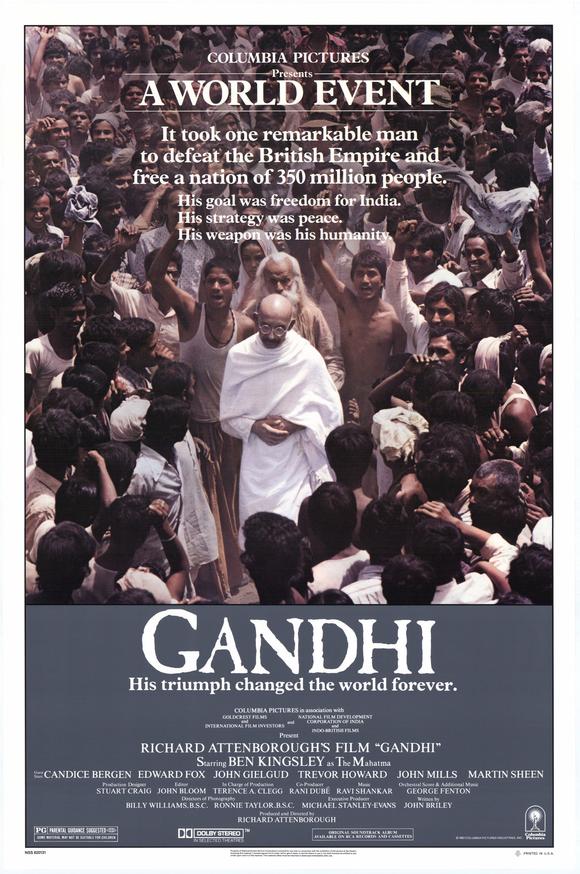 Directed by Richard Attenborough
 The Oscar Grouch