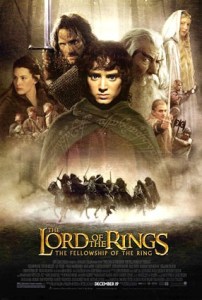
 Directed by Peter Jackson
Although I usually plan out which movies I’m going to watch a couple of weeks in advance, I don’t always. I found myself this week with a couple different years’ worth of movies out from the library; I had choices. I was kind of leaning toward 1997, but I realized on Saturday night that I really wanted to watch Gosford Park. I hesitated, though, because I also knew that that meant I would have to watch another Lord of the Rings movie. I had seen this one before (twice, even), but I had disliked Peter Jackson’s interpretation enough that I didn’t want to see the rest of the movies. My desire to watch Gosford Park overcame my negativity about Fellowship, so here I am trying to write unbiasedly about another movie that is apparently universally beloved, but I don’t quite get why.
So what’s the story? Frodo Baggins, an Hobbit living in the idyllic Shire, discovers that a family heirloom is actually a dangerous artifact belonging to an ancient evil sorcerer. Frodo sets out on a journey with his friends to destroy the ring and save the world.
The Good: The production design is fantastic. There are many different races in Middle Earth, and the design gives each race their own look for everything, from clothing to dwellings. It’s all done very well, very beautifully. I don’t necessarily agree with all their decisions, but I still admire the look of the film.
Howard Shore’s music is beautiful. It captures everything from the naiveté and joy of the Shire to the heroism of Aragorn to the eerie beauty of the Mines of Moria. I may not care much for the movie in general, but I do love the music.
Ian McKellen does some seriously good acting as Gandalf, the wizard who sets the events in motion. The moment where Frodo volunteers to take the ring and Gandalf’s face falls…just beautiful. Gandalf is many things – jolly firework-maker, stern counselor, frightened man betrayed by his master. Ian McKellen shows all of those facets very convincingly. Sean Astin is the other acting standout. He plays Samwise Gamgee, Frodo’s gardener and faithful friend. He isn’t glad to leave the Shire, but he refuses to abandon Frodo, no matter how dark the journey gets or how scared he is. It’s fabulous work.
The Bad: The Elves all talk like Jareth the Goblin King (aka David Bowie) from Labyrinth. I think they’re supposed to be showing how wise and calm they are, but because they also kind of look like Jareth, especially Elrond, it’s kind of distracting.
I wasn’t a big fan of how much time was spent on Aragorn and Arwen’s love story. I felt like there were other things that must have been cut to explore that at length. Boromir, for example, didn’t get much backstory, only a line or two about how his people are already fighting for survival. This lack of development made it hard to see him as anything but a bad guy, when he was really a proud, desperate Man who wanted to save his city and his people.
Some of the acting in Fellowship of the Ring is good; some is indifferent. But some is downright bad. Elijah Wood never showed much emotion as Frodo; he was just kind of….there. Orlando Bloom was just as wooden as Legolas. He looked nice, but luckily he didn’t have much to do beyond yelling out dangers (“Wargs!” “Orcs!”) in a noble voice.
The Ugly: There were a couple of glaring plot holes and inconsistencies. (Possible spoilers here, although I feel like everyone in the world has seen this movie, so…) For example, if the chain Frodo was wearing the ring on fell off his neck when he stumbled and fell on the mountain, how in the world did it stay on when the lake hydra-creature had him by the ankle and was waving him back and forth in the air? The ring should have been lost in the lake. And why did Pippin and Merry go to Bree and beyond with Frodo and Sam? They had no reason to. And why did Elrond let them go as part of the Fellowship? They had no training in any kind of weapons, no survival skills, nothing. They would really be more of a hindrance than an asset. And why did the Hobbits trust Strider in the first place? He gave them no sign, no reason for them to trust him. It really bugged me. How did Strider know to have four Hobbit-sized swords ready? Pippin and Merry were impulsive last-minute additions. Grrrr.
Oscars Won: Best cinematography; best makeup; best music, original score; best effects, visual effects.
Other Oscar Nominations: Best picture; best actor in a supporting role (Ian McKellen); best director; best writing, screenplay based on material previously produced or published; best art direction-set decoration; best costume design; best film editing; best music, original song (“May It Be”); best sound.
The part where I get to whine about how different the movie is from the book: Actually, The Fellowship of the Ring follows the book much more closely than The Two Towers does. Things are left out, and Glorfindel is sacrificed to give Arwen more screen time, but at least there is no Aragorn-goes-over-a-cliff-but-is-saved-by-his-horse moment. I wasn’t a big fan of changing Arwen so much, but the lack of female characters in the trilogy could be a concern for this day and age, so it’s kind of understandable. I also don’t like that Tom Bombadil was left out. He himself is perhaps not important to the story, but the Hobbits did need to stumble into the Barrow-Wights to find the swords that can break the spell on the Ringwraiths, and Tom saves them from the Wights. I haven’t seen The Return of the King, so I can’t say how Peter Jackson overcomes that important plot point, but it should have been set up in this movie.
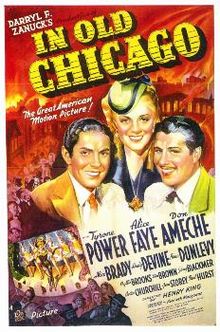 Directed by Henry King
 The Deer Hunter
 Directed by Quentin Tarantino
 The Oscar Grouch