Directed by Edward Dmytryk
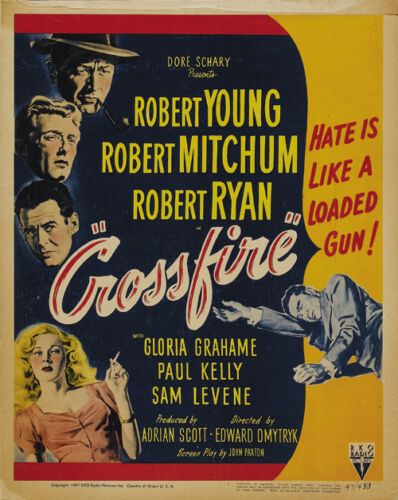
I didn’t know very much about this movie before I watched it. The DVD case made it appear to be a thrilling film noir with Gloria Grahame as the femme fatale. I’d been burned before, though (see: Dead End https://theoscargrouch.wordpress.com/2017/05/18/dead-end-1937/), so I didn’t let myself get my hopes up.
So what’s the story? Crossfire starts with the murder of a man, followed by the murderer running away. There’s confusion with the light and shadows, and we don’t know who the murderer is, but soon an off-duty soldier shows up to the apartment looking for his buddy who had been there earlier. The police zero in on the buddy, but did he really do it?
The Good: This movie may be the noiriest noir I have ever seen. There are so many shadows obscuring everything, figuratively and literally. Sometimes the shadows seem almost overwhelming. Light is used sparingly and very well.
The music is used very much like the light: sparingly and well. Almost the only music in the movie at all is the music from the activity going on around the soldiers: music in a dance hall, music heard on the street while they pass bars, music in a movie that they watch. The filmmakers did not rely on music to tell you how to feel.
The acting is great. Apparently, if you were a man who wanted a part in this movie, you had to be named Robert. Robert Ryan is Montgomery, the soldier who points civilian detective Robert Young in the direction of his buddy. Robert Mitchum is a soldier who doesn’t believe Montgomery’s accusation and goes looking for the truth on his own. To be fair, though, the Roberts were not the only good actors, although they were all superb. Sam Levene’s role as Samuels, the murdered man, is small, but he makes the character come alive in a way that his death hits pretty hard. Gloria Grahame plays a very sympathetic femme fatale; she’s less femme fatale and more “hooker with a heart of gold.”
I rarely comment on the theme or message of a movie, but I feel like it’s important in the current political climate in the United States. Crossfire is about the dangers of vilifying “the other,” about feeling that you or your group is more important than or just straight-up better than another group. It warns about the danger of falling into that trap and says that even if you yourself feel safe, you need to stand up for others in the persecuted group. It’s a good message in a movie that isn’t a feel-good movie.
The Bad: It did drag at times. Not often, but there were a few scenes that could be trimmed just a little bit to make the movie tighter.
The Ugly: I really did not understand who The Man was or what he was doing in the movie. His character just added unnecessary confusion.
Oscars Won: None.
Oscar Nominations: Best picture; best actor in a supporting role (Robert Ryan); best actress in a supporting role (Gloria Grahame); best director (Edward Dmytryk); best writing, screenplay.
Fun Bonus Fact: Although Crossfire deals with antisemitism, the novel that it is based on, The Brick Foxhole, is about homophobia, which is incredibly progressive for a book published in 1945.
 The Oscar Grouch
Leave a comment