Great Expectations (1946)
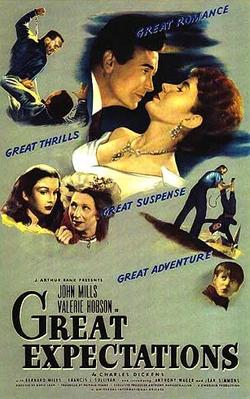 Directed by David Lean
I read Great Expectations, the Dickens novel this movie was based on, when I was fifteen. I had to read it for my English class. And guess what? I hated the book. However, I was blown away by the opening scene of this movie when my teacher showed it to us during class. It was so moody and so perfect. It was proof to me that they could make a good movie from a not-so-great book.*
So what’s the story? Young Philip Pirrip, called Pip, lives an uneventful life with his sister and her blacksmith husband, Joe, until one day when they hear that a convict has escaped from a nearby convict ship. Pip meets the convict in the graveyard and feeds him until the convict is recaptured. A year later, Pip’s interesting life continues when he is asked to come to the home of the mysterious Miss Havisham, a recluse living in a great house. There he meets the beautiful, yet horrible, Estella, with whom he immediately falls in love even though she treats him so terribly. He continues to visit Miss Havisham and Estella until one day he is informed that someone has set up an annuity for him so he can live like a gentleman in London. Who is his mysterious benefactor? What is Miss Havisham’s secret? Why is Estella such a brat?
The Good: Great Expectations is a movie filled with light and shadow, both figuratively and literally. The cinematographer, Guy Green, did a remarkable job painting the book’s theme of the impossibility of judging good from bad simply from appearances with his choices of when to use bright lights and when to use darkness and shadow. Miss Havisham’s house is dark and brooding, rather like the lady herself.
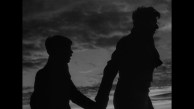
I couldn’t find an example of the chase scene online, so I took a screenshot while watching Great Expectations on my phone. I heartily apologize to the copyright owner if this is a violation, but I did it in admiration and I’m not making any money from this blog.
Pip’s rooms in London are generally filled with the careless light of a young man finding himself wealthy for the first time in his life, yet when a menacing figure comes into the room, it is suddenly filled with shadow. The best part, though, is when Pip, Joe, and the policemen are chasing the convict over the marshes. The men are shadows against a slightly lighter background. No words are spoken; it’s a pantomime of shadows set to music. I honestly don’t remember if I saw the whole movie in my English class, but I remembered that particular scene for twenty years.

Estella, Miss Havisham, and Pip in the ruined mansion.
The movie is so well cast. The actors not only do an amazing job in their respective roles, but they also have really good chemistry together. Even the actors in small parts are great. Tony Wager shines as young Pip. John Mills is excellent as Pip in his later years, even though he looks waaaay too old to be a young man just starting out in London. Alec Guinness has the enthusiasm and carelessness needed for the character of Herbert Pocket, while Francis L. Sullivan plays the solicitor Mr. Jaggers to world-weary perfection. Bernard Miles is sweetly humble as Joe, and Martita Hunt is fabulous as the cold, haughty Miss Havisham. Finlay Currie brings a goodness to the role of Magwich the convict while still retaining his rough edges. I just realized that I basically listed the entire cast, so that just goes to show how brilliantly the movie was cast.
Historical costuming is often a challenge. Many, many costume designers feel the need to bring the clothes “up to date” by using contemporary hairstyles or completely decide to ignore the time period altogether and put the characters in whatever they think looks good. The designer here managed to resist the temptation; the clothes are both period- and class-appropriate.
The screenplay is a good adaptation of Dickens. Some Dickens adaptations I have seen are much too sunny when compared to his books (I’m looking at YOU, “Oliver!”[1968]). Others have been so bleak. But Dickens himself was a master of of striking the balance of showing the bleakness of his times while celebrating the wonderful things and odd characters in life. The writers of this adaptation of Great Expectations did an excellent job finding their own balance.
The Bad: Besides John Mills looking too old to play Pip as a young gentleman, it is never explained why Pip has a high class accent when he was raised by a blacksmith. It’s such a tiny thing, but it bothered me throughout the movie.
The Ugly: I waited in vain for an explanation of why Pip loved Estella. She was always, always mean to him and to everyone else. She was pretty, but there was literally no other reason for Pip to love her beyond her beauty. I don’t think it’s completely the movie’s fault; Dickens didn’t explain it, either. But I would really love to see any glimmer of a reason for a good soul like Pip to spend his life wanting a thoroughly unpleasant person. (Although I did just realize that maybe he thinks that is how men should be treated based on how he sees his sister treat Joe. Still, I want a better reason.)
Oscars Won: Best cinematography, black-and-white; best art direction-set decoration, black-and-white.
Other Oscar Nominations: Best picture; best director; best writing, screenplay.
*(Don’t worry, though. I reread Great Expectations ten years later, and realized that it’s actually an enjoyable book when a) you’re reading it for pleasure rather than because you are forced to, and b) when you have enough life experience to be able to relate to it.)
 The Oscar Grouch