I'd like to spank the Academy

Archive for March, 2015

The Wizard of Oz (1939)

wizard of ozDirected by Victor Fleming

I don’t remember the first time I saw The Wizard of Oz. It must have been before I was six, because that’s when I read the book for the first time, and I definitely noticed the differences. I have seen it many times since the first, as I sure many people in the United States have. My mom reminisced about how it always used to be on TV on Easter. It’s a classic that I think will never really leave the public consciousness.

So what’s the story? Dorothy Gale is running away from her Kansas farm when she gets caught in a tornado and transported to the magical land of Oz. She sings, dances, makes friends and learns a valuable lesson as she tries to avoid the Wicked Witch of the West.

The Good: Watching this as an adult, I was struck by the costumes and makeup. It must have taken serious creativity to make three grown men into a scarecrow, a tin man, and a lion. And those costumes are fairly convincing. Okay, so the Cowardly Lion walks on two legs instead of all fours, but watch carefully when he first appears; he is on four legs then, and it’s really quite impressive. The flying monkeys also must have taken some serious work. I don’t even want to know how long it took everyone to get into their makeup every day. The fantasy would have failed without those two things, so it’s a good thing they were both excellent.

I was very impressed by Ray Bolger, who plays the Scarecrow. He moves like his legs are really made of straw. It’s just a tiny detail, but I think it shows his ability. Also, I’m going to allow myself to be impressed with Frank Morgan, who plays five roles in this movie, which I didn’t realize until just now when I saw it on IMDb. It’s obvious that he plays the Wizard of Oz and Professor Marvel, but he also has three other parts. The costumes and makeup helped there, too, but his acting skills also needed to come into play.

I can’t decide how I feel about the music. I feel like just about everyone in the English-speaking world can sing along with many of them, but it is so easy for them to get stuck in your head. I’m not sure if that’s a sign of a good song or a bad song or if it means nothing at all, but it’s annoying. But the songs are fun, even if they don’t usually advance the plot or reveal much character. I’m guess I’m kind of neutral on the subject of the songs in the movie. I do like the background music, though.

The Bad: Some of the acting is hammy by today’s standards. I’m guessing it’s because they were making a movie based on a children’s book and were aiming to appeal to children, but occasionally I cringed.

I was also sad about the screenplay. L. Frank Baum’s book is not only a great adventure story, but it’s also a satire, and there are some lovely lines about people with no brains working in the government, etc. I wish the writers had kept some of those pointed little jabs in.

The Ugly: I hate the ending. It has always made me so mad that it’s just a dream. Why can’t it have been real? What’s wrong with having a little bit of magic in the world? It’s not a dream in the book. Dorothy really goes to Oz and eventually moves there with Uncle Henry and Aunt Em. I know it will probably never happen since this is a major classic, but I would love it if someone made another movie version of The Wonderful Wizard of Oz and stuck a little bit more closely to the source material.

Oscars Won: Best music, original song (“Somewhere Over the Rainbow”); best music, original score.

Other Oscar Nominations: Best picture; best cinematography, color; best art direction; best effects, special effects.
Stagecoach (1939)

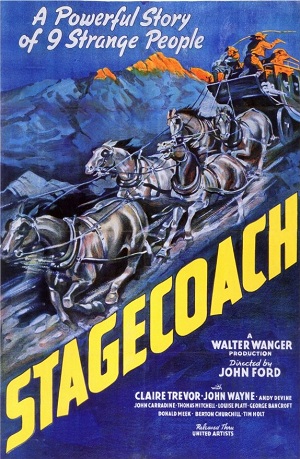
Stagecoach_movieposterDirected by John Ford

I grew up on westerns. I grew up on John Wayne westerns. And yet I had somehow never seen this movie. In some ways, that’s a good thing. I saw it for the first time when I was definitely old enough to appreciate it. But I think I would have liked it just fine when I was ten. I know I would have liked it when I went through my John Wayne phase and tried to watch all his movies when I was fourteen. So while I won’t be suing my dad for neglect because he didn’t show me this movie, I feel like I missed a lot of years when I could have been enjoying this movie. And that’s too bad, because this is a great movie. I liked it so much that I half wanted to start it over again from the beginning as soon as it was over.

So what’s the story? Despite the passengers knowing that Geronimo and his people are on the warpath, a stagecoach full of people begins its journey. Each stop brings more bad news and hardship, yet the oddly-assorted group of passengers presses on, determined to reach their final destination.

The Good: This is the first time in this batch of movies that I’ve been very impressed by the cinematography. Stagecoach is such a beautiful movie. John Ford knew how to compose a shot and how to use gorgeous scenery to its best advantage.

I’ve been rhapsodizing about acting a lot these past couple weeks, and I’m going to keep on doing it. This was yet another well-acted movie from 1939. Everyone was perfect. Claire Trevor especially stood out to me as the “dance hall girl” who is getting run out of town. I thought Trevor did a very good job of showcasing Dallas’s humanity and desire to be seen as a person. I have always liked John Wayne, but I liked seeing him so young in this movie. He had a different kind of energy as a young man than he did as an older one. Neither one is  better than the other; they’re just different. Thomas Mitchell as the doctor/town drunk was good, because Thomas Mitchell is always good, but when he stood up to Luke Plummer, he became superb. I’m also going to mention Andy Devine, mostly because Disney’s Robin Hood (1973) was my favorite Disney cartoon growing up, and it’s fun to hear Friar Tuck’s voice coming out of a real person’s mouth.

The Bad: I realize this movie was made in the 1930s, and I know that society’s mores have changed since then, but I live now, so I was a little bit unhappy with the portrayal of minorities, both the Native Americans and Hispanics. It’s definitely not the worst I’ve seen, and it didn’t detract from my enjoyment of the movie, but I did catch myself wondering if I should enjoy a movie so much when it put forth the opinion that the white men had every right to live on Indian land if they felt like it.

The Ugly: I can’t think of one ugly thing in this movie. That’s unusual for me. But Stagecoach is just an excellent movie.

Oscars Won: Best actor in a supporting role (Thomas Mitchell); best music, scoring.

Other Oscar Nominations: Best picture; best director; best cinematography, black-and-white; best art direction; best film editing.

Of Mice and Men (1939)

1939 Of mice and men - La fuerza bruta (ing) 03Directed by Lewis Milestone

I read the book Of Mice and Men when I was a junior in high school. I didn’t care for it much; I couldn’t figure out how John Steinbeck could fit so much misery into such a short book. And I haven’t read it since, but watching this movie made me want to, because even though the movie Of Mice and Men is still sad due to the utter hopelessness of these men’s lives, the fact that someone out there understands their situation and dreams and feelings gives hope back to those who feel downtrodden by life. I’m not a Depression-era drifter, but this movie gave me some hope. It made me realize that I am not alone in what I want out of life. That’s a very powerful thing for a work of art to do.

So what’s the story? During the Depression, friends George and Lennie go from ranch to ranch looking for work. George is a small guy, but he’s smart. Lennie is hulking giant; he’s mentally slow, but he works hard and is very kind-hearted, especially towards small animals. George and Lennie have a dream of having their own small place where they can farm for themselves and do what they want to do when they want to do it. They are starting work on a new ranch. Curly, the ranch owner’s proud, jealous son, has a wife, Mae, whom he constantly suspects of cheating. Being the only woman on the ranch is lonely for her, but it’s even worse because none of the ranch hands will talk to her because Curly doesn’t like it when they do. The tensions on the ranch are about to explode and take away George and Lennie’s dreams.

The Good: This movie was exceptionally well-cast. Lon Chaney, Jr. plays Lennie and does a wonderful job of playing a kind man who truly doesn’t understand his own strength. His performance is powerful, and I’m really trying to decide why he didn’t get nominated for an Oscar for it. Burgess Meredith plays George very well. He gives a very good performance of a man torn between his love and loyalty to a friend and his frustration when that friend makes mistakes that pull them both down. Betty Field, who plays Mae, also does a good job. Mae is kind of crass and low-class, but she’s also so lonely. Her desire to really live life is just bursting out of her. I felt much sorrier for her than I remember feeling when I read the book. The rest of the cast is good, too. The hands are especially sympathetic. I don’t know how they got such perfect people for every role, but it happened.

I noticed the music from the beginning. I kept thinking it sounded more symphonic, more complex somehow than a typical 1930s movie score. I found out that Aaron Copland wrote the music, and it suddenly made sense. It was beautiful music, and it didn’t overwhelm the movie like some scores did in the 1930s. It fit the movie just perfectly.

The Bad: I can’t exactly put my finger on just why I felt this way, but I feel like it dragged a bit in some places. I can’t really think of a boring scene, but the pacing was off somehow. Maybe it’s because when I watched it, my mind wasn’t the sharpest it’s ever been. So yeah. Take that comment with a grain of salt. Or better yet, watch the movie and tell me in the comments if I was right or wrong!

The Ugly: This is not a happy story. It’s the story of men living on the fringes of society, wanting no more than the freedom to make their own decisions about life, but who can’t rise above where their circumstances have placed them. The ending is heart-wrenching, because John Steinbeck understood life, and life is not easy.

Oscars Won: None.

Oscar Nominations: Best picture; best sound, recording; best music, scoring; best music, original score.

Random Fact: This movie was adapted from the play that was based on the book. Weird, huh?

Love Affair (1939)

Love_AffairDirected by Leo McCarey

This was the movie that was responsible for some of the difficulties last week. The first copy I checked out from the library was the worst quality DVD I had ever watched. The disc itself was fine; it didn’t have any scratches or divots. But the sound was so bad I couldn’t understand what anyone was saying half the time, and the picture looked like a bad transfer of a sub-par VHS. I didn’t feel like watching that DVD would give me a fair picture of Love Affair, so I had to dig up another copy from a different library. (It is available for streaming on Amazon, but Amazon was being extremely stubborn; while I could see that the movie was there, it wouldn’t let me stream it. Amazon kept trying to stream Downton Abbey, and wouldn’t believe me when I said I wanted anything else. True story.) Anyway, the second DVD I got wasn’t impressive, either, but at least I could understand what the characters were saying. The picture was clearer, too; it still looked like a VHS, but it was at least a higher quality one. It made me feel bad. This movie deserves better.

So what’s the story? Michel Marnay, a famous French playboy, is traveling by sea to New York to join his heiress fiancé. He meets Terry McKay, a down-to-earth American woman who is coming back from a business trip. She’s engaged to her boss. Michel and Terry fall in love, but decide to part for six months to give Michel a chance to prove to himself that he can be something more than just a playboy and that he’s worthy of Terry. They make plans to meet at the top of the Empire State Building after the six months. With so much determination between the two, what could possibly go wrong? If this story sounds suspiciously familiar, that’s probably because Leo McCarey remade his own movie in 1957 and called it An Affair to Remember.

The Good: I was a little bit nervous going in. I had only seen Charles Boyer in one movie before this one, and that was Gaslight. I don’t like Charles Boyer’s character in Gaslight, and I wasn’t sure he would be a good enough actor to erase that character from my mind. But Charles Boyer makes a very charming playboy turned good. Irene Dunne plays an independent woman who refuses to fall for silly pick-up lines equally well. They made a very good, very believable screen couple. I could understand why they would fall for each other, which is something that doesn’t always happen.

There is also another person who deserves mention in this movie for her acting. Maria Ouspenskaya plays Michel’s darling, elegant little grandmother. She’s not in the movie very long at all, but I couldn’t help falling in love with her. She is such a sweet, beautiful old lady.

The screenplay was very fun. Terry gets to say all sorts of things to remind Michel that as attractive and charming as he is, he’s still just a man. But Terry isn’t perfect, either, and she gets called out on her imperfections, too. I like the evenhanded treatment of both people.

The Bad: The one problem with the story is that I think it is inconsistent with Terry’s character that she doesn’t share her secret with Michel. I realize she is a proud and independent woman, but I feel like she would have trusted his love enough to at least give him a chance to react to it. But then I guess the story would have resolved too quickly.

The Ugly: Again, this isn’t the movie’s fault, but someone really needs to make a decent DVD of this movie. It’s inexplicable to me that no one has. I suppose it’s because this movie has been overshadowed by An Affair to Remember, but Love Affair is equally good and deserves a better DVD.

Oscars Won: None.

Oscar Nominations: Best picture; best actress in a leading role (Irene Dunne); best actress in a supporting role (Maria Ouspenskaya); best writing, original story; best art direction; best music, original song.

Wuthering Heights (1939)

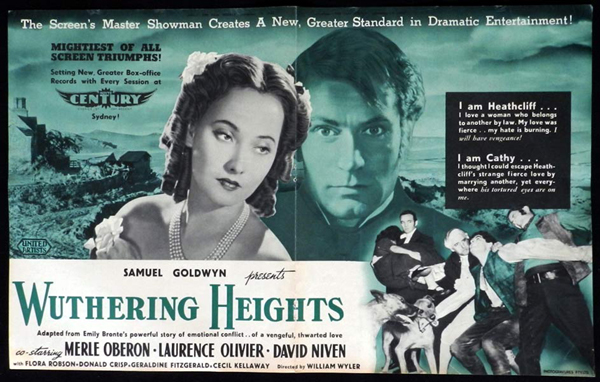
WUTHERINGHEIGHTSTRADEAD2Directed by William Wyler

Yep, this one is out of order, too. I had to take the DVD back to a somewhat far away library, so I had to watch Wuthering Heights instead of the more alphabetically appropriate movie I was planning on; ironically, it was Of Mice and Men. Best laid plans and all that. But they will all get reviewed eventually, so I don’t really suppose it matters the order that I do them in. I just like to do them alphabetically so that people know that I’m being impartial and not putting them in order of which I like best.

Film adaptations of books are tricky. Books are so personal, and everyone has their own interpretation, so you will never be able to please everyone. But I hate the book Wuthering Heights. Heathcliff is a terrible person who makes everyone around him miserable in his quest for revenge. I had heard that this wasn’t a very faithful adaptation, so I hoped that they would have been able to turn this movie into something that I liked. Sadly, they didn’t.

So what’s the story? Heathcliff, a starving, ragged orphan, is adopted off the streets of Liverpool by the kindly Mr. Earnshaw and taken to Earnshaw’s house, Wuthering Heights, to be raised with Earnshaw’s children, proud Hindley and impulsive Catherine. Cathy and Heathcliff become great friends and vow undying love, but when Mr. Earnshaw dies, Hindley takes over and makes Heathcliff a servant. As they grow up, Cathy and Heathcliff fall more deeply in love with (or become more obsessive about) each other, but Cathy wants to be rich. She urges Heathcliff to go away and make something of himself so that they can marry. After an accident, Cathy stays for some time with the Lintons, her wealthy, kindly neighbors and glimpses what a future with wealth and comfort would be like. When Edgar Linton proposes, Cathy accepts. What will Heathcliff do to get revenge for all the wrongs done to him?

The Good: Geraldine Fitzgerald, who also did an amazing job in Dark Victory, plays Isabella Linton heartbreakingly well. She’s a silly girl, but that doesn’t mean that she doesn’t feel the wrongs done to her by Heathcliff. So good.

Laurence Olivier plays Heathcliff. He was a very good-looking man and an incredible actor. I felt sorry for Heathcliff in this movie, which I never did while reading the book, so props to Olivier.

The Bad: Merle Oberon’s Cathy is a spoiled, selfish girl who is unwilling to give up her place in society and a comfortable home for true, pure love. If it’s the screenplay’s fault that she appeared like that, than she did a good job of acting. But I felt like they were trying to make her sympathetic, and that never came across for me. I was kind of hoping that Heathcliff would fall in love with someone else, just so she could see that she wasn’t that great.

This is another movie from the 1930s that fell victim to the idea that accurate costuming didn’t matter. If the director and/or producers decided to have it take place in the 1860s, which is what the clothes vaguely suggest, that’s fine, but Heathcliff was gone for a while, right? And yet the ladies are still wearing the same fashions that they were before he left. The passage of time through clothes wasn’t shown at all. That would have been a very nice touch, but since it didn’t happen, I was left with the feeling the Heathcliff didn’t really leave for all that long. I guess people could make fortunes in America incredibly quickly in those days.

The Ugly: The ending is so incredibly bad. It makes Cathy and Heathcliff out to be tragic lovers who, due to circumstances beyond their control, were unable to be happy in life, but can now be happy together after death. The movie was already melodramatic, but the ending takes the movie past melodramatic to beyond cheesy. Ugh.

Oscar Won: Best cinematography, black-and-white.

Other Oscar Nominations: Best picture; best actor in a leading role (Laurence Olivier); best actress in a supporting role (Geraldine Fitzgerald); best director; best writing, screenplay; best art direction; best music, original score.

The week is over, but the nominees of 1939 aren’t! Join me next week for the rest of the best of 1939, including the juggernaut: Gone with the Wind.

Mr. Smith Goes to Washington (1939)

Mr. Smith Goes to WashingtonDirected by Frank Capra

Mr. Smith Goes to Washington is one of the movies I had seen before I started this project and was happy to watch again because it’s so good. I was also happy in a really weird way that I couldn’t get it from the library I work at; there was a waiting list. For a movie from 1939. So I have hope for the future now, even though I had to get the movie from a different library.

So what’s the story? A senator from an unnamed state dies, and the governor needs to appoint a replacement. The corrupt political boss that got him elected tells him to pick one person, while the unions and other state leaders give him another name. His savvy kids (all eight of them!) tell him to appoint their local scout leader, Jefferson Smith. Not wanting to offend anyone, the governor appoints Jefferson Smith. Jeff is a naive patriot who loves his country and believes in the Constitution, but the rest of the elected officials from his state are corrupt and trying to push graft through. It’s up to him and his cynical assistant to stop the evil political machine from succeeding.

The Good: There is lots of good acting in the movie. Jimmy Stewart plays Jefferson Smith, and he’s always good. Jean Arthur is the cynical assistant Saunders who is slowly won over by Smith’s naivety. The corrupt senior senator is Claude Rains, who is one of my personal favorites, and I think it’s a shame that he never won an Oscar. He did get a best supporting actor nomination for this movie, though. So did Harry Carey , who is listed as President of the Senate, but if I remember my Constitution correctly, doesn’t that make him Vice President of the United States? Anyway, he has almost no lines in this movie, but his face is incredibly expressive.

I actually wrote a paper in college about the music in this movie for an American history class where they required us to watch Mr. Smith Goes to Washington; the music is very instrumental (hahaha) to the drama of the movie. Dimitri Tiomkin used lots of American folk songs and patriotic songs to underscore Smith’s fight against corruption.

I’m going to award kudos to the makeup people for this movie, too. I had always thought that Mr. Smith Goes to Washington was made in the late forties, many years after The Adventures of Robin Hood (1938) and Casablanca (1942). I assumed this because of Claude Rains, who looks so much older in this movie than in the other two. But since that is all down to the makeup department and not natural aging, I have to congratulate the makeup department for fooling me.

While I was watching this movie, I assumed that they had gotten permission to film on location at the Capitol Building. Nope! They just rebuilt the Senate Chamber in complete detail in a studio in California. It’s crazy good, and it says to me that Frank Capra cared a lot about this movie.

Another detail that I appreciated was that Capra never named the state that Smith is from or the which political party any of the politicians belong to. He made it so that no one could say, “Well, it didn’t happen in my state or my party, so I’m fine.” He didn’t allow anyone to be complacent about corruption in the government.

The Bad: As Jefferson Smith is trying to expose the corruption, his Boy Rangers back home try to spread the word about what he’s doing. The political machine shuts them down, and it’s very hard to watch. It’s not graphic, but if you’re sensitive to children in danger, be warned. Watch the movie anyway, but know that that’s coming.

The (Possibly) Ugly: Patriotism, idealism, and optimism aren’t always highly regarded now. People are more cynical, especially about the government. Some people might say that this movie is unbearably cheesy because of that. I don’t find it so; I kind of wish there were more people now who did believe that what they do can make a difference.

Oscar Won: Best writing, original story.

Other Oscar Nominations: Best picture; best actor in a leading role(James Stewart); best actor in a supporting role (Harry Carey); best actor in a supporting role (Claude Rains); best director; best writing, screenplay; best art direction; best sound, recording; best film editing; best music, scoring.

Difficulties

TechnicalDifficultiesMy fabulous planning skills were foiled this week by some unforeseen technical difficulties, so there is no new post today. Be sure to come back tomorrow for more awesome movie reviews!

Ninotchka (1939)

ninotchkaDirected by Ernst Lubitsch

 When I looked at the list of nominees from 1939, I didn’t recognize the name Ninotchka at all. My first feelings when I saw that name on the list were feelings of frustration; I didn’t want to watch a depressing Russian love story with Greta Garbo, who would probably die at the end after a dramatic illness (yes, that’s what I assumed the story was after only seeing the title). I was so pleased to find out when I watched it that it is the complete opposite of those assumptions. I was also pleased to find out that it’s a freakin’ awesome movie.

So what’s the story? The Soviet experiment is failing, and the government has sent emissaries to capitalistic countries to sell some of the treasures that they confiscated from wealthy Russians. Three rather incompetent men are sent to Paris to sell some jewels that had belonged to Duchess Swana during the Revolution. Swana finds out they have her jewels, and her lover, Leon, volunteers to get them back. He manages to gum up the process enough that the government sends Ninotchka, a very stern woman, to Paris to fix the mess. Will Leon be able to change Ninotchka’s views of the world?

The Good: This movie is hilarious. The screenplay is very well done. There are lots of good zingers from Ninotchka about the uselessness of Parisian society that manage to make fun of both communism and capitalism at the same time. So funny.

The acting is very good. Greta Garbo makes Ninotchka’s transition from a committed, no-nonsense Communist Party member to a woman in love believable. My favorite moment is when she goes out dressed in fashionable clothes instead of her practical Soviet clothes. She’s so self-conscious and feels a little bit silly, while at the same time she knows she looks good. It’s a very woman thing, and Garbo plays it perfectly. The three original envoys sent to Paris are very funny, always making excuses about why they need to spend money for the good of the Party. Melvyn Douglas as Leon was a little bland, but not terrible.

Since it’s high Parisian society in the late 1930s, the clothes are lots of fun. That is all.

The Bad: Although I completely understood why Leon fell for Ninotchka, I could never quite understand why she fell for him. I always like to understand couples in a romantic movie, but I wasn’t able to do so in Ninotchka.

The Ugly: While all of the Russians have (more or less) Russian accents, all of the Frenchmen have American accents. It’s a tiny thing, but it really distracted me.

Oscars Won: None.

Oscar Nominations: Best picture; best actress in a leading role (Greta Garbo); best writing, original story; best writing, screenplay.

Dark Victory (1939)

dark victory posterDirected by Edmund Goulding

People who care about such things may notice that I have gone out of order. Yes, I realize d comes before g in the alphabet, so yes, this should have been the first review of the week. But I don’t watch the movies in alphabetical order; I watch them as I want to watch them. And I had watched Goodbye, Mr. Chips earlier in the week, but stupid daylight savings time prevented me from getting to Dark Victory until later than I wanted. So write your congressman and say you want to put an end to daylight savings time.

So what’s the story? The reason I hadn’t watched Dark Victory was that the story just didn’t appeal to me. Judith Traherne is a young sporting socialite; she breeds and rides horses and hunts and all that kind of stuff. She’s had blinding headaches for the last six months, but when she misses a jump when riding her horse, she realizes something is seriously wrong. She is diagnosed with a brain tumor and has it removed, but the doctor knows that someday it will come back; Judith will be dead before then end of a year.

The Good: This movie had the potential to be either incredibly melodramatic or deadly dull. In order to avoid that, the viewer has to care about Judith. Bette Davis makes you care. Judith tries to pretend that she’s not really worried at the beginning, but Bette Davis lets us see beneath the strong words and actions to the scared young woman. She glows when she falls in love; she becomes tough, yet brittle when she feels like that love has betrayed her. I  found myself in complete sympathy with Judith, even though our lives are so very different. If this movie had starred a lesser actress, it would have been soapy garbage. Bette Davis saved it from that.

The supporting cast is also stellar. Geraldine Fitzgerald as Judith’s personal secretary and best friend is a standout. I hadn’t seen her in anything before, but I think I get to see her in a few more nominees, which makes me happy.

The Bad: Max Steiner wrote the soundtrack for this film, and the music is nice, but it’s  very dramatic. I realize that that was the trend of the time, but I like my soundtracks to be a little more subtle.

The Ugly: I think the fact that Bette Davis is so good kind of highlights a major weakness of this movie. The storyline is tripe. It’s silly and contrived and over dramatic. My advice for watching this movie is to allow yourself to get swept up in the fabulous acting and don’t think too hard about anything else. Also, Humphrey Bogart in a small supporting role with a bad fake Irish accent? No. Very ugly.

Oscars Won: None.

Oscar Nominations: Best picture; best actress in a leading role (Bette Davis); best music, original score.

Fun fact: There’s a very attractive young playboy in Dark Victory who looked kind of familiar to me, but I couldn’t place him, so I looked him up on IMDb. Turns out the very attractive playboy would be president of the United States a little over forty years later. Weird.

Goodbye, Mr. Chips (1939)

Goodbye,_Mr._Chips_(1939_film)_posterDirected by Sam Wood

I remember watching this movie when I was a young teenager. I liked it then. It’s a sweet movie. But watching it now was a totally different experience. Now I understand Mr. Chips so much better. We are actually very much alike; we are both slightly shy, rather reserved people who work with young people, but have a very hard time actually connecting to them. Because of this, I could empathize with his experiences, and I spent most of the last half of the movie in tears. It’s not an excessively tragic movie, but life itself is very sad sometimes.

So what’s the story? Mr. Chipping arrives at Brookfield School, a boarding school for English boys, in 1870. Over the next fifty-odd years, he experiences love and joy, heartache and heartbreak, all while teaching classics and other life lessons to the future leaders of England.

The Good: Often in movies that span a lot of time, two actors will play a single part, with one person playing the young man and the other playing the old man. That’s not the case in this movie. Robert Donat plays Chips from his twenties through his eighties — and he does a fantastic job. He walks differently as he gets older, he holds himself differently, he even moves his mouth differently. It’s very impressive. And that’s not all he does. Mr. Chipping changes dramatically personality-wise through the movie. It’s a struggle at first, but eventually being open and loving and caring towards the boys becomes second nature. Robert Donat shows us all of that through his portrayal of Mr. Chips. It’s an excellent performance.

The makeup artists did a very good job, too. They had to, or it would have been silly to pretend that a man in his mid-thirties was really in his eighties. They didn’t just put Donat in a grey wig and call it good(I’m looking at you, Giant!), but they gave him wrinkles and old man eyebrows and everything he needed to convincingly play an old man.

I also like how they showed the passage of time with the boys coming to the school in different uniforms and talking about current events. That was a nice way to handle a lot of years without something conventional like a fluttering calendar and without simply putting the date on the screen.

The Bad: When you are making a sentimental movie, it’s hard not to cross the line into cheesiness. Most of the time, this movie stayed on the right side of that, but the ending was a little much. Superimposing the face of Colley, who represents four generations of students, onto the screen was cringe-worthy. I know, I know, it was the 1930s, and people were less cynical then I think, but it was still a bit much.

This movie also has a slight costuming problem. I was trying to figure out about how old Chipping would have been when he met Katherine, but her clothes and hairstyle don’t quite match any era. Lots of movies throughout the history of movies have had the same problem; the actors are just put into clothes that feel old-timey without being from any specific time period. It can get ugly. Goodbye, Mr. Chips isn’t the worst I’ve seen, but it could have been better.

The Ugly: There wasn’t anything ugly about this movie unless you don’t like sweet sentimental movies about the difference one person can make to many. If that’s the case, don’t even bother with this one.

Oscars Won: Best actor in a leading role (Robert Donat).

Other Oscar Nominations: Best picture; best actress in a leading role (Greer Garson); best director; best writing, screenplay; best sound, recording; best film editing.